Learners from Eastern Cape schools exposed to the science of road building as a career path.
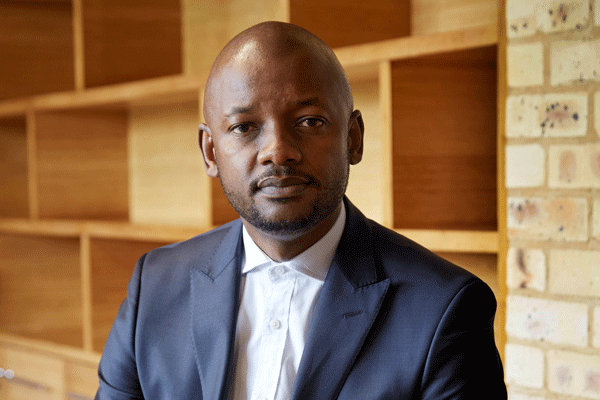
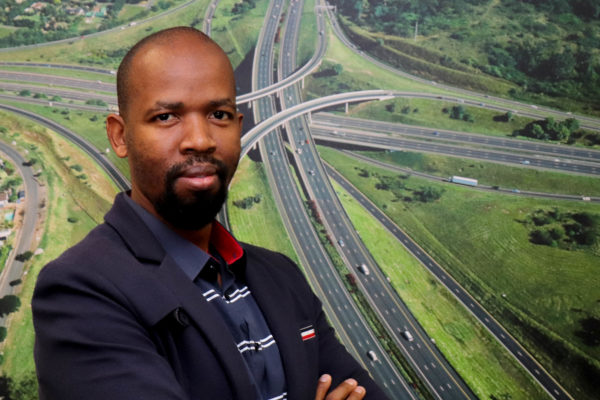
Makhosandile Nondinyana (left) a KSD TVET College civil engineering student who is doing his internship on SANRAL’s project in Cradock was explaining to learners how the periodic table help civil engineers use elements in material design.
The South African National Roads Agency (SOC) Limited (SANRAL) exhibition at Scifest Africa 2018 proved to be a hit with school children in Grahamstown this month.
Established by the Grahamstown Foundation in 1996, SciFest Africa is South Africa’s national science festival, promoting public awareness, understanding and appreciation of science, technology and innovation in South Africa. The festival celebrated its 22nd anniversary event from 7-13 March 2018 in Grahamstown.
At this year’s SciFest about civil engineering, SANRAL’s exhibit explained the importance of building good roads, the different road signs and what line markings are. It also highlighted scholarship and bursary opportunities available to learners in primary and high schools.
Michelle Ah Shene, SANRAL marketing and communications representative, said: “There has been an influx of learners enquiring about the scholarships and bursary programmes. The younger learners were also very excited about what makes line markers glitter and what civil engineering entails.”
Learners can apply for the SANRAL scholarship programme, which supports academically deserving applicants from grades 10 to 12. The minimum requirements are an overall average of 75% with subject choices that include maths, physical science and English. For further information on the bursary and scholarship programme visit www.nra.co.za
“Approximately 122 students at tertiary institutions are pursuing their academic goals with the support of SANRAL bursaries and about 196 high school learners have received scholarships,” Ah Shene concluded.
Learners inspired to help communities
Likhona Duba, an 11-year-old grade six learner at Sinako Lower High Primary School, had enjoyed the experiments and “really liked learning more about road signs and knowing the difference between permanent and temporary ones”.
For Paul Papiso, a teacher at Sinako Lower High Primary School, the road signs part of the SANRAL exhibition was important as road signs form part of the natural science and technology syllabus.
Aviwe Nzema, a 16-year-old from Khulani Commercial School in East London, would like to be a pilot or civil engineer someday: “I love doing things for my community and think building bridges and roads so that people will have quicker access to clinics or schools is a good way of helping the community.”
SakhileNdaba, an 18-year-old matric learner at Butterworth High School, said his first time visiting the SciFest had been important: “I believe what we learn at the SciFest will help us with our school work. I would like to be a civil engineer like my brother who inspires me.”
AphiweNogqala, 18, also in matric at Butterworth High School, also wants to follow in his aunt’s footsteps who is a civil engineer based in Cape Town: “There will always be a need to build roads to make trips shorter between towns and cities. Building better and safer roads can reduce road accidents.”
Spin-offs will include employment, Eco-tourism and economic development.
The N2 West Coast road aims to connect Eastern Cape and KwaZulu-Natal and create economic opportunities for the communities living on the Wild Coast.
The construction contracts on the green-fields portion of the new N2 Wild Coast route are projected to spend over R400-million in wages and create approximately 8 000 direct jobs from the main contractors.
With almost R3-billion projected to be spent on SMME suppliers and sub-contractors as well as the turnover effect of wages, a huge boost in indirect jobs in the local region can be expected.
The new route will bring:
Regional economic development
Significantly faster delivery times and lower transportation costs between KZN and EC;
Shorter and flatter route will result in a 1½ to 3 hours saving in travel time, particularly for heavy vehicles;
About R1.55-billion per year in time cost savings to the economy.
Local economic development
Positive impact on the local economies of Port St Johns, Lusikisiki and Mzamba, as well as Flagstaff, Bizana and Holy Cross.
Major eco-tourism and conventional tourism opportunities
Over 600 000 additional tourists over 10 years projected;
Wild Coast will be a viable weekend destination for KZN residents;
New route will open a potential tour bus or self-drive route from Port Elizabeth to Durban;
Strict environmental legislation will ensure only a limited number of coastal nodes can be developed commercially and will ensure that the Wild Coast will remain ‘wild’;
The two mega bridges, particularly the Msikaba cable stay bridge, will be tourist attractions in their own right. A tourism visitors centre is planned for the Msikaba bridge;
The numerous spectacular waterfalls between PSJ and Port Edward can be developed into a ‘waterfall route’.
Local socio-economic development
Improved access to healthcare, education and other social and economic opportunities;
Improved access to agriculture and other local economic activities.
A weight limitation has been placed on the bridge, with no abnormal vehicles allowed.
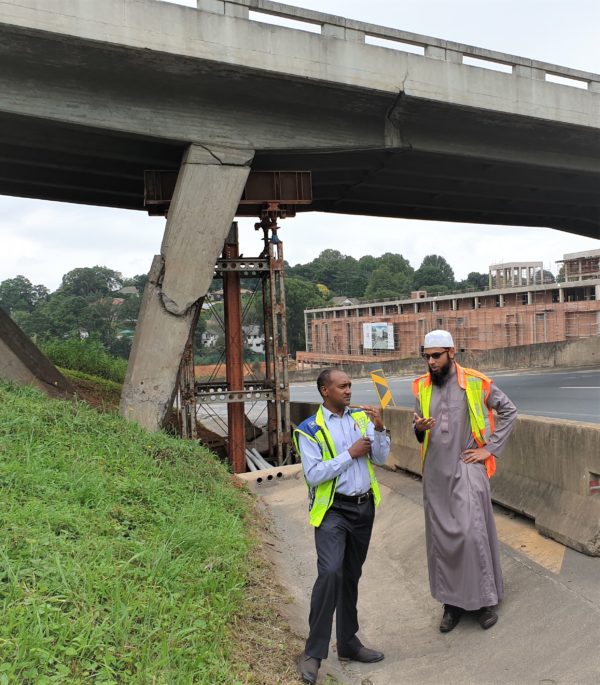
Ravi Ronny, SANRAL Eastern Region Design Planning and Construction Manager and SANRAL Eastern Region Project Manager and Structures specialist Mohammed Parak at the bridge.
Engineers have declared the Peter Brown bridge in Pietermaritzburg safe for use.
Following a site visit by engineers from the South African National Roads Agency (SOC) Limited (SANRAL), the bridge across the N3 has been considered safe to be used by normal vehicles.
The bridge was damaged when a truck collided with it in 2016, damaging one of the structural columns.
SANRAL Eastern Region Project Manager and Structures specialist Mohammed Parak said temporary steel frames had been erected to adequately support the bridge in place of the damaged column.
Regular inspections
“The safe load restriction for the surrounding roads is 20 tons and therefore the same weight limitation has been placed for the bridge. The bridge is inspected regularly by SANRAL engineers and any areas of concern are attended to as quickly as possible,” said Parak.
Ravi Ronny, SANRAL Eastern Region Design Planning and Construction Manager, said the bridge is monitored by SANRAL’s routine road maintenance team daily.
“The estimated cost of upgrading the bridge, which only requires a few months to fix, is between R3 to R5-million,” he said.
He added abnormal vehicles were not allowed to use the bridge.
After the installation of the temporary steel frame structure, the bridge was surveyed and a complete repair design was completed by structural design consultants, GIBB Engineering and Architecture.
SANRAL Eastern Region project manager Hugh Brooks said: “As with any road construction site, abnormal vehicles should obey the adequate load restriction signs that are in place along the N3 leading up to the bridge.
“There has been a delay in the finalising of the construction tender document to ensure maximum participation of black SMMEs in the contract in line with the new PPPFA regulations.”
Brooks concluded that the bridge is structurally safe to accommodate vehicles that adhere to the restriction measures applicable to the local roads in the area.
SANRAL has placed this project high up on the regional tender timetable for the 2019/20 financial year.
The expo seeks to expose rural schools to SANRAL’s career opportunities, internships, and scholarship and bursary programmes.
HARD WORK PAYS OFF: Businesswoman and motivational speaker Bongiwe Mafani and actor Moshe Ndiki were speakers at SANRAL’s Career Expo in Mdantsane in the Eastern Cape.
The South African National Roads Agency SOC Limited (SANRAL’s) national Career Expo kicked off in Mdantsane in the Eastern Cape recently, with more than 1 000 Grade 9 learners from nine high schools attending.
The learners were addressed by motivational speaker and businesswoman BongiweMafani, actor Moshe Ndiki and SANRAL Southern Region’s research associate and PhD candidate Keith Nare.
The two-day expo, hosted by SANRAL in partnership with the Eastern Cape Department of Education (EC DoE), was held at the Dr WB Rhubusana Building in Mdantsane and the Mdantsane Public Library in Nu 14 on Thursday 28 February and Friday 1 March respectively.
Bringing rural schools’ options
The expo seeks to expose rural schools to SANRAL’s career opportunities, internships, and scholarship and bursary programmes. It is also aimed at increasing SANRAL bursary and scholarship beneficiaries in the province.
During the 2017/18 financial year, 161 students received SANRAL bursaries to pursue higher education and 203 high school learners were enrolled in the roads agency’s scholarship programme.
“SANRAL aims to contribute towards strengthening the country’s expertise in engineering and construction through its development programme and through the bursary and scholarship programmes. These programmes enable young people to further their studies,” said WelekaziNdika, SANRAL Southern Region’s Stakeholder Relations and Communications Coordinator.
Sydney Swazi, deputy chief education specialist from the EC DoE, said: “We are humbled by this partnership. Our children are being exposed to alternative career choices to empower them to decide wisely.”
Lunga Mnyatheli, deputy chief education specialist from the EC DoE, said: “We feel honoured by the level and quality of presentations made by all the speakers. We are determined to make this an annual event.”
BongiweMafani, originally from Butterworth, reminded learners of the vital role education plays. “Keep a positive mind and know you can achieve anything,” Mafani said.
Moshe Ndiki, the programme director on day two of the expo, encouraged learners to follow their passion. “Push your passion more than anything,” he urged.
Ndiki, who hails from Mdantsane said, “for you to become the best in maths and science you need to practice. Also, seek help if you struggle.”
SANRAL’s Keith Nare encouraged the learners saying: “With passion, hard work and commitment you can achieve anything. Your roots do not have to determine your future.”
SANRAL’s Ndika said Grade 9 learners were invited because they must make subject choices in Grade 10. “We want to encourage them to take maths and science as these are the main subjects required when applying for a SANRAL scholarship or bursary.”
“Through our internal and external bursary programme, the scholarship programme and SANRAL’s training of communities in areas close to our major road projects, we are committed to building a competent skills base in South Africa to support the objectives of the National Development Plan, whilst achieving SANRAL’s transformation goals,” Ndika said.
Learners Speak
NoluvuyoNtayiya, 14, a Grade 9 learner at Sinethemba High School, said she hopes to become a doctor.
“This expo has motivated me and given me an opportunity to learn more about what SANRAL does,” Ntayiya said.
QhamokuhleToyiya, 16, a Grade 9 learner at Vulamazibuko High School, said he plans to study nursing or architecture.
“The speakers inspired me to work harder. I am glad SANRAL has told us more about the scholarship and bursary programmes,” Toyiya said.
OkuhleMzileni, 12, a Grade 9 learner at Sandisiwe High School, aspires to become a doctor.
“Being here left me feeling more motivated to study further,” Mzileni said.
AphiweZembetha, 15, a Grade 9 learner from Sakhisizwe High School, wants to become an engineer.
“I am now more eager to invest time in my studies. Listening to Mrs Ndika speak about what SANRAL does and their scholarship offering has made it easy for me to decide on a career choice.”
The scholarship programme, in its tenth year, will consider applicants with a 70-75% aggregate in Maths and Science, a 65% mark in English and an overall 75% plus pass rate. It pays for school fees, books, stationery, uniform, sports uniform and for hosting the learner at a gala dinner/luncheon.
SANRAL’s bursary scheme was initiated in 2007 and caters for students with outstanding academic performance in civil engineering and related studies in the built environment.
For more information on the scholarship and bursary programmes visit www.nra.co.za.
SANRAL is taking measures to completeconstruction work after it became known that the primary contractor, Basil Read, filed for business rescue.
The roads agency is in discussion with the contractor’s insurance company to find another suitably qualified and experience contractor who could complete the works on behalf of Basil Read.
The South African National Roads Agency (SOC) Limited (SANRAL) is taking alternative steps to ensure the construction of the Polokwane Ring Road is completed as early as possible.
Plans are also in place to minimise traffic disruptions on the section of the N1 between the Shell Ultra City and the R71 (Tzaneen Road), and ensure the safety of commuters travelling on the national road south of Polokwane.
Progress Hlahla, the Regional Manager of SANRAL’s Northern Region, said certain measures had to be taken to complete construction work after it became known that the primary contractor, Basil Read, filed for business rescue.
The original expectation was that Basil Read might be able to get its finances back on track and resume work on the second phase of the Polokwane Eastern Ring Road. It has since become clear that this will not be achieved.
SANRAL’s options
Hlahla said there are two alternatives open for SANRAL.
The roads agency is in discussion with the contractor’s insurance company to find another suitably qualified and experience contractor who could complete the works on behalf of Basil Read.
SANRAL will also try to ensure that any new contractor would continue with the labour and SMME companies involved in the project.
If this process is successful work can recommence in the second quarter of 2019 and current estimates are that it can then be completed within 15 months of resumption.
The alternative option requires SANRAL to call for formal tenders for the completion of the outstanding work.
This tender process will take at least six months to be drafted, advertised, evaluated and awarded.
SANRAL is aware that the suspension of the project has created disruption to traffic and inconveniences for road users.
“The plans we are putting in place are designed to address the problem quickly and ensure work can continue at the earliest possible stage,” said Hlahla.
Safety assessment are done on a regular basis and measures will be implemented to ensure the safety and convenience of all road users, including motorists and pedestrians.
Prior to commencing construction, 60 varieties of plant species were carefully removed and then replanted.
The majority of the rescued plants were Fynbos and bulb species, which were temporarily housed in nurseries before being re-introduced into a 22-hectare receptor area adjacent to the N7.
When the South African National Roads Agency (SOC) Limited (SANRAL) started construction on the N7 in 2016, it made sure that its efforts to improve connectivity through an improved road network would not harm the natural environment.
This project involved the upgrade of the N7 section 1 between Philadelphia and Kalbaskraal, from a single to a dual carriageway freeway.
This section of the road runs through the Malmesbury Renosterveld and is home to an extensive range of indigenous vegetation.
Environment does not suffer
Prior to commencing construction, the team carefully removed nearly 60 varieties of plant species, the majority of which were Fynbos and bulb species, which were temporarily housed in nurseries before being re-introduced into a 22-hectare receptor area adjacent to the N7.
Freddie Henning, Resident Engineer from ERO Engineers, said: “SANRAL’s agreement with environmentalists entailed a trade-off, where for every hectare of indigenous ground that would be used for the widening of the N7, SANRAL would give six hectares of receptor area back to Cape Nature.”
As construction is completed, plants are systematically reintroduced to their natural environment and where the space in the road reserve does not permit this, the plants were translocated to the receptor area.
Large quantities of alien vegetation were cleared to make room for indigenous plant species in the receptor area.
Highest levels of care taken
“A major challenge was the nearly non-existent rainfall. However, with some creativity and the use of water collection tanks, we were able to water the plants only when necessary, to ensure their survival,” said Ian Anderson, Rehabilitation Specialist from Vula Environmental Services, who worked with SANRAL to ensure the highest levels of environmental responsibility at all times.
“The plants were translocated during winter, in order for them to adjust to the new environment so that they are strong and able to thrive during the hot summer months,” said Anderson.
“It is important that we maintain a healthy balance that will ensure that infrastructure upgrades like these can co-exist harmoniously with our natural environment. I believe that we are doing just that, and I am proud of SANRAL’s excellent track record in working with environmental specialists, to make sure we always give back to the environment, way more than we ever take out,” said Randall Cable, SANRAL Western Region Manager.
Northern Cape MEC for Roads and Public Works believes the move towards a computerised system can only improve the already outstanding services rendered by various role players.
Mxolisi Simon Sokatsha, the Northern Cape MEC for Roads and Public Works believes the Road Incident Management System in a province as vast as the Northern Cape is crucial to saving lives on the roads.
As the Northern Cape Department of Roads and Public Works, we are incredibly proud of our association with the South African National Roads Agency (SOC) Limited (SANRAL).
They are an integral part of the road construction industry in our province and through their projects they not only aid job creation and skills development, but they leave a legacy of skilled citizens who are able to access further developmental opportunities.
Improved road safety
The almost complete three intersections at key entry points to The Diamond City will improve the safety of road users and pedestrians.
The department is glad to highlight that the improved and upgraded intersections (which were previously classified as high accident zones) will contribute to much safer roads.
Furthermore, we had no fatalities during the construction period, and we thank road users for their patience and for adhering to the safety instructions of the flagmen on site.
A section of the road that falls under provincial jurisdiction, between Olifantshoek and Kathu, needed urgent repair and because of the cooperative relationship we have with SANRAL, they incorporated the repairs into an existing project, and the department simply carries the cost thereof – seamless workflow with minimal disruption to road users.
Constant development
We are also encouraged by the constant development and improvement of the Road Incident Management System and in a province as vast as the Northern Cape, this infrastructure is crucial to saving lives on our roads.
The move towards a computerised system can only improve the already outstanding services rendered by various role players, including Emergency Medical Services and traffic, to the South African Police Service, Routine Route Maintenance and many other entities.
I want to encourage road users to be vigilant, courteous and to show concern not only for their own safety, but also that of other road users in the Northern Cape, particularly pedestrians.
Let us ensure that we all reach our destinations safely.
This is an opinion piece by Mxolisi Simon Sokatsha, the Northern Cape MEC for Roads and Public Works.
SANRAL iscommitted to engaging with industry forums and the public at large and have already forged some positive relationships with key stakeholders in this regard.
Skhumbuzo Macozoma, SANRAL CEO, said SANRAL remains committed to training and capacity building and, where the need exists, will ensure emerging SMMEs have the tools to enable them to compete fairly for economic development opportunities.
As we reflect on 20 years of being responsible for the development and upkeep of the national road network, we look back with pride on some of the significant achievements – the road network has tripled from 6 700km in 1998 to over 22 000km currently.
We also take key lessons from these projects in a bid to improve the way we engage with our stakeholders going forward.
That underpins our direction for the next 20 years. We have heard the cries from the SMMEs and start-ups, which further inspires our efforts to break down monopolies in the supply chain of materials, equipment, technologies, systems and other areas to ensure broad-based participation by black South Africans.
To this end, we are committed to engaging with industry forums and the public at large and have already forged some positive relationships with key stakeholders in this regard.
Projects
Our flagship projects in the Northern Cape are nearing completion. On the N12, the bridge over the Orange River is in the home stretch and we look forward to formally opening that bridge early in 2019.
The three intersections just outside Kimberley: Cape Town Road (N12), the Douglas Road (R357) and the Griekwastad Road (N8), which were upgraded to traffic circles, already have lighting in place and are having the finishing touches added.
Between Olifantshoek and Kathu, we have significantly upgraded major intersections to traffic circles because of a dire need to reduce motor vehicle accidents and increase safety conditions with regard to road engineering.
Going forward, all SANRAL projects will be facilitated through an inclusive and consultative process, using project liaison committees (PLCs) that are being set up locally in the targeted project areas with relevant stakeholders.
In some areas this is easier said than done. It requires a concerted effort, particularly at a local-government level, to assuage people’s fears that political allegiance will be rewarded.
We look forward to rolling out new projects across the Northern Cape in 2019 and we hope that the work we’ve done in terms of stakeholder engagements will pave the way for eligible local labour and SMMEs to seize the opportunities that road construction projects can bring to marginalised communities along the route.
We remain committed to training and capacity building and, where the need exists, we will ensure emerging SMMEs have the tools to enable them to compete fairly for economic development opportunities.
This is an opinion piece by SkhumbuzoMacozoma, SANRAL’s CEO.
In keeping with government’s Infrastructure Development Plan, SANRAL will use roads infrastructure development as the catalyst for job creation and empowerment.
Dumisani Nkabinde, SANRAL Eastern Region regional manager, said that SANRAL wants to play a leadership role in sectors of the economy that are critical to job creation, skills development and community empowerment.
Communities in far-flung rural areas in northern KwaZulu-Natal (KZN) have not been overlooked by the South African National Roads Agency (SOC) Limited (SANRAL).
They have been provided with safer walkways for pedestrians and periodic road maintenance has been carried out on crucial routes that serve passenger and goods vehicles.
In the process, hundreds of jobs have been created and SMMEs have been developed.
SANRAL this week embarked on a drive to inform stakeholders of the opportunities that exist in the construction industry.
In keeping with government’s Infrastructure Development Plan, SANRAL will use roads infrastructure development as the catalyst for job creation and empowerment.
Taking SANRAL to the people
SANRAL hosted its Taking SANRAL to the People programme in Kwangwanase at Kosi Bay in Northern KZN to promote dialogue between the agency, different spheres of government, business, communities and other key stakeholders affected by its projects.
Dumisani Nkabinde, SANRAL Eastern Region regional manager, said that through this programme SANRAL shares information with stakeholders about its continuing role in infrastructure development, job creation and skills development initiatives, and also engages in dialogue on issues of mutual interest.
Nkabinde said communities far away from large cities and towns were often forgotten, but that these were the very people who needed jobs, empowerment and road safety education.
He said SANRAL will also draw from Horizon 2030, its renewed statement of intent of how the roads agency will grow to deliver a national road system that contributes to a better South Africa for all.
In tandem with Horizon 2030, SANRAL will also give real meaning to its transformation policy, which recognises the critical role SANRAL plays in the construction, engineering and related sectors.
Nkabinde said: “We are mindful of the impact that procurement and employment practices in these industries have on millions of people across South Africa. We accept our responsibility to help transform these sectors and to maximise the participation of black contractors, professionals and suppliers beyond the current regulatory levels in all aspects of our business.
“As a responsible state-owned entity, SANRAL wants to play a leadership role in sectors of the economy that are critical to job creation, skills development and community empowerment.
“We want to set high standards for ourselves, and encourage our partners and stakeholders in these industries to join us in the quest to transform the South African economy.”
Projects
SANRAL has undertaken several projects in northern KZN to make roads safer for pedestrians, whilst rehabilitating and upgrading existing roads.
Driven by road safety concerns, SANRAL constructed pedestrian facilities on the N2 between Nyalazi River and Hluhluwe River.
This project entailed the rehabilitation and replacement of the damaged existing walkway and the construction of additional walkways.
In addition, existing culverts were extended on sections where they crossed the walkway.
Also, of critical importance, is the fact that this work was also used to start contributing more to the Manguzi community, with numerous jobs created for the people of Manguzi, a significant number of whom were women.
Furthermore, black owned SMMEs were also contracted to the tune of R2.24-million in addition to the R1.2-million spent on local labour and the 63 people trained in furtherance of skills development through maintenance of the R22 from Mseleni River to Phelendabe circle.
Nkabinde said theR22 serves as the main access road and is bordered by residential developments. SANRAL continually reseals the road, including the protection of the gravel shoulders by construction edge beams, keeping community and road safety top of mind.
He added that considering SANRAL’s focus is not only job creation, but also the meaningful participation of black businesses, SANRAL spent a total of R13-million on the employ of localSMMEs in addition to the 63 residents of Manguzi having gained employment, 20 of whom are women.
SANRAL, as part of its continued presence in the area, undertakes ongoing maintenance of the road from Phelendaba circle to Manguzi.
This route forms part of the Spatial Development Initiative that links Hluhluwe in the south to the Mozambican border, and which traverses numerous settlements and villages.
The first 12km passes through areas with agricultural activity on both sides of the road. From the 12-kilometre mark to the 22-kilometre mark in Manguzi, there is more intensive development – peri-urban and urban – on either side of the road, culminating at the end of the route with the commercial development of the Manguzi central business district.
SANRAL does surface repairs where needed, including extensive base patching, surface patching, asphalt edge break repairs, construction of concrete edge beams and slurry surface texture improvement.
This also included the construction of a new seal surface treatment over the entire road surface
Upcoming projectsinclude the maintenance of the N2 from Empangeni to the border of Mpumalanga Province. This will also include R22 sections 1–5 from Hluhluwe to the Mozambican border, a total distance of 427 kilometres.
Planned work includes the repairs of pavements, grass cutting, attendance to drainage structures, road reserve cleaning as well as maintenance of road amenities.
One of the project’s requirements is that at least 60% of scheduled work should be contracted to sub-contractors. The main contractor, Rainbow Civils, has to date contracted several 1CE and 2CE contractors. In addition, the project currently has five sub packages in place
Fast-tracking empowerment
To fast-track empowerment in the road construction industry, SANRAL has signed a Memorandum of Understanding (MoU) with Bell Equipment in July 2018.
The MoU will give small contractors access to earth-moving machinery to allow them to participate more meaningfully in major construction projects.
Access to sophisticated and more advanced equipped used in construction has been identified as one of the biggest hurdles that continues to face emerging contractors.
Emerging contractors often do not have the capital to buy the machinery used for excavations, ground moving and the grading of roads.
The key motivation behind this MoU is to attract new entrants into the construction and engineering sectors, particularly black contractors, who will in turn grow their business and create jobs.
The cooperation between SANRAL and Bell Equipment is also expected to help to promote fair competition in the construction and engineering sectors.
It is expected that black-owned contractors will now have access to finance, leasing and rental options of road construction equipment, enabling them to participate in major tenders where high standards of quality are required.
“The MoU also demonstrates the road agency’s resolve to use its contracting and procurement processes to facilitate the growth of emerging contractors,” said Nkabinde.
“Bell Equipment will use its infrastructure of 26 branches throughout the country to provide technical support to assist emerging contractors with their strategic partnerships with financial institutions, with banks also playing a hand to secure finance for emerging contractors.”
Deaths on the road
Deputy Minister of Transport, Sindisiwe Lydia Chikunga, who was also on a road safety campaign in the Manguzi area, said that according to the preliminary Festive Season Road Safety Report there were 1 612 deaths on South African roads during the last festive season.
The report covered the period from 1 December 2018 to 8 January 2019. Of these deaths, 328 were in KwaZulu-Natal with 267 crashes.
She said interventions that dealt with ameliorating road safety did not only end with driver, pedestrian or vehicle safety.
They also dealt with the improvement of hazardous South African roads through engineering.
She urged road users to take personal responsibility for safety on South African roads for all the 365 days of the year.
Agency seeking to break down monopolies in the industry, and tackle unemployment, poverty and inequality
SANRAL is currently reviewing its procurement documents to enable small black-owned contractors to access more work opportunities on SANRAL projects.
The South African National Roads Agency (SOC) Limited (SANRAL) and the National African Federated Building Industry (NAFBI) have signed a Memorandum of Understanding (MOU) to develop small contractors.
The agreement is aimed at providing mentorship, guidance and coaching to emerging contractors to enable them to participate in road construction and maintenance projects.
NAFBI is an autonomous, non-profit organisation responsible for economic access facilitation, capacity building and business linkages with the aim of transforming the construction industry in South Africa.
According to Ismail Essa, SANRAL Transformation Manager, the two parties entered into an agreement on matters of mutual interest in order to best serve their strategic, transformation and empowerment interests by exploring options and solutions to maximise the participation of small contractors in SANRAL projects.
“SANRAL is currently reviewing its procurement documents to enable small black-owned contractors to access more work opportunities on SANRAL projects. Most of these contractors require assistance and mentorship before, during and post the tendering phase to win the tender and then execute the project successfully while making a reasonable return,” he said.
Essa said that through this initiative SANRAL seeks to break down monopolies in the industry, and tackle societal ills that include unemployment, poverty and inequality.
Other agreements
The MOU agreed on 14 February 2019 at the SANRAL Central Operations Centre (COC) is one of a number recently signed by the roads agency to level the playing fields in the industry.
In July 2018, SANRAL signed an agreement with Bell Equipment to allow small businesses access to construction equipment, which is one of the major critical factors to successfully deliver on projects.
This was followed by another agreement with Barloworld Equipment for access to CAT earthmoving machines and CAT power systems in southern Africa. SANRAL also signed an MOU with Wirtgen Group South Africa for access to machinery.
What the NAFBI agreement entails
As part of the agreement, SANRAL will conduct information sessions from time to time for capacity building and information sharing and will invite NAFBI to provide mentoring in the areas of technical competence, financial and human resource activities, as well as contractual and legislative matters.
NAFBI National President Aubrey Tshalata believes the partnership with SANRAL is key and is a giant step in preparing their members in all nine provinces to be ready to participate in SANRAL projects.
Tshalata said: “NAFBI has a membership of 6 840 contractors, mostly from townships, Villages, Small towns and are active in local projects.
“This will bring about local economic growth, improve quality on projects, improve skills and accelerate black economic empowerment in a meaningful way. We want to develop real sustainable contractors who are able to compete and perform.”
The MOU will be in place for a period of five years with the option to renew if both parties agree.