In the third installment of our #JustW8 campaign we highlight drinking and driving.
Most motorists don’t ever believe they have had too much to drink but it has been proven that alcohol consumption is one of the biggest causes of car crashes in the country.
SANRAL’s ongoing road safety campaign, #JustW8, seeks to dispel the notion among road users that they can still safely drive while breaking the most common unsafe driving practices.
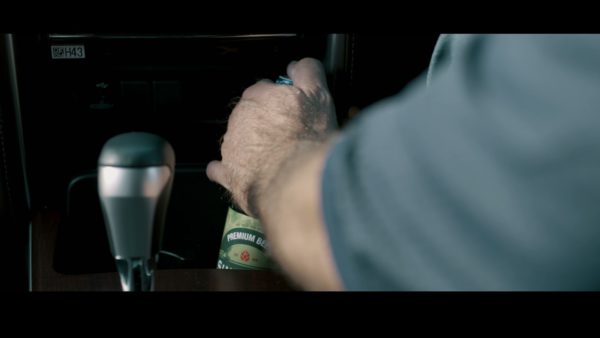
This week’sscenario involves drinking and driving which is one of the most common unsafe driving practices.
Most motorists don’t ever believe they have had too much to drink but it has been proven that alcohol consumption is one of the biggest causes of car crashes in the country.
Scenario 3
It’s a sunny afternoon and the father and daughter duo are taking a nice leisurely drive.
The dad has a beer in the cup holder, so he reaches for it and opens the bottle when his daughter chimes in with sounds of disappointment.
The dad is reminded that although he is not drunk, drinking and driving should be shunned.
His daughter reminded him to #JustW8 until they are home.
Poor road design can also cause crashes, so SANRAL holds technical design highly.
As a road authority, SANRAL’s primary sphere of influence is engineering. However, the N2 and N3 upgrade programme will allow for the facilitation of an integrated approach to improve safety for all road users.
It is not just human factors, such as speeding, not wearing seat-belts or careless driving, that increase the risk of a crash occurring. Poor road design can also cause crashes.
Designing for all users – During the upgrade programme, the N2 and N3 will be designed with the needs of all road users in mind – including pedestrians, non-motorized road users and local communities and businesses. The safety of motorists and pedestrians alike, will be a central consideration in every decision made about construction.
Quieter pavements – By using noise reducing asphalt mixes and specialized concrete grinding techniques, motorists will be able to travel along the N2 and N3 peacefully with less tyre noise.
Robust pavements – More damage is caused to roads by heavy vehicles than light vehicles. To cater for growing volumes of freight traffic on the N2 and N3, the pavement design methods and materials to be used in sections most prone to deterioration will be carefully considered.
Environmental considerations – During construction on the N2 and N3, SANRAL commits to enhancing eco-efficiency and identifying and managing or eliminating environmental risks. SANRAL will encourage planting partnerships in its quest to re-populate the entire road reserve to a similar state it was in before construction. Already during the upgrading of the Hammarsdale Interchange, several plant species, including a range of specially protected bulbs and aloes growing along the busy N3, have been translocated to a temporary nursery to save them from being destroyed.
Aesthetically pleasing – Bridge structures are built to last for decades and often serve as a gateway to a community. Good bridge design not only considers structural integrity, but also aesthetics. Therefore, SANRAL believes it is important for the new bridge structures along the N2 and N3 to be pleasing to the eye. The redesigned EB Cloete Interchange (Spaghetti Junction) – 3D image shown here – will feature a cable suspended bridge from an iconic arch.
Geometric design – The upgrades on the N2 and N3 will utilise geometric design to optimise efficiency and safety while minimising cost and environmental damage. The smooth flow of traffic will be balanced.
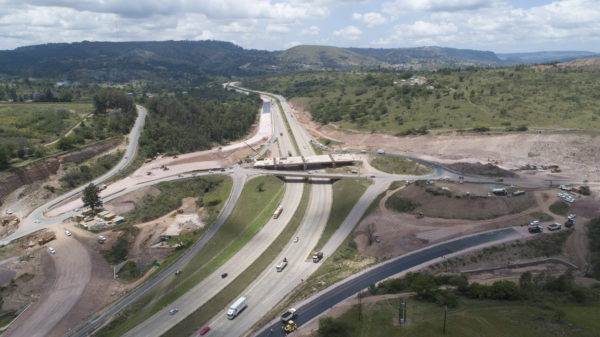
Safety improvements – Apart from resolving chronic traffic congestion by creating greater mobility through construction of additional traffic lanes, the upgrading of the N2 and N3 will result in increased safety. Dangerous curves will be ironed out. Unsafe intersections will be redesigned. Major realignment of the N3 highway will take place at Key Ridge (3D image shown here) where the steep grades cause major traffic congestion and serious crashes.
SANRAL is pushing ahead with its Transformation Policy through which it aims to transform the construction industry by contracting local – and mostly black – companies.
SANRAL CEO Skhumbuzo Macozoma said roads are our primary responsibility, but what is dear to us is enhancing the lives of communities and transforming the construction industry.
The mainstay economic activities of the North West province – mining, agriculture and tourism – are all reliant on excellent roads.
Providing these is what the South African National Roads Agency (SOC) Limited (SANRAL) does for the national network it is responsible for.
It is in line with the approach sketched by former Minister of Transport, Dr Blade Nzimande, during a recent visit to the province where he emphasised that the Strategic Integrated Programme (SIP4) will accelerate infrastructure growth and stimulate the regional economy.
To ensure this, the continuous and routine maintenance of these roads is vital, as is the upgrading of those road that are carrying ever more traffic.
Projects
At the end of last year, the road works on the R34 near Schweizer Reneke were completed, making for safer driving and less congestion.
The R505 from Wolmaransstad to the N14 is being upgraded and we look at the progress and the benefit this project entails for road users and communities in two local municipalities.
We do the same for the upgrading of the N4 from Pampoennek to the R512.
Of interest is the profiling of planned projects for this financial year as well as where to find the necessary tender information.
This is important, especially for local SMMEs, as SANRAL is pushing ahead with its Transformation Policy through which it aims to transform the construction industry by contracting local – and mostly black – companies.
Our routine road maintenance programme continues to keep the national road network right up there on the global scale of excellence.
Roads are our primary responsibility, but what is dear to us is enhancing the lives of communities and transforming the construction industry.
This is an opinion piece by SkhumbuzoMacozoma, SANRAL’s CEO.
The Premier of the North West believes the province has immense potential for growth in key sectors of the economy – most notably tourism, agriculture, and mining.
North West Premier Job Mokgoro said the N4 toll road is the primary economic artery in the region and connects it with Gauteng and serves as a gateway to the SADC through Botswana.
Our provincial road and transport infrastructure are critical enablers of future economic growth in the North West Province and as the 6th Administration, we have set ourselves clear targets to accelerate balanced growth in line with the objectives of the National Development Plan.
The North West is a province with immense potential for growth in key sectors of the economy – most notably tourism, agriculture, and mining.
The provincial Spatial Development Plan provides the framework for growth, but we are keenly aware of the fact that access to socio-economic opportunities must be created on safe and accessible roads.
For this reason, we value the productive partnership that has grown between the province and SANRAL over the years. In the recent State of the Province Address, we announced that some R4.54-billion was spent on the improvement and maintenance of our world-class road infrastructure.
The N4 toll road is the primary economic artery in the region and connects us with Gauteng and serves as a gateway to the SADC through Botswana.
We therefore welcome the major upgrades to the road that are currently underway in the Madibeng Local Municipality area.
Similar upgrades are taking place on key roads in the Kenneth Kaunda, Ngaka Modiri Molema and Dr Ruth SegomotsiMompati Districts.
Through our road networks, we can move agricultural and mining products to the markets and open new destinations for the growing number of tourists who are eager to visit our beautiful and diverse province.
The SANRAL initiatives complement the province’s own Roads Recovery Plan to improve transport infrastructure and significantly reduce maintenance backlogs.
We intend to spend an additional R732-million in the current financial year on the upkeep of road infrastructure including bridge construction, rehabilitation and the upgrading of roads from gravel to surface.
A distinctive feature of SANRAL’s projects is its ability to create jobs in local communities and support the growth of local suppliers, local entrepreneurs and local contractors.
These projects make valuable contributions to the broader provincial economy and enable local communities to gain valuable experience on major construction projects.
Our newly-elected administration is ready to serve the people of the North West. We are ready to accelerate the economic development of the province and looking forward to a growing partnership with SANRAL to achieve our objectives.
This is an opinion piece by Prof Job Mokgoro, the Premier of the North West province.
This week we showcase our second scenario and the difference it makes to #JustW8
The South African National Roads Agency (SOC) Limited (SANRAL) believes that if you pause to think about the consequences of your actions, you would choose the better option.
The roads agency has compiled short videos that educate about everyday driving practices and how when you #JustW8 the outcome can be changed.
This week we feature scenario 2, that involves texting and driving.
Scenario 2
The scene starts with an aerial view of an intersection and a young man in the car with their mom.
His mom receives a text and simultaneously reaches for her phone.
As she grabs her phone to read the text, her son grabs it from her and throws it to the back seat, while smiling at her sarcastically.
While the act of taking her mom’s phone and throwing it to the backseat is playful, it is more of a protective and responsible act of a passenger.
His mom looks at him and smiles realizing how responsible he is.
His act is testament to the #JustW8 campaign. His mom didn’t really have to read the text immediately.
The programme promotes engineering as a career among high school learners who have the potential to study engineering at a tertiary level.
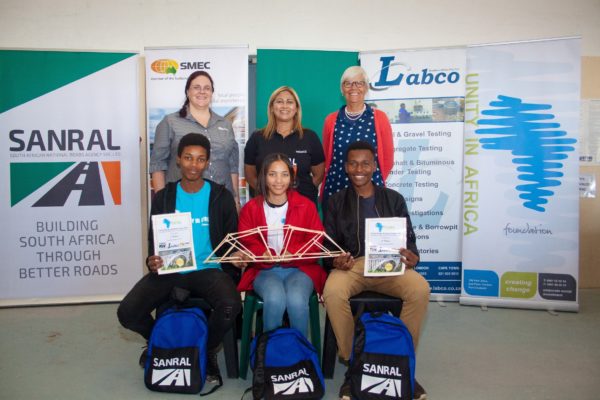
The winning team, from left, Likhaya Ntshiza (Molly Blackburn High School), Vicarlia Edinberry (Sanctor High School) and Samkelo Ngobese (Daniel Pienaar High School) were crowned the winners of the iGEMs bridge building competition hosted at the SANRAL Technical Excellence Academy Laboratory in Struandale, Port Elizabeth. They were joined by, Tronél Candiotes-Strydom from SMEC (from left, standing), Michelle Ah Shene from SANRAL and Laurene Booth-Jones from Unity in Africa Foundation.
More than 30 academically-deserving Grade 11 and 12 learners from disadvantaged and socio-economic vulnerable backgrounds got a glimpse of the civil engineering industrywhen they designed and built model bridges as part of the iGEMS holiday programme.
The South African National Roads Agency (SOC) Limited (SANRAL), together with SMEC South Africa, Labco and Unity in Africa Foundation collaborated in hosting the fifth annual iGEMS bridge building competition, where learners from 16 high schools were taught the skills required to plan and build a bridge.
The competition was held at the SANRAL’s Technical Excellence Academy Laboratory in early July.
Unity in Africa Foundation run a programme called incubating Great Engineering Minds (iGEMS).
The programme promotes engineering as a career among high school learners who have the potential to study engineering at a tertiary level.
Bridge building
The bridge building competition was one of a series of workshops, site visits and projects held during the July school holiday for the iGEMS learners.
The holiday programme is part of Phase one in a four-stage ‘education to employment’ programme, which incubates incumbents for about seven years until they graduate.
Based on the format and rules on the South African Institution of Civil Engineering’s (SAICE) bridge building competition, learners had to design and then build model bridges using only wooden sticks, rope and glue in a limited time frame following functional specifications and construction methods.
The bridges were judged on aesthetics, weight and structural strength. Strength testing was done using suspended weights that literally stretched the bridges to breaking point in an ultimate showdown between the 10 teams.
Samkelo Ngobese, a 17-year–old, grade 11 learner from Daniel Pienaar High School, said he is very passionate about engineering and wants to pursue a career in the civil engineering industry.
He said: “I want to study and pursue a career in civil because of the love I have for building infrastructures and safer roads for motorists.”
Ngobese’s favourite subjects at school are mathematics, which he obtained 70% and 78% in physical science and a level 5 in Civil Technology during this June exams.
“After doing a lot of research, I found that my favourite subjects are core subjects needed for civil engineering,” he said.
Vicarlia Edinberry, a 16-year–old, grade 11 learner at Sanctor High, experienced surprising qualities about herself during the iGEMS bridge building competition.
“Knowing how to work well with other members of the team was one of the surprising qualities. The competition taught me how to use my listening skills and consider other members’ opinions, and that is why we were able to work as a team and develop good communication skills,” Edinberry said.
She further added that civil engineering is interesting in such a way that it enables one to give back to the community and encourages one to do the best to their ability.
Likhaya Ntshiza, a 16-year–old, grade 11 Molly Blackburn High School learner, said the biggest highlight of the competition was working with his teammates who were focused on building their bridge and who knew how to share different ideas effectively with one another for the bridge to be a success.
“My team members and I had unique skills on how to build the bridge and everyone shared creative yet relevant ideas for the bridge” he said.
Ntshiza believes that with the relevant equipment and active team members, he can build a model bridge in future.
Investing in the future
“Investing in these high school learners is an investment in our country. Engineering is a scarce skill in the country. If we do not invest in the youth throughout their high school and university studies, we face the risk of not having engineers building and maintaining South Africa’s national road network,” said Mbulelo Peterson, SANRAL Southern Region Manager.
Peterson added that programmes initiated by SANRAL to address education and skills development, include among other, awarding of bursaries and scholarships to deserving students all over the country to further their studies.
In 2018, 41 scholarship and 16 bursary recipients were from the Eastern Cape. The low figure of bursary recipients in 2018 can be attributed to the fact that there was no institution offering a BSc & BEng in Civil Engineering qualification in the province.
In 2019, an additional four Eastern Cape students received a bursary. Going forward, the number of bursary recipients in the province is likely to increase now that Nelson Mandela University offer a BEng Tech in Civil Engineering degree qualification.
Other projects SANRAL Southern Region supports is the Science, Technology, Engineering and Related Management/Mathematics (STEM) Fields Pipeline Project in Port Elizabeth, hosted by the Nelson Mandela Bay University (NMU) which help high school learners improve their understanding of maths and science.
SANRAL’s Technical Excellence Academy (TEA) provides engineering candidates with the much-needed training to qualify for registration, which means they are likely to achieve the training outcomes required by the Engineering Council of South Africa (ECSA) sooner than candidates not in a similarly enabling environment.
SANRAL took ownership of the R67 from Grahamstown to Queenstown after it was declared a national road in 2012.
Thirty (30) SMMEs worked on the project and a total of 369 jobs were created.
Periodic maintenance on the R67 between Fort Beaufort and Seymour in the Eastern Cape is improving road safety for pedestrians and motorists.
The 14-month road maintenance project by the South African National Roads Agency (SOC) Limited (SANRAL), valued at R151-million, which commenced last year, is helping to create safer travel experiences for motorists.
This road connects the towns of Fort Beaufort and Seymour and is a vital link between Fort Beaufort and Queenstown.
Mbulelo Peterson, SANRAL Southern Region Manager, said: “The installation of guard rails in the high fills as well as the construction of the Baddafort intersection has helped to improve the safety of the road. The stretch of the road was also fenced to prevent animals from crossing the road. This has made a significant change and has helped reduce the number of accidents on the road.”
SANRAL took ownership of the R67, from Grahamstown to Queenstown, after it was declared a national road in 2012. As part of its mandate, SANRAL is responsible for maintaining this important road.
The average daily traffic on this road ranges from between approximately 600 and 700 vehicles per day in both the North and South directions, while the average percentage of heavy vehicles using this road is around 12.8%.
This means that approximately 89 trucks use the road in each direction every day.
SMMEs benefit
Thirty (30) SMMEs worked on the project and a total of 369 jobs were created.
“This was regarded as one of the most important road development projects in the area over the last three years since it created job opportunities for 369 people from the local communities,” Peterson said.
Nomfundo Maneli, a Seymour resident and worker at Zubra Cleaning Services and General Training said her role in the project was to erect fencing.
She worked on the project for two months and during that period she had hoped to increase her CIDB rating to Level Two.
“We received training on safety and security before we started with the project, and the training taught me things that I thought I would never know,” Maneli said.
Lwando Solani, who lives in Seymour and is a construction worker at Solenzo Trading and Projects CC, worked on this project for three months.
Before working on the project, he received one-week training on the installation of guard rails.
“Since the maintenance I am happy to say that the road is now safe for pedestrians and motorists to use,” Solani said. After completing the project Solani’s CIDB Level 2 increased to CIDB Level 3.
Nolady Booi, the managing director at Azakhiwe Trading Enterprise and resident of Seymour, was responsible for stone pitching.
“We did the stone pitching in such a way that no water can come through,” Booi said. She worked on the project for two months thereafter her CIDB Level increased to Level 2.
Project scope
Texture slurry from km 0.2 to km 40.8, both left-and-right-hand side.
Scattered asphalt patching along the length of road up to km 40.8
Rut filling on certain sections for ruts measured to be more than 20mm.
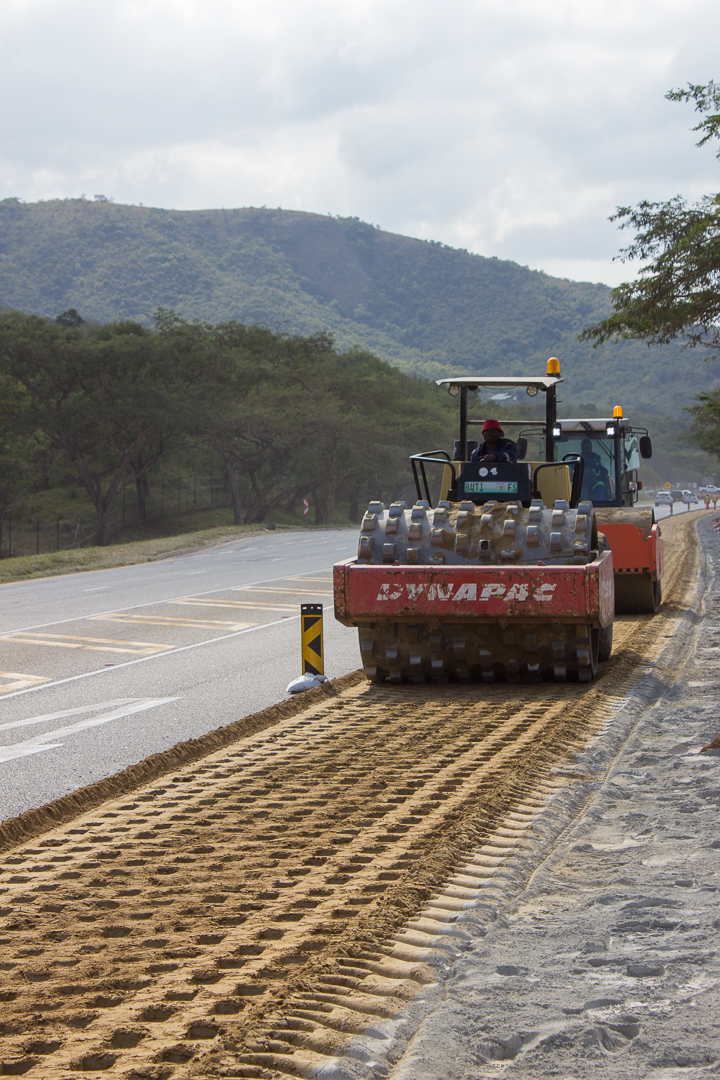
Milling the last 1.2 km 180mm asphalt and base stockpiled to be re-used and 150 mm to insitu carted to spoil. The subbase was replaced by recycled stockpiled material. Imported G2 Base with a cape seal black top.
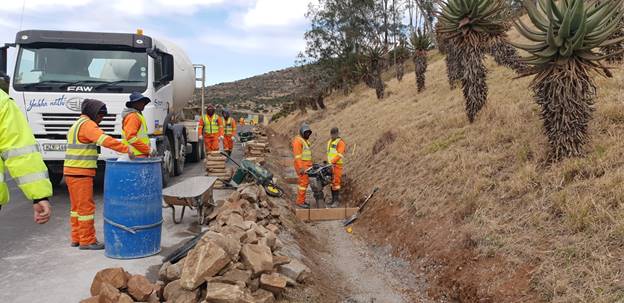
Identified Targeted Enterprise works included: fencing, stone pitch, subsoil drains, concrete lined drains, gabions, concrete edge beams, kerbing and paving, bus bay platforms and construction of guardrails.
Re-Sealing 40.8km of the road where 23km was a triple seal and the rest double.
Training and development
Target Enterprises (TEs) or Small Medium Micro Enterprises (SMME’s) who participated on this project had to be registered with the Construction Industry Development Board (CIDB).
They were given tender training, which was specific to their respective packages such as construction of stone pitching, installation of guard rails, erection of fencing and gabions.
This training included a five-day intervention on Tendering for Construction Contracts and two extra days were provided for SMMEs that required additional assistance.
“As a requirement for this project, it was important that tenderers were familiar with the specification that relates to the transformation of the construction industry and adhered to the policies of Reconstruction and Development programmes and other similar Government initiatives,” Peterson said.
The Target Enterprise Management Team provided guidance and mentoring to the prospective tenders and an accredited training service provider was organised to provide the necessary training.
SAQA accredited competency certificates and attendance certificates were awarded to the SMMEs.
Practical training was also organised for Targeted Enterprises (TEs). This included a two-day theory training and three-day practical skills training.
The training was for fencing, guardrails, gabion and stone pitching. All participants of the trainings attended that were deemed competent received SAQA accredited certificates.
TRAC prides itself on offering quality road infrastructure and therefore continuously works on improving and maintaining the N4 Toll Route.
Trans African Concessions (TRAC) thanks road users for their patience and understanding during this time.
Road users will be delighted to hear that the rehabilitation of Schoemanskloof between Crossroads and the Mashishing Intersection is complete and Stop/Gos have come to an end.
The R80-million project ensured the pavement on the 15,7km stretch of Schoemanskloof has been rehabilitated to improve driveability.
It also benefited local communities as the contractor – Tau Pele Construction – subcontracted portions of the initiative to locals.
Numerous local labourers were also temporarily employed for the project.
During the 10 months of roadworks, Stop/Gos had to be implemented. Trans African Concessions (TRAC) thanks road users for their patience and understanding during this time.
TRAC prides itself on offering quality road infrastructure and therefore continuously works on improving and maintaining the N4 Toll Route to ensure that it’s on par with world standards, for the benefit and safety of our road users.
Our new road safety campaign asks you to #JustW8 before you make certain decisions while driving.
#JustW8 until you are not mobile to put on your make-up.
Each year, nearly 1.2 million people die and millions more are injured and disabled as a result of road crashes.
South Africa has one of the worst road safety records with over 40 people dying daily on our roads and a further 20 being left permanently disabled.
Road deaths are prevalent among pedestrians and then passengers, while young males are causes for most fatalities on the road.
With the #JustW8 campaign, SANRAL is challenging the youth to take a pause and think about the consequences of their decision making.
This road safety campaign seeks to dispel the notion among road users that they can still safely drive while breaking the most common unsafe driving practices.
These unsafe driving practices include drinking and driving; texting and driving; speeding; not wearing seat-belts; and breaking road rules.
SANRAL believes that if you pause to think about the consequences of your actions, you would choose the better option.
The roads agency has compiled short videos that educate about everyday driving practices and how when you #JustW8 the outcome can be changed.
This week we feature scenario 1.
Scenario 1
Our 1st scenario happens in the morning.
We see the highway and a car coming onto an on-ramp and stopping at the robots.
Then we see a young woman driving with 2 of her friends, one in the front seat and another friend at the back.
We don’t get to see the friend in the front seat, but we see her arm when she hands over a make-up bag to the driver.
The friend in the back seat scratches his throat and looks at his friend.
She looks to the mirror and then to the back, she rolls her eyes and hands the friend on the passenger seat back the mascara.
No dialogue.
Young flamboyant friend looks to the side and waves at the young men in the next car en route to school with his mum.
With the decision to #JustW8 and not put her make-up on, the day went smoothly.
TRAC encourages road users to take responsibility for their own safety, by applying anti-crime safety tips.
TRAC encourages road users to take responsibility for their own safety.
Hijackings and armed robberies are still priority crimes on South African roads.
With the safety and well-being of the N4 Toll Route’s road users a priority for Trans African Concessions (TRAC), members of the public are urged to take precautions against becoming victims of these crimes.
TRAC encourages road users to take responsibility for their own safety, by applying the following anti-crime safety tips when travelling on our route:
Plan your trip and let someone know the expected time of your arrival.
Avoid driving with your windows open and keep the doors locked. Keep valuables out of sight.
Avoid distractions while driving, such as using a cell phone.
Always check the rear-view mirror to see if you are being followed. If you suspect you are being followed, drive to your nearest police station or a busy public area.
Never stop on the highway, even near toll plazas. Stationary vehicles are extremely vulnerable to criminal elements.
Do not stop on the side of the road for a toilet break.
Be vigilant when drawing money at ATMs. Do not accept help from strangers.
Pay your toll fees at the toll plazas only. Ignore anyone who approaches you and indicates they are accepting toll fees on behalf of TRAC.
Do not stop for suspicious law enforcement vehicles. Should you be tailed by a law enforcement vehicle, it is permissible for you as a driver to opt to stop at a public area, such as a filling or police station.
If you need to stop due to an emergency, try to do so only at designated facilities such as filling or police stations.
Be vigilant against opportunistic criminal elements that may create a breakdown situation to force you to stop on the side of the road and attack you.
Ensure your car is in good working condition. A well-maintained car is less likely to break down and leave you vulnerable.
Should your vehicle have mechanical or maintenance problems, especially at night, avoid getting out of the vehicle to inspect it. Call or text TRAC’s 24-hour Helpdesk immediately on 0800 87 22 64/082 881 4444 for prompt roadside assistance. When contacting the Helpdesk, you will be required to give your name, contact information, vehicle type, registration number and your exact location (use the nearest Blue Marker board located every 200 metres on the side of the N4 Toll Route).
Do not give anyone a lift, under any circumstances.