The voucher, which must be handed to the toll collector when passing through the plaza, will only be valid during the road closure and is only applicable to motorists who pay cash.
Road users are advised that traffic disruptions may occur on or towards the N4 Toll Route, due to the closure of the R555 for the duration of race,
Trans African Concessions (TRAC) is again supporting the annual Rotary Greatest Train Race (GTR), which takes place this year on Saturday, August 24.
One of TRAC’s biggest contributions to the 2019 race is the special concession that it is offering to Class 1 vehicles at the Middelburg Toll Plaza, during the closure of the R555 between eMalahleni and Middelburg, for the staging of the race.
Qualifying motorists, who will be diverted by marshals and traffic officials onto the N4 between 05:00 and 14:00 on race day, will be given a unique voucher that grants them a discounted rate of R24.00 (instead of R62.00) at the Middelburg Plaza.
The voucher, which must be handed to the toll collector when passing through the plaza, will only be valid during the road closure and is only applicable to motorists who pay cash.
No other forms of payment, including electronic tag payments or GTR permits, will qualify for the discounted tariff.
TRAC vouchers will be available from TRAC marshals at the following locations:
eMalahleni
Corner of OR Tambo and Voortrekker Road (at the Sasol Garage)
N4 off-ramp towards Middelburg, at the Ridge Casino
Middelburg
T-junction at Van Dyksdrift Road
Four-way stop at the R555 weighbridge
TRAC Marshals will also be at the designated parking zones to direct and manage traffic.Road users are advised that traffic disruptions may occur on or towards the N4 Toll Route, due to the closure of the R555 for the duration of race, however this will be temporary and road users are urged to be patient.
The GTR is a charity road running event, organised by the local rotary club, to raise funds for the less fortunate while having fun at the same time.
As the GTR creates a platform for the public to join forces to create change and bring relief to those in need, it fits well within TRAC’s corporate social investment responsibilities.
TRAC’s 24-hour Helpdesk will be available to assist road users with queries and information relating to the N4 Toll Route and the special concession, throughout the event.
The fully operational call centre can be reached on 0800 87 22 64 or 082 881 4444 or via the Live Chat feature on our newly launched website atwww.tracn4.co.za.
Investments in roads infrastructure upgrades, especially in rural and underdeveloped communities, provides an opportunity for generating economic growth and alleviating poverty.
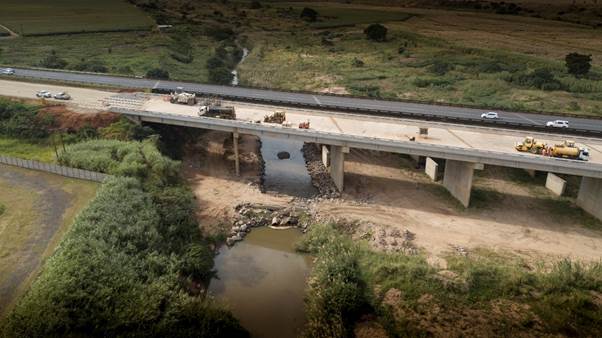
Aerial view of construction works on the N2.
Tenders to the value of R8.3-billion for construction work in KwaZulu-Natal will be issued within the current financial year as announced by President Cyril Ramaphosa.
This will include seven major tenders on the N3 which will go out in the next three months once the regulatory approvals have been received and land acquisition finalised.
This massive programme that will stretch over several years will increase road safety, ease traffic flows as well as access to and from industrial areas between these two major cities in KwaZulu-Natal.
It is part of a R40-billion two to three-year investment programme by the road’s agency.
Looking at a bigger picture for the N3 and N2 upgrades, a total of 12 projects is expected to create more than 23 500 direct job opportunities.
The programme will take 8 to 10 years to be completed.
Locals benefit
Direct job opportunities are actual individuals per ID number on site based on SANRAL averages over time of 262 jobs per R100-million project value.
In the case of community projects, of which two (consisting of multiple packages) are planned in the province, 290 jobs on average.
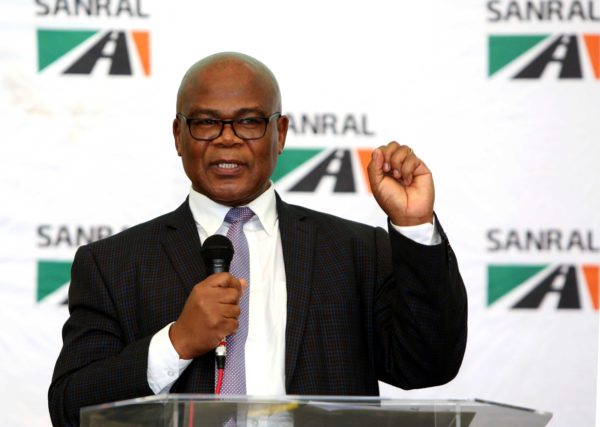
“This excludes SANRAL’s continuous routine road maintenance as part of our robust preventative maintenance strategy aimed at taking care of the road assets we have,” said Dumisani Nkabinde, SANRAL’s Eastern Region manager.
Treasury has allocated about R21.5-billion per year for the maintenance and improvement of SANRAL’s 19 262km non-toll network, including the national road network in KwaZulu-Natal.
The SANRAL network forms the backbone of the country’s transport system the country depends heavily on road transport for the movement of 94% of all people and 87% of all goods in the country.
The national road network serves as a catalyst for balanced economic growth, business confidence, investment and the transformation of society.
Transforming the industry
A growing share of contracts will be allocated to black-owned construction companies and enterprises owned by women, the youth and the disabled.
In its long-term vision, Horizon 2030, SANRAL committed itself to the transformation of the construction and engineering sectors through the allocation of tenders to new entrants in these sectors.
Over the past six months SANRAL has brokered memorandums of understanding between emerging companies and major suppliers of construction equipment and machinery.
These partnerships give black-owned companies greater access to financing, expertise and the sophisticated equipment required to tender for larger contracts.
Dumisani Nkabinde, Regional Manager of SANRAL Eastern region, said: “The upgrades are part of Government’s rollout of Strategic Infrastructure Projects in line with the National Development Plan, specifically the Strategic Integrated Projects, of which the N2 and N3 upgrades are within the SIP2 program.
“The N3 upgrades will solve bottlenecks between Durban and Pietermaritzburg. Daily, the N3’s traffic consists of a minimum of 45 000 vehicles a day. If the N3 is not upgraded, the potential loss we as South Africans will face is R1 billion per annum.”
More than roads
Back in 2015, the economic study undertaken as part of SIP revealed that closure of the N3 was estimated to cost the economy between R250 000 and R300 000 per hour.
“Therefore, the N2 and N3 are not just roads – they are the epitome of empowerment and are essentially South Africa’s lifelines for the transportation of freight from Durban to Gauteng, the economic hub of the country,” said Nkabinde.
Nkabinde concluded that investment in roads infrastructure upgrades, especially in rural and underdeveloped communities, provides an opportunity for generating economic growth, alleviating poverty, reducing the scourge of inequality and increasing international competitiveness.
In line with SANRAL’s transformation policy, of the R100-million budget for this project, R20-million was earmarked for SMME development.
The success of this project has been a huge team effort.
The South African National Roads Agency (SOC) Limited (SANRAL) is incredibly proud of two refurbished bridges over the Orange River on the N12 outside Hopetown, which have earlier this year come into full operation.
Construction started in 2016 and notwithstanding some challenges along the way, some of which include working under live traffic conditions, the project was successfully completed.
Fanie Swanepoel, resident engineer explained that what was once a 9,3m wide, single carriageway bridge, with a pedestrian sidewalk without hand rails, is now an impressive structural masterpiece with a width of 15,4m, significantly increasing the capacity of the N12 as a major industrial and commercial artery between the Northern Cape and particularly the Western Cape.
Tiago Massingue, SANRAL Project Manager, said: “Building piers for a 12-span bridge into the Orange River was no walk in the park. We had to time our work carefully, taking seasonal rainfall, the strength of the river, environmental regulations and most importantly, the safety of the workers into account every step of the way.”
SMMEs benefit
In line with SANRAL’s transformation policy, of the R100-million budget for this project, R20-million was earmarked for SMME development, which not only created a platform for economic growth of small businesses in the surrounding areas, but directly impacted job creation for the locals.
Abraham Swartz from Hopetown, one of the subcontractors on this project, is incredibly proud of the 10 residents he was able to give gainful employment to.
“I too have learnt so much from the main contractor, particularly regarding safety practices on site. It was my first time working on a project of this magnitude and I am grateful to SANRAL for giving us small businesses the opportunity to work alongside the big contractors and be capacitated for long-term sustainability,” said Swartz.
These bridges have been serving the South African Road user and communities for well over 50-years.
Swartz added that the success of this project has been a huge team effort and he is humbled to have led the team through the many challenges, to finally being able to see the end of the road.
“We hope that these bridges will serve road users for another 50-years and that the skills transfer and knowledge sharing that has been such a key component of our commitment to the local community, will stand them in good stead as they pursue further developmental opportunities,” concluded Massingue.
Through its transformation policy, SANRAL has been working to reshape the construction and engineering sector by setting targets for the participation of black contractors, suppliers and professionals in all projects commissioned.
Progress Hlahla, the Regional Manager of SANRAL’s Northern Region, said it was SANRAL’s goal, as with all of their projects, to go beyond roads.
More than 330 residents, mostly youth, have been employed and some 30 provided with generic, engineering and entrepreneurial skills training since the commencement of the R505 Wolmaransstad to Jakkalsfontein N14 project.
“We have also made a concerted effort to empower SMMEs from the Ngaka Modiri Molema and Kenneth Kaunda municipalities by involving them in various parts of the project,” said Progress Hlahla, the Regional Manager of SANRAL’s Northern Region.
“It was our goal, as with all of our projects, to go beyond roads and we are proud of what we continue to achieve in this regard.”
Youth made up 71% of all labour employed on the project, a considerable number in view of South Africa’s youth unemployment figures.
Statistics South Africa reported that more than one in every three young people did not have a job in the first quarter of 2019.
Transforming industries
Through its transformation policy, SANRAL has been working to reshape the construction and engineering sector by setting targets for the participation of black contractors, suppliers and professionals in all projects commissioned by SANRAL.
Over R49-million has been spent on black-owned SMMEs to date, with more to be allocated as the project progresses.
Speaking on how this project has directly uplifted small businesses and employees locally, Hlahla said: “Our approach is to facilitate the training of emerging contractors to enable them to achieve higher gradings from the Construction Industry Development Board. This gives them a better footing to participate in major construction tenders in future. Primary contractors who tender for SANRAL work must submit their own transformation and training policies to ensure that the benefit is also extended to their employees.”
The agency embarked on the R571–million project to upgrade the important north-south link connecting the N12 and N14 national roads in the North West in November 2016.
The improvements, which include the resurfacing of 91km of the R505, repair of pavements, reshaping of open side drains, replacement of existing fencing and the installation of new guardrails at major culverts, is estimated to reach completion later in 2019.
The roads agency has over 150 projects lined up in different parts of the province for the next 3 financial years (2019/20, 2020/21 & 2021/22).
SANRAL Southern Region Manager Mbulelo Peterson addressing stakeholders during Taking SANRAL to the People in Queenstown.
Nomfuneko Bojana Matshoba, owner of Mickey Mouse Trading, shared her journey with the South African National Roads Agency (SOC) Limited (SANRAL) during the Taking SANRAL to the People stakeholder engagement session held in Queenstown in late July 2019.
“I have taken the lessons learnt in the classes provided by SANRAL and put them to practice on the job sites. I started as a Grade 1 CIDB SMME and today I am a Grade 5,” said Bojana Matshoba.
The Taking SANRAL to the People stakeholder engagement session is aimed at promoting dialogue between the road’s agency, all spheres of government, business fraternity, communities, emerging contractors and other key stakeholders affected by SANRAL projects.
Testament to SANRAL
Bojana Matshoba said: “I have grabbed every opportunity SANRAL has given me with both hands. It was not easy. I had to meet the criteria before being accepted into the learnership training programme. I started as a general worker, trained to become a supervisor and was placed at a bigger contractor’s site as an intern doing in–service training to be a competent supervisor.
“I am now able to do everything myself, from quantifying my BOQ, daily site diaries, costing measurements, payment certificates, monitor quality control, cost and production daily and making sure I maintain my statutory obligation compliant at all times. I look forward to receiving my Grade 7 CIDB certification on the SANRAL sub-contract job that I am currently busy with.
“I have invested in learning before earning because I know knowledge is power and it will make me succeed in the Civil Engineering industry and built environment.”
Eastern Cape
SANRAL in the Eastern Cape manages a road network of 4 952km.This is 22% of its total 22 214km national road network. Since 2009, SANRAL has injected R33.3-billion into the Eastern Cape’s road network.
The roads agency has over 150 projects lined up in different parts of the province for the next three financial years (2019/20, 2020/21 & 2021/22). Some are in the planning phase, some in the design phase and some in the construction phase.
The Southern Region’s top 10 Capex projects (completed or ongoing) situated in the Chris Hani District Municipality include:
The R67 from Swart Kei River to Queenstown in the Enoch Mgijima Local Municipality, valued at over R400 million and will commence in 2020.
The construction of walkways to address safe and all-weather pedestrian mobility, as well as the upgrading of the R56 traversing through the towns of Indwe, Elliot Ugie and Maclear, in the Emalahleni Local Municipality, valued at R635 million, has been completed.
Enoch Mgijima Local Municipality Mayor Luleka Gubhula, said they were “humbled” by SANRAL hosting the stakeholder engagement in their jurisdiction.
“We are truly humbled that towards the close of Mandela Month, SANRAL hosted the leg of dialogue in Komani, a town strategically located at the centre of not only Enoch Mgijima, but the greater Chris Hani District,” she said.
“SANRAL leadership has faith in the potential that Komani and its surroundings has in the context of its Horizon 2030 Strategy. We, too, wish to emphasise our faith in our potential for growth and meaningful transformation. We do so because of the friendly N6 route that positions Komani at the centre of the road network of the Eastern Cape, connecting all provinces in South Africa and about six countries in the SADC region,” said Mayor Gubhula.
Maintenance
SANRAL’s mandate also entails performing Routine Road Maintenance (RRM) of the road network. In this regard, the agency maintains several routes within Chris Hani District Municipality.
SANRAL’s major road infrastructure delivery projects in the Chris Hani District include the upgrading of the R67 between Queenstown and Whittlesea, which has seen training of several candidate engineers, as well as skills development and transfer through Small, Medium and Micro Enterprise (SMME) development programmes.
Part of the engagement was to inform stakeholders of ongoing projects and upcoming tenders.
Mbulelo Peterson, SANRAL Southern Region Manager said, “SANRAL is committed to growing SMMEs in the road construction industry. It is important for us to support contractors from the beginning and provide them with the necessary training that will assist them when it comes to the tendering process as well.”
Peterson added that this engagement was also to share SANRAL’s Horizon 2030 vision and transformation policy.
“Through our transformation policy, we promote inclusive participation by all stakeholders, ensure skills training, and the transfer of knowledge and experience to small construction businesses,” Peterson said.
The aesthetics of this project have been carefully considered to maximize the blending in of the construction works with the natural fauna and flora in the area.
According to Alex van Niekerk, Planning, Toll and Transport Manager at SANRAL, the project was expected to be completed in December 2019.
Linking two of South Africa’s economic blossoming provinces, Gauteng and the North West, is the R512 which is currently under construction by SANRAL.
SANRAL has invested in excess of R300-million for the construction of the road, which stretches from the R512 to the west of the Hartbeespoort Dam through Pampoennek, eventually connecting with the N4 to Rustenburg.
Some of the funds will be invested into the local community as part of SANRAL’s commitment to community and local business development.
According to Alex van Niekerk, Planning, Toll and Transport Manager at SANRAL, the project was expected to be completed in December 2019.
Unique engineering interventions
This date may, however, change slightly due to some terrain that required unique engineering interventions to deliver a safe and successful project.
“The project goes through a mountain where there’s a major cutting through the mountain. The aesthetics of this project have been carefully considered to maximise the blending in of the construction works with the natural fauna and flora in the area. The cut faces are blended in to tie into the surroundings,” said Van Niekerk.
This was achieved through slope stabilisation installed on the cut faces, which was then covered with concrete that was finished in such a way as to mimic the natural rock faces.
There is also a game underpass for wildlife to cross underneath the newly constructed road.
The structure has a height of 5.6m to allow enough natural light through the tunnel, which will encourage the wildlife to use the underpass, said Van Niekerk.
Currently, the project is approximately 68% complete with regards to expenditure and 80% complete in terms of time.
The new expected completion date is around March 2020. Once completed, road users can look forward to a much safer road, which will allow for efficient mobility and with no toll costs.
Youngsters in a group must be able to think cautiously and have the #JustW8 mentality.
Group-think in a situation is important and can save lives. Be the positive in a group situation and #JustW8
The South African National Roads Agency (SOC) Limited (SANRAL) is continuously trying to caution road users on the effects of negligent behavior on the road.
The #JustW8 road safety campaign by SANRAL is challenging the youth to take a pause and think about the consequences of their decision-making.
Scenario 4
The next scenario in our road safety campaign deals with group think among youth and how it affects road users.
It starts with the little girl from scenario 3 looking out the window after being disappointed by her dad who she managed to convince to #JustW8 before opening his alcoholic beverage.
There’s a car next to theirs filled with youngsters jamming to music. They are laughing and having a good time when the driver picks up his bottle of beer.
As he picks it up, he looks to his left and sees the little girl. She shakes her head disapprovingly and while looking straight at her, he slowly puts the beer down.
The car with the little girl drives off but as he and his friends drive off, they encourage him to just #W8.
Group think in a situation is important and can save lives. Be the positive in a group situation and #JustW8
Treasury has allocated about R21.5-billion per year for the maintenance and improvement of SANRAL’s 19 262km non-toll network.
Tenders to the value of R8.3-billion for construction work on the N3 between Durban and Pietermaritzburg will go out to tender during the current financial year.
Major road construction tenders to the value of more than R40-billion will be issued by the South African National Roads Agency (SOC) Limited (SANRAL) to the construction sector over the next two to three years.
“We expect a surge in road construction projects over the medium-term framework as part of the broader national efforts to invest in economic infrastructure,” said Louw Kannemeyer, the roads agency’s Engineering Executive.
“We are confident that this investment will help to boost the construction sector which has been under severe pressure in recent years, and also cascade down to black-owned and emerging enterprises, who will receive much larger shares of tenders in future.”
Treasury has allocated about R21.5-billion per year for the maintenance and improvement of SANRAL’s 19 262km non-toll network.
Projects
This will go towards a total of 940 projects, of which 325 are already under construction.
Kannemeyer said the new projects will include some 90 major capital works projects larger than R500-million each, which will go out to tender during the three-year medium-term period.
Tenders to the value of R8.3-billion for construction work on the N3 between Durban and Pietermaritzburg will go out to tender during the current financial year.
This is financed through the infrastructure stimulus package announced by President Cyril Ramaphosa in 2018.
This will include seven major tenders on the N3, which will be issued within the next three months once the regulatory approvals have been received and land acquisition finalised.
Tenders
Starting in August, SANRAL will issue smaller tenders related to routine road maintenance and periodic maintenance across the entire SANRAL network and in all nine provinces.
The more than 50 tenders will be released in a controlled manner so as not to flood the market.
“The projects will provide economic and social infrastructure that has the potential to unlock economic growth, stimulate local economies and create jobs within the communities located close to the construction activities,” said Kannemeyer.
The SANRAL network forms the backbone of the country’s transport system and serves as a catalyst for balanced economic growth, business confidence, investment and the transformation of society.
Kannemeyer says a growing share of contracts will be allocated to black-owned construction companies and enterprises owned by women, the youth and the disabled.
In its long-term strategy, Horizon 2030, SANRAL committed itself to the transformation of the construction and engineering sectors through the allocation of tenders to new entrants in these sectors.
Over the past six months SANRAL has brokered memorandums of understanding between emerging companies and major suppliers of construction equipment and machinery.
These partnerships give black-owned companies greater access to financing, expertise and the sophisticated equipment required to tender for larger contracts.
“We are confident that the R40-billion in tenders that are in the pipeline will benefit the broader construction sector and contribute to the growth of new enterprises who have been excluded from major contracts in the past,” said Kannemeyer.
Local businesses were engaged on how they can participate in road construction contracts in the area, as well as strengthen existing relationships with the municipalities.
SANRAL visited the Sedibeng district municipality, which consists of the Midvaal, Emfuleni and Lesedi local municipalities.
Achieving transformation in the construction industry is a priority for the South African National Roads Agency (SOC) Limited (SANRAL)and this was what the participants at a stakeholder meeting in the Sedibeng local municipality have heard.
The agency set itself a new vision for 2030 and introduced a Transformation Policy. The aim is to promote inclusive participation by all stakeholders, ensure skills training and the transfer of knowledge and experience to small construction businesses.
SANRAL visited the Sedibeng district municipality, which consists of the Midvaal, Emfuleni and Lesedi local municipalities.
The aim was to engage local businesses on how they can participate in road construction contracts in the area, as well as strengthen existing relationships with the municipalities.
Progress Hlahla, SANRAL Northern Region Manager, said stakeholders are a key pillar of the agency, and this is one way to reinforce the commitment to empowering and developing local communities.
“We are an agency that seeks to improve people’s lives beyond road construction. Such engagements provide the ideal platform to empower small businesses, allocate a growing portion of major projects to emerging contractors,transfer skills and experience so that these contractors will in future be independent players,” he said.
SMMEs
A key part of the discussions on the day addressed the expectations that local SMMEs have from SANRAL projects and to ensure a clear understanding of the agency’smandate.
Information was given about planned community development projects, the effects of road furniture theft, protests and road closures, project stoppages by business forums and building encroachments.
Among the 250 attendees was the Executive Mayor of Sedibeng,CIIr Busisiwe Modisakeng, who referred to the challenges faced by SMMEs, such as delayed payments and access to skills, and said “What makes me happy is that SANRAL is a business–ready organisation with the various projects that may be coming up”.
The district’s vision is to become a metropolitan city of choice and SANRAL intends to provide support by investing in the improvement of road infrastructure through the Ekurhuleni and Johannesburg routine road maintenance contracts.
Starting in February 2020, these projects will include grass cutting, patching and pavement repairs, vegetation and chemical control, guardrail repairs, fencing repairs and the cleaning of culverts, concrete drains and channels.
Other work involves the collection and removal of debris and litter, road sign cleaning, the removal of illegal signage as well as the maintenance of inlet and outlet structures. SANRAL will issue between three and five work packages for sub-contractors to tender for.
“In the new financial year, SANRAL hopes to go out to tender on a project, which entails the overlay of the N1 Vaal River to Klein Rietspruit and minor bridge repairs. This will further increase opportunities for participation by black-owned businesses,” explained Hlahla.
Another planned project for the municipality is:;
Capex project: N.001-190-2017/1: Concrete Pavement Repairs and Replacement of Joint seals on National Route N1 Section 19 Klein Rietspruit to Section 20 N12/Potch Interchange, which is currently in the planning phase and will be started in the 2019/2020 financial year for over a period of 15 months.
“SANRAL will continue engaging with stakeholders at all levels. Such engagements go a long way in forging collaboration with communities and affording local businesses an opportunity to participate in developing the economy,” said Hlahla.
Local communities are benefiting extensively from the project which boasts 17 local small, medium and micro-enterpriseshavingbeen appointed and 220 jobs created.
The entire project is expected to take 36 months to complete and the contractor, WBHO Construction, has confirmed that no delays or complications have been experienced so far.
The extensive upgrade between Belfast and Machadodorp on the N4 Toll Route is progressing well, with 14% already complete.
The R400-million project which commenced in March this year will see 30km of Section 5B rehabilitated and upgraded to a four-lane carriageway.
The entire project is expected to take 36 months to complete and the contractor, WBHO Construction, has confirmed that no delays or complications have been experienced so far.
This is good news given that the project was suspended in 2018 due to community unrest.
However, months of negotiations between the eMakhazeni Local Municipality, Trans African Concessions (TRAC), South African National Roads Agency (SOC) Limited (SANRAL) and WBHO/Motheo JV resulted in the signing of a memorandum of understanding (MOU) and a nod for resuming the project.
In line with the MOU, local communities are benefiting extensively from the project and to date 17 local small, medium and micro-enterprises have been appointed and 220 jobs created.
Several traffic accommodations have been implemented and will remain in place throughout the construction period, including speed reductions, contraflows and occasional Stop/Gos to remove old road markings. Road users are urged to visit TRAC’s websitewww.tracn4.co.zafor regular updates to assist in the planning of trips.
TRAC prides itself on offering quality road infrastructure, which requires regular upgrades, rehabilitation and routine maintenance.
We are aware that roadworks may at times cause traffic disruptions and would therefore like to thank the public for their patience and understanding at construction zones.