
One of the longest incrementally launched bridges in the Southern Hemisphere, the Mount Edgecombe Interchange, is complete. It is an upgrade from a two-level to a four-level interchange, costing some R900m and cut travel time from 25 minutes to one. The spectacular construction is already a landmark.
Blog
N6 on track

Upgrading of the N6 between Smithfield and Rouxville is on track. It entails improving the road alignment, to improve safety and capacity and rehabilitate the Caledon bridge. This involves widening the piers, bases and the deck. The contract is valued at R450m and began in May of last year.
SANRAL’s 223 projects
During 2017/18 SANRAL undertook a total of 223 projects to build new roads, improve existing roads, and rehabilitate roads in a sub-optimal condition. These projects on non-toll and toll roads directly under the agency’s management involved a total of 848km of roadway.
The total number and value of new construction contracts awarded in 2017/18 were considerably lower than in the previous year. In 2016/17, a total of 172 new contracts were awarded with a combined value of R15.9bn. In this financial year, there were some delays in the awarding of tenders for the design of projects. The reason for the delays can be attributed to a technical process initiated by National Treasury during the course of 2017. The issues at stake related to interpretations of certain regulations contained in the Preferential Procurement Policy Framework Act (PPPFA).
Treasury has since provided clarity about the definitions of provisional and prime cost sums and how they were applied in practice. The resolution of this matter provides greater certainty to both SANRAL and the broader construction and engineering sectors.
As a result, the Agency expects to see more tenders for road design coming to the market in the coming weeks. As we erase the backlog this will also kickstart tender processes for the construction of roads.
The reasons for some of the delays other than the above delays in awarding contracts, range from additional construction work required for slope stability measures and safety reasons, to disputes that arose either in the labour relations field or with community role-players in respect of local sub-contracting. The last factor has become a substantial risk to construction projects in several provinces and sometimes poses a serious threat to the safety of contractors.
SANRAL is totally committed to the participation of local communities in road projects and has formalised this through project liaison committees, which are now a requirement for all projects. The agency is devoting more resources to managing local-level stakeholder relations with the objective of improving communication across all stakeholders.
In 2017/18, SANRAL recorded total revenue of R16.285bn (2016/17: R13.95bn). An annual grant from the fiscus of R15.9bn was received.
Total revenue realised across all toll routes managed directly by SANRAL amounted to almost R5.2bn in 2017/18.
SANRAL’s total expenditure for 2017/18 amounted to R26 523m, and 66% of this spending was related to non-toll roads. Spending was approximately 2.3% lower than in 2016/17.
As it enters the third decade of its existence SANRAL has produced a long-term strategy – Horizon 2030 – that reflects the dynamic nature of the organisation, and the changing developmental priorities of the country.
In a parallel process SANRAL developed a comprehensive transformation policy which was widely consulted across the country. This policy recognises the agency’s pivotal position within the construction and engineering sectors and the impact that SANRAL’s tender processes have on the growth of emerging enterprises owned by black South Africans, women and the youth.
But the Agency is also responding to the needs of broader society especially in the fields of education and training. It has developed productive partnerships with local universities to improve the quality of educational outcomes in critical subjects such as science, technology, engineering and mathematics.
Some160 students and 200 high school learners benefit from bursaries and scholarships.
SANRAL’s own Technical Excellence Academy in Port Elizabeth is enabling post-graduate engineering students to make a successful transition from the academic environment into professional careers.
The National Treasury will remain the primary source of funding, but SANRAL will also, increasingly explore opportunities for public-private partnerships.
‘SANRAL must always take a listening posture’
Siphiwo Mxhosa is SANRAL’s Stakeholder Relations Manager and has been at the helm for a little over a year. We chat to him about the agency’s stakeholder pillar.

Why is stakeholder engagement important to SANRAL?
Because we want to entrench Constitutional values – to deliver infrastructure to the people of South Africa. We also want to correct the past practice of engineering projects that excluded South Africans. A more active citizenry has meant that nothing can be delivered to the people if their participation is not defined and allowed.
What responsibilities does SANRAL have to its stakeholders?
SANRAL has a Constitutional responsibility to its stakeholders to ensure that they fully participate, that their voice and contribution matter and are fully taken into consideration.
What actions could SANRAL take to address stakeholders’ concerns when they arise?
SANRAL must always take a listening posture. The agency must always act and communicate on the views and contributions of all its stakeholders, no matter who they are.
What are the benefits of engaging stakeholders?
Cohesive delivery and mutual relationships that are sustainable, even during disagreements. This will, in the long term, assist those same stakeholders to be the organisation’s mouthpiece to the world. They will own and protect SANRAL’s roads infrastructure against any form of attack, vandalism or theft.
What are the risks of doing it wrong or not at all?
Massive resources costs for the country – negative reviews by ratings agencies, loss of funders and irreparable reputational damage to the brand.
KwaZulu-Natal’s gateway to Africa
The upgrade of the N3 is essential if one of the government’s strategic integrated projects, linking Durban harbour with Gauteng, is to succeed. We chat to eThekwini mayor Zandile Gumede about the implications of the project.

How important are roads?
Road infrastructure plays an important role in our lives as individuals and communities. It connects people with people and business to business. It helps to speed up the transportation of goods and people from one point to another. It is the backbone of our economic activities, and by building more roads and maintaining our existing roads, we keep the economy running smoothly.
Is the upgrade of the N3 necessary?
I welcome the upgrade of the N3 between Durban and Pietermaritzburg because it carries a large volume of goods and people. It is a busy route and not only connects us with our neighbouring major city, Johannesburg, but also with other provinces. As Durban is the city with the busiest port and biggest container harbour, the N3 is an important corridor because it enables us to have smooth trade. We welcome the improvement and upgrades, as they are a clear demonstration of our government’s commitment to deliver strategic infrastructure that will transform our economy, create jobs and stimulate further opportunities for growth.
What are some of the challenges with the current N3?
In its present state, the N3 cannot cope with the high volume of heavy vehicles. Also, the topography of certain sections of the route contributes to bottlenecks and crashes. The closure of the N3 causes major economic losses for businesses. We are hoping that this project will be completed on time. Working with the provincial government, the Minister of Transport and SANRAL, we hope to have this project completed with minimal delay. We remain optimistic that any challenges affecting the project will be resolved and that it moves with speed.
Would this upgrade improve the economy?
When people and goods move at the required pace, we will be able to facilitate trading services and ensure that we deliver on time. There will be more opportunities in terms of trade, transport, tourism and business activities in general.
How do you feel about the upliftment of local labour/SMMEs on the project?
We at eThekwini Municipality have adopted a framework that seeks to transform our local space for the socioeconomic development of our people. Our approach is and has always been that locals should benefit in terms of job opportunities. Community-based businesses, as well as formal and informal traders, must also benefit. Although this is a national project, communities living close to the project should be afforded the opportunity to own it through employment and subcontracting.
What is the role of the private sector in making the most of this project?
The partnership between the government and private sector is a strength. When we work well together, we create more opportunities to fight poverty, inequality and unemployment. The private sector must ensure that it performs and produces good-quality work that matches industry standards. It must also ensure that there is a transfer of skills and empowerment.
Engaging to build a strategy for success
A company’s relationship with the public it serves forms the backbone of a good strategy for its projects. SANRAL’s Stakeholder Strategy is an integral part of the brand.
SANRAL’s stakeholder engagement practices are key success factors in achieving its strategy, which is why ‘Stakeholder’ is one of the organisation’s pillars.
The agency’s priority in creating value, in partnership with its stakeholders, is to ensure that stakeholder relationships are established and maintained ethically and accountably.
This is done through corporate governance mechanisms that include its Stakeholder Engagement Strategy and Implementation Plans.
The Stakeholder Engagement Strategy specifies the norms and values that guide SANRAL’s stakeholder relations and establishes a systematic approach to the management of its stakeholder engagements.
Stakeholder engagement is extremely important to the operation of any organisation. Before developing a strategy for engagement with stakeholders, a business must first understand what stakeholder engagement means to the organisation.
Although it’s often used as an alternate phrase for public relations or reputation management, stakeholder engagement requires a shift in the corporate mindset – a change from treating stakeholders’ issues as outside concerns that need to be managed to serious topics that call for real discussion.
Stakeholder perspectives should inform the company’s strategy and operations if properly embraced.
Stakeholders influence brand equity – the public’s evaluation of a brand – which develops and grows because of their experiences with the brand.
This happens through awareness of, familiarity with, use of, preference for and loyalty to the brand.
However, the level of knowledge about stakeholder relations can vary among key individuals in a company and there may be a need to develop the organisation’s internal capacity before it launches any engagement activities.
It is therefore important that engagement is made a requirement for the development of an effective strategy.
This helps to avoid the risk of being unprepared to listen to stakeholder views and the risk of unintended misrepresentation. It also helps identify the internal champions and owners of future engagement activities.
These individuals are the internal stakeholders, who ideally should be involved in the process of building a strategy. There are many views of what stakeholder engagement involves. These include:
- Ensuring that the relevant parties on whom business objectives have an impact are aware of the company’s projects, as well as their roles and responsibilities in ensuring the success of the projects;
- Identifying the extended audience for communications, the project-related information they should receive and how often
- Ensuring that all the project needs have been identified, their impact is understood and that any project assumptions have been tested.
When speed is good on the roads
Modern engineering made it possible for a bridge to be erected in two weekends.
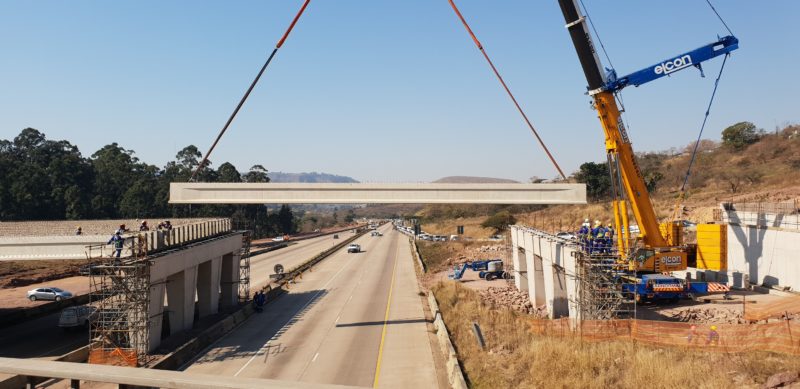
It took just four days and minimal disruption for South African National Roads Agency (SOC) Limited (SANRAL) to erect a bridge over both carriageways of a busy highway in KwaZulu-Natal.
Traffic on the N3 from Durban to Pietermaritzburg was recently diverted for two consecutive weekends as a new bridge was erected at Hammarsdale.
The development of the Keystone Park Light Industrial, Warehousing and Logistics Precinct at Hammarsdale has increased the volume of traffic – especially heavy vehicles – using the intersection of the N3 and MR 385.
SANRAL upgraded the interchange from a simple diamond interchange to a new semi-parclo (partial clover leaf) free-flow interchange to prevent a back-up of trucks onto the busy N3.
SANRAL Eastern Region project manager, Stephné Wilmot, said: “Given the high volumes of traffic using the N3 and the urgent need to construct the intersection as soon as possible to alleviate growing congestion by heavy vehicles, it was decided to use time-saving construction measures.”
Ian Jackson, resident engineer at Hatch consulting engineers, said precast beams were used to minimise delays.
He said: “With short to medium span bridges, you basically have three types of decks – cast in-situ; precast beams and deck slab; and a launched deck.
“The cast in-situ is the cheapest but will entail closing a carriageway for approximately three to four months and diverting both directions of traffic onto the one carriageway, and then repeating the procedure for the next deck. Thus, it is time consuming and severely affects traffic.”
A launch deck is cost prohibitive because it is expensive to set up the launch yard, said Jackson. The geometrics of the bridge would only allow the launch of two decks. There are practical and cost constraints.
“Thus, a precast beam deck and slab has the least disruption of the traffic – two days in which to place the beams across each carriageway – and is also the most cost effective,” he said.
Specialised casting yard
Jackson said the beams were cast in a specialised casting yard five kilometres away from the construction site.
The beams were transported from the casting yard to site with special low-bed vehicles.
As each beam weights 37 tons, a large crane was used to lift and place each beam in position.
It took two days to position 23 beams per deck. Owing to the positioning of the crane to lift the beams and the potential danger to traffic, each carriageway was closed during the lifting and placing operation.
Hope restored on the road of death
SMMEs and NGOs from the Thembisile Hani Local Municipality have benefitted from SANRAL training programmes.
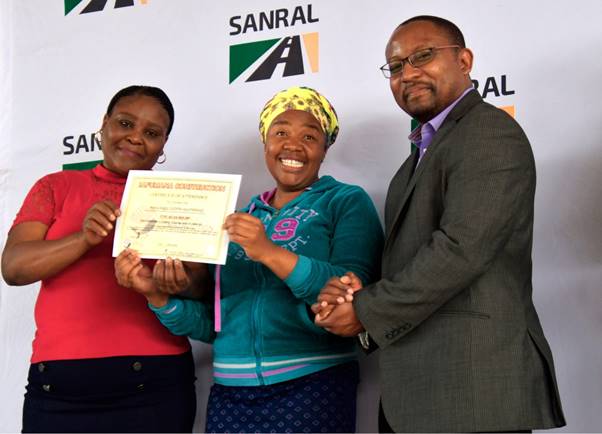
Small, medium and micro-sized enterprises (SMMEs) and Non-Governmental Organisations (NGOs) from the Thembisile Hani Local Municipality recently completed training programmes designed to provide them with the skills they require to succeed in the construction industry.
In total, 135 SMMEs and 185 NGOs attended the programmes, with the SMMEs placing focus on the process of applying for tenders.
While working on the Moloto Road project and seeking to partner with locals, the South African National Roads Agency (SOC) Limited (SANRAL) noticed local SMMEs have little exposure to the tendering process, which disadvantages them when responding to bids.
Supporting emerging-black-owned businesses
SANRAL Northern Region Manager, Progress Hlahla, said: “If we are going to transform the construction industry, it goes without saying that where we can we must provide emerging black-owned businesses with the support they require.
“The last thing we want is for a talented organisation to lose out on an opportunity due to their lack of experience and know-how in completing tender documents.”
Participants in the programme were trained in contract documentation, pricing and basic tendering processes, amongst other skills.
Speaking at the certification ceremony held at Kwaggafontein Hall, Thembisile Hani Local Municipality, Cllr Motanyane, said: “We are grateful for the work SANRAL and Raubex construction have done in training our people. It will give them a ray of hope and bring them closer to opportunities that may arise. We hope this initiative will not stop with this group, but that many communities are able to benefit.”
From death to hope
Project Manager of section 2 on the road, Nontobeko Mathenjwa, said: “This is a good story for us to tell. Over the years, we have been working on transforming Moloto Road from one of death to one that brings an enhanced livelihood for South Africans.
“Today, we celebrate yet another ray of hope for the community of Thembisile Hani as their own are certified and ready to take on the construction industry”
To date, R21-million has been spent on local sub-contractors, SMMEs and local suppliers in the Mpumalanga section of the Moloto Road project, a considerable contribution to the local economy and job creation.
The R573 Moloto Road is one of South Africa’s busiest and essential economic routes connecting Gauteng, Mpumalanga and Limpopo.
It is part of SIP1, which is designed to unlock the northern mineral belt with the Waterberg as the catalyst. The Mpumalanga section was incorporated into the SANRAL network in 2015 and since then, continued routine road maintenance has been done to improve safety and mobility.
Approximately R4.5-billion has been allocated to the road upgrade across Mpumalanga, Limpopo and Gauteng over a five-year period.
Levelling the playing field for transformation
SANRAL signs deal to further enhance the inclusion of black-owned enterprises in the construction sector.
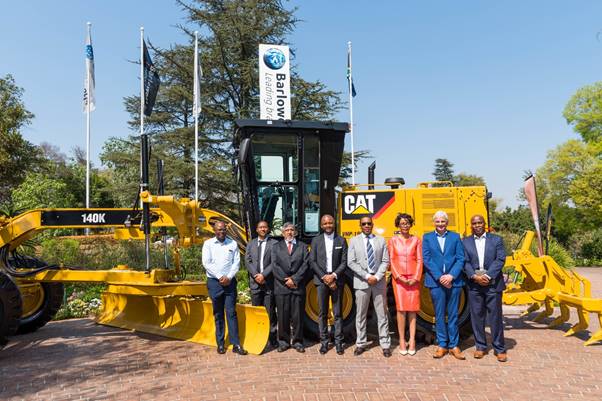
The South African National Roads Agency (SOC) Limited (SANRAL) and Barloworld Equipment reached a monumental agreement that will benefit emerging contractors in the construction industry.
The agreement between SANRAL and Barloworld Equipment, the dealer for Cat earthmoving machines and Cat power systems in southern Africa, will allow black-owned enterprises greater access to equipment, financing and training, which will enable them to tender more effectively on road construction projects managed by the agency.
Skhumbuzo Macozoma, the CEO of SANRAL, said: “This will open up the industry to new participants and remove many of the barriers that prevent companies owned by black, women and youth entrepreneurs to compete effectively against the entrenched players in the construction sector.
“Through our co-operation with Barloworld Equipment we are promoting the growth of black business and taking positive steps to support a sector with immense potential for growth and job creation.”
This is the second Memorandum of Understanding between SANRAL and a top industrial company to support the growth of emerging contractors.
Emerging contractors empowered
Emmy Leeka, CEO of Barloworld Equipment southern Africa, said this is an opportunity to contribute to empowerment in the construction industry.
“We have built valuable partnerships with black-owned enterprises through the years and this initiative will take our activities to a higher level,” said Leeka.
“This will enable us to deliver on our incubation and empowerment commitments and work with SANRAL towards the greater goal to transform the engineering and construction sectors,” said Vasco Santos, Executive Head: Construction, Rental & Used at Barloworld Equipment.
The Memorandum of Understanding sets out future co-operation between SANRAL and Barloworld Equipment across a broad range of activities, including providing small contractors in the SANRAL supply chain access to equipment, financing and training.
Barloworld Equipment will set up structures that will enable contractors to benefit from options to lease or rent equipment.
The company will also offer training to owners, employees and maintenance staff. Together, SANRAL and Barloworld Equipment will promote partnerships in the fields of training, fleet management, marketing and communication.
Proof of SANRAL’s transformation policy
Macozoma said the partnership is proof that SANRAL’s efforts to transform the construction sector and promote fair competition are delivering results.
Lack of access to sophisticated machinery and equipment is a major barrier for small contractors and prevents participating in large construction tenders.
Macozoma said: “By working together with established companies, we can remove these barriers and enable black-owned companies and enterprises owned by women and the youth to participate on a level playing field.
“This step will, no doubt, have a ripple effect within the construction and engineering industries and also benefit job creation within local communities where smaller enterprises now become part of the supply chains on larger projects.”
Road improvement creates opportunities for locals
SANRAL makes it easier for the people of the Bojanala Platinum District Municipality to connect to opportunities.

Road users in the Bojanala Platinum District Municipality will be brought closer to various destinations as the South African National Roads Agency (SOC) Limited (SANRAL) embarks on a project to improve the R52, which is the shortest and most convenient route between Koster and Rustenburg.
The road is currently a 38.7km, two-lane, single-carriageway from Koster to Rustenburg with gravel shoulders.
Improvements
Improvements will include the addition of paved shoulders as well as the construction of appropriate surfacing, which will improve overtaking opportunities and decrease the high risk of accidents due to potholes.
Motorists will enjoy these benefits at no extra cost as the road will not be tolled.
“The R52 is at a very early stage of design, which will take 24 months to complete,” said SANRAL Project Manager, Lugisani Muravha.
This will be followed by the construction phase, which will commence in mid-2020 and be completed in 30 months. A contractor will be appointed once the design has been completed.
SMMEs benefit
“Road users and communities of Bojanala Platinum District Municipality will benefit from the project through improved road safety and contracting opportunities for local SMMEs,” said Muravha.
Construction labour and sub-contractors will be sourced from the Local Municipality and District Municipality respectively.
From January 2015 to the end of June 2018, SANRAL had invested over R2.8-billion on various road maintenance, repair and upgrades in the North West province.
This investment is expected to increase to as much as R12.8-billion as the 55 projects it has embarked on move closer to completion.
SANRAL’s regional manager for the northern provinces, Progress Hlahla, said: “We will continue to deliver quality infrastructure to enhance mobility in the region.
“We look forward to successfully implementing this project in line with our horizon 2030 strategy and our transformation policy, which seeks to enhance transformation in the built environment.”