Blog

SANRAL ready to implement “shovel-ready projects” in government’s new stimulus drive

President Cyril Ramaphosa

A R400-billion infrastructure fund to finance investment in critical infrastructure at national, provincial and local levels, was announced by President Cyril Ramaphosa on 21 September.

SANRAL welcomes the government’s emphasis on infrastructure as a primary driver for economic growth and job creation. Local and international investors take the quality of a country’s primary road network into consideration when they make decisions on where to establish projects that will stimulate broader growth and development.

National and provincial roads as well as infrastructure relating to human settlements and public transport will be among the top funding priorities.

The funds will go towards “shovel-ready infrastructure projects” – especially in the areas of roads and dams, President Ramaphosa said in a major policy speech at the Union Buildings.

This investment – the South African Infrastructure Fund – will be funded through the reprioritisation of existing government spending as well as resources coming from development finance banks and institutions and private sector investors.

The new plan is different from previous government initiatives because it is linked to implementation and specific timelines to ensure “projects are delivered on time and within budgets.”

A dedicated Infrastructure Execution Team has been created within the Presidency – consisting of people with extensive project management and engineering expertise to assist with project design and oversee implementation. The team will implement lessons learnt from the massive roll-out of infrastructure prior to the 2010 World Cup.

The role of the Presidential Infrastructure Commission will be strengthened to ensure improved coordination across the three spheres of government. This will “reduce the current fragmentation of infrastructure spend and ensure more efficient and effective use of resources.”

The private sector will also be invited “to enter into meaningful partnerships with government in this fund.”

Potential for job creation through investment

The President said infrastructure expansion and maintenance has the potential to create jobs on a large scale, attract investment and lay a foundation for sustainable economic expansion.

Details about the reprioritisation of revenue within the existing budget will be provided by the Minister of Finance, Nhlanhla Nene in his Medium-Term Budget Framework to be delivered in Parliament in October.

The contribution from the Fiscus will be more than R400-billion. This will then be used to leverage additional resources from developmental financial institutions, multilateral development banks, private lenders and investors.

The infrastructure investment is at the core of a comprehensive “economic stimulus and recovery plan” announced by Mr Ramaphosa which consists of –

  • Growth enhancing economic reforms
  • The reprioritisation of public funding to support job creation
  • The establishment of the Infrastructure Fund
  • Addressing urgent and pressing matters in education and health
  • Investments in municipal social infrastructure improvement.

“These measures will be implemented immediately to ignite economic growth, restore investor confidence, prevent further job losses, create new jobs and address urgent challenges faced by vulnerable groups in the community,” he said.

He expressed his confidence that the new economic stimulus and recovery package will play a decisive role in reversing the current contraction in the South African economy.

Construction projects that are already being implemented by SANRAL will fit in seamlessly with other initiatives designed to attract investment from the private sector and develop finance banks. They are well-structured and well-managed, and SANRAL has a proven reputation of working in partnerships with the private sector.

  • In the Eastern Cape work on the N2 Wild Coast Road is well underway including the construction of two of the largest bridges in Africa, across the Mtentu and Msikaba gorges. This development will boost tourism, stimulate trade and facilitate access to services in one of the most underdeveloped regions of the country. Contracts to the value of more than R2.7bn have been earmarked for small and black-owned enterprises.
  • Construction on the Moloto Road has already started and some R4.5bn is allocated to this project in the current financial year. It includes major safety upgrades to a road that connects rural communities in Limpopo and Mpumalanga to the core of the Gauteng economy.
  • The Mt Edgecombe interchange near Durban will be officially opened in October. This R900m project will provide improved access to tourism, agri-processing and commercial activities on the North Coast of KwaZulu-Natal.
  • The N7 is a vital artery for economic development in both the Northern and Western Cape. It connects the Cape Peninsula with Namibia and feeds economic activity along the entire West Coast. Current upgrades between Hopefield and Melkbosstrand represents a R2.3bn investment in infrastructure in the region.

Upgrade improves safety, uplifts local business

Communities along the R510 from Rustenburg to the Limpopo border seeing considerable economic benefits. 

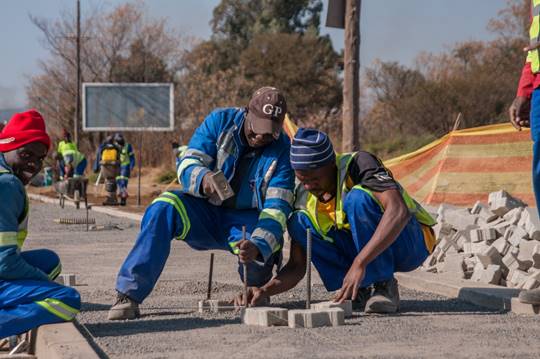
Workers paving a way for pedestrians. Local SMMEs were used.

The repairing and resealing of the R510 which runs from Rustenburg to the Limpopo border, has been completed.  

The road is now more comfortable for drivers and safer for pedestrians. It has brought some considerable economic benefits to emerging contractors and suppliers in the area. 

According to South African National Road Agency SOC Limited (SANRAL) project manager Nontobeko Mathenjwa, a total of about R50-million was spent on local small, micro and medium enterprises (SMMEs), and over 100 local jobs were created during the repair and reseal of the road.  

The safety of all road users, both motorists and pedestrians, was the main purpose of this improvement. 

Making a better South Africa 

The project involved the repairing and resealing of the pavement along the 61km of road as well as the upgrading of three intersections.  

Two intersections were improved by adding slip lanes and constructing bus bays. A raised pedestrian crossing at one of the three intersections was built to aid school children who cross the road when walking to school.  

There have been many reports of crashes over the past few years due to bad road user behaviour. 

“The R510 connects the North West and Limpopo provinces. It is, therefore, critical for us to keep the road in a good condition. We also made the road safer by putting up new road signs, fixing of the edge breaks and shoulders,” said Mathenjwa. 

Some R142-million was spent on the project, which commenced in November 2016. 

Speaking about why the agency felt it was important to carry out these repairs, regional manager for SANRAL Progress Hlahla, said: “Our mandate is to better South Africa. We can only achieve this by making sure that citizens are able to get around without a hassle.  

“Their education and economic endeavours are dependent on good quality infrastructure and, it goes without saying, that where we can we should provide opportunities for growth. That is why we purposely involved local SMMEs in this project.” 

While the project has made the road considerably safer, the roads agency has requested road users to obey the rules of the road and to be aware of their surroundings.  

“No matter how many safety features we install, a key variable is road-user behaviour. During this project we saw horrific road-user behaviour which led to several fatalities,” said Hlahla.

Roads are part of South Africa’s heritage

“Roads tell a story of who we are, where come from as a country … and speak to our future.” 

South Africa’s national roads are internationally recognised for their excellence – safe, comfortable to drive on and clearly marked with no potholes. 

Enjoying a holiday this Heritage Month has not just been about arriving at the destination, but the joy of travelling there.  

As the saying goes, you may have travelled near and far, but you have not experienced a country until you have taken a journey on its roads. 

South Africa’s national roads are internationally recognised for their excellence – safe, comfortable to drive on and clearly marked with no potholes. 

September has been set aside as Heritage Month, which translates to a time to reflect on our history, diverse cultures and traditions. 

Vusi Mona, South African National Roads Agency (SOC) Limited (SANRAL) General Manager of Communications, said: “South Africa has an interesting history marked by fascinating landmarks, such as historic buildings, pieces of art and important heritage sites which tell our story and journey as a country.” 

One of South Africa’s major heritage assets are the country’s roads. 

This basic infrastructure, which is taken for granted, serves a bigger purpose than merely just routes for travel. 

“Roads tell a story of who we are and where we come from as a country, we choose to name them after our heroes and icons. Most importantly roads speak to our future. South African roads are described in the National Development Plan as the country’s largest single public asset,” said Mona. 

SANRAL changed the narrative 

Some roads began as tracks made by ox wagons. There was no supporting infrastructure. Transport of people and goods was difficult. 

Over time things changed for the better, thanks to agencies such as SANRAL. 

It was one of the first state-owned entities to be established in the democratic era. Its mandate is to manage and control the national road network and create economic value for the nation by providing road infrastructure, explained Mona. 

The agency has been the custodian of national roads since 1998 and looks after all the national roads in South Africa’s nine provinces – linking cities to towns and people to places. 

Mona said: “Roads can unlock the economic potential of a region. Small towns across the country have transformed into major tourist destinations for our local and international community. Moreover, they have turned into hubs for business due to access provided by roads. 

“When we build roads, we are not only uplifting communities. We are building a legacy and creating landmarks. This year, as we celebrate Heritage Month, remember that you own the roads that make our country unique.”

Intelligence makes a difference on South African roads

 SANRAL and partners continue to prioritise road safety throughout the countrywide network. 

The Intelligent Transport System (ITS) uses technology to manage traffic and to provide road users with information on traffic conditions on a real-time basis.

The South African National Roads Agency (SOC) Limited (SANRAL), in partnership with local law enforcement authorities, provincial governments, and various agencies from the department of transport, has adopted a sophisticated approach to road safety management. 

Responding to incidents promptly on freeways can save lives. 

As road safety remains a major challenge globally, South Africa continues to prioritise the safety of all road users throughout the countrywide network.   

Using tech to manage traffic 

The Intelligent Transport System (ITS) uses technology to manage traffic and to provide road users with information on traffic conditions on a real-time basis. 

The system employs closed-circuit television (CCTV) cameras, enhanced communications, traffic detection and traffic information devices to continuously monitor freeways. 

To further support ITS, SANRAL implemented an On-Road-Service (ORS) along its major freeways in Gauteng (covering approximately 250km). 

SANRAL On-Road-Services are operated 24-hours a day and are tracked, monitored and dispatched from the road agency’s Traffic Management Centre (TMC).  

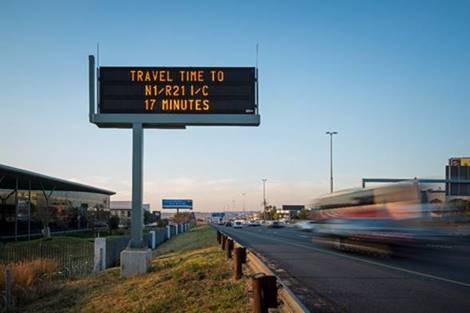
The operators are responsible for visual surveillance of the freeway network to detect incidents, manage traffic flow, report incidents to relevant authorities, dispatch response vehicles and distribute information to the public using Variable Message Signs (VMS) located along the freeways, Twitter and the i-traffic website. 

For example, in cases where drivers experience a breakdown on the freeway, the TMC, through CCTV cameras, immediately identifies this as an incident and dispatches an ORS vehicle to help remove the vehicle from the road to the nearest safe spot.  

This service is provided at no cost to the road user. 

This service currently includes 10 Incident Response Units (IRU) and 10 Towing Recovery Units (TRU), eight Heavy Recovery Units (HRU), six Motorcycle Medical Response Units (MMRU) and five Medical Response Units (MRU) stationed at various strategic points on the freeways. 

ITS is a world-class system that serves as an example of how infrastructure improves the quality of life of commuters and sustains the economy of the country. 

This is only the first of many planned measures by SANRAL to improve road safety management for all road users.

New SANRAL board announced

Following a Cabinet meeting held on 22 August 2018, it announced that five new non-executive members were appointed to SANRAL’s Board:

  • Mr Themba Barrange Mhambi (Chairperson);
  • Mr Alderman Robert Haswell;
  • Ms Nkareng Mpobane;
  • Mr Thamsanqa Piet Matosa; and
  • Ms Lungile Madladla.

Ms Lungile Madlala returns to the Board. She was a member between 2008 and 2013, was a board member of the Construction Industry Development Board, was an executive committee member of the World Road Association and chairman of Inoxa Industries. She is a trained civil engineer with two decades corporate governance experience in both public and private spheres.

Mr Alderman Robert Haswell J.P. had a distinguished academic career here and internationally, was elected to the Pietermaritzburg city council in 1984 and was the first mayor of the Maritzburg-Msunduzi Transitional Local Council in 1995.

Ms Nkareng Mpobane has a degree in economics from the University of the Witwatersrand and has worked at RMB Private Bank.

Mr Thamsanqa Piet Matosa was president of the National Union of Mineworkers (NUM) in 2015 and in 2018 global deputy president of the Building and Woodworkers International Workers Union.

Mr Themba Barrange Mhambi did his BA Honours at the University of Johannesburg and his masters at New York University in the USA. He has been active as a lecturer, project manager and strategy developer at several educational institutions as well as state-owned enterprises.

“A trailblazing step”

Access to sophisticated equipment used in construction is one of the biggest hurdles facing emerging companies. They often do not have the capital to purchase major machinery used for excavations, ground moving and the grading of roads.

But emerging contractors in the construction industry will now be better able to participate in major projects following a landmark agreement between SANRAL and two construction machine suppliers, Barloworld and Bell.

The agreement with Barloworld Equipment will give black-owned enterprises greater access to equipment, financing and training which will enable them to tender more effectively on road construction projects managed by SANRAL.

“This will open up the industry to new participants and remove many of the barriers that prevent companies owned by black, women and youth entrepreneurs to compete effectively against the entrenched players in the construction sector,” says Skhumbuzo Macozoma, the Chief Executive Officer of SANRAL.

“Through our co-operation with Barloworld Equipment we are promoting the growth of black business and taking positive steps to support a sector with immense potential for growth and job creation.”

The Memorandum of Understanding sets out cooperation across a broad range of activities, including providing small contractors in the SANRAL supply chain with access to equipment, financing and training.

Together, SANRAL and Barloworld will promote partnerships in the fields of training, fleet management, marketing and communication.

Emmy Leeka, CEO of Barloworld Equipment Southern Africa, sees it as an opportunity to empower emerging contractors: “We have built valuable partnerships with black-owned enterprises through the years and this initiative will take our activities to a higher level.”

The other agreement, with Bell Equipment, will also help to promote fair competition in the construction and engineering sectors.

Small contractors will now be able to purchase, rent or lease road construction equipment that will enable them to participate in major tenders where high standards of equality are required. Bell will also leverage its existing partnerships with the financial sector to give small contractors access to financing.

Bell sees the agreement as an opportunity to position itself as a road construction equipment supplier of choice. “This partnership with SANRAL will enable us to grow our customer base and contribute greatly to the empowerment of emerging contractors in the industry,” says Bell chairman Gary Bell.

Macozoma says of the agreements: “Our primary objectives are to grow the construction and engineering sectors and attract new entrants, especially black contractors who can build businesses and create jobs.

“It is a trailblazing step for the South African construction industry.”

  • Barloworld Equipment is a division of Barloworld Ltd, a multinational brand distribution company listed on the JSE.
  • Bell Equipment has a global footprint and more than six decades of experience in the manufacturing of construction equipment.

Transformation rolling on

Transforming the construction industry is a major thrust of SANRAL. The country-wide consultation on the draft transformation policy has been concluded, implementation of those sections that were generally supported has begun, the policy is now final with just some clauses requiring ministerial and cabinet approval.

But implementation of those sections that were generally supported has started. The various tender documents are being revised to give effect to the Transformation Policy.

Thus the market has been segmented to make for a more equitable approach – construction companies with CIDB grades 1-4, those with 5-7 and 8 & 9 compete in different sections of the contract market. Entry-level work packages (sub-contract) already normally go to those with CIDB grades 1 and 2.

There were two holdups in implementation, though.

One was the need to rework the evaluation system to ensure compliance with Treasury prescripts. This has meant a slow-down in awarding contracts, which had an impact on the broader construction industry.

The roll-out of some fifty projects has started, but these are in the design phase and construction will obviously start later than originally planned. The awarding of tenders has also resumed but the fact of the matter is simply that the effect of this delay will be felt for some time into the future

The second hurdle to overcome had a more serious effect. At times SANRAL’s road building operations countrywide came to a virtual standstill. This was due to the demands by so-called business forums which would just come onto a construction site, demanding 30% of the contract value but refusing to go through the proper prescribing procurement processes.

These “forums” remain an on-going risk. The route to counter this is to have more intensive stakeholder engagement with people and institutions in the affected areas, and engage the main contractor, subcontractors via the project liaison committee and the implementation of the principles of the 14-point plan.

It is only when all of this has failed that law enforcement authorities would be engaged.

Transformation does not simply mean that 30% of a contract value must go to the formerly disadvantaged without proper procurement processes being followed. It also means that the roads agency has to step in – to ensure there is open, equal and fair access, plus inclusivity. Classroom teaching and practical work on the ground are part of the approach. To prepare and guide the new small contractors to be able to execute the required tasks to fulfil the contract.

There is also a transformation desk to deal with all upcoming problems, as well as partnership agreements with various service providers for equipment, finance mentorship who can assist where SANRAL does not have the capacity.

The roads agency’s role in transformation has meant that more opportunities have to be provided. Support systems have to be in place to prepare, guide and mentor the new entrants into a highly competitive industry!

First family moved

Construction of the N2 West Coast Road has meant that a small number of people had to move from their homes to new ones built nearby by SANRAL. This is particularly true near the massive Mtentu and Msikaba bridges. The first family has already moved in and several new houses have been completed and will soon be occupied.

Tender training

135 SMMEs and 185 NGOs along the Moloto Road recently completed training programmes to enhance their tendering skills. They were trained in contract documentation, pricing and basic tendering processes, among others. So far approximately R21m has been spent on local sub-contractors, SMMEs and local suppliers.