
Blog

Strong steps taken against overloading

Weigh-in-motion (WIM) technology has been installed at several traffic control centres on major highways.  
Plans are in place to expand the network of WIM systems at strategic locations around bigger towns and at border posts.  

New technology introduced on the South African National Roads Agency (SOC) Limited (SANRAL) network enables road authorities to get accurate data on the weight of vehicles while they are traveling at normal speeds.  

This is a major boost for national efforts to combat the overloading of vehicles and improve the general safety of road users.  

Weigh-in-motion (WIM) technology has been installed at several traffic control centres on major highways.  

Plans are in place to expand the network of WIM systems at strategic locations around bigger towns and at border posts.  

Overloading is a primary concern for road users and traffic authorities. Overloaded vehicles contribute greatly to road damage and heavy trucks are more likely to break down on the road, resulting in traffic jams, delays and frustration among motorists.  

WIM technology 

Some of the elements of the WIM technology are embedded in freeway surfaces through inductive loops connected to electronic equipment.  

Sensors accurately measure the weight of the vehicle and transmit the data through fibre networks or satellite technology to provincial control centres or SANRAL’s headquarters in Pretoria. 

The network of WIM systems will be built to meet the high standards required for law enforcement.  

These standards are being developed and must be approved by the National Regulator for Compulsory Specifications.  

Once new legislation has been passed and the standards are approved, WIM will be used to prosecute serious offenders.  

The benefits of this technology are already apparent. Dangerously overloaded trucks will no longer be able to evade physical weigh stations by diverting to secondary roads and causing damage to surfaces not designed to sustain such loads.  

The technology will also improve the productivity of law enforcement officials and reduce the risk of corruption that might occur at weighbridges.  

The monitoring of vehicles at conventional weighbridges on national routes continues. During 2017/18, more than 1.78million vehicles were weighed and more than 30,600 drivers charged for overloading.  

SANRAL also has eight vehicle-inspection facilities at major weighbridges, where 10,652 vehicles were tested for road worthiness.  

Of these, 30% failed to meet road safety standards and traffic police on site acted through the issuing of fines or the removal of vehicles from the roads. 

Ensuring safer roads

SANRAL has played a significant role in updating the road safety component of the roads policy by integrating aspects relating to engineering, education and enforcement. 

Jason Lowe, the Head of SANRAL’s Road Safety Engineering Focus Group, believes poor historical spatial planning and pedestrian management has necessitated the need to accommodate Non-Motorised Transport.

The Roads Policy for South Africa sets benchmarks on all matters relating to road regulation, infrastructure, safety, funding and non-motorised transport.  

It provides the necessary overarching framework to ensure that South Africa’s roads are better managed and safer, and encompasses all modes of transport to deliver a sustainable approach to roads management.  

The South African National Roads Agency (SOC) Limited (SANRAL) has played a significant role in updating the road safety component of the roads policy by integrating aspects relating to engineering, education and enforcement. 

Historical disadvantages 

Historically, national road guidelines placed their primary focus on motorists. This was because non-motorists were not legally allowed to enter the national road reserve. 

Poor historical spatial planning and pedestrian management has, however, necessitated the need to accommodate Non-Motorised Transport (NMT) users within the national road reserve.  

Minor focus was also placed on other road users 

For most people in rural areas, walking is the only available option, even for transporting goods. Many people, especially in rural areas, live the experience of public and non-motorised transport daily, and sometimes throughout their lives.  

Addressing challenges 

SANRAL has worked on guidelines for Public Transport and Non-Motorised Transport to address challenges in accessibility and mobility, and to incorporate all road-users, including pedestrians and cyclists, safely into the national road network.  

These guidelines will contribute to redressing pre-democracy failures in infrastructure, such as poor pedestrian management; poor spatial planning, which sees high-volume pedestrian generators located close to the freeways; and the high number of schools located within 2km of SANRAL roads.  

There is a need for balance among freeway mobility, public transport and pedestrian accommodation, while ensuring the safety of pedestrians and other road users.  

More than 40% of the yearly fatalities on our roads affect vulnerable road users such as pedestrians, wheelchair users and cyclists.  

The updated guidelines are intended to make roads safer for these users.  

This is an opinion piece by Jason Lowe, the Head of SANRAL’s Road Safety Engineering Focus Group 

Young people, women encouraged to participate in SANRAL projects

Interacting with the town’s business community was opportune for SANRAL to share information about its continuing role in infrastructure development, job creation and skills development. 

SANRAL recognises the critical role that it plays in the construction and related industries and is mindful of its impact to South Africans.

Deputy Transport Minister, Sindisiwe Chikunga, has called on young people, women and other previously disadvantaged individuals to participate in the South African National Roads Agency (SOC) Limited’s (SANRAL) road construction projects, enabling them to contribute to the economy. 

The deputy minister was speaking to the business community at SANRAL’s flagship Taking SANRAL to the People programme in eDumbe, KwaZulu-Natal. 

“Working together with SANRAL, as the department we continue to ensure that all women, the youth and people with disabilities, particularly in rural areas, have access to opportunities that government offers,” she said. 

With high unemployment and illiteracy rates, the rural community of Paulpietersburg does not often have easy access to information about government services. 

Interacting with the town’s business community was opportune for SANRAL to share information about its continuing role in infrastructure development, job creation and skills development. 

The roads agency will also host a career expo in eDumbe in August. 

Transformation 

“SANRAL recognises the critical role that it plays in the construction and related industries and is mindful of its impact to South Africans. Through Horizon 2030, SANRAL uses the management of the country’s national roads assets to speed up transformation of the country’s economy,” said the deputy minister. 

Horizon 2030 was approved by the SANRAL Board in 2018; it considers key recommendations of the National Development Plan (NDP) and it is a proactive response by the roads agency to build a more inclusive economy. 

Echoing the deputy minister’s sentiments, Melba Geca, SANRAL’s northern region stakeholder coordinator, said accelerating transformation is in line with SANRAL’s transformation strategy, enabling communities to benefit on its projects. 

Monageng Mokgojwa, SANRAL’s eastern region stakeholder coordinator, said the roads agency has several Memorandum of Understanding (MoUs) with industry players in the engineering and built industry sector in order to accelerate efforts and open doors for black owned contractors. 

“The MoUs attract new entrants into the construction and engineering sectors, who will in turn grow their businesses and create jobs. They also demonstrate SANRAL’s resolve use its contracting and procurement processes to facilitate the growth of emerging contractors,” he said. 

SANRAL has signed MoUs with Bell Equipment, Barloworld, Wirtgen, Pilot Crash Tech and National African Federation for Building Industry (Nafbi). 

No fatalities on SA section of the N4 Toll Route this Easter

One of the key contributors to a safer N4 this Easter was the TRAC N4 Easter Road Safety Awareness and Swift Response Campaign.   

Trans African Concessions (TRAC) is pleased to announce that there were zero fatalities on its South African section of the N4 Toll Route this Easter.  

There was also a considerable decline in accidents overall compared to 2018, even though record traffic volumes were experienced over the long weekend. 

Twenty-nine accidents were recorded on the N4 from Thursday 18 April to Monday 22 April 2018, which is a huge decline from last year’s 73 crashes.  

Twenty of these accidents occurred in South Africa and nine in Mozambique, where one fatality was recorded at the start of the weekend. We convey our heartfelt condolences to the family of the deceased. 

As expected, a major increase in traffic was recorded over the Easter weekend, with hourly counts at Middelburg, TRAC’s biggest and busiest South African toll plaza, reaching over 2 450 cars on Monday, 22 April.  

The Ressano Garcia and Lebombo border posts also reported busy conditions on Monday, however, traffic flowed smoothly at the international crossing throughout the weekend. 

Easter Campaign 

One of the key contributors to a safer N4 this Easter was the TRAC N4 Easter Road Safety Awareness and Swift Response Campaign.  

This initiative saw the bulk of Mpumalanga Emergency Services and TRACAssist teams stationed at strategic points along the route to reduce response times to roadside emergencies and incidents.  

Another contributing factor was the high visibility of traffic and law enforcement authorities throughout the 570km route.  

Their constant presence ensured that motorists were more road safety conscious and respected road rules and regulations.   

This achievement would not have been possible without the cooperation of road users and TRAC thanks all motorists for their efforts.  

TRAC believes that road safety is everyone’s responsibility. The N4 Toll Route will continue to become safer and better if this philosophy is applied by all who use it. 

SANRAL career expo in Mangaung a huge success

SANRAL is committed to developing skills of learners who express an interest in studying and building a career with SANRAL or similar organisations. 

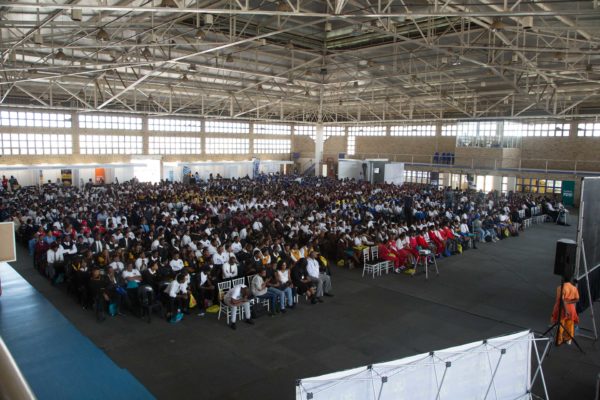
Hundreds of learners from several high schools in the Free State attended the SANRAL Career Expo.

Almost 2000 learners from several high schools in the Free State who were undecided about what career to follow after passing matric left the Career Expo with a good idea of the job they would like to pursue. 

The South African National Roads Agency (SOC) Limited (SANRAL) hosted a Career Expo for Grade 10–12 learners in Mangaung and exposed the pupils to SANRAL’s career opportunities, internships and scholarship and bursary programmes. 

In addition, 10 other exhibitors showcased opportunities available to learners within their respective organisations. 

SANRAL is committed to developing skills of learners who express an interest in studying and building a career with SANRAL or similar organisations within the built environment, specifically in the fields of road infrastructure, environmental management and the civil engineering industry. 

Dumisani Nkabinde, SANRAL Eastern Region regional manager, said: “SANRAL needs specialists in fields ranging from engineering to the environment and, more recently, in electronics as it increases the use of technology to detect and respond to incidents, and to keep road users aware of conditions on the national network. 

“SANRAL aims to contribute towards strengthening the country’s expertise in engineering and construction through its development programme, and through the bursary and scholarship programmes. These programmes enable young people to further their studies.” 

Monageng Mokgojwa, SANRAL Eastern Region Stakeholder Engagement Coordinator, was full of praise for the Free State Department of Education for ensuring the Career Expo was supported by schools. 

“We are humbled by the partnership with the Department of Education as the Career Expo exposed learners to alternative career choices to empower them to decide wisely. 

“We feel honoured by the level and quality of presentations made by all the speakers.” 

Learners speak 

Mpho Sello, a grade 12 learner from Bainsvlei Combined High School in Manguang, said he was inspired by SANRAL’s involvement in the built environment.  

He plans to pursue a career in civil engineering as he loves the challenging aspect and applying for a SANRAL bursary would be a stepping stone to his dream. 

Zukiswa Mbali, also in grade 12 at the same school, said she gained broader knowledge about engineering as a career. 

“Civil engineering is one of my career options as there is a big demand for women engineers in the industry. Building roads and bridges helps build relationships and better lives in and around communities in South Africa.” 

She expressed keen interest in applying for a SANRAL bursary soon. 

Concrete section to be improved

Major rehabilitation and expansion works will include the removal and replacement of failed concrete slabs and thereafter the overlaying of the entire section. 

It is with great pleasure that Trans African Concessions (TRAC) announces the rehabilitation of Sections N4-3 and N4-4, between the OR Tambo Interchange and the Van Dyksdrift Interchange. 

This 17km stretch of the N4 Toll Route was originally built as a concrete road and currently has an asphalt overlay.  

Major rehabilitation and expansion works will include the removal and replacement of failed concrete slabs and thereafter the overlaying of the entire section. In addition, 7km’s of passing lanes will be constructed.  

The project 

The project, valued at almost R300-million, is currently out on tender and is set start in July 2019.  

It is expected to take 18 months to complete. Road users are advised that traffic flow will be affected throughout the project as lane reductions and/or deviations will be in effect. 

Other upgrades and rehabilitation projects along the route are ongoing. These include the major upgrade between Belfast and Machadodorp, which resumed last month.  

The R400-million project will see Section 5B rehabilitated and upgraded to a four-lane carriageway. Blasting started this month and the roadworks are expected to take 36 months to complete.   

The major upgrade of the N4 between Matola and Maputo (Sections 19 and 20) in Mozambique is ongoing and Mozambican road users will soon have a six-lane carriageway to enjoy between these two cities.  

This extensive project includes comprehensive roadworks between the Shoprite Centre Intersection in Matola and the 16 of June Circle in Maputo. 

The project fell behind schedule due to circumstances beyond TRAC’s control, but it is now due for completion in July 2019.  

Although closures relating to the roadworks will be in place until June 2019, streetlights are being installed and will be operational this month. 

TRAC prides itself on offering quality road infrastructure and therefore continuously works on improving and maintaining their route.

Trans African Concessions would like to thank the public for their patience and understanding at construction zones and assures them of their continued commitment to maintaining the N4 Toll Route on par with world standards. 

Paving the way forward

Pilot Crushtec and SANRAL enter into MoU to promote transformation and empowerment in South Africa. 

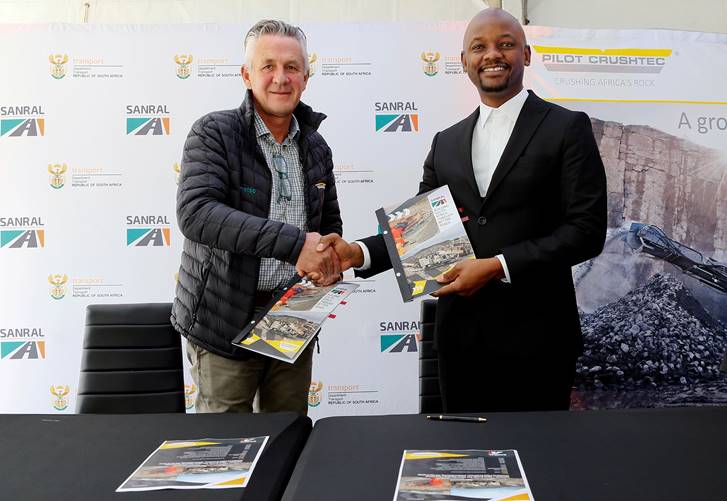
Pilot Crushtec CEO Sandro Scherf and SANRAL CEO Skhumbuzo Macozoma shake hands following the MoU signing ceremony at Pilot Crushtec in Boksburg.

South Africa has the largest and, arguably, best road network on the continent. The continuous expansion and maintenance thereof generate billions in revenue and employs tens of thousands of individuals.  

The barriers to entry for newcomers wishing to take advantage of this lucrative sector are, however, restrictive due to high cost of capital equipment and lack of expertise within the field.  

It is with this in mind that Pilot Crushtec and SANRAL have signed a memorandum of understanding (MoU) that will, among others, give small to medium enterprises access to expertise and machinery required to tender and execute major SANRAL projects. 

Pilot Crushtec International was founded in 1990 and has established itself as southern Africa’s leading supplier of mobile and semi-mobile crushing, screening, recycling, sand washing, stockpiling, compacting and material handling solutions. 

A win/win situation 

Entering the MoU made perfect sense for both SANRAL and Pilot Crushtec 

As one of the industry leaders in the sector, Pilot Crushtec is well placed to be able to equip up and coming contractors and quarry owners with the opportunity to be educated by their team of experts who have over 30years of experience in the field on how to get the most out of their operations.  

Francois MaraisPilot Crushtec sales and marketing director, said: “Additionally, we would really like the opportunity to promote our locally produced products for road building. 

“These products are world leaders in the space and are exported to a number of international locations for manufacturing top grade road stone and aggregates. 

“Both new, and existing clients will benefit from this initiative as we will be sharing our best practices and expertise in the quarrying and road stone manufacturing environment in order to ensure that south African roads are built using the best materials available.”   

Skhumbuzo MacozomaCEO of SANRAL, said: “It is our intention, with MoU’s like this, to open up the industry to new participants and remove many of the barriers that prevent companies owned by black people, women and youth entrepreneurs and other designated groups to compete effectively against the entrenched players in the construction sector. 

“We hope that, via our co-operation with Pilot Crushtec we are able to promote growth of black business and take constructive steps to support a sector that has immense potential for growth and job creation.” 

Macozoma said the partnership is proof that SANRAL’s efforts to transform the sector and promote fair competition are delivering results.  

He added: “Lack of access to sophisticated machinery and equipment is a major barrier for small contractors and prevents them for participation in large tenders. By working together with established companies, we can remove these barriers and enable black-owned companies and enterprises owned by women and the youth to participate on a level playing field.  

This step will, no doubt, have a ripple effect within the construction and engineering industries and also benefit job creation within local communities where smaller enterprises now become part of the supply chains on larger projects.” 

Benefits 

The MoU will deliver several benefits to Pilot Crushtec, SANRAL, new contractors and the industry at large.  

“Giving us access to young, up and coming contractors, who will get a chance to learn from our experience, is just the beginning. We will also be able to educate new contractors on how to produce the best quality road aggregates which will, by extension, improve roads across the country,” said Marais.  

“We also produce and manufacture equipment locally that gets exported internationally for production of road aggregates, and it’s the best of its kind in the world. That said, there are cheaper imported products used in the country which may lead to inferior end-products being used in our roads. Case in point is our Twistertrac VSI which is used to create perfectly shaped road stone that is of the highest quality found internationally. 

“It is our hope that, by collaborating on issues of financing, buy- back options, training of small contractor’s asset management and utilisation of crushing and screening machinery equipment, we can ensure a vibrant, robust industry for many years to come,” concluded Marais. 

Building for better quality of life


The new N2 will open this coastal strip while also providing a safer, flatter and faster link between Durban and the industrial centres of East London and Port Elizabeth. 

The new N2 will benefit businesses operating along the entire east coast as well as stimulating development of the Wild Coast.

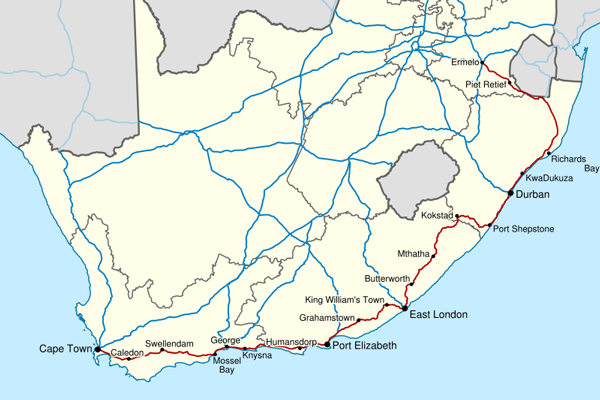
The N2 Wild Coast road (N2WCR) construction project is one of SANRAL’s most ambitious.  

It stretches over 410km from East London to the Eastern Cape’s boundary Progress on Community Development Programme with KwaZuluNatal.  

It is scheduled for completion in 2024 and will be a major factor in the development of some of South Africa’s most disadvantaged municipal areas.  

The project has two main components:  

  • A major upgrade of existing roads, the N2 between East London and Mthatha and the R61 between Mthatha and Ndwalane (near Port St Johns). The section-by-section improvement of these roads has been underway since 2011.  
  • The construction of 96km of “greenfields” – or brand new – highway and 17km of upgrading between Ndwalane and the Mtamvuna River (near Port Edward) via Lusikisiki, serious building activity on this section commenced in 2018 with the Mtentu River mega-bridge, which will be the highest bridge in Africa.  

Reasons to prioritise the Wild Coast: 

  • The eastern half of the Eastern Cape cries out for economic and work opportunities. Its people suffer deprivation while living in a resource-rich area. Good road access is a pre-condition for development of the Wild Coast’s significant potential for tourism and other economic activity.  
  • Once easier access and mobility is provided through the new road, the Pondoland stretch of the Wild Coast with its deep gorges, rugged coastline, many waterfalls, beautiful secluded beaches and unique flora and local culture, there will be huge potential for conventional-, adventure- and eco-tourism. Inland the high rainfall and fertile ground provides great potential for agricultural development.  
  • The current N2 turns inland from Mthatha and due to the many deep gorges and poor road infrastructure there is a vast inaccessible land corridor along the coast between Port St John and Port Edward. 

The new N2 will open this coastal strip while also providing a safer, flatter and faster link between Durban and the industrial centres of East London and Port Elizabeth.  

It will benefit businesses operating along the entire east coast as well as stimulating development of the Wild Coast.  

  • Currently the N2 east of Mthatha records exceptionally high numbers of road deaths. Contributing factors are driver behaviour, the volume of traffic, the mountainous terrain, mist, pedestrians and the straying of animals onto the road. Poor access to the area for emergency services increases the risk of fatalities. 
  • Life is difficult in villages in the area. Breadwinners and learners commute long distances. They spend hours in buses and taxis or walking. Migrant workers seldom visit home. The new highway supported by the road access management system linking this high order road with lower order roads will be an important first step to safer, more convenient travel and a better quality of life. The upgrading of lower order roads found in the villages near the new route and linking these roads to the new N2 will translate into community development projects which will be constructed by local Small, Medium and Micro Enterprises (SMME) through tendering and theoretical and practical training. 

National roads set to be busy this Easter holiday

The Easter Holidays are traditionally a period when traffic increases on most major national and provincial highways. 

Road users are advised to be vigilant over the Easter holidays.

Traffic is set to surge on national roads across the country from the afternoon of Thursday, 18th April through to Friday, 19th April – with traffic volumes expected to spike again from Monday, 22nd April to Tuesday 23rd April after a relatively calm weekend. 

The Easter Holidays – from Friday 19th to Monday 22nd April – is traditionally a period when traffic increases on most major national and provincial highways, with the peak traffic times over the period being mostly on the Thursday before the long weekend and Easter Monday. 

Traffic projections: 18th – 22nd April 2019 

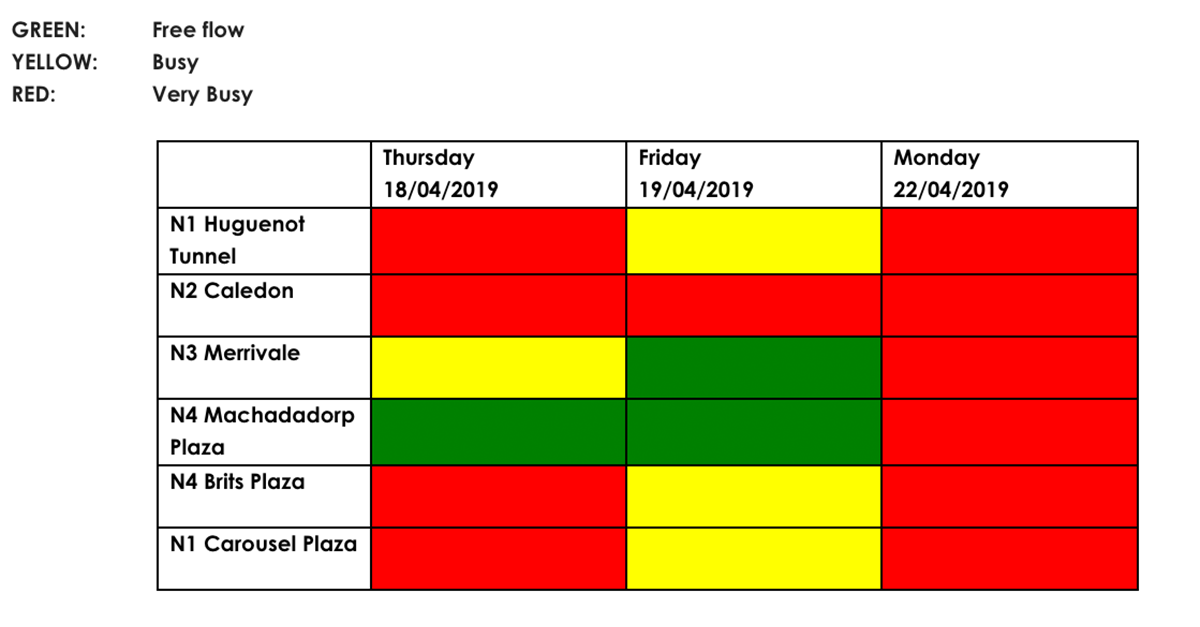
Travelers going towards Cape Town from the north will experience congestion at the Huguenot Tunnel and going northwards, again on Easter Monday.  

There will be heavy traffic on Thursday, 18th April, on the N2, towards Caledon, and again on Easter Monday, going toward Grabouw. 

The N3 will see heavy traffic traveling from the coast towards Johannesburg on Easter Monday at the Merrivale Interchange as well as going towards Durban from the Reef. 

The same applies for the Machadadorp Plaza on the N4 going from Nelspruit to Middelburg on Easter Monday.  

This is also true for the Brits Plaza on the same highway going west on the two days before Good Friday as well as Easter Monday. In the opposite direction, this holds for Thursday 18th April and Good Friday. 

Heavy traffic volumes are expected on the N1 heading towards Polokwane on the day before Good Friday and coming back, toward Pretoria, on Easter Monday. Also along the N1, at Capricorn Plaza towards Beit Bridge, heavy traffic flows are expected on Thursday while going toward Polokwane heavy traffic and congestion will occur ln Easter Monday. 

These are the expected peak travel times barring any unforeseen major traffic incidents or weather conditions.  

Road works during Easter Holidays 

“Construction work during peak hour traffic will be limited and no journeys on any of the major highways will be unnecessarily prolonged due to road building activities,” said Vusi Mona, General Manager for communications at the South African National Roads Agency (SOC) Limited (SANRAL). 

Road safety 

Mona calls on road users to obey speed limits, to take a break when tired and to refrain from texting and driving. 

“The national and provincial road network is a safe environment and if drivers stick to the rules of the road and display tolerance and courtesy towards fellow road users, we should be able to cut down on the unacceptably high rate of fatal crashes on our roads,” said Mona. 

SANRAL is taking great care to prevent pedestrians or stray animals from entering the freeway network but road users are cautioned to be vigilant, especially at night. 

Expected traffic volumes 

The table below gives an overview of expected heavy traffic volumes on major routes across the country.  

Routes not included below will be free-flowing throughout the coming long weekend barring unforeseen weather and traffic incidents. 

TRAC drives road safety awareness this Easter

To avoid traffic backlogs, all roadworks will be suspended for the long weekend. There will also be no Stop/Go’s or lane closures at construction sites throughout the route. 

Statistics indicate that the Easter weekend sees the biggest surge in traffic volumes on this route, with traffic conditions expected to peak.

The N4 Toll Route expects high traffic volumes this Easter weekend as holiday-makers and workers travel from Gauteng to Mpumalanga and Mozambique. 

In anticipation of these high volumes, Trans African Concessions (TRAC) will again boost its efforts to accommodate the influx of traffic and ensure that the N4, east of Tshwane, stays safe and congestion free. 

Statistics indicate that the Easter weekend sees the biggest surge in traffic volumes on this route, with traffic conditions expected to peak as follows: 

Thursday 18 April – 12:00 – 22:00
Friday 19 April – 08:00 – 14:00
Monday 22 April – 11:00 – 22:00

Road Safety Campaign
 

This is one of the driving factors of the TRAC N4 Easter Road Safety Awareness and Swift Response Campaign, held annually at Alzu Petroport, near Middelburg, and other strategic locations along the 570km route.  

The first stage of the campaign will see TRAC hold a road safety activation on Friday 19 April at Alzu to interact with members of the public to generate road safety awareness, offer a well-deserved and proper rest stop (including free coffee and massages) and educate them about TRAC’s 24-hour Helpdesk and TRACAssist – both of which will be on full alert throughout the Easter holiday. 

On 18, 19 and 22 April, emergency services and TRACAssist units will be stationed at strategic points on the route, from early in the morning until late in the evening, to reduce response times to roadside emergencies and incidents.  

The stations will be at Bronkhorstspruit, Alzu (only on April 22), Middelburg Plaza, Milly’s, Kia Ora, Hectorspruit and the Matola Weighbridge in Mozambique.  

Each one will serve as the central dispatch centre for their various sections of the N4 Toll Route. 

TRACAssist and the TRAC 24-hour Helpdesk will lead this initiative, with the latter being the communications’ hub.  

The TRAC Helpdesk is the first to be alerted of incidents on the road and therefore plays a vital role in this project.  

Other participating emergency services include private and public ambulance services and paramedics, Fire and Rescue, Provincial Traffic, SAPS and pathology units. 

Co-operation 

TRAC will once again work with the Lebombo Border Control Operational Coordinating Committee to assist with traffic management measures en route to the border post.  

This will be done through the provision of signage and other logistical requirements. The border will be open 24 hours a day from 16 to 26 April 2019 and road users are urged to plan their trip, accordingly, bearing in mind the heavy traffic volumes expected along the route and at the international crossing. 

To avoid traffic backlogs, all roadworks will be suspended for the long weekend. There will also be no Stop/Go’s or lane closures at construction sites throughout the route.  However, all construction areas are still deemed active and road users are urged to be cautious and obey road signage. 

The safety and well-being of the N4 Toll Route’s road users is TRAC’s primary concern and we urge everyone using our beautiful route to make full use of our road safety initiative by calling the TRAC Helpdesk on 0800 87 22 64 in South Africa or +258 84 34 34 34 6 in Mozambique, for fast assistance and response to any problem.