
Blog

Learners exposed to different career paths at SANRAL Career Expo

The expo seeks to expose rural schools to SANRAL’s career opportunities, internships, scholarship and bursary programmes. 
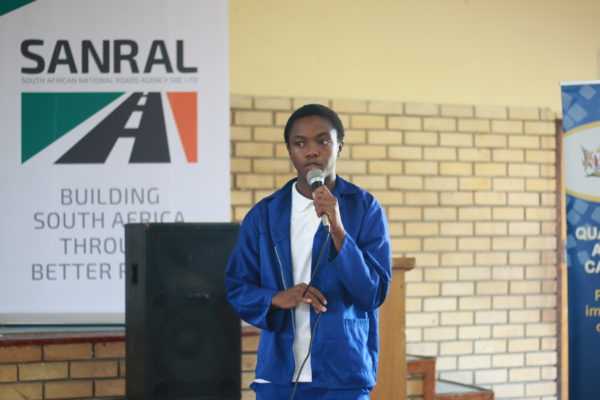
Sivuyise Gada, a 14-year-old Grade 8 learner at Hector Petersen High School addressed nearly 500 Grade 9 learners in King William’s Town on Tuesday, 14 May, at a Career Expo hosted by SANRAL in partnership with the Eastern Cape Department of Education.

The South African National Roads Agency (SOC) Limited (SANRAL) recently hosted a Career Expo in partnership with the Eastern Cape Department of Education (DoE). 

The Career Expo was aimed at SANRAL sharing information on its bursary, scholarship and graduate programmes. It also provides a platform for nearly 3 000 Grade 9 and Grade 12 learners to make an informed decision pertaining career choice. 

This is an annual event with the purpose to empower, inform, educate and create awareness around careers in the construction and related industries.  

SANRAL is committed to developing skills of the learners who have an interest in civil engineering, construction and other career paths. 

Welekazi Ndika, SANRAL Southern Region Stakeholder Relations Coordinator, said: “The expo seeks to expose rural schools to SANRAL’s career opportunities, internships, scholarship and bursary programmes. It is also aimed at increasing SANRAL bursary and scholarship beneficiaries in the province.  

“The expo featured several exhibitors from various industries to share information about other career choices.” 

A dream 

At the expo, Sivuyise Gada, a 14-year-old Grade 8 learner from Zwelitsha zone 4, shared his dream of becoming a mechanical engineer at SANRAL’s Career Expo at Ginsberg Community Hall in King William’s Town. 

Gada, a learner at Hector Petersen High School, was one of the event speakers who addressed nearly 500 Grade 9 learners.  

He won a career dressup competition that was held at the East London International Convention Centre (ICC) in 2018. 

Gada said: “What made me stand out from my peers is passion and interest in this field of study (mechanical engineering).” 

He told the learners mechanical engineers “are always in demand and it is like having a passport to getting into many industries”.  

Some of the fields mechanical engineers deal with are the design of automotive parts, aircons, elevators, and machines, he said. 

“I want to help my communityI want to fix their cars at a reasonable price. You can design machines or automotive parts and work in various industries,” said Gada. 

Mathematics is essential 

Lunga Mnyatheli, a Deputy Chief Education Specialist (FET Humanities) at the Eastern Cape DoE, said his message to learners was on scarce skills and personal development.  

“Today we are here to share very critical information about careers with Grade 9 learners, and it is very important to choose wisely because the choices that you make during your school years will determine your future.” 

Mnyatheli said 99% of careers in engineering need pure mathematics, the students must aim very high and not settle for level 2 -3 in their results. 

Kaoma Mwansa, 15-year-old from Westbank High School, acknowledged that not every learner knows which career to choose after matric.  

“This career expo will help us make informed decisions. We have been exposed to other career paths that we can follow,” Mwansa said. 

“We are still in high school, some of us are not really aware of other careers other than being a doctor, lawyer, journalist or a teacher. This is a good initiative, it will help us explore other career choices and be informed,” said Mila-Anda Ntantiso, a 14-year-old from Charles Morgan High School in Ginsberg township. 

Ndika added that SANRAL is committed to contributing to the development of human capital in South Africa so it can realise its potential. 

“We need young engineers who can design and build quality roads. We can’t do this without people who have foresight. Grab the opportunities presented to you. Work hard to get good grades. We offer scholarships to high school learners, but there is a criteria and bursaries are offered to university students,” Ndika said. 

Scholars were asked to share their strategies on how to achieve higher marks. Reholele Matubatuba, 14, from Bhisho High School said: “I believe that I have to draw up a timetable that will guide me and manage my time in order to get better marks. 

Career exhibitor from the Department of Agriculture, Forestry and Fisheries, Amanda Damane said; “A lot of people think that agriculture is all about farming. They do not know that there are other aspects to it, like agricultural engineering and food science, I encourage learners to explore careers in agriculture because there are exciting career paths that they can follow.” 

Scholarships and bursaries 

Now its 10th year, SANRAL’s scholarship programme will consider applicants with a 65-75% aggregate in maths and physical science, a 65% mark in English and an overall 75% plus pass rate.  

It pays for school fees, books, stationery, uniform, sports uniform and for hosting the learner at a gala dinner/luncheon. 

SANRAL’s bursary scheme was initiated in 2007 and caters for students with outstanding academic performance in civil engineering and related studies in the built environment. 

Both scholarship and bursary applications will open in June and close at the end of September 2019. 

For more information on the scholarship and bursary programmes visit www.nra.co.za. 
Hammarsdale to strengthen logistics, transport corridor

The project has presented the area with an excellent opportunity for local SMME development, and the creation of employment opportunities for the area’s population.   

The improved geometry of these ramps demands significant cuttings into the existing ridges, requiring the regular blasting activities that have become familiar to frequent travellers along the route.

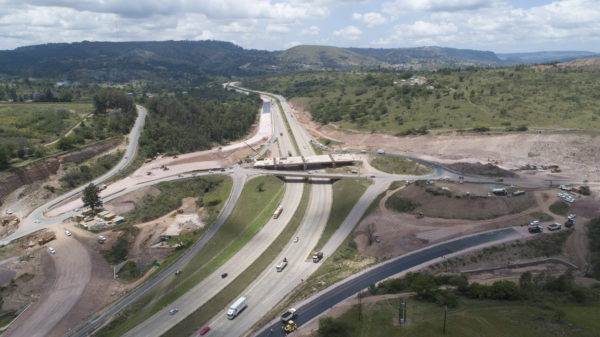
Once completed, the existing simple diamond interchange at Hammarsdale will be an upgraded semi-parclo (partial clover leaf), freeflow interchange.  

This upgraded interchange will accommodate the increased volume of traffic resulting from the development of the area as a distribution node for freight logistics companies, including the 152ha Keystone Park industrial precinct.  

The national and provincial importance of the Hammarsdale Interchange stems from its location on the N3 between the eThekwini and Msunduzi municipalities, its proximity to the rail line linking Gauteng to the Durban harbour, and the proposed inland container terminal at Cato Ridge.  

To fast-track construction of the interchange, SANRAL entered into a co-funding partnership with the eThekwini Municipality to share the R276-million cost of the project. Stefanutti Stocks (Pty) Ltd were appointed in 2016 to undertake the construction of the new interchange.  

The upgrades 

The planned upgrades include the construction of six new on and off ramps.  

The improved geometry of these ramps demands significant cuttings into the existing ridges, requiring the regular blasting activities that have become familiar to frequent travellers along the route.  

A new five-lane lane overpass bridge with a precast beam deck and slab has been constructed to replace the existing bridge, which will be demolished once the ramps have been completed.  

The new bridge was erected across both carriageways of the N3 in a record four days by using a large crane to lift and place 46 beams, each weighing 37 tons, over two consecutive weekends.  

Once the interchange has been completed, lighting will be installed to ensure the whole intersection is lit at night for increased safety of both pedestrians and motorists.  

The project has presented the area with an excellent opportunity for local SMME development, and the creation of employment opportunities for the area’s largely unemployed population.  

Additional emphasis has been placed on training local labourers, ranging from generic skills training to NQF level training courses.  

The upgrade of the interchange was scheduled for completion in November 2018 but has not been without complications and delays.  

Construction activities were interrupted for an extended period in 2018 by local business forums, extending the expected construction period to mid-August 2019. 

SANRAL strives to keep South Africa world-class

SANRAL positions itself to play a defining role in keeping South Africa world-class through its infrastructure. 

The value of the South African National Roads Agency (SOC) Limited (SANRAL) to the South African economy through the provision and maintenance of a world-class primary road network will continue to grow with new infrastructure programmes being rolled out. 

At SANRAL, we work to guarantee our country world-class infrastructure and a high level of mobility for our people and goods transportation, because South Africa deserves it.

Update on the N2 and N3 upgrades

Due to the length and estimated cost of the N2 and N3 upgrades, the strategy is to split the corridor into several detailed design and construction packages.   

These upgrades will include the widening of the N2 and N3 carriageways, with four to five lanes in each direction, and the reconfiguration of most major interchanges along these route sections.  

The upgrades of the N2 and N3 in KwaZulu-Natal form part of the national government’s key Strategic Integrated Projects, SIP2: Durban-Free State-Gauteng Logistics and Industrial Corridor.  

The upgrade of the N2 will focus on a 55km length of the route, from Lovu River on the South Coast, to Umdloti on the North Coast.  

The N3 upgrade will focus on an 80km section from Durban to Pietermaritzburg.  

These upgrades will include the widening of the N2 and N3 carriageways, with four to five lanes in each direction, and the reconfiguration of most major interchanges along these route sections.  

Ravi Ronny, SANRAL Eastern Region Design and Construction Manager, said due to the length and estimated cost of the entire N2 and N3 upgrades, the strategy is to split the corridor into several detailed design and construction packages. 

The stimulus package  

Upgrading of the N2 and N3 is expected to take between five to eight years. President Cyril Ramaphosa recently introduced the “stimulus package” as a new measure “to reignite growth, stimulate economic recovery and secure confidence in sectors affected by regulatory uncertainty and inconsistency”.  

Projects earmarked for the stimulus package will be funded from the existing budget envelope with R50-billion already identified by the government for infrastructure projects nationally.  

SANRAL’s allocation from the total stimulus package is some R3.5-billion, which will be used to initiate the SIP2 projects over the next two years.  

Two N2 project packages and five N3 project packages, identified as critical areas, were allocated the stimulus funding accordingly.  

The stimulus funding for these project packages has, therefore, assisted in the fast-tracking of the commencement of these projects.  

The first N2/N3 construction package is now expected to be awarded by the end of 2019. 

What makes roads last?

SANRAL is a state-owned agency responsible for the planning, design, construction and maintenance of the national road network. 

SANRAL is also developing a rating system that is dedicated for road projects and which promotes the use of sustainable best-practices in the planning, design and construction of roads.

Five factors influence the performance of a pavement (road surface):  

TRAFFIC: Traffic is the most important factor influencing pavement performance. The performance of pavements is mostly influenced by the loading magnitude, configuration and the number of load repetitions by heavy vehicles. The damage caused per pass to a pavement by an axle is defined relative to the damage per pass of a standard axle load, which is defined as an 80kN single axle load (E80). Thus, a pavement is designed to withstand a certain number of standard axle load repetitions (E80s) that will result in a certain terminal condition of deterioration at the end of its design life, which typically has been 20 years in South Africa. Roads are not designed to last 20 calendar years, but for axle load repetitions estimated to occur over a 20-year period. If the estimates are correct, a road could reach end of its life after only five calendar years.

MOISTURE (WATER): Moisture can significantly weaken the support strength of natural gravel materials, especially the subgrade. Moisture can enter the pavement structure through cracks and holes in the surface, laterally through the subgrade, and from the underlying water table through capillary action. The result of moisture ingress is the lubrication of soil particles, loss of particle interlock and subsequent particle displacement resulting in pavement failure.

SUBGRADE: The subgrade is the underlying soil that supports the applied wheel loads. If the subgrade is too weak to support the wheel loads, the pavement will flex excessively, which ultimately causes the pavement to fail. If natural variations in the composition of the subgrade are not adequately addressed by the pavement design, significant differences in pavement performance will be experienced.

CONSTRUCTION QUALITY: Failure to obtain proper compaction, improper moisture conditions during construction, quality of materials and accurate layer thickness (after compaction) all directly affect the performance of a pavement. These conditions stress the need for skilled staff, and the importance of good inspection and quality control procedures during construction. 

MAINTENANCE: Pavement performance depends on what, when and how maintenance is performed. No matter how well the pavement is built, it will deteriorate over time based upon the factors mentioned above. The timing of maintenance is very important. 

Ensuring bridges adhere to the highest standards

At present, 93% of bridges are in good condition – a very high percentage considering that SANRAL has increasingly taken over the management of older provincial roads where safety standards were lower.   

The majority of bridges – including the 927 managed by SANRAL’s concessionaires – has been inspected since 2015. Where roads are upgraded or new bridges and culverts constructed, inspectors again ensure that standards are met. 

The national road network, including its bridges and culverts, is in excellent condition because of routine road maintenance.  

The almost 9 900 major bridges and culverts on the SANRAL road network undergo major safety inspections every five to six years.  

This is done by the Committee of Transport Officials, a team of inspectors with advanced experience in engineering, construction and safety standards.  

The majority of bridges – including the 927 managed by SANRAL’s concessionaires – has been inspected since 2015. Where roads are upgraded or new bridges and culverts constructed, inspectors again ensure that standards are met.  

At present, 93% of bridges are in good condition, a very high percentage considering that SANRAL has increasingly taken over the management of older provincial roads, where safety standards were lower.  

When older roads are taken over, SANRAL immediately starts with comprehensive maintenance and rehabilitation programmes to ensure the roads also comply with its high safety requirements.  

Strict rules for building bridges 

SANRAL applies strict conditions to the construction of bridges across its roads.  

Before the construction of a bridge, a consulting engineering firm with an experienced bridge engineer is appointed during the design phase.  

The consulting firm undertakes internal reviews of bridge designs, while on medium- to large-span bridges a tender is put out by SANRAL for a peer review of the design.  

The reviewing firm will also have experienced bridge engineers, who will undertake the review of the bridge design and any construction issues.  

In addition, SANRAL has its own code of practice for the design of highways, bridges and culverts.  

Emphasis is placed on the safe load capacity of the bridge. All bridges are built according to the Committee of Land Transportation Officials’ standard specifications for road and bridge works.  

A tender is also put out for an independent site laboratory, which will test construction materials.  

In addition, SANRAL appoints a consulting firm to undertake construction supervision. The agency also interacts with all involved in design and construction of a bridge throughout the process. 

KwaZulu-Natal road upgrades will boost national economy

SANRAL has long recognised that the importance of transport infrastructure to economic growth creates opportunities for private investment in road development and management.   

Skhumbuzo Macozoma, SANRAL CEO, believes roads are the arteries through which the economy pulses. By linking producers to markets, workers to jobs, students to school, and the sick to hospitals, roads are vital to any development agenda.  

KwaZulu-Natal has two major ports in Durban and Richards Bay, and the expeditious movement of goods to the rest of South Africa and neighbouring countries is an economic priority.  

The upgrading of the N2 and N3 at a cost of more than R28-billion will ensure that the required infrastructure is built to resolve the traffic congestion currently experienced by providing higher mobility and increased safety.  

The N3 upgrade will boast a four to five-lane freeway per direction on an 80km stretch between Pietermaritzburg and Durban.  

The N2 upgrade will entail a four to five-lane freeway per direction over the 54km route between Amanzimtoti and Dube Tradeport.  

The N3 upgrades will solve bottlenecks between Durban and Pietermaritzburg.  

Fast-tracking empowerment 

To fast-track empowerment in the road construction industry, SANRAL signed memorandum of understanding with suppliers of construction machinery that give small contractors access to these to allow them to participate more meaningfully in major construction projects.  

Thus, new entrants will be attracted to the construction and engineering sectors, particularly black contractors, who will in turn grow their business and create jobs.  

SANRAL has long recognised that the importance of transport infrastructure to economic growth creates opportunities for private investment in road development and management.  

Public Private partnerships (PPPs) are an alternative means of financing and operating the national road network, with the costs being recovered through user charges or tolls. 

The mandate of the N3 Toll Concession which is to design, finance, construct, operate and maintain the section of the N3 extending from Cedara in KwaZuluNatal to Heidelberg in Gauteng has seen millions of Rands being poured into refurbishment and periodic maintenance of this stretch of the N3 to make it operationally more efficient and safer.  

Roads are the arteries through which the economy pulses. By linking producers to markets, workers to jobs, students to school, and the sick to hospitals, roads are vital to any development agenda.  

Rutted roads will give a rotten economy. Hence, SANRAL will always ensure that our roads are right and proper to make South Africa grow and develop. 

This is an opinion piece by Skhumbuzo Macozoma, SANRAL CEO. 

Road innovation protects all

The use of technology to promote road safety is very much aligned with the ‘Safe Systems’ approach adopted globally through the United Nation’s Plan for Road Safety. 

SANRAL will continue to play a proactive role in ensuring a road environment that is self-explanatory, forgiving and which provides for the needs of all road users, including pedestrians.  

Engineering plays an important role in road safety in South Africa. It serves no point to preach road safety to people if the very roads they are using are dangerous because of the way they have been designed or maintained.  

We need innovative engineering solutions and to show greater respect for laws to intervene in areas that are high-crash zones.  

Indeed, you may find that to reduce pedestrian deaths on a stretch of road all that is needed is a safe pedestrian crossing point.  

The safety strategy must be able to respond to that kind of challenge. A recent example demonstrates that better roads can bring about a safer environment and contribute to a reduction in the number of crashes and fatalities.  

Globally aligned 

The use of technology to promote road safety is very much aligned with the ‘Safe Systems’ approach adopted globally through the United Nation’s Plan for Road Safety. 

This approach also underpins South Africa’s National Road Safety Strategy. The Safe Systems approach accentuates the need for all stakeholders to accept responsibility for road safety.  

SANRAL will continue to play a proactive role in ensuring a road environment that is self-explanatory, forgiving and which provides for the needs of all road users, including pedestrians.  

Examples 

The R71 linking Polokwane with the eastern parts of Limpopo is well known as one of the busiest stretches of road in the country, especially during Easter when it carries more than 17 000 vehicles a day en route to Moria for the religious pilgrimage. 

SANRAL’s re-engineering of the road to Moria entailed the construction of a new intersection and a dual carriageway on the busiest stretch close to Zion City.  

A new pedestrian walkway was also constructed to provide members of the community improved and safer access away from the main road surface.  

Residents of Klerksdorp in the North West can look forward to a safer road environment with the construction of concrete sidewalks and kerbing, fencing off a section of the road, minor capacity improvements and drainage, as well as improvements to four existing intersections on the N12 near the Jouberton and Alabama townships.  

At the R1.14-billion Mount Edgecombe interchange, which was officially opened by Minister of Transport Blade Nzimande in October 2018, road safety has been improved with the implementation of directional ramps, cutting down the need for controlled signalisation and associated back-up of traffic onto the freeway, thereby ensuring safer free flow of traffic in all directions.  

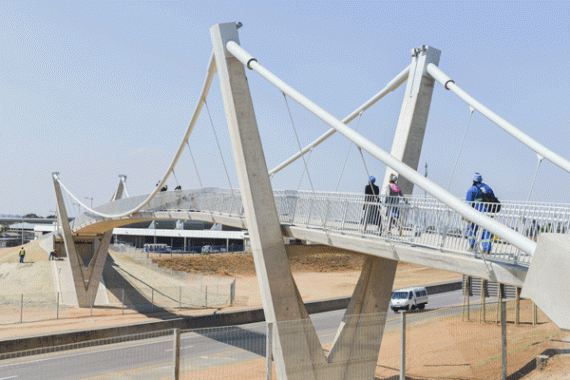
Public transport lay-byes with footways connected to a pedestrian bridge crossing over the N2 have been constructed to ensure the safety of pedestrians.  

Also, high-tech lighting has been installed to ensure the whole interchange is properly lit at night for increased safety.  

The upgrading of a 33km stretch of the N2 between Mtunzini toll plaza and the Empangeni T-junction that has been the scene of several fatal crashesbegan in March 2016 and is nearing completion.  

This entails transformation into a 14m-wide, safer dualcarriage highway, which will enable the key arterial road to cope with increased traffic volumes.  

The major overhaul of the entire stretch of the R573 Moloto Road, which has earned the title “road of death” because of the many fatal accidents there, will see several illegal access routes being closed off through proper fencing and new, safer walkways being constructed.  

The 160km stretch of road runs through three provinces: Gauteng, Limpopo and Mpumalanga, and is used by approximately 50 000 commuters every day.  

Road markings, including paint and studs, are being given priority attention countrywide, owing to many serious crashes occurring at night when markings are not clearly visible. 

SANRAL has introduced performance-based road marking contracts, as there have been too many instances where road markings have deteriorated long before their specified lifespan.  

Under this new system, payment is only made to the contractor once it has been ascertained that the paint complies with minimum standards over a length of time. 

SANRAL to apply sustainable roads rating system in road infrastructure delivery

SuRF’s rating tool is set up so road authorities can set targets for relevant credits they wish to apply to specific projects for use by their service providers.   

Dumisani Nkabinde, Regional Manager – SANRAL Eastern Region, said: “The SuRF rating tool provides a unique focus on the socio-economic impact of road projects in the context of South Africa’s inequality, unemployment challenges, skills development and history of restricted movement.”

For the first time in South Africa, a rating system is being developed that is dedicated for road projects and which promotes the use of sustainable best-practices in the planning, design and construction of roads 

The Sustainable Roads Forum (SuRF) rating tool allows road authorities to set sustainability intervention targets for their projects, and to start measuring and reporting them in a clear, transparent and aligned manner.  

The tool, which is being piloted on the N3 corridor upgrade between Durban and Pietermaritzburg in KwaZulu-Natal, provides a list of design and construction interventions, guidance for implementation and a unified method of reporting.  

It also introduces the concept of a carbon footprint and attempts to start quantifying the reduction in the carbon footprint resulting from the interventions.  

Dumisani Nkabinde, Regional Manager – SANRAL Eastern Region, said unlike similar tools in use, which predominantly weigh scores based on the environmental aspect of sustainability, the SuRF rating tool provides a unique focus on the socio-economic impact of road projects in the context of South Africa’s inequality, unemployment challenges, skills development and history of restricted movement.  

Nkabinde said: “Several attempts have been made in the past to set up rating systems for the broader infrastructure industry such as roads, dams, buildings, power plants and toll systems but these took a one-size-fits-all approach.  

“Thus, the roads industry in South Africa started pursuing a rating system which would be entirely specific to roads.”  

Royal HaskoningDHV undertook the earliest stages in developing a new localised rating system with support from SANRAL.  

“South Africa is playing catch up as countries such as New Zealand, America and Australia have had a rating system for many years.  

“In these countries, sustainability in infrastructure provision is enshrined in law. Their construction and consulting companies use the sustainability rating system as a business strategy and this gives them a competitive advantage over their rivals,” said Nkabinde, adding that South Africa should have adopted a mandatory rating system a long while back. 

SuRF’s rating tool is set up so that road authorities can set targets for relevant credits they wish to apply to specific projects for use by their service providers.  

These are then used for progress reporting purposes and final scoring on completion of the project phases.  

There are currently 10 mandatory intervention levels for “best practices”:  

  • Relevant environmental, social and heritage resources related permits obtained;  
  • Compilation of an Environmental Management Plan;   
  • Proper disposal of hazardous waste;  
  • Use of energy efficient plant;  
  • Initial and follow-up pedestrian surveys;  
  • Noise impact assessment;  
  • Early community engagement;  
  • Youth Skills Development (in-service training)  
  • Percentage of works reserved for labour intensive construction and targeted enterprises;  
  • As-built data reporting. 

Let’s be safe 24-7, 365!

At SANRAL, road safety is always top of mind.

Skhumbuzo Macozoma, SANRAL CEO, said that from a technology perspective, SANRAL is constantly innovating to manage some of the dominant causes of crashes related to speeding, overloading and unsafe driver behaviour.

Being alert and aware should be of the utmost importance each time you are on the road.  

Sadly, road safety usually only crosses people’s minds during peak periods of seasonal travel.  

The soaring incidence of crashes and high road fatality rates dominate the headlines and give rise to fervent public debate. But, then, road safety awareness fades away. Until the next horrific crash.  

At the South African National Roads Agency (SOC) Limited (SANRAL), road safety is a consistent priority.  

We take our responsibility for it very seriously. Our primary duty is to manage and maintain the country’s freeway network, but within this mandate road safety is one of the key pillars of our business.  

South Africa subscribes to the modern global approach to road safety.  

Known as the “safe systems” approach, it recognises that we can best achieve our objective to reduce fatalities by integrating safer roads, safer vehicles, more effective post-crash responses and sustained education and awareness campaigns.  

From a technology perspective, SANRAL is constantly innovating to manage some of the dominant causes of crashes related to speeding, overloading and unsafe driver behaviour. 

We recognise the fact that road users are human and that humans make mistakes. It is our responsibility to provide a forgiving road environment to minimise the impact of such behaviour. 

Through our education and awareness programmes, we endeavour to integrate road safety education into the curriculum of schools and to increasingly use technology and social media to encourage safe behaviour in all sectors of the population.  

This integrated approach is the bedrock of what we do, yet we are increasingly looking at technology to make our roads even safer than they are. 

This is an opinion piece by Skhumbuzo Macozoma, SANRAL CEO.