Youngsters in a group must be able to think cautiously and have the #JustW8 mentality.
Group-think in a situation is important and can save lives. Be the positive in a group situation and #JustW8
The South African National Roads Agency (SOC) Limited (SANRAL) is continuously trying to caution road users on the effects of negligent behavior on the road.
The #JustW8 road safety campaign by SANRAL is challenging the youth to take a pause and think about the consequences of their decision-making.
Scenario 4
The next scenario in our road safety campaign deals with group think among youth and how it affects road users.
It starts with the little girl from scenario 3 looking out the window after being disappointed by her dad who she managed to convince to #JustW8 before opening his alcoholic beverage.
There’s a car next to theirs filled with youngsters jamming to music. They are laughing and having a good time when the driver picks up his bottle of beer.
As he picks it up, he looks to his left and sees the little girl. She shakes her head disapprovingly and while looking straight at her, he slowly puts the beer down.
The car with the little girl drives off but as he and his friends drive off, they encourage him to just #W8.
Group think in a situation is important and can save lives. Be the positive in a group situation and #JustW8
Treasury has allocated about R21.5-billion per year for the maintenance and improvement of SANRAL’s 19 262km non-toll network.
Tenders to the value of R8.3-billion for construction work on the N3 between Durban and Pietermaritzburg will go out to tender during the current financial year.
Major road construction tenders to the value of more than R40-billion will be issued by the South African National Roads Agency (SOC) Limited (SANRAL) to the construction sector over the next two to three years.
“We expect a surge in road construction projects over the medium-term framework as part of the broader national efforts to invest in economic infrastructure,” said Louw Kannemeyer, the roads agency’s Engineering Executive.
“We are confident that this investment will help to boost the construction sector which has been under severe pressure in recent years, and also cascade down to black-owned and emerging enterprises, who will receive much larger shares of tenders in future.”
Treasury has allocated about R21.5-billion per year for the maintenance and improvement of SANRAL’s 19 262km non-toll network.
Projects
This will go towards a total of 940 projects, of which 325 are already under construction.
Kannemeyer said the new projects will include some 90 major capital works projects larger than R500-million each, which will go out to tender during the three-year medium-term period.
Tenders to the value of R8.3-billion for construction work on the N3 between Durban and Pietermaritzburg will go out to tender during the current financial year.
This is financed through the infrastructure stimulus package announced by President Cyril Ramaphosa in 2018.
This will include seven major tenders on the N3, which will be issued within the next three months once the regulatory approvals have been received and land acquisition finalised.
Tenders
Starting in August, SANRAL will issue smaller tenders related to routine road maintenance and periodic maintenance across the entire SANRAL network and in all nine provinces.
The more than 50 tenders will be released in a controlled manner so as not to flood the market.
“The projects will provide economic and social infrastructure that has the potential to unlock economic growth, stimulate local economies and create jobs within the communities located close to the construction activities,” said Kannemeyer.
The SANRAL network forms the backbone of the country’s transport system and serves as a catalyst for balanced economic growth, business confidence, investment and the transformation of society.
Kannemeyer says a growing share of contracts will be allocated to black-owned construction companies and enterprises owned by women, the youth and the disabled.
In its long-term strategy, Horizon 2030, SANRAL committed itself to the transformation of the construction and engineering sectors through the allocation of tenders to new entrants in these sectors.
Over the past six months SANRAL has brokered memorandums of understanding between emerging companies and major suppliers of construction equipment and machinery.
These partnerships give black-owned companies greater access to financing, expertise and the sophisticated equipment required to tender for larger contracts.
“We are confident that the R40-billion in tenders that are in the pipeline will benefit the broader construction sector and contribute to the growth of new enterprises who have been excluded from major contracts in the past,” said Kannemeyer.
Local businesses were engaged on how they can participate in road construction contracts in the area, as well as strengthen existing relationships with the municipalities.
SANRAL visited the Sedibeng district municipality, which consists of the Midvaal, Emfuleni and Lesedi local municipalities.
Achieving transformation in the construction industry is a priority for the South African National Roads Agency (SOC) Limited (SANRAL)and this was what the participants at a stakeholder meeting in the Sedibeng local municipality have heard.
The agency set itself a new vision for 2030 and introduced a Transformation Policy. The aim is to promote inclusive participation by all stakeholders, ensure skills training and the transfer of knowledge and experience to small construction businesses.
SANRAL visited the Sedibeng district municipality, which consists of the Midvaal, Emfuleni and Lesedi local municipalities.
The aim was to engage local businesses on how they can participate in road construction contracts in the area, as well as strengthen existing relationships with the municipalities.
Progress Hlahla, SANRAL Northern Region Manager, said stakeholders are a key pillar of the agency, and this is one way to reinforce the commitment to empowering and developing local communities.
“We are an agency that seeks to improve people’s lives beyond road construction. Such engagements provide the ideal platform to empower small businesses, allocate a growing portion of major projects to emerging contractors,transfer skills and experience so that these contractors will in future be independent players,” he said.
SMMEs
A key part of the discussions on the day addressed the expectations that local SMMEs have from SANRAL projects and to ensure a clear understanding of the agency’smandate.
Information was given about planned community development projects, the effects of road furniture theft, protests and road closures, project stoppages by business forums and building encroachments.
Among the 250 attendees was the Executive Mayor of Sedibeng,CIIr Busisiwe Modisakeng, who referred to the challenges faced by SMMEs, such as delayed payments and access to skills, and said “What makes me happy is that SANRAL is a business–ready organisation with the various projects that may be coming up”.
The district’s vision is to become a metropolitan city of choice and SANRAL intends to provide support by investing in the improvement of road infrastructure through the Ekurhuleni and Johannesburg routine road maintenance contracts.
Starting in February 2020, these projects will include grass cutting, patching and pavement repairs, vegetation and chemical control, guardrail repairs, fencing repairs and the cleaning of culverts, concrete drains and channels.
Other work involves the collection and removal of debris and litter, road sign cleaning, the removal of illegal signage as well as the maintenance of inlet and outlet structures. SANRAL will issue between three and five work packages for sub-contractors to tender for.
“In the new financial year, SANRAL hopes to go out to tender on a project, which entails the overlay of the N1 Vaal River to Klein Rietspruit and minor bridge repairs. This will further increase opportunities for participation by black-owned businesses,” explained Hlahla.
Another planned project for the municipality is:;
Capex project: N.001-190-2017/1: Concrete Pavement Repairs and Replacement of Joint seals on National Route N1 Section 19 Klein Rietspruit to Section 20 N12/Potch Interchange, which is currently in the planning phase and will be started in the 2019/2020 financial year for over a period of 15 months.
“SANRAL will continue engaging with stakeholders at all levels. Such engagements go a long way in forging collaboration with communities and affording local businesses an opportunity to participate in developing the economy,” said Hlahla.
Local communities are benefiting extensively from the project which boasts 17 local small, medium and micro-enterpriseshavingbeen appointed and 220 jobs created.
The entire project is expected to take 36 months to complete and the contractor, WBHO Construction, has confirmed that no delays or complications have been experienced so far.
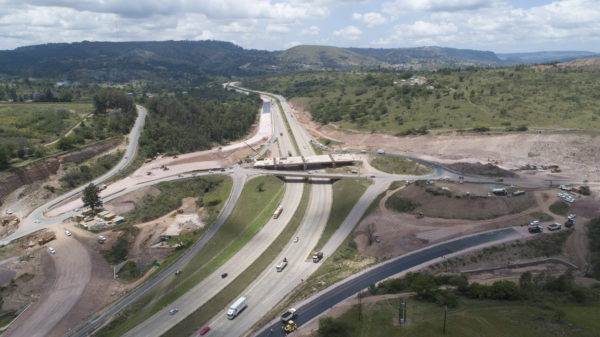
The extensive upgrade between Belfast and Machadodorp on the N4 Toll Route is progressing well, with 14% already complete.
The R400-million project which commenced in March this year will see 30km of Section 5B rehabilitated and upgraded to a four-lane carriageway.
The entire project is expected to take 36 months to complete and the contractor, WBHO Construction, has confirmed that no delays or complications have been experienced so far.
This is good news given that the project was suspended in 2018 due to community unrest.
However, months of negotiations between the eMakhazeni Local Municipality, Trans African Concessions (TRAC), South African National Roads Agency (SOC) Limited (SANRAL) and WBHO/Motheo JV resulted in the signing of a memorandum of understanding (MOU) and a nod for resuming the project.
In line with the MOU, local communities are benefiting extensively from the project and to date 17 local small, medium and micro-enterprises have been appointed and 220 jobs created.
Several traffic accommodations have been implemented and will remain in place throughout the construction period, including speed reductions, contraflows and occasional Stop/Gos to remove old road markings. Road users are urged to visit TRAC’s websitewww.tracn4.co.zafor regular updates to assist in the planning of trips.
TRAC prides itself on offering quality road infrastructure, which requires regular upgrades, rehabilitation and routine maintenance.
We are aware that roadworks may at times cause traffic disruptions and would therefore like to thank the public for their patience and understanding at construction zones.
In the third installment of our #JustW8 campaign we highlight drinking and driving.
Most motorists don’t ever believe they have had too much to drink but it has been proven that alcohol consumption is one of the biggest causes of car crashes in the country.
SANRAL’s ongoing road safety campaign, #JustW8, seeks to dispel the notion among road users that they can still safely drive while breaking the most common unsafe driving practices.
This week’sscenario involves drinking and driving which is one of the most common unsafe driving practices.
Most motorists don’t ever believe they have had too much to drink but it has been proven that alcohol consumption is one of the biggest causes of car crashes in the country.
Scenario 3
It’s a sunny afternoon and the father and daughter duo are taking a nice leisurely drive.
The dad has a beer in the cup holder, so he reaches for it and opens the bottle when his daughter chimes in with sounds of disappointment.
The dad is reminded that although he is not drunk, drinking and driving should be shunned.
His daughter reminded him to #JustW8 until they are home.
Poor road design can also cause crashes, so SANRAL holds technical design highly.
As a road authority, SANRAL’s primary sphere of influence is engineering. However, the N2 and N3 upgrade programme will allow for the facilitation of an integrated approach to improve safety for all road users.
It is not just human factors, such as speeding, not wearing seat-belts or careless driving, that increase the risk of a crash occurring. Poor road design can also cause crashes.
Designing for all users – During the upgrade programme, the N2 and N3 will be designed with the needs of all road users in mind – including pedestrians, non-motorized road users and local communities and businesses. The safety of motorists and pedestrians alike, will be a central consideration in every decision made about construction.
Quieter pavements – By using noise reducing asphalt mixes and specialized concrete grinding techniques, motorists will be able to travel along the N2 and N3 peacefully with less tyre noise.
Robust pavements – More damage is caused to roads by heavy vehicles than light vehicles. To cater for growing volumes of freight traffic on the N2 and N3, the pavement design methods and materials to be used in sections most prone to deterioration will be carefully considered.
Environmental considerations – During construction on the N2 and N3, SANRAL commits to enhancing eco-efficiency and identifying and managing or eliminating environmental risks. SANRAL will encourage planting partnerships in its quest to re-populate the entire road reserve to a similar state it was in before construction. Already during the upgrading of the Hammarsdale Interchange, several plant species, including a range of specially protected bulbs and aloes growing along the busy N3, have been translocated to a temporary nursery to save them from being destroyed.
Aesthetically pleasing – Bridge structures are built to last for decades and often serve as a gateway to a community. Good bridge design not only considers structural integrity, but also aesthetics. Therefore, SANRAL believes it is important for the new bridge structures along the N2 and N3 to be pleasing to the eye. The redesigned EB Cloete Interchange (Spaghetti Junction) – 3D image shown here – will feature a cable suspended bridge from an iconic arch.
Geometric design – The upgrades on the N2 and N3 will utilise geometric design to optimise efficiency and safety while minimising cost and environmental damage. The smooth flow of traffic will be balanced.
Safety improvements – Apart from resolving chronic traffic congestion by creating greater mobility through construction of additional traffic lanes, the upgrading of the N2 and N3 will result in increased safety. Dangerous curves will be ironed out. Unsafe intersections will be redesigned. Major realignment of the N3 highway will take place at Key Ridge (3D image shown here) where the steep grades cause major traffic congestion and serious crashes.
SANRAL is pushing ahead with its Transformation Policy through which it aims to transform the construction industry by contracting local – and mostly black – companies.
SANRAL CEO Skhumbuzo Macozoma said roads are our primary responsibility, but what is dear to us is enhancing the lives of communities and transforming the construction industry.
The mainstay economic activities of the North West province – mining, agriculture and tourism – are all reliant on excellent roads.
Providing these is what the South African National Roads Agency (SOC) Limited (SANRAL) does for the national network it is responsible for.
It is in line with the approach sketched by former Minister of Transport, Dr Blade Nzimande, during a recent visit to the province where he emphasised that the Strategic Integrated Programme (SIP4) will accelerate infrastructure growth and stimulate the regional economy.
To ensure this, the continuous and routine maintenance of these roads is vital, as is the upgrading of those road that are carrying ever more traffic.
Projects
At the end of last year, the road works on the R34 near Schweizer Reneke were completed, making for safer driving and less congestion.
The R505 from Wolmaransstad to the N14 is being upgraded and we look at the progress and the benefit this project entails for road users and communities in two local municipalities.
We do the same for the upgrading of the N4 from Pampoennek to the R512.
Of interest is the profiling of planned projects for this financial year as well as where to find the necessary tender information.
This is important, especially for local SMMEs, as SANRAL is pushing ahead with its Transformation Policy through which it aims to transform the construction industry by contracting local – and mostly black – companies.
Our routine road maintenance programme continues to keep the national road network right up there on the global scale of excellence.
Roads are our primary responsibility, but what is dear to us is enhancing the lives of communities and transforming the construction industry.
This is an opinion piece by SkhumbuzoMacozoma, SANRAL’s CEO.
The Premier of the North West believes the province has immense potential for growth in key sectors of the economy – most notably tourism, agriculture, and mining.
North West Premier Job Mokgoro said the N4 toll road is the primary economic artery in the region and connects it with Gauteng and serves as a gateway to the SADC through Botswana.
Our provincial road and transport infrastructure are critical enablers of future economic growth in the North West Province and as the 6th Administration, we have set ourselves clear targets to accelerate balanced growth in line with the objectives of the National Development Plan.
The North West is a province with immense potential for growth in key sectors of the economy – most notably tourism, agriculture, and mining.
The provincial Spatial Development Plan provides the framework for growth, but we are keenly aware of the fact that access to socio-economic opportunities must be created on safe and accessible roads.
For this reason, we value the productive partnership that has grown between the province and SANRAL over the years. In the recent State of the Province Address, we announced that some R4.54-billion was spent on the improvement and maintenance of our world-class road infrastructure.
The N4 toll road is the primary economic artery in the region and connects us with Gauteng and serves as a gateway to the SADC through Botswana.
We therefore welcome the major upgrades to the road that are currently underway in the Madibeng Local Municipality area.
Similar upgrades are taking place on key roads in the Kenneth Kaunda, Ngaka Modiri Molema and Dr Ruth SegomotsiMompati Districts.
Through our road networks, we can move agricultural and mining products to the markets and open new destinations for the growing number of tourists who are eager to visit our beautiful and diverse province.
The SANRAL initiatives complement the province’s own Roads Recovery Plan to improve transport infrastructure and significantly reduce maintenance backlogs.
We intend to spend an additional R732-million in the current financial year on the upkeep of road infrastructure including bridge construction, rehabilitation and the upgrading of roads from gravel to surface.
A distinctive feature of SANRAL’s projects is its ability to create jobs in local communities and support the growth of local suppliers, local entrepreneurs and local contractors.
These projects make valuable contributions to the broader provincial economy and enable local communities to gain valuable experience on major construction projects.
Our newly-elected administration is ready to serve the people of the North West. We are ready to accelerate the economic development of the province and looking forward to a growing partnership with SANRAL to achieve our objectives.
This is an opinion piece by Prof Job Mokgoro, the Premier of the North West province.
This week we showcase our second scenario and the difference it makes to #JustW8
The South African National Roads Agency (SOC) Limited (SANRAL) believes that if you pause to think about the consequences of your actions, you would choose the better option.
The roads agency has compiled short videos that educate about everyday driving practices and how when you #JustW8 the outcome can be changed.
This week we feature scenario 2, that involves texting and driving.
Scenario 2
The scene starts with an aerial view of an intersection and a young man in the car with their mom.
His mom receives a text and simultaneously reaches for her phone.
As she grabs her phone to read the text, her son grabs it from her and throws it to the back seat, while smiling at her sarcastically.
While the act of taking her mom’s phone and throwing it to the backseat is playful, it is more of a protective and responsible act of a passenger.
His mom looks at him and smiles realizing how responsible he is.
His act is testament to the #JustW8 campaign. His mom didn’t really have to read the text immediately.
The programme promotes engineering as a career among high school learners who have the potential to study engineering at a tertiary level.
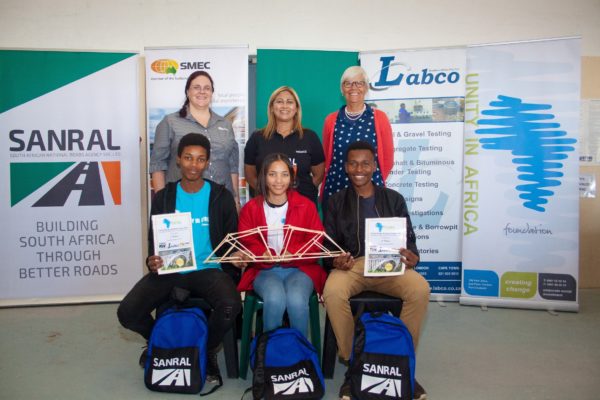
The winning team, from left, Likhaya Ntshiza (Molly Blackburn High School), Vicarlia Edinberry (Sanctor High School) and Samkelo Ngobese (Daniel Pienaar High School) were crowned the winners of the iGEMs bridge building competition hosted at the SANRAL Technical Excellence Academy Laboratory in Struandale, Port Elizabeth. They were joined by, Tronél Candiotes-Strydom from SMEC (from left, standing), Michelle Ah Shene from SANRAL and Laurene Booth-Jones from Unity in Africa Foundation.
More than 30 academically-deserving Grade 11 and 12 learners from disadvantaged and socio-economic vulnerable backgrounds got a glimpse of the civil engineering industrywhen they designed and built model bridges as part of the iGEMS holiday programme.
The South African National Roads Agency (SOC) Limited (SANRAL), together with SMEC South Africa, Labco and Unity in Africa Foundation collaborated in hosting the fifth annual iGEMS bridge building competition, where learners from 16 high schools were taught the skills required to plan and build a bridge.
The competition was held at the SANRAL’s Technical Excellence Academy Laboratory in early July.
Unity in Africa Foundation run a programme called incubating Great Engineering Minds (iGEMS).
The programme promotes engineering as a career among high school learners who have the potential to study engineering at a tertiary level.
Bridge building
The bridge building competition was one of a series of workshops, site visits and projects held during the July school holiday for the iGEMS learners.
The holiday programme is part of Phase one in a four-stage ‘education to employment’ programme, which incubates incumbents for about seven years until they graduate.
Based on the format and rules on the South African Institution of Civil Engineering’s (SAICE) bridge building competition, learners had to design and then build model bridges using only wooden sticks, rope and glue in a limited time frame following functional specifications and construction methods.
The bridges were judged on aesthetics, weight and structural strength. Strength testing was done using suspended weights that literally stretched the bridges to breaking point in an ultimate showdown between the 10 teams.
Samkelo Ngobese, a 17-year–old, grade 11 learner from Daniel Pienaar High School, said he is very passionate about engineering and wants to pursue a career in the civil engineering industry.
He said: “I want to study and pursue a career in civil because of the love I have for building infrastructures and safer roads for motorists.”
Ngobese’s favourite subjects at school are mathematics, which he obtained 70% and 78% in physical science and a level 5 in Civil Technology during this June exams.
“After doing a lot of research, I found that my favourite subjects are core subjects needed for civil engineering,” he said.
Vicarlia Edinberry, a 16-year–old, grade 11 learner at Sanctor High, experienced surprising qualities about herself during the iGEMS bridge building competition.
“Knowing how to work well with other members of the team was one of the surprising qualities. The competition taught me how to use my listening skills and consider other members’ opinions, and that is why we were able to work as a team and develop good communication skills,” Edinberry said.
She further added that civil engineering is interesting in such a way that it enables one to give back to the community and encourages one to do the best to their ability.
Likhaya Ntshiza, a 16-year–old, grade 11 Molly Blackburn High School learner, said the biggest highlight of the competition was working with his teammates who were focused on building their bridge and who knew how to share different ideas effectively with one another for the bridge to be a success.
“My team members and I had unique skills on how to build the bridge and everyone shared creative yet relevant ideas for the bridge” he said.
Ntshiza believes that with the relevant equipment and active team members, he can build a model bridge in future.
Investing in the future
“Investing in these high school learners is an investment in our country. Engineering is a scarce skill in the country. If we do not invest in the youth throughout their high school and university studies, we face the risk of not having engineers building and maintaining South Africa’s national road network,” said Mbulelo Peterson, SANRAL Southern Region Manager.
Peterson added that programmes initiated by SANRAL to address education and skills development, include among other, awarding of bursaries and scholarships to deserving students all over the country to further their studies.
In 2018, 41 scholarship and 16 bursary recipients were from the Eastern Cape. The low figure of bursary recipients in 2018 can be attributed to the fact that there was no institution offering a BSc & BEng in Civil Engineering qualification in the province.
In 2019, an additional four Eastern Cape students received a bursary. Going forward, the number of bursary recipients in the province is likely to increase now that Nelson Mandela University offer a BEng Tech in Civil Engineering degree qualification.
Other projects SANRAL Southern Region supports is the Science, Technology, Engineering and Related Management/Mathematics (STEM) Fields Pipeline Project in Port Elizabeth, hosted by the Nelson Mandela Bay University (NMU) which help high school learners improve their understanding of maths and science.
SANRAL’s Technical Excellence Academy (TEA) provides engineering candidates with the much-needed training to qualify for registration, which means they are likely to achieve the training outcomes required by the Engineering Council of South Africa (ECSA) sooner than candidates not in a similarly enabling environment.