SANRAL is leading the way through innovative road design and the application of technology to create a safe and sustainable primary road network.
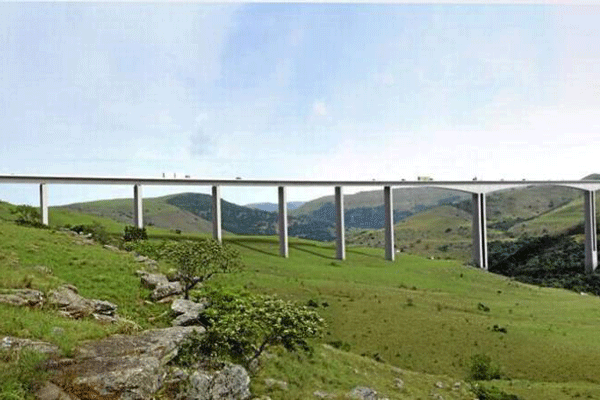
The Concrete Society of Southern Africa recognised the new 166-m Mtentu bridge for its “unique design features and construction techniques,” and gave it the 2019 Fulton Award for innovation.
Technology and innovation are changing road construction and road management throughout the world.
South Africa is no exception and SANRAL is leading the way through innovative road design, and the application of technology to create a safe and sustainable primary road network.
Through collaboration with universities and research institutions SANRAL contributes to knowledge generation in fields as diverse as transportation planning, road materials development and environmental conservation.
Innovation also played a major role in a recently completed road construction project:
To improve road safety a decision was taken to widen the bridge over the Olifants River on the N7 near Clanwilliam. However, the width of the original structure could not be increased, and the only workable solution was the construction of a second bridge running parallel to the existing one;
The Concrete Society of Southern Africa recognised the new 166-m bridge for its “unique design features and construction techniques,” and gave it the 2019 Fulton Award for innovation. SANRAL awarded the contract for this project to Stefanutti Stocks Coastal.
SANRAL’s most valuable assets are vested in its human resources. Through the years it has attracted an enviable group of engineers, professionals and artisans that are able to manage some of the continent’s most challenging infrastructure projects.
The pool of knowledge within the agency is enriched through collaborations with a wide range of contractors – including emerging enterprises – who bring their own skills and intellectual resources to construction projects.
These are some of the contracts SANRAL initiated during this year.
In several instances, progress was set back by cash flow difficulties experienced by contractors, including some long-established construction companies.
Contracts were awarded for several major projects during the year, including:
The strengthening of the R511 between Brits and Beestekraal in the North West. This R172–million contract was awarded to NZK Footprint Engineering. The commencement date was January 2019 and completion is scheduled for July 2020.
The construction of the cable-stayed bridge across the Msikaba River on the green fields section of the N2 Wild Coast road in the Eastern Cape. This challenging 36-month engineering project – the 580–metre bridge will be the second–longest main span bridge in Africa – was awarded to the Moto Engil/Concor Joint Venture. Valued at R1.9-billion, the project is scheduled to be completed in January 2022.
The design review and supervision contract for an upgrade of the N11 from the Newcastle industrial area through to Madadeni, east of Ladysmith in KwaZulu-Natal. The upgrade will improve road alignment, making it more direct, and will double the capacity of the road to a dual carriageway of freeway standard. The estimated construction cost is R531-million and the consultant is BVI Consulting Engineers Western Cape.
Construction of pedestrian facilities on the N2 between Umlaas Canal and Wandsbeck Road in eThekwini, KwaZulu-Natal. The project seeks to eliminate hazardous use of the road shoulder by large numbers of pedestrians and provide safer crossing facilities. It is valued at R29.7-million and was awarded to GNS Civils.
The location of and prospecting for new sources of road building materials located within 50km of national roads in KwaZulu–Natal. The contract, valued at R22.6-million, has been awarded to FDKL Engineering Consultants.
Significant construction delays were experienced on several projects. In several instances, progress was set back by cash flow difficulties experienced by contractors, including some long-established construction companies.
The affected projects were:
The improvement of the R573 from Siyabuswa to Marble Hall in Limpopo.
The N2 upgrade at Caledon, Western Cape.
The construction of a new bridge over the Gwaiing River at George, Western Cape.
The upgrade of the R61 from Baziya to Mthatha in the Eastern Cape was interrupted when contractor Basil Read went into business rescue in June 2018. The appointed business rescue practitioner was unable to finance completion of the project by Basil Read and the process of appointing a replacement contractor was at an advanced stage at the end of the financial year.
The number of projects delayed by financial difficulties of contractors was larger than usual in 2018/19.
Two projects were delayed due to modifications in the scope of work:
On the N6 between Rouxville and Smithfield in the Free State, poorer than expected ground conditions caused time and cost over-runs.
Modifications were made to the foundation design of the traffic control centre being built on the N5 near Senekal, Free State.
Generally slow progress, sometimes compounded by work stoppages and protests, also caused project delays.
Work on the N2/M41 Mount Edgecombe Interchange near Durban progressed slower than scheduled.
There were work stoppages at the Hammarsdale Interchange on N3, which exacerbated other delays.
The contractor abandoned work on the Mtentu River Bridge – part of the N2 Wild Coast Project – when community unrest disrupted an already-delayed project. SANRAL instituted court action aimed at securing resumption of work by the contractor.
Significant delays were experienced on three toll road projects:
The completion of the Polokwane and Musina ring road projects were delayed due to Basil Read experiencing cash flow problems and applying for voluntary business rescuein June 2018.
There was slow progress on the N1 upgrade between Holfontein Interchange and Kroonstad and penalties were imposed in May 2018 at a rate of R30000 a day.
To accommodate the surge in traffic, TRAC has conducted intense preparations it believes will assist to prevent heavy backlogs.
Extremely heavy traffic is expected on the route to the Lebombo Border Post in Komatipoort.
This festive season is expected to be extremely busy on the N4 Toll Route, with Trans African Concessions (TRAC) anticipating thousands of motorists to travel between Gauteng, Mpumalanga and Mozambique in December 2019 and January 2020.
To accommodate the surge in traffic, TRAC has undergone intense preparations it believes will assist to prevent heavy backlogs.
These include ensuring toll plazas are fully manned on peak traffic days, conducting double route patrols on earmarked days, and having its route patrol, roadside assistance and 24-hour Helpdesk teams on high alert throughout the festive period.
Traffic on the N4 Toll Route is expected to peak on 6, 7, 13, 14, 20, 21 and 22 December 2019 and 4 and 5 January2020.
On these days, all of TRAC’s response units, in collaboration with emergency services such as the SAPS, paramedics, Fire and Rescue and Provincial Traffic, will be deployed to strategic points along the route –Bronkhorstspruit, Middelburg, Milly’s, Mbombela (Nelspruit), Hectorspruit, Komatipoort and Matola Weighbridge (Mozambique) – to enhance incident/accident support.
Extremely heavy traffic is expected on the route to the Lebombo Border Post in Komatipoort.
Truck delays
Over the past few monthsTRAC has issued warnings about the heavy truck delays at the border and again warns members of the public of the current status quo.
Road users are urged to note that although delays at the border impact traffic flow on the N4, border clearing processes do not fall under TRAC’s jurisdiction or responsibility and it cannot be held liable for, or assist with, backlogs relating to this.
However, TRAC will work closely with the Lebombo Border Control Operational Coordinating Committee and Ressano Garcia Border officials to assist with traffic management measures to improve traffic flow.
This includes the provision of several logistical items and road user information.
Although the Lebombo and Ressano Garcia Border posts will be operational 24 hours from 13 December to 13 January, road users are advised that traffic management operations will be implemented from 11 December.
These include:
South Africa (eastbound)
A traffic control point at Coopersdal, where all vehicles are to come to a dead stop. Be patient and expect an approximate 30-minute delay;
Taxis will be diverted to the old Komatipoort Airfield, which has been prepped by TRAC to accommodate over 1 000 vehicles at a time. Clearing will be done at this facility and taxis will then be escorted to the border;
Commercial vehicles (trucks) will be redirected onto the Coopersdal road (R582) and?Strydomsblok to be processed at KM 7. These vehicles will return via the same route and queue at Mananga Road while awaiting border crossing;
Busses will also be cleared at KM 7;
Private vehicles must proceed straight on the N4 to the Lebombo Border Post. These road users are urged to stay in the right lane after passing the BP garage as the left lane will be reserved for trucks, convoys and official vehicles;
To avoid unnecessary traffic on the route, vehicles on theroute to Komatipoort, Kruger National Park or Ngwenya Lodge are advised to use the Tenbosch turnoff;
Mozambique (westbound)
There will be three (3) lanes of traffic in the westbound lane and one lane in the opposite direction;
There will be six (6) stop areas, one next to Moamba, for observation purposes only, one compulsory stop at KM 10 and KM 14, and another one next to the cemetery in Ressano Garcia;
On the remaining three locations the traffic will be split as follows:
Main dispatching of travellers at KM 4 and KM 7;
Organising of police escort at KM 4;
Each control point will be manned by the police, customs and immigration officials;
Public transport terminal will be transferred to the Ressano Garcia Border Post.
TRAC is also pleased to announce that construction on the N4 Toll Route will be on hold during the construction sector’s annual leave period, from 13 December 2019 to 6 January 2020.
However, all construction areas will still be deemed active and road users are urged to be cautious and obey road signage.
The safety and wellbeing of the N4 Toll Route’s road users is TRAC’s primary concern and it urges everyone using its beautiful route this holiday season to make full use of this initiative by calling the TRAC Helpdesk on 0800 87 22 64 for quick, effective assistance for any problem.
TRAC further encourages road users to stay abreast of news about the route, throughout the festive season, by following it on Twitter@TRACN4route or visiting its website atwww.tracn4.co.za.
In 2018/19 contracts to the value of R5 206 million were awarded to black-owned companies.
In 2018/19 contracts to the value of R5 206-million were awarded to black-owned companies.
SANRAL’s bold initiatives to transform the construction industry and maximise the participation of black contractors, professionals and suppliers are yielding tangible results.
The agency’s transformation policy recognises the critical role it plays in the construction and engineering sectors, and the impact it can have on millions of people across the country.
Much progress has been made in the past financial year to implement SANRAL’s commitment to transformation, including:
The breaking down of monopolies in supply chains for construction materials, equipment and technology, and ensuring maximum participation of black individuals and companies;
The creation of development programmes and partnerships within the industry to ensure the rapid growth of black entities. SANRAL facilitates partnerships between major suppliers of equipment and technology and emerging enterprises that need access to such equipment to enable them to tender for larger work packages;
An increase in the number of community development projects undertaken in small towns and villages adjacent to the SANRAL network. These projects enable SANRAL to train, mentor and nurture new black contractors in rural areas and provide them with entry points into the mainstream construction sector.
In 2018/19 contracts to the value of R5 206–million were awarded to black-owned companies. More than 70% of contracts for the construction and maintenance of national roads were awarded to them and the share of value increased to 61% from 53% in the previous year.
The growing presence of women in the construction sector is particularly encouraging. No less than 25% of total contract value was secured by companies owned by black women.
WHAT IS THE LENGTH OF SANRAL ROADS CURRENTLY IN LIMPOPO
The length is 3 645km.
LIST OF SANRAL ROADS IN LIMPOPO:
N1 from Gauteng-Limpopo boundary to Beit Bridge border post
N11 from Mpumalanga-Limpopo boundary to Grobler’s bridge border post
R33 from Marble Hall to Lephalale
R36 from Mpumalanga-Limpopo boundary to N1 Bandelierkop
R37 from Polokwane to the Limpopo Mpumalanga boundary
R40 from Mpumalanga-Limpopo boundary to R71 Phalaborwa
R71 from Polokwane to Phalaborwa
R81 from Polokwane to Giyani
R81 Gasekgopo to Munnik
R101 from Bela Bela to Polokwane
R510 from North West-Limpopo boundary to Monte Christo
R511 from North West-Limpopo boundary to R510 near Thabazimbi
R516 from Bela Bela to Thabazimbi
R518 from Lephalale to Lebowakgomo
R520 from Vaal water to R510
R521 from Polokwane to Vivo
R523 from Vivo to Masekwaspoort
R524 from Makhado to Kruger National Park (Punda Maria)
R526 from Mica to R71
R529 from R71 to Giyani
R531 from R40 to Kruger National Park
R532 from R36 to Mpumalanga-Limpopo boundary
R555 from Stofberg to Burgersfort
R567 from N11 to Seshego
R572 from Monte Christo to Tom Burke
R573 from Siyabuswa to Marble Hall (Moloto?Road)
R574 from R33 near Groblersdal to Mmotwaneng
R578 from Makhado to Giyani
R579 from Mmotwaneng to Lebowakgomo
WHAT PROJECTS ARE CURRENTLY UNDERWAY IN LIMPOPO?
R573 Moloto Road
N1 Polokwane ring road
N1 Musina ring road
R518 Lephalale to Marken
WHY DOES SANRAL DO SO MUCH MAINTENANCE WORK ON LIMPOPO ROADS?
SANRAL does so to protect the roads to international standards. What the agency has spent on routine road maintenance has remained roughly consistent with amounts spent in the last two years as these mundane activities are critical to preserving the lifespan of roads and maximising the return on capital investment.
HOW HAS THE N1 HELPED UNLOCK THE ECONOMIC POTENTIAL OF THE REGION?
It has provided the necessary road connection between different regions. This enables the efficient transportation of goods, coal and produce. It also provides a good connection to Limpopo’s tourist attractions. Importantly, the development of the N1 stimulated the creation of opportunities for contractors, SMMEs and local labour, as well as other related businesses through downstream activities.
WHY IS THE R573 MOLOTO ROAD UPGRADE IMPORTANT?
The Moloto Road is an economic route connecting the Limpopo, Mpumalanga and Gauteng provinces. It serves 50 000 commuters daily. This road is notorious for its high fatality rate. Upgrades will have a positive impact on the lives of many people and save lives. The construction of the road will also create employment and opportunities for the development of small contractors, suppliers and other businesses.
HOW IS SANRAL CONTRIBUTING TO LOCAL JOB CREATION?
Suitably qualified emerging enterprises are given an opportunity to perform some of the work awarded to main contractors. As per the policy for SMME development, main contractors are required to subcontract 30% of the contract value to SMMEs of CIDB grading 1-6. In certain cases, main contractors enter joint ventures, with an 80/20 split between a 9CE main contractor as the lead partner and lower grading contractors (5CE, 6CE or 7CE) as the JV targeted partner.??
WHAT DO BETTER ROADS IN LIMPOPO MEAN FOR OUR ECONOMY?
Road infrastructure plays an important role in the national economy. Limpopo has much to offer tourists. It is vital to have good roads to enable easy access to tourist attractions. Roads are also a conduit to export markets.
HOW DO I BRING ROAD CONDITIONS TO SANRAL’S ATTENTION?
All SANRAL-managed roads have road signs that display contact numbers on which road conditions on that road can be reported. Otherwise SANRAL’s Northern Region Office can be contacted during office hours on 012-426-6200.
It will function as a freeway with controlled access to and from the N1 highway.?
The duration of the contract for the outstanding works is 24 months and is estimated to end in October 2021.?
The South African National Roads Agency (SOC) Limited (SANRAL) is pleased to report some progress on the Musina ring road project, which began in 2016 and unfortunately stopped in March 2018.
Located on the western side of the Musina CBD, the project consists of 8km of new single carriageway roadway with one lane in each direction and paved shoulders.
It will function as a freeway, with controlled access to and from the N1 highway. After the original contractor was unable to complete the project due to liquidity issues, the contract was ceded under law to a different contractor.
This was done through a guarantor who obtained prices from several contractors.
After evaluation, the guarantor proposed the contract be ceded to Raubex.
Raubex’sappointment includes the completion of some earth and layer works, the bridges and the newly–built houses that will be handed over to community members who will be relocated due to the construction of the road.
Speaking about the impact on SMMEs and local labour, Progress Hlahla, SANRAL’s Northern Region Manager, said: “We are trying to ensure locals and SMMEs who were engaged by the previous contractor can be honoured by the new contractor”.
The duration of the contract for the outstanding works is 24 months and is estimated to end in October 2021.
Dr Monica Mochadi, the MEC for Public Works, Roads and Infrastructure in Limpopo, believes SANRAL’s contribution to the transformation of the construction sector must be applauded.
Road safety remains a major concern considering the high volumes of vehicles that travel on our roads, especially during high peak periods.
The Limpopo provincial government is committed to the expansion and improvement of our primary road network.
Roads play a critical role in all of the priority economic sectors identified in the Provincial Growth and Development Strategy, most notably tourism, agriculture, mining and commerce.
The bulk of our products and services are carried on the primary road network and none of our world-class heritage and tourism sites would be accessible without the existence of well-designed and well-maintained roads.
It is encouraging to note some of the critical construction projects that were placed on hold have now resumed.
We are looking forward to the completion of both the Polokwane and Musina Ring Roads, which will contribute greatly to improved traffic flows on the vital N1 freeway and create a much safer environment for all road users.
Road safety remains a major concern considering the high volumes of vehicles that travel on our roads, especially during high peak periods.
We thus welcome the installation of cutting-edge technology near the Kranskop Toll Plaza in Modimolle, which has already contributed to a reduction in fatalities on one of the busiest stretches of roads.
SANRAL’s contribution to the transformation of the construction sector must be applauded.
An increasing number of black-owned companies and enterprises owned by women are now participating in construction and road maintenance projects, and acquiring skills that will enable them to grow and create more jobs.
This is an opinion piece by, Dr Monica Mochadi, the MEC for Public Works, Roads and Infrastructure
Although truck traffic build-up is not a new dilemma on this part of the route, volumes have escalated considerably since September 2019.
Road users, local landowners and businesses have approached TRAC about the problem, which has TRAC extremely concerned for numerous reasons.
As the holiday season approaches – during which high traffic volumes are expected on the N4 Toll Route – Trans African Concessions (TRAC) remains concerned about the truck backlog on the route to the Lebombo Border Post.
The delays, about which concerns were raised earlier this month, have intensified, with truck queues now starting 5km from the Komati Load Control Centre on some days.
Although truck traffic build-up is not a new dilemma on this part of the route, truck traffic volumes have escalated considerably since September 2019.
Lack of capacity
Road users, local landowners and businesses have approached TRAC about the problem, which has TRAC extremely concerned for numerous reasons.
These queues not only block farm and business entrances, they also obstruct traffic flow and create safety hazards, which are concerning ahead of the upcoming peak travel period.
TRAC recently met with Lebombo Border Post management and other stakeholders to understand the reasons behind the backlog, which, according to officials, is mostly due to a lack of capacity at the border.
The officials said that the truck traffic is simply too excessive to be accommodated adequately.
In a bid to improve safety in the affected area and alleviate some of the frustration, TRAC has erected a four-way stop at the Komatipoort/Sasol Garage Intersection.
TRAC believes this will at least improve vehicle movement across the intersection.
However, further intervention from the relevant authorities is needed to eradicate the problem.
Clearing procedures must improve drastically and additional human resources arerequired, especially during the upcoming holiday season.
TRAC is also of the opinion that expansion is overdue at the Komati Load Control Centre, which is managed by TRAC and owned by SANRAL.
This should include the expansion of the facility through the addition of a second layby and improvements to the access road.
Remain patient
In view ofthe build-up, TRAC urges all road users to take care when driving on this section of the route, to remain patient and adhere to road regulations.
TRAC also encourages road users to plan their trips, especially over the holiday period when high traffic volumes are expected.
The Lebombo Border will be operational 24-hours a day from 13 December 2019 to 13 January 2020, which will alleviate some of the congestion.
For more information, traffic updates or to report a problem, call TRAC’s 24-hour Helpdesk on 0800 87 22 64/082 881 4444 (RSA) or +258 84 34 34 34 6 (Moz). Alternatively, follow on Twitter @TRACN4Route.
SANRAL’spriority is to ensure there is a viable primary road network in place that can serve as a catalyst for economic growth and development.
Skhumbuzo Macozoma, SANRAL CEO, said Limpopo remains a key player in the improvement of our country’s economy..
Our mandate as the national road’s agency is to finance, improve, manage and maintain South Africa’s national road infrastructure.
Roads in Limpopo have improved significantly since their handover to SANRAL. This has been no easy task, but it has been worth it.
From SANRAL’s perspective, we have made sizeable investments in infrastructure projects in Limpopo ranging from new road construction and major improvements, to special maintenance and rehabilitation projects.
Our priority is to ensure there is a viable primary road network in place that can serve as a catalyst for economic growth and development, and facilitate the efficient delivery of all services to communities.
World-class roads
Let’s talk about some of the great work our world-class team of engineers has been doing on parts of the 3 645km of Limpopo’s roads under SANRAL’s management.
They have placed a major focus on ensuring these roads are engineered to international standards, and for the safe and efficient mobility of road users.
While we have been working hard to maintain these high standards, we have encountered some challenges.
From delays of some of our project work due to higher than usual temperatures, to a complete halt of work on the Polokwane and Musina ring roads due to financial troubles experienced by the contractor.
It is with great pleasure, however, I can confirm that there is progress on these sections of the N1, which is a key link to the rest of Africa.
Another notable project underway in Limpopo is the rehabilitation of the R81 from Gasekgopo to Munnik.
We are excited about this improvement as the deterioration of this road posed a major safety risk to road users.
The road works on the R573 (Limpopo section) are progressing well.
Limpopo remains a key player in the improvement of our country’s economy. Our routine road maintenance projects will also go a long way towards uninterrupted mobility for road users wanting to take advantage of the province’s booming tourism, agriculture and mining industries in the province.
As has become customary for SANRAL in recent years, the regional team, as part of our ongoing engagements with communities around the country, hosted a Taking SANRAL to Elias Motsoaledi event where pertinent discussions around the empowerment of emerging black–owned businesses took place.
It is our belief that through these engagements and the implementation of our transformation policy, we will be able to meaningfully contribute to the eradication of poverty, unemployment and inequality.
This is an opinion piece by Skhumbuzo Macozoma, SANRAL’s CEO
Despite financial pressure, SANRAL has continued with construction and maintenance programmes, and remains committed to social and economic transformation.
Macozoma said that SANRAL’s existing policy of affirming black contractors through the tendering system delivered more opportunities than in previous years.
The social and economic climate prevailing in 2018/19 presented numerous challenges to the South African National Roads Agency (SOC) Limited(SANRAL).
With a reduced allocation of R12?369–million from the fiscus and continued financial pressure on the toll portfolio due to the sustained under-collection of e-toll fees, SANRAL had to carefully consider how to utilise existing resources.
Our first concern was to keep our programme of construction on toll and non-toll roads moving steadily forward with as little delay as possible, and to protect our road assets by sustaining essential road maintenance work.
Social justice and economic transformation
It was also imperative to resist sacrificing or putting “on hold” our commitment to social justice and economic transformation.
It was equally important to continue our investment in human capital for a future construction sector, in road safety,in the physical development of rural communities and more.
Our investment in road development, improvement and maintenance for the year was R12?680–million – 19% lower than the preceding year.
Our spending on routine road maintenance remained roughly consistent with amounts spent in the last two years.
The year also saw the first measures to implement the Transformation Policy launched in 2017.
SANRAL has always used its contracting power to enable black contractors to participate in the construction industry.
But it had limits: black contractors encountered solid barriers to securing major contracts for complex projects.
To counter this, four partnerships were concluded to ease the purchasing of equipment and provision of mentorship.
Our existing policy of affirming black contractors through the tendering system delivered more opportunities than in previous years.
However, the value of actual work performed by SMMEs and the number of work and training opportunities were affected by the number of work projects available.
Yet, we allocated the highest amount yet – nearly R25-million – to bursaries for staff members, university students and scholarships for high school learners.
Our road safety education programme reached approximately 200 000 learners and we continued to fund mass media campaigns to improve road safety.
This is an opinion piece by Skhumbuzo Macozoma, the CEO of SANRAL.