

Blog

SANRAL empowers SMMEs

Dolosse-1
The dolosse are interlocking blocks of concrete and are being manufactured at the Markman Casting Yard.


The South African National Roads Agency Limited (SANRAL) is empowering small business in the Eastern Cape and driving South Africa’s National Development Plan (NDP).

South Africa’s NDP or Vision 2030 aims to eliminate poverty and reduce inequality by 2030. According to the plan, South Africa can realise these goals by drawing on the energies of its people, growing an inclusive economy, building capabilities, enhancing the capacity of the state, and promoting leadership and partnerships throughout society.

SANRAL has contracted small businesses in the Eastern Cape to manufacture dolosse, which are used to protect N2 freeway and parallel railway line adjacent to the Settlers interchange in Port Elizabeth from destructive waves from the sea.

The dolosse are interlocking blocks of concrete and are being manufactured at the Markman Casting Yard.

Thabiso Ngozwana, SANRAL Southern Region project manager, said: “Twenty people, five each from the four SMME sub-contracting companies, received training.

“The four SMME sub-contracting companies were selected for the 17 SMME packages which were identified and advertised as part the N2 Bramlin to Soutwerke (Port Elizabeth bypass) special maintenance project.”

Skills development at the heart of SANRAL

The training was provided by Meroe Skills Development in July this year and included practical sessions on the cleaning and assembly of concrete form work, basic concrete technology, concrete mixing, placing, finishing and testing.

The course was offered as part SANRAL’s Small Contractor Development, Training and Community Participation programme and is aimed at creating sustainable enterprises.

“It was important for SANRAL to host the concrete training and to empower local SMMEs in the manufacture of pre-cast concrete products and to increase local participation on the N2 project,” said Ngozwana.

Portia Ngcwabe, who has a post graduate degree in management and is the owner of Phefong Construction had five of her staff attend the concrete training programme.

She said: “By attending the workshop my staff can produce good products and do any concrete work. In the past the staff would receive on-the-job training from the contractors but this was an opportunity for them to gain skills and a qualification.

“This is a great opportunity for black women especially in the civil engineering industry which is dominated by men.”

Nwabisa Mgubasi, a qualified architectural draughtsman and co-owner of Sokhazimla Trading CC also attended the concrete training and said she now knows how to mix concrete properly.

“I learnt the ratio of how to get the different strengths of concrete. This is an amazing opportunity and I am now also in a position to impart my knowledge to the next person,” she said.

Nathi Lusizi who works for Magna Civils said the course was very informative. “I not only know how to mix and make concrete but also know how important it is to vibrate the concrete to make sure there are no bubbles trapped in the concrete mix.”

Where to now on the N1/N2 Winelands project?

Following a decision by the Western Cape High Court SANRAL, on the advice of its legal representatives, lodged its application for leave to appeal to the Constitutional Court. The project is more than a decade in the making. It was conceived to improve the link between the Western Cape and the rest of the country, and is a strategic infrastructure project necessary to sustain and develop the Western Cape economy and bring significant economic development.

Moody’s Review

SANRAL was placed under review by credit rating agency, Moody’s, in September. Issues outside of SANRAL’s control has forced the review, such as FutureGrowth’s stated aversion to investment in state-owned enterprises and pronouncements by detractors which is causing motorists to disobey the laws of the country and contribute to a lower level of cash receipts from e-tolls. SANRAL is confident that it can overturn the review as it manages two portfolios: toll and non-toll. The toll portfolio is less than 15% of SANRAL’s total portfolio, is managed as a global portfolio and does not separate specific toll routes for project financing.

Highly successful September bond auction held

The bond auction was held on 14 September. Total bids of more than R1. 7 billion were received which meant it was more than three times oversubscribed. Of this, R988 million was allocated on bond HWS09 at a spread of 143 basis points. The success of the auction means that SANRAL’s Going Concern status is intact.

Update on the N2 Wild Coast Toll Road

Good progress is being made on the N2 Wild Coast Toll Road (N2WCTR) project with various work packages and activity streams for the greenfields section going ahead in the first two quarters of the 2016/17 financial year.

According to Craig McLachlan, project manager for the N2WCTR, activities so far this year focused on the procurement of service providers for engineering work packages of the greenfields portion of the road, stakeholder consultation, SMME outreaches, training and development, and land acquisition.

“Importantly, we plan to break ground in November this year with the construction of the service roads to the bridge sites,” he said.

n-route_lead3_update-on-the-n2-wild-coast-toll-road

BRIDGES

A key feature of the N2WCTR project will be two architectural landmarks for the rural Wild Coast landscape in the form of two mega bridges – part of the greenfields portion of the road – over the Mtentu and Msikaba river gorges.

Pre-qualified bidders for the mega-bridges were taken on a site visit to the Mtentu and Msikaba River gorges as part of preparation for the submission of their bids. The closing date for the proposals is 12 December 2016, and SANRAL will appoint the service provider in 2017.

Construction of the two mega bridges will begin early in 2017.

SERVICE ROADS

Service road must be built to enable the appointed service providers to access the bridge sites. SANRAL appointed two service providers in October to build the 19 kilometre haul roads to the construction locations of the Mtentu and Msikaba sites.   Construction of the service roads is due to start this month.

SMME OUTREACHES

In July, SMMEs and businesses from the surrounding towns, communities and villages had an opportunity to engage SMME support agencies and businesses together with SANRAL. The meeting focused on the opportunities before, during and after construction of the N2WCTR and the programmes and commercial products available to assist them.

COMMUNITY DEVELOPMENT

A community development programme for a group of 32 participants from the communities of Flagstaff, Lusikisiki and Port St. Johns kicked off in August.  The 18-month programme comprises training in entrepreneurship, engineering, tendering and general life skills.  Following the completion of the programme, the participants will be involved in delivering community access roads.


ENVIRONMENTAL MANAGEMENT: SEARCH & RESCUE MISSIONS

On the environmental front, ‘search and rescue missions’ will take place before construction of any section of the project. These missions are scheduled between September 2016 and February 2017.  SANRAL has appointed a service provider with botanical and conservation expertise to implement aspects of the environmental management plan for the N2WCTR. The service provider will be responsible for ‘search and rescue’, horticultural and rehabilitation services of threatened, protected and rare plant species.

International road safety lessons

Road safety is a global priority and South Africa is playing a leadership role in the international efforts to reduce deaths and minimise the impact of injuries resulting from accidents.

The United Nations has launched a Decade of Action for Road Safety in 2011 to address the concern that nearly 1.3 million people are killed on the world’s roads every year – and a further 50 million are disabled for life or severely injured.

n-route_lead-2_road-safety

A year ago, the Minister of Transport, Ms Dipuo Peters, attended a high-level conference in Brazil where countries provided mid-term feedback on the implementation of the Global Action Plan. This was an opportunity to measure South Africa’s success against international standards but also to learn from best practices adopted by other countries.

On her return Minister Peters said South Africa is making remarkable strides in the implementation of safety programmes – but there are also key lessons to be learned from the global experience:

  1. Road safety management must be reconfigured to effectively address the key challenges in the country.
  2. The mind-set of traffic policing must be shifted towards education and information for road users about the objectives behind traffic regulations.
  3. The successful implementation of road safety policies is dependent on productive partnerships between government, the corporate sector, civic society and communities.
  4. The youth must be increasingly mobilised to promote road safety policies and mobilise society.
  5. Road safety education aimed at children must be stepped up and supported by active measures to promote safety devices such as child restraints in vehicles.
  6. The “Safe Systems Approach” should be implemented for all future engineering and construction projects. This approach recognises the need to introduce engineering solutions to prevent deaths and reduce injuries in crashes caused by human errors.
  7. Road safety management should be professionalised through academic development programmes and twinning partnerships.
  8. There must be active participation from the business sector, civic society and NGOs to introduce road safety programmes and mobilise resources to extend education, training and awareness among all communities.

Gordhan gives nod to tolling

SANRAL welcomed the measured Medium Term Budget Policy Statement tabled in Parliament by Finance Minister, Pravin Gordhan, on 26 October.

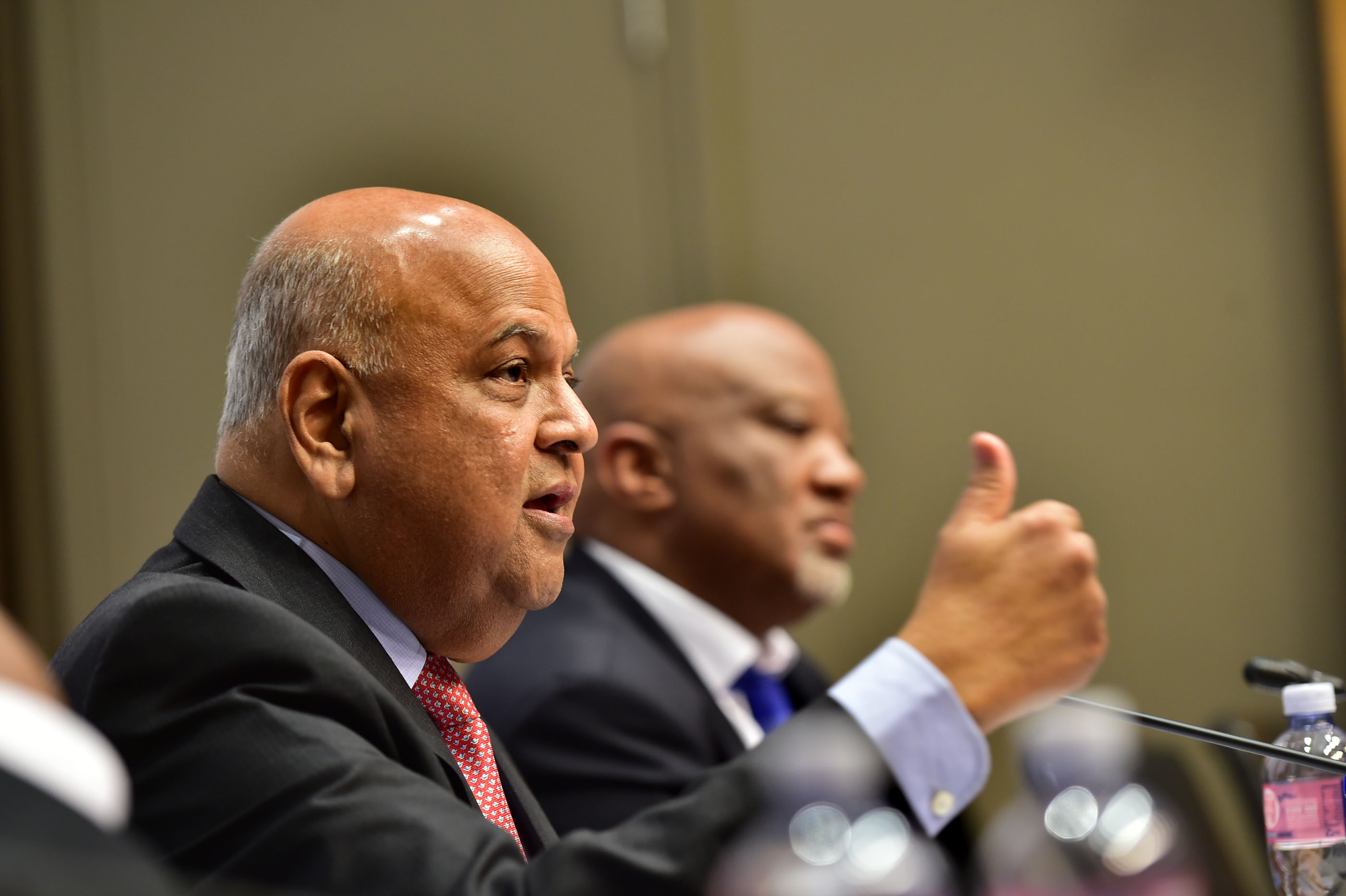
Finance Minister Pravin Gordhan addresing the media during the Mid Term Budget Speech (MTBS) in Imbizo, Parliament in Cape Town. 26/10/2016 Kopano Tlape GCIS

“In these tough economic times, it was heartening to see government’s unequivocal commitment to infrastructure spending, support for a number of SANRAL projects and most importantly the principle of tolling,” said Dumisani Maluleke, Deputy Chief Financial Officer at the roads agency.

Although public attention was strongly focused on government’s response to the crisis in higher education the two recurring themes in both the Budget speech and Medium Term statement – MTBPS – were reductions in public sector spending and increased investment in physical infrastructure, including roads.

Maluleke said: “This framework is of significant importance to SANRAL because it demonstrates government’s commitment to infrastructure investment in general – and roads in particular – and offers advance indications of long-term shifts in expenditure or revenue patterns that might be in the pipeline.”

The Budget statement lists six issues which are causing “rising spending pressures” across the public finances. These range from the public sector wage bill and rising costs of health care to the depreciation of the exchange rate. However, it also singles out the issue of funding of South Africa’s road infrastructure.

Congestion is growing on the national road network and the condition of many provincial roads is deteriorating, but there is uncertainty about the funding model for expansion and maintenance.

Minister Gordhan listed two primary SANRAL projects as examples of investment in economic infrastructure in line with the National Development Plan, namely the Moloto Road upgrade and the N2 Wild Coast Toll Road.

Funding for the N2 Wild Coast Toll Road – including the envisaged nine bridges – will be from the Budget, and importantly, “the road upgrades will be tolled.”

With this statement the principle of the user-pays or tolling, to fund major road infrastructure projects, has been endorsed at the highest level.

SANRAL the bridge to skill development

bridges-1
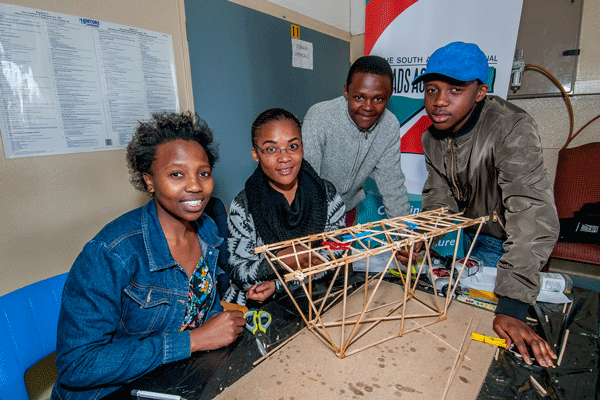
(From Left – Right) Ntandokazi Baxana (Ethembeni Enrichment Centre), Lusanda April (Woolhope High School), Enzokuhle Ziyekile (Solomon Mahlangu High School) and Solomzi Sokupa (Woolhope High School) busy with finishing touches to their warren truss bridge.


The South African National Roads Agency Limited (SANRAL) is developing new talent that will take South Africa to new heights when they hosted a model bridge building competition for high school learners in the Eastern Cape.

Skills development is an important pillar in South Africa’s National Development Plan or Vision 2030 as it will ensure a capable workforce to support an inclusive growth path.

SANRAL along with Unity in Africa iGEMs and SMEC South Africa hosted a model bridge building competition in Struandale, New Brighton.

Thirty scholars from 18 high schools around Nelson Mandela Bay attended the competition and all they had to their use was pine wood, tubes of glue and some string to make their models.

The bridges were judged according to aesthetics and the weight the bridge was able to withhold before it collapsed. The aim of the competition was to teach the learners about the basic principles of infrastructure engineering.

The competition, which started two years ago, is based on The South African Institution of Civil Engineering’s (SAICE) Bridge Building Competition.

Laurene Booth-Jones, programme co-ordinator, said: “Our first intake saw 16 students register on the programme and our second intake saw double the number. Our ‘education to employment’ programme offers students a practical understanding of the theory through learnerships at one of our partner companies. Learners who are passionate about engineering are our passion.”

The first phase of the programme is Grade 11 and 12 extra classes. During phase two all the learners attend learnerships at one of our member companies. In phase three the student gets enrolled in university. The students get the opportunity to go back and work in one of the member companies in phase four.

Sean Strydom, SANRAL’s Southern Region construction materials and project manager, said: “There is a need for employable, professional, well-trained engineers. iGEMs allows the learners that go through the programme to walk away with lifelong knowledge and experience.

“A Cape Town version of the programme (Go for Gold) has seen one of the program graduates receive a bursary from SANRAL. SANRAL supports youth development and we understand the need for it. We are pleased we were afforded the opportunity to host such a programme of stature here at the SANRAL Materials lab.”

Tronél Candiotes-Strydom, professional technologist (Roads and Highways) at SMEC South Africa, also played a vital role in organising the bridge building competition.

Strydom said: “We are passionate about learners who are currently disadvantaged. We want to give these learners an opportunity to uplift themselves so that they have a shot at a better future. We just want to make the world a better place, and we are glad we had the opportunity to influence the lives of these learners in a positive way.”

SANRAL and its university partnerships

UCT-1
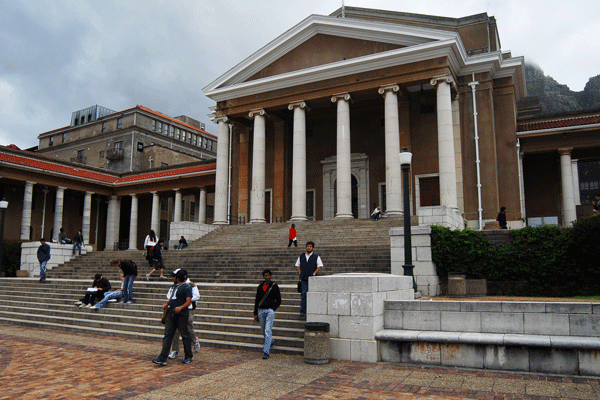
A skilled and capable workforce will support an inclusive growth path according to South Africa’s Vision 2030.


SANRAL is dedicated to providing skills development to the future workforce of South Africa and has therefore partnered with various academic institutions to achieve this.

SANRAL has partnered with Wits University, University of the Free State (UFS), as well as Nelson Mandela Metropolitan University.

South Africa’s National Development Plan, or Vision 2030, insists skills development will provide a skilled and capable workforce to support an inclusive growth path.

Wits University Targeting Talent Programme

SANRAL funded 49 of the 797 learners who participated in the developmental Targeting Talent Programme (TTP) at Wits University in 2015. A key objective of TTP is to facilitate a smooth transition to higher education for promising learners.

During 2015, there was a Mathematics and Science Supplementation Session in March and April and 43 of the SANRAL-funded TTP learners attended. In addition, Wits University hosted a Residential Academic Enrichment Camp in June and July. It catered for 900 learners in grades 10, 11 and 12 and was funded by the Department of Science and Technology, SANRAL, Beyond Petroleum South African Education Foundation Trust (BPSA EFT) and the Industrial Development Corporation.

In 2015, information was gathered on the current activities of a group of 140 young people who had been funded by SANRAL and BPSA EFT to participate in TTP in 2012. This revealed that 92.9% of the group had gone on to higher education. In addition, it showed that:

  • Wits University was the institution most often selected 36.9% of the students studying there. The University of Limpopo and University of Johannesburg were attended by 13.8% and 13.1% of the group respectively.
  • A large majority of the former TTP participants opted for science and maths-based degrees.
  • About half the group, 47.7% to be exact, had advanced to their third year of study in the minimum time possible. About 42% were in their second year of study, which could indicate either a gap in studies or a need to repeat a number of subjects.

Science-for-the-Future at University of the Free State

During 2015, SANRAL signed a three-year partnership agreement with the UFS to continue supporting its Science-for-the-Future programme. This comprises two distinct elements:

  • An ICT Laboratory Programme that delivers e-education in science and maths to high school learners with a talent and passion for these subjects.
  • The Family Math and Science Programme which equips educators to deliver activity-based sessions on maths and science for young learners and their families, in order to demystify these subjects and build the interest and confidence required to succeed at them.

Nelson Mandela Metropolitan University Science, Technology, Engineering and Mathematics Pipeline Project

The Science, Technology, Engineering and Mathematics Pipeline Project (STEM PP) project aims to develop the skills of grade 10-12 learners in Port Elizabeth and Uitenhage schools. The goal is to increase the number of learners who qualify to study for a degree in a science-related field.

Through regular laboratory sessions, STEM PP uses experiments to teach concepts, improves theoretical understanding, exposes learners to ICT, and fosters an interest in science as a subject and engineering as a career. SANRAL invested R1.72-million in this project in 2015.

It has grown steadily since 2010 and in 2015 further expansion was facilitated by access to additional laboratories. The number of participants increased by an impressive 36%, from 1 603 in 2014 to 2 181 in 2015. This includes a small number of student educators and educators.

Top Employer accolades

Top-employer-1
SANRAL prides itself in proving exceptional employee conditions which are achieved partly through acquiring talented staff and then nurturing and developing them throughout all the levels of the organisation.


The South African National Roads Agency Limited (SANRAL) has been bestowed the honour of being a Top Employer for 2017 by the Top Employers Institute.

This was announced at a gala dinner in Pretoria on 13 October 2016. This makes it SANRAL’s 7th Top Employer certification in the last decade.

At the event, 164 organisations spanning 32 countries representing 23 industry sectors were honoured and certified.

Heidi Harper, Corporate Services Executive at SANRAL, said: “The certification is a great achievement for the agency’s commitment to adding value to their staff and ensuring employment equity at every level of the business.

“SANRAL believes that employees are at the core of what the agency achieves. We believe in creating a balanced workforce which embraces diversity, especially since we live in a multi-cultural and multi-racial country.”

Top Employer seal of approval

As a certified Top Employer, SANRAL proudly wears the exclusive certification seal for an entire year. The seal is not only a recognisable symbol of the organisation’s successful employee environment over the past 12 months, but also of its commitment to develop and become an even better employer.

The Top Employers Institute is a Netherlands based independent organisation which surveys employers and their employee conditions in South Africa and measures them against international standards.

Their certificate is only awarded to companies that achieve the best standards of excellence in employee conditions. To determine the winner, participating companies have to complete an international HR best practices survey. All results are independently audited to verify the standard of employee conditions.

Samantha Crous, Regional Director Africa Top Employers Institute, said: “Top employership is clearly more than good business practice, it is business leadership at its best.”

SANRAL prides itself in proving exceptional employee conditions which are achieved partly through acquiring talented staff and then nurturing and developing them throughout all the levels of the organisation. The results of which are remarkable. For example, stats show that 95.4% of SANRAL employees are committed to their roles and 85.5% found their role enjoyable.

The roads agency also runs an effective occupational health and safety structure where trained safety officers ensure that safety is observed by all staff members. Through initiatives like the eKhaya Wellness Programme, SANRAL aims to enhance the employee and workplace effectiveness by encouraging the prevention, early identification and management of health conditions affecting employees and the resolution of personal issues.