
Blog

Rural spectacle


model-1Bridges have fascinated people through the centuries; their purpose is self-evident as being the link between transportation routes be they footpaths, railways or roads. Although its primary purpose is functional and it must be safe to use, a bridge can be a thing of beauty.

Some of the world’s bridges have become tourist attractions in their own right; the Golden Gate Bridge in San Francisco, Sydney Harbour Bridge in Australia and Millau Viaduct in France are just a few examples. People are especially fascinated by large bridges.

Of South Africa’s 750 000km of highway, some 22 000 falls under the jurisdiction of the South African National Roads Agency, SANRAL, which includes approximately 9 500 bridges and major culverts.

Two spectacular bridges on the new N2 Wild Coast Highway – the Msikaba River Bridge and the Mtentu River Bridge –– are about to be added. The first steps towards making this a reality were taken recently in inviting tenders for the two bridges. Apart from making a major contribution to transport infrastructure and to the well-being of the people who live along the new Greenfields portion of N2 which is about 113km in length, the bridges will be true landmarks of international note. In searching for safe and economical designs Sanral has also driven the need for aesthetic designs that will act as positive landmarks for the new highway. It is our view that this aim was achieved in that a good balance was struck between economy and aesthetics in the final solutions that were adopted.

The designs of the bridges are complete and tenders have been invited. Due to the size and complexity of the two bridges, the tender process will only be completed early in 2017 and construction is programmed to begin in the middle of 2017.

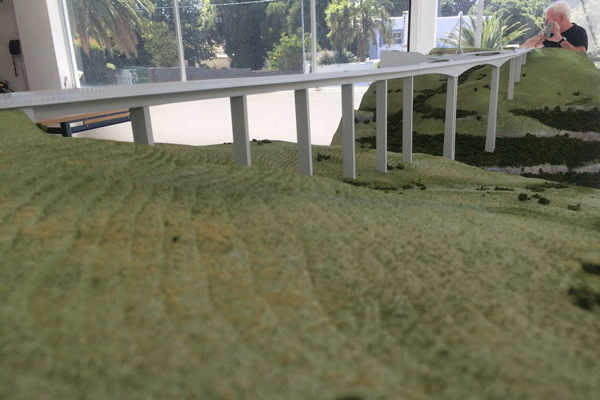
The Msikaba River Bridge will be 580m single span cable-stayed bridge. The bridge is a unique spectacular structure that crosses a deep forested gorge which is flanked on each side with high sandstone cliffs. At no stage will work be done in the gorge and the deck will be cantilevered out from the banks using conventional construction techniques. The bridge is 190m above the river and the bridge erection team will undoubtedly presented with some challenging weather conditions. The deck is a composite steel and concrete deck of overall width of 22.8m. Four traffic lanes with narrow shoulders are provided for and two 1.4m wide pedestrian footway. This bridge will be the largest span cable-stayed bridge in South Africa.

model-3

Some 18km north of the Msikaba River is the proposed Mtentu River Bridge. The deck of this bridge is some 220m above the river and it will be a 1 132m-long concrete structure with a balanced cantilever main span of 260m with depth of deck varying from 15m at the piers to 5m at the centre. The approach spans of the bridge will be incrementally launched and consist of 66m-long spans with a constant depth of 5m. The two piers supporting the balanced cantilever portion of the deck will be 154m high and the bridge will be a wholly prestressed concrete bridge with an overall width of 20.1m. Four traffic lanes with narrow shoulders will be provided and two 1.4m-wide pedestrian footways. This bridge will be one of only a few such large concrete balanced cantilever bridges with spans of 260m or more in the world.

The bridges and the overall highway project will be a catalyst for local development, bringing direct and indirect business opportunities, boosting small and medium enterprises while connecting local communities with each other as well as bigger towns along the road. It will also make the Wild Coast tourist attractions more accessible.

Both structures with their clean, functional lines are also expected to become tourist attractions and will be complemented by the natural beauty of the area. Visitors who stop to view the bridges will also see the natural beauty of the valleys they cross. Pedestrian walkways with safety screens will be provided along both sides of each bridge and they will be fully accessible to allow everyone to view the magnificent valleys from the bridges. In addition viewing sites will be built nearby so that the public can view the bridges and admire the natural beauty of their settings.

As with all Sanral bridges, safety, aesthetic and environmental issues play a major role in the planning, the design phases and the future construction phases of the Msikaba and Mtentu bridges. This will be the case for all the highways and bridges on the Wild Coast Highway, where the protection of the environment has featured strongly.

The future inspection and maintenance of the bridges will be incorporated in the overall bridge inspection routine at Sanral. Durable concrete has been specified to minimise future maintenance and the design of the bridges followed South African bridge design codes which have their basis in international codes. Where the South African codes do not cover any particular aspect of design, international codes are used instead.

The construction of these two new bridges and the Greenfields section of the highway will bring economic benefits to the Eastern Cape as well as the transport benefits from reducing the travel distance between the major cities of Durban and East London by 75km. This will bring benefits to the local economy as well as the national economy and major tourist destinations will be more easily accessible.

Written by Edwin Kruger, the bridge network manager of the South African National Roads Agency Limited.

Minister wants drunk driving reclassified

Drunk-driving-1
Reclassifying drunk driving as a schedule 5 offence means it will be in the same category as rape and murder.

With the road death toll up by 5% over the festive season, the Department of Transport will seek to reclassify drunken driving as a schedule 5 offence.

Road deaths were announced on 10 January 2017 by Minister of Transport, Dipuo Peters, and it was revealed 1 714 people were killed in road crashes during the period 1 December to 9 January.

Reclassifying drunk driving as a schedule 5 offence means it will be in the same category as rape and murder.

Peters said: “Ladies and Gentlemen, we have come from one of the most challenging festive seasons which stretched our resources to the limit, which also put a strain on our law enforcement operations and unleashed untold misery on many families. However we remained unrelenting and resolute through it all and we prevailed against all the odds.

“It is also important to note that the festive season road safety programme is not implemented in isolation, but forms part of an ongoing 365-day programme that the Department of Transport and its agencies in conjunction with our transport stakeholders and the general public carry out throughout the year to ensure that lives are saved.”

Although the death toll rose by 5%, a significant amount of financial resources were invested to promote awareness, intensify enforcement and up-scale general visibility. Public Education and Awareness campaigns were launched and some are still running across different media platforms, including radio, television, newspapers and below the line media.

“Strategic partnership with the likes of Engen Petroleum and Trace Urban TV Channel on #Ridewise campaign has gone a long way in planting seeds and inspiring other stakeholders to follow suite,” said Peters.

Road deaths in Limpopo increased 31% year on year, KwaZulu-Natal was up 18% and Free State 17%, while Gauteng and Mpumalanga increased 11% and 9% respectively.

Peters said: “The fact that an overwhelming majority of fatal crashes were as a result of a single motor vehicle overturning and head-on collisions points to the incompetence of our drivers to handle their motor vehicles. This buttresses the point and the aspersion of rampant corruption within our Drivers Licencing Testing Centres (DLTCs), compounded by the voluntary collusion and participation by our road users in their unflinching desire to acquire driver’s licences.

“There is an influx in our roads of drivers who are not competent and qualified to be driving on our roads. Such drivers lack appreciation and comprehension of the importance of roads signs and golden rules of the road.”

Peters added that she has instructed the Road Traffic Management Corporation to undertake an audit of how driving licences as well as roadworthy certificates are processed and issued at our testing stations, so that we can have an appreciation of how it is possible that so many incompetent drivers and un-roadworthy vehicles could be on our roads.

“Equally important is to understand the role played by private testing stations and driving schools in facilitating the issuing of documents to unqualified motorists,” said Peters.


Make use of reflective animal belts


reflectors-1
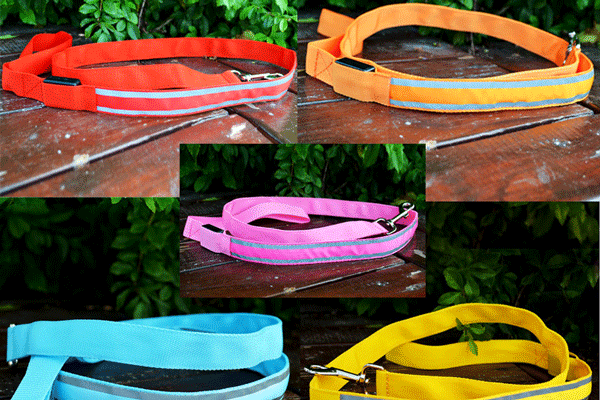
Reflectors will help drivers identify stray animals at night.

The Department of Transport spent over R5-million on reflective animal belts, because stray animals, especially cattle, can cause serious damage to lives and vehicles when they are involved in accidents on the road.

Acting MEC for Transport in Limpopo, William Ntlatla, said they bought reflector belts for animals at a cost in excess of R5 million, however Blouberg cattle owners have failed to make use of the belts.

Ntlatla made this statement during a campaign held at Ga-Machaba village with regard to road safety during the festive season.

According to the department, the campaign serves as a way to engage with Blouberg farmers and give away animal reflective belts and ear rings.

“We urge our communities to work with us and ensure that we do not have stray animals on our roads.” said Ntlatla.

“Stray animals on our roads are a huge concern as we have lost many lives as a result. Together we need to take an active role in dealing with stray animals as it is our collective responsibility. We need to guide our animals away from the roads and let them graze freely far away from our roads.”

Sergeant Pebetsi Kwapa, from the Polokwane Stock Theft Unit, urged herd owners to brand the animals as stock theft statistics continue to rise every day.

“According to the law, an animal which is not branded does not have an owner. Working together in branding our animals can help to reduce the percentage of stock theft,” said Kwapa.

4000 belts distributed during Transport Month

The danger of stray animals also took centre stage during Transport Month in Limpopo.

Provincial Roads and Transport MEC Lehlogonolo Masoga committed to hold meetings with livestock owners, traditional leaders and community members to address the issue.

“Stray animals causing accidents remain a concern on our roads. We will be meeting with communities during our outreach campaigns, where we will address the issue of stray animals extensively,” he said at the time.

MEC of Transport in Limpopo, Mapula Mokaba-Phukwana, distributed 4000 reflective animal neck belts to livestock owners during the launch of Transport Month 2016.

The department has, to date, distributed approximately 150 000 reflective animal neck belts to livestock owners since 2009.

Region benefits from SANRAL projects

Pakalsdorp-bridge-1
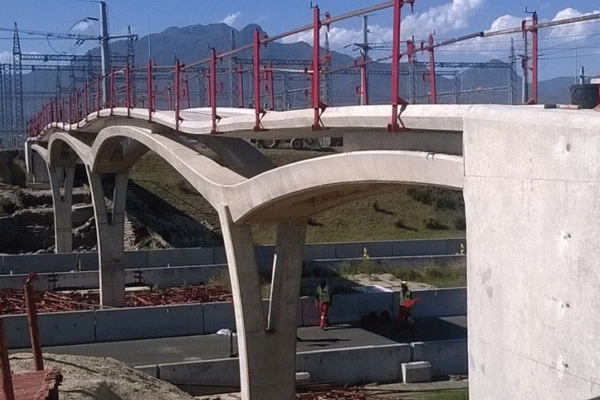
The Pacaltdorp’s pedestrian bridge being constructed.

The South African National Roads Agency Limited (SANRAL) plans to spend R139-million on periodic maintenance on 23km of the N2 between Mossel Bay and Great Brak next year.

Furthermore, work on a new bridge over the Gwaing River will commence midyear in 2017 at a cost of R88-million.

This forms part of continuous road maintenance and improvement in the Southern Cape, which SANRAL says will benefit small, medium and micro-enterprises (SMMEs).

Randall Cable, SANRAL’s western region engineering manager, emphasised the road agency’s continuing role in infrastructure development and job creation initiatives in the region when he addressed key government, business and community stakeholders in George recently.

“SMMEs benefit from SANRAL projects as they perform a range of tasks such as routine road maintenance contracts. Contractors, in turn, create much-needed job opportunities in the Southern Cape and along the N2,” said Cable.

Next year will see the start of several more improvements and maintenance to the N2, such as on the 44km stretch between Caledon and Riviersonderend (R429m); 57km between Riviersonderend and Swellendam (R97m); 29km between Heidelberg and Riversdale (R670m); as well as improvement on the Knysna Nekkies intersection (R30m) and the Plettenberg Bay intersection (R80m), to name but a few.

Cable also highlighted the two recently completed projects in the region:

Pedestrian facilities

The purpose-built walkways, which stretch over a distance of about 8km along the N2 between the York Street interchange and the Garden Route Mall in George, are designed to provide safe access for residents of the nearby residential areas of Thembalethu, Pacaltsdorp, Lawaaikamp and Ballotsview along the N2 corridor. The project included the installation of lighting and CCTV cameras.

To ensure that pedestrians do not cross the highway at will, a two metre-high, welded mesh fence was erected along the N2, separating the pathways from the freeway.

During the duration of the contract 170 permanent job opportunities were created.

Widening and new pedestrian bridge

The Pacaltsdorp interchange bridge and approach roads were widened to create additional turning lanes, sidewalks and a traffic median island. The project included the rehabilitation of existing asphalt surfacing, the relocation of traffic signals, the provision of street lighting and the replacement of road markings and road signs.

A new pedestrian bridge that provides a safe point for pedestrians to cross the N2 freeway was also constructed.

George Municipality contributed 10% of the contract value of R82, 5-million and 106 permanent job opportunities were created during the duration of the contract.


Road safety during the Festive Season

road-safety-1

Statistics indicate that at least 40 people die daily in South Africa due to road crashes. The high number of crashes can be attributed to various crimes and road traffic offences.

These crimes include: excessive speed, unsafe overtaking, driving under the influence of alcohol and unsafe crossing on the roads by pedestrians.

Minister of Transport Dipuo Peters recently addressed the 2016 Africa Road Safety Summit held under the theme: Halving Road Deaths and injuries by 2020.

She said: “Human beings are fallible and even the most safety-conscious individual will make a mistake or commit an error of judgement that might lead to a crash. Our road management authorities and the construction sector are increasingly taking this into account in the planning, design, building and maintenance of road networks. Best global practices in design and engineering are increasingly being implemented in developing countries and South Africa is, indeed, fortunate to draw on the experience and expertise available at an organisation such as SANRAL – which is widely-respected among its peers in the industry.

“Last month SANRAL hosted the meeting of the World Road Association which brought together the leading thinkers in the fields of planning and design. Local research shows that in the order of 95% of road traffic crashes happens as a direct result of one or more traffic offences.”

These include: human factor (82%), vehicle factors (10%) and, road environment factors (8%).

The severity of fatal crashes in South Africa mainly attributed to:

  • The speed at which a crash happens – the higher the speed the higher the rate;
  • The wearing rate of seatbelts, the higher the wearing rate the lower the severity.

Road Safety tips

These road safety tips are courtesy of Arrive Alive, the road safety campaign of the Department of Transport.

These include:

  • Obey the rules of the road and carry your driver’s license with you.
  • Plan the route to your holiday destination and allow yourself enough time to reach the destination.
  • Make sure that your vehicle is in a roadworthy condition before departure. All lights and indicators, windscreens, windscreen wipers, brakes, steering, shock absorbers, exhaust system and tyres should be carefully examined for faults.
  • Do not overload.
  • Try to avoid driving after dark if possible.
  • Have a good rest before you embark on your journey.
  • Take safety breaks every 2 hours or 200km. Rest, have an energy drink and continue once well rested.
  • Do not drink and drive.
  • Try to recognize potentially dangerous drivers on and pedestrians alongside the road and keep well clear of them.
  • Be visible – drive with your lights on.
  • Headlights should be dipped well before an approaching vehicle is within the range of the main beam.
  • Always wear your seat belt and see that everyone in the car is wearing theirs.
  • Drive defensively.
  • Stay within the speed limit at all times.
  • Only overtake when it is absolutely safe to do so.
  • Maintain at least a 2-second following distance – this distance should be increased at night, in foggy or rainy conditions and when the road is wet.
  • Expect others to not be as obedient to the law as yourself.
  • Avoid distractions on the road such as texting, conversations on cellular phones etc.
  • Be courteous towards fellow road users – keep your temper and resist the temptation to retaliate.
  • Know your emergency numbers – When you need assistance, kindly call the following numbers: Police – 10111; Fire – 10177; Netcare 911 – 082 911; ER24 – 084 124 and Cell phone emergency – 112

Upgraded N14 freeway opened

N14-inside
Phase 1 of the N14 project entailed the rehabilitation of 20km of the dual carriageway starting from Hendrik Potgieter Drive and extending up to Diepsloot.


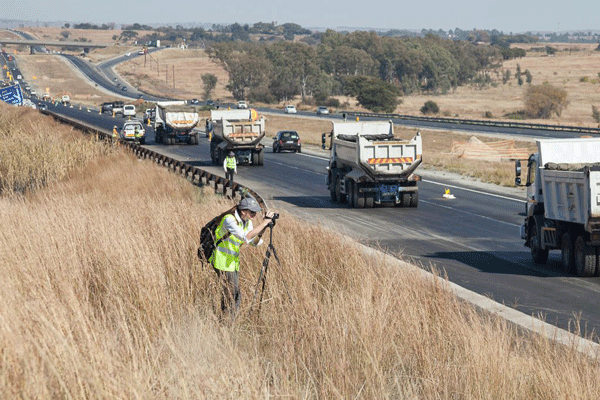
Gauteng MEC for Roads and Transport, Dr Ismail Vadi has officially opened the upgraded N14 freeway from Krugersdorp to Diepsloot.

The R306-million, 18-month-long project, launched in July 2015 together with Gauteng Premier David Makhura, was completed on time and within budget.

The MEC explained that Phase 1 of the N14 project entailed the rehabilitation of 20km of the dual carriageway starting from Hendrik Potgieter Drive and extending up to Diepsloot near Centurion, in Tshwane.

“We’ve basically given a new lease of life to a very busy freeway and there will be no toll fees,” said Vadi.

The N14 is a high traffic volume freeway that was under severe stress. It had an annual traffic growth rate of 3.2 %. It had degraded over the years and needed urgent rehabilitation.

It is a major provincial arterial road from the southern and western regions of Gauteng to the north and is used for workplace travelling and freight traffic. It also serves as an economic link to the Western corridor of the province.

MEC Vadi pointed out that the freeway links Lanseria Airport, the Cradle of Humankind and North West Province and is expected, in future, to play an important role in kick-starting the development of a new city around Lanseria Airport.

“This project has completely repaired 20kms of N14 and given it a new design life of 20 years. It provided employment and skills development training during construction to over 300 local employees; enabled economic empowerment of local contractors and improved the road safety features on the freeway,” added Vadi.

He thanked motorists for their patience during the construction period and announced Phase 2 of the upgrade will be launched in 2017.

Gauteng Roads and Transport annual report

During the 2015/16 Gauteng Roads and Transport annual report announcement, Vadi spoke on how the department remains focused on achieving “an integrated and efficient transport system in Gauteng that promotes sustainable economic growth, skills development and job creation, fosters quality of life, socially includes all communities and preserves the environment”.

Vadi said: “Urbanization and urban densification help to provide a transport solution as it reduces the home to work trips over long distances. All sectors of our economy and our people at large benefit when there is an integrated approach to spatial and transport planning. Essentially, what we’re talking about is creating smart cities in the Gauteng city-region that are supported by good public transport systems. Simultaneously, we have to keep our feet firmly on the ground to meet the commitments made in our Annual Performance Plan.

“We are pleased to report that Gautrain received a clean audit, and both the Department and g-Fleet achieved unqualified audit opinions from the Auditor-General. We are encouraged by the progress made in getting the financial statements of gFleeT on the proper footing. Our challenge now is to sustain the progress made at the entity and to ensure that the department gains a clean audit.”

SANRAL fights HIV/Aids

HIVAids-1
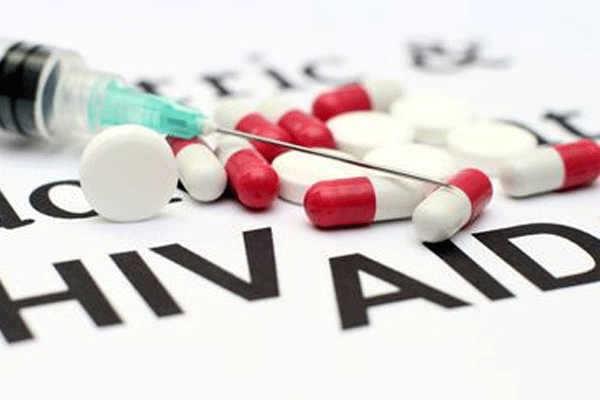
More than 2000 SANRAL workers on their Routine Road Maintenance (RRM) projects nationally are recipients of its Wellness Programme.


World Aids Day is celebrated worldwide every 1 December and the South African National Roads Agency Limited (SANRAL) has stepped up its efforts to fight the scourge of the HIV/Aids pandemic.

The roads agency has substantially stepped up its commitment with its landmark wellness programme now accessible to more than 2000 workers on their Routine Road Maintenance (RRM) projects nationally.

The national construction industry is adversely affected by the depletion of skills most notably caused by HIV/Aids and opportunistic infections such as tuberculosis to the degree that SANRAL is championing the workers in the industry which are amongst the most-at-risk given their work circumstances and taken a landmark step to eradicating the scourge on its Routine Road Maintenance (RRM) workers.

The Wellness Programme

The implementation of this national programme is designed to assist with their general wellness management by providing tools, one-on-one counselling with a wellness champion as well as a hotline which they are able to call. The programme training subject matter varies from substance abuse and alcoholism, lifestyle diseases management and prevention as well as broader wellness communication campaigns and Wellness Days.

Kobus van der Walt, SANRAL’s Western Cape regional manager, said: “As a key role player in the roads construction industry, SANRAL has an important role in leading the sector in promoting the wellness of our workers through education and providing opportunities for them to the being regularly tested for HIV/Aids, TB and maintaining a treatment programme post diagnosis.”

In part the nationwide programme focuses on HIV/AIDS awareness and treatment campaign as a key identifier against the spread amongst those most vulnerable to infection. This comes in the wake of good news that South Africa recorded a slight decline in the number of infections between the period of 2005 and 2015. However, as high levels of poverty and drug abuse which are key leading factors leading to infection it still means that about 8,4-million South Africans have HIV and about 155 000 died from AIDS last year alone.

Van der Walt said: “Poverty and the lack of access to proper healthcare in rural areas means that people aren’t always aware of the dangers of ill-health of the impacts that it has for the broader community. The increase in infections means that the AIDS pandemic is not over, is not limited to individuals anymore but is fast becoming societal as families lose bread winners.

“This means that we are not able to break the poverty cycle. It also prevents South Africa from closing the industry’s already widening scarce skills gap with essential jobs like graders and digger-loader operators.”

The prevalence of HIV/AIDS, tuberculosis and preventable substance abuse is often a result of poor social awareness and is linked to structural factors inherent in the construction sector such as solitary work environments, extended periods spent away from home and inadequate access to health care services.

The programme now covers all construction workers, including sub-contractors and their immediate families, working on SANRAL’s roads maintenance projects nationally.  Workers from both the Western and Northern Cape provinces have already benefitted from the programme over the past three years as part of an initial pilot project which was successfully run in the two provinces.

Now all RRM workers will be provided with free training, counselling and testing for a range of illnesses as well as provide access to healthcare professionals for treatment.

To this end some 17 Wellness Champions have already been appointed and undergone SETA-accredited peer educator training during the pilot project.

The roads agency has appointed CareWorks HIV Management because of its proven track record in carrying out wellness programmes in South Africa to manage and facilitate the programme within the Western and Northern Cape region. They will be responsible for, amongst others training outcomes, ensuring that all HIV and TB-positive staff gain access to life-saving treatment and that HIV and TB-negative employees acquire adequate knowledge to be able to manage their status.

SANRAL brings jobs to communities

construction-1
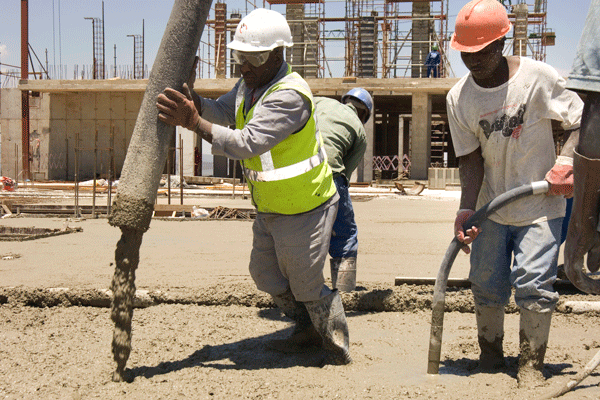
An estimated 230 jobs were created with the upgrading of the N1 Great North Toll Road including the Eastern Ring Road.

The South African National Roads Agency Limited (SANRAL) is upgrading the N1 Great North Toll Road including the Eastern Ring Road and naturally, locals will benefit.

An estimated 230 jobs for locals is expected to be created for the upgrading.

Vusi Mona, SANRALs spokesperson, said: “These jobs will be in the form of builders and labourers from the city and surrounds, to assist in the completion of the project.”

The National Route N1 is the link between South Africa and the rest of Africa and forms an essential link to stimulate economic growth in Sub-Saharan Africa as well as local economic development in the metropolitan area of Polokwane.

Upgrading progress

Sanral recently upgraded sections between Makhado and Musina, and is currently upgrading the section between Beit Bridge and Musina. Furthermore, planning for a ring road at Musina is far advanced, leaving the section of the N1 at Polokwane as the only section that is not free flowing on the N1 north.

As a result, Polokwane experiences a mix between local and through traffic in the CBD, resulting in pedestrian conflict, as well as damage to pavements. Taking through traffic out of the CBD will have a positive effect on road user safety, the ambience and nature of the CBD.

Sanral proposes to complete the approximately 6.5 km section of the Eastern Ring Road by March 2018.

The proposal includes the construction of interchanges at crossroads such as the Burgersfort (R37), Tzaneen (R71), and R81 roads, which will also improve accessibility to Moria.

Moria is The Zion Christian Church’s headquarters and hosts the largest Christian gathering in South Africa twice a year, in Easter and again on December.

Sanral completed the financial feasibility study of the project and is currently progressing with the geometric design for the project. The bulk of the land has been acquired. The environment impact assessment (EIA) commenced in August 2007.

Bottelary interchange construction begins

Bottelary-Road-R300-interchange-1
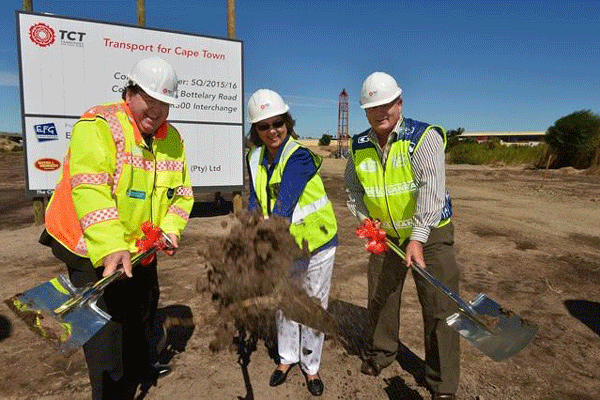
MEC Donald Grant, Mayor Patricia De Lille and SANRAL Regional Director Kobus van der Walt at the SOD turning of the R300 interchange.


The South African National Roads Agency Limited (SANRAL) enhances South Africa’s National Development Plan’s (NDP) ambition to have an efficient, competitive and responsive infrastructure network.

The NDP, also known as Vision 2030, seeks to eliminate poverty and reduce inequality by 2030. According to the plan, South Africa can realise these goals by drawing on the energies of its people, growing an inclusive economy, building capabilities, enhancing the capacity of the state, and promoting leadership and partnerships throughout society.

With the NDP in mind, the construction of the new Bottelary Road/R300 interchange in Kuils River, Cape Town, will make it easier to travel to and from Stellenbosch, the N1, N2 and the airport.

The sod turning ceremony was held earlier this year to mark the start of the construction. Since then a large amount of development has taken place.

Brett Herron, the City’s Mayco member for Transport for Cape Town (TCT), said: “The bridge structure over the Kuils River is complete. The on- and off-ramps to and from the R300 freeway are already on a sub-base level with two more layers, which consist of the base course and asphalt to follow, in order to reach the final finished road level.

“The intersections on Bottelary Road are nearing completion with the estimated opening time in March/April 2017, if all goes as planned.”

The initial deadline for the project by the City of Cape Town and its partners, the Western Cape Government Department of Transport and Public Works and SANRAL, was set at mid-2017.

Traffic alleviation

Last week Herron confirmed the project was on track with the estimated date of completion being the end of March and April 2017, “pending any unforeseen delays”.

Peak hour traffic congestion on Van Riebeeck is especially bad at the Kuils River Hospital and in the area near the R300 Bridge. Thanks to a combined budget of R60-million for the Bottelary Road/R300 project, this will hopefully soon be something of the past.

Of the R40-million the City has allocated for road congestion projects in the 2015/16 financial year, R10-million is being spent on this interchange. The city is the largest contributor to the project, contributing R31-million to the construction costs. Provincial government will be spending R29-million, while SANRAL purchased the land for the interchange.

A huge distribution centre for Shoprite across from the interchange is due for completion towards the end of 2017. The interchange also borders on the Brackengate Business Park.

KNOW YOUR WHOA