
Blog

New ramp opens at Mount Edgecombe Interchange

Motorists from Phoenix and Mount Edgecombe smiled as they swung onto the new ramp at the Mount Edgecombe Interchange for the first time on Monday morning.

Corne Roux, left, SANRAL Eastern Region Project manager, and Henk Kaal, engineer from SMEC South Africa, the engineering and development consultancy that supervised construction of the N2/M41 Mt Edgecombe Interchange, wave through the first vehicles travelling from Phoenix and Mt Edgecombe to use the new ramp onto the N2 southbound towards Durban.

With relief on their faces, motorists from Phoenix and Mount Edgecombe smiled as they swung onto the new ramp at the Mount Edgecombe Interchange for the first time on Monday morning, 5 March, as they travelled towards the N2 southbound to Durban.

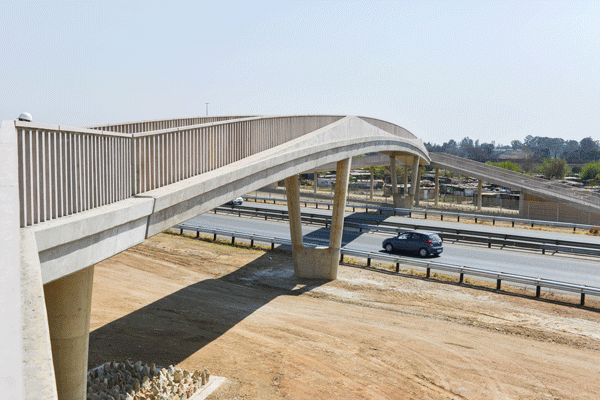
The one-kilometre long bridge – one of the longest structures ever built in South Africa over one of the busiest intersections in KwaZulu-Natal – forms part of the improvements undertaken by the South African National Roads Agency (SOC) Limited (SANRAL) at the N2/M41 Mount Edgecombe Interchange north of Durban. It connects Phoenix and uMhlanga with Durban and the North Coast of KwaZulu-Natal.

Corne Roux, SANRAL Eastern Region project manager for the Mount Edgecombe Interchange, said: “Only one lane of the new ramp from Phoenix and Mount Edgecombe will be open to traffic to enable the temporary ramp that had been in use to be demolished to allow for completion of the construction of a new ramp from the N2 northbound, taking traffic towards the Gateway shopping complex. The second lane of the new ramp will be open in about a month’s time.

He urged motorists to be cautious, patient and cooperative, and adhere to speed limits during the construction.

One of the largest SANRAL projects

The iconic Mount Edgecombe Interchange, which is one of the largest projects presently undertaken by SANRAL in KwaZulu-Natal, is more than a masterpiece of award-winning architecture – it is a vital artery of the greater eThekwini Metropolitan highway system for easing traffic, relieving congestion and is a significant business enabler.

Due to the expansion of the uMhlanga and La Lucia Ridge areas, the existing interchange had been operating at capacity with vehicles backing up on the M41 and onto the N2 during peak hours.

An additional 40 000 vehicles enter or leave the N2 from the M41 daily, resulting in substantial queuing of vehicles during the day.

This, together with expected future expansions and anticipated development of the Cornubia area, required the existing interchange to be upgraded in order to improve the flow to and from the N2 and M41 to the supporting road network.

The Mount Edgecombe Interchange upgrade has changed the landscape forever and is sure to become a well-known landmark in years to come.

The new four-level interchange facility provides at least two lanes on each of the major movements. The upgrade includes the implementation of directional ramps, which eliminates the need for controlled signalisation and ensures free flow of traffic in all directions.

The construction has been jointly funded by SANRAL and KwaZulu-Natal Department of Transport.

Two bridges part of the project

Two incrementally launched bridges are part of the interchange upgrade.  One bridge, which is 948 metres in length – the longest incrementally launched bridge in South Africa – joins the Mount Edgecombe side of the M41 with the N2 South. The other bridge is 440 metres long and joins the uMhlanga side of the M41 with the N2 North.

The 948m bridge has 23 piers and two abutments and was built from two ends – one portion launched on a curve and the other on a straight.

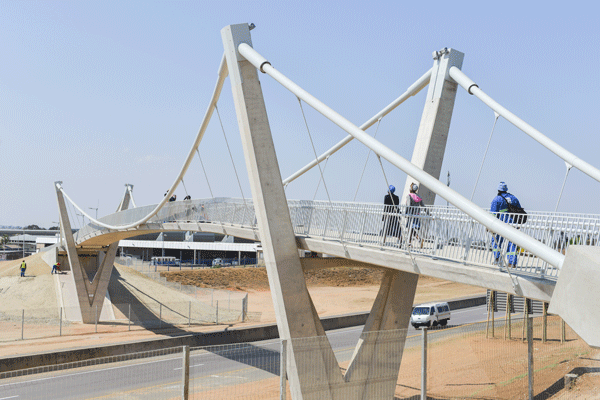
A pedestrian bridge has been constructed over the N2 and will connect to new footways.

In addition, lighting will be installed to ensure the whole interchange is lit at night for better safety.

Road development to bring changes to Buffalo City

Public participation is important to the planning of the Breidbach Interchange in King William’s Town.

Large projects such as these need the involvement of the community.

A planned state-of-the-art interchange at Breidbach in King William’s Town will make a big difference for the local community – with billions of Rands being set aside for its construction.

The contract has yet to go out to tender, so the South African National Roads Agency (SOC) Limited (SANRAL) has not given an exact figure for the project.

The national roads agency and the Buffalo City Metro are working together on the development.

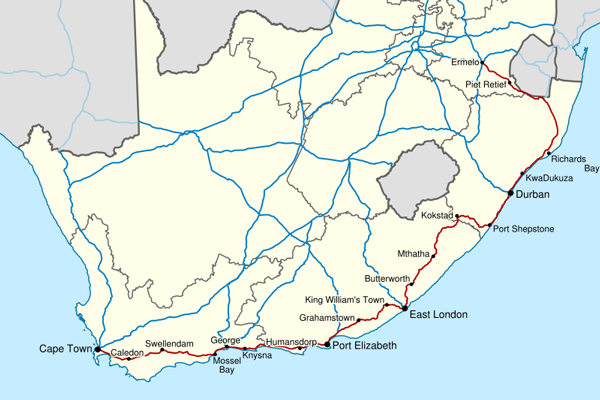
SANRAL is currently at the design stage for upgrading a 60km stretch of the N2 from Green River to Buffalo River Bridge (3.2km), and the construction of the new Belstone (8.2km) and Breidbach (9.8km) interchanges.

The metro was engaging those in the various wards who would be affected by the project, said Buffalo City portfolio head for the infrastructure and engineering department, Ncedo Kumbaca.

“There are two projects planned by SANRAL in the King William’s Town area,” Kumbaca noted; the Breidbach interchange in ward 44 and the King William’s Town bypass – the Belstone interchange – which will run across wards 37, 38, 39 and 43.

Ward 44 encompasses Breidbach and surrounds, ward 37 covers Westbank, ward 38 contains Lower Mngqesha Handsmission, ward 39 covers Shorneville and Ginsberg and ward 43 encompasses Tyutyu, and Bhisho.

Buffalo City welcomes SANRAL projects

The road agency had met Buffalo City officials to outline the role of the metro in the project and to facilitate stakeholder management, said SANRAL’s community development specialist, Xoliswa Chubana.

Large projects such as these needed the involvement of the community, she added.

“SANRAL, together with the municipality, would need to appoint a project liaison officer for the respective projects and set up a project liaison committee for the duration of the projects,” Chubana said.

“Firstly, that involves the councillors and the municipality. We have already introduced the design team to the municipality. The set-up and appointment of the project liaison committee can follow hereafter,” said Chubana.

Wild Coast greenfields development to help people of Mpondoland

The N2 Wild Coast Road Project will be a catalyst for sustainable local economic and social development.

The N2 Wild Coast road project is a high mobility route that will link the Eastern Cape and KwaZulu-Natal while lowering travel time and costs, and improving accessibility to a large part of the Eastern Cape.

The R9-billion investment the South African National Roads Agency (SOC) Limited (SANRAL) has put aside for greenfields development as part of the N2 Wild Coast Road Project will go a long way in improving the lives of ordinary people in Mpondoland.

The N2 Wild Coast road project is a high mobility route that will link the Eastern Cape and KwaZulu-Natal, lower travel time and costs, and improve accessibility to a large part of the Eastern Cape.

It will be a catalyst for sustainable local economic and social development.

SANRAL’s flagship Taking SANRAL to the People programme went to Lusikisiki to share information and build partnerships with communities and other project stakeholders. Representatives of the agency met leaders of government, business, traditional leaders and community organisations during the programme.

Said SANRAL project manager, Craig McLachlan: “SANRAL will continue with its endeavours to be a developmental partner for the OR Tambo and Alfred Nzo district municipalities.

“We will continue to keep the different stakeholders in the region abreast of the project’s developments,” McLachlan added.

The roads agency will open a regional office in nearby Flagstaff.

Closer to the people

The opening of the Flagstaff office will make it easier for the communities of the OR Tambo and Alfred Nzo district municipalities to get in touch with SANRAL.

Flagstaff was identified as the most central area for the entire greenfields section of the project.

“The Flagstaff office will be the point where local people can contact SANRAL directly,” SANRAL’s southern regional manager, Mbulelo Peterson, noted.

Local small, medium and micro enterprises (SMMEs) no longer have to travel to Port Elizabeth to collect and submit tenders. “There will also be a tender office where tenders for SMMEs can be collected and submitted and tender briefings can be held,” Peterson said.

The Flagstaff office will also offer temporary work space and meeting facilities for project managers attending project meetings and site visits.

“We are making every effort to promote transformation by ensuring that SMMEs are exposed to work experiences that were previously not possible,” Peterson said.

SANRAL, working with the provincial government and local municipalities, continues to upgrade roads that provide infrastructure and enable agro-industrial and tourism development for the Eastern Cape.

SANRAL must be relevant to communities in which it operates

At the heart of SANRAL’s transformation policy is the empowerment of previously disadvantaged communities as well as safe mobility, says SANRAL project manager Marlize Nel-Verwey.

SANRAL project manager Marlize Nel-Verwey believes SANRAL community development programmes will uplift a lot of previously disadvantaged communities.

For almost a year, the South African National Roads Agency (SOC) Limited (SANRAL) has worked hard at developing its long-term strategy – Horizon 2030 – as well as its draft transformation policy.

Horizon 2030 acknowledges the contribution the agency can make in building a capable developmental state, driving economic development through providing and maintaining critical infrastructure.

“Although SANRAL’s primary focus is the delivery of a safe, efficient, reliable and resilient national road transport system, the objectives laid out in these important documents can only be achieved if the agency remains relevant to the communities in which it operates on a daily basis,” says SANRAL project manager Marlize Nel-Verwey.

At the heart of Horizon 2030 and the agency’s transformation policy lies the urgency to develop and empower South Africa’s previously disadvantaged people and communities, through training and mentorship, and safe access and mobility, respectively.

SANRAL’s community development projects (CDPs) are training programmes through which people receive South African Qualifications Authority-accredited training in road building.

“It was important that the development and implementation of these projects be identified as a key focus area of Horizon 2030,” Nel-Verwey says.

The individuals who took part in the training programmes not only learnt about road building in general, but also took part in the construction of access roads and ancillary facilities under the mentorship of experienced construction staff.

Transforming the construction industry

“The CDPs have massive potential to contribute to the transformation of the construction and related industries,” Nel-Verwey says.

It is for this reason that the draft transformation policy states that, in addition to the customary stand-alone CDPs, as of 1 April 2018, conventional projects will include CDP components wherever feasible.

“And because these projects play such a significant role in both Horizon 2030 and our draft transformation policy, the agency is in the process of developing a CDP strategy, which will inform policy and implementation plans.”

While developing the draft CDP strategy, it became evident that the implementation of these projects present SANRAL with numerous opportunities. The most important prospects include:

  • improving the agency’s reputation by building stakeholders’ trust in SANRAL at grassroots level;
  • making a significant impact in human capacity building (development) and transforming the construction industry;
  • making a significant impact in the promotion of road safety for all modes of transport, particularly for vulnerable communities and road users;
  • improving access to the national road network, which promotes mobility and economic development; and
  • providing or facilitating non-motorised and public transport facilities, which contribute to the socio-economic development of marginalised communities and road users.

“SANRAL’s enhancement of its CDP programme is not just good news for South African communities of all shapes and sizes, it bodes well for the agency’s relationship with the public we serve,” says Nel-Verwey.

Marlize Nel-Verwey is a project manager in SANRAL’s southern region.

Uplifting communities beyond upgrading roads

SANRAL is taking part in a partnership to provide schoolgirls from poorer areas with a year’s supply of sanitary towels.

Learners from Ndzondelelo Senior Secondary School in Zwide, Port Elizabeth received a year’s supply of sanitary towels donated by SANRAL in partnership with Vukani Multi Sport Club.

South Africa’s national road agency sees its mission as broader than just building and maintaining the country’s roads – it is about playing an important role in uplifting communities.

With this in mind, the South African National Roads Agency (SOC) Limited (SANRAL) Southern Region joined the Vukani Multi Sport Club (VMSC) on a drive to provide sanitary towels to schoolgirls in Zwide, Port Elizabeth.

Twenty-six Grade 8 girls at Ndzondelelo Senior Secondary School were given a year’s supply of sanitary towels.

This was part of the first phase of the drive by SANRAL’s Southern Region and VMSC to donate personal hygiene products to girls from disadvantaged backgrounds around Nelson Mandela Bay.

“R10 from you will mean something different to the children at the school,” said school principal, Dan Ngcape, who explained that the school serviced very poor areas including Soweto-On-Sea, Zwide and Veeplaas.

“The contributions made by SANRAL and Vukani Multi Sport Club are a huge deal to the kids. These kids will not forget this day,” said Ngcape.

The girls spoke of having to make use of towels or toilet paper or even having to cut up a sock during menstrual cycles.

Sanitary towels cost between R10 and R60 for a pack of 10, depending on the brand purchased.

Every year organisations across the country get involved in providing sanitary towels to schoolgirls from impoverished backgrounds, and thereby providing dignity and support.

Giving back to communities

SANRAL’s national office had a sanitary towel drive last year, said Southern Region marketing coordinator Michelle Ah Shene, and various schools were identified for the donation of sanitary towels.

“Ndzondelelo Senior Secondary School was selected after we were approached by Vukani club to partner with them on the project. The school is also located close to the R75 project in Port Elizabeth that SANRAL is currently working on.

“Supplying a smaller group of girls with a year’s supply of sanitary towels will make more of an impact. The girls will benefit over a longer period of time instead of just receiving a month’s supply of pads,” Ah Shene said.

President of VMSC, Wonga Mfula, said: “It is our responsibility to give back to society and let people know wellness is important”.

Apart from the provision of training programmes in construction works, building roads and bridges, SANRAL also focuses on developing human capital through educational programmes at tertiary institutions, providing internships for trainees and awarding bursaries and scholarships to university students and high school learners, Ah Shene noted.

STEM programme helps learners and teachers

An education programme focussing on the sciences has helped more than 2 200 Eastern Cape high school learners and teachers since its inception in eight years ago.

Learners in the Gate Project from Khumbulani High School, Ethembeni Enrichment Centre and Khwezi Lomso Comprehensive School.

The Science, Technology, Engineering and Mathematics in Action Pipeline Programme (STEM PP) offered by the Nelson Mandela University has improved the academic lives of more than 2 200 Eastern Cape high school learners and teachers since its inception in 2010.

The project, run in partnership with in partnership with the South African National Roads Agency (SOC) Limited (SANRAL), consists of several educational programmes, all focused on increasing competence in STEM subjects.

The programmes target both learners and teachers.

Learners from various high schools in Nelson Mandela Bay participate in the Getting Ahead in Technology and Engineering programme and the Selected Learner programme.

Classes are held at the university’s Missionvale Campus in Port Elizabeth, as it is easily accessible to all communities.

The primary objective of STEM PP is to increase the number of Grade 12 learners achieving marks that are good enough to enter tertiary training in engineering and science.

SANRAL supports the programme through funding.

Enhancing understanding

“The aim of the courses is to enhance the learners’ understanding of and promote positive attitudes towards science and mathematics,” said STEM PP manager Isabel van Gend.

“Participants receive valuable extra tuition in career-related fields and are equipped with the necessary skills to operate in a higher education or science-related work environment.”

Nadia Petrus, a Grade 11 learner from Bertram High School in Bloemendal, participates in the Selected Learner and Getting Ahead in Technology and Engineering programmes, which has helped improve her maths and science marks immensely.

“The study guidelines helped me focus on my work and where to improve most of my marks,” she said.

Another Grade 11 participant, Michaela Aliva from St James (RC) Senior Secondary School in Schauderville, said she had been struggling with her physical science marks. “Now they’ve improved and I understand the work much better.”

Teachers enjoying it too

The Educator Toolbox programme has also yielded great results for learners and their instructors.

Uitenhage High School teacher Lee-Ann van Heerden said that physical and life sciences teachers from her school had attended various career exploration sessions, as well as workshops on teaching and learning strategies for Grade 10-12 physical and life sciences.

“Our learners now have a better understanding of theory,” she said.

As part of Getting Ahead in Technology and Engineering programme, the university also facilitates a 10-hour study method course at the start of the year, which includes summary and memory techniques.

Physical science and its mathematical concepts are the focus of the course.

The Selected Learner programme, which was introduced at 19 schools in Nelson Mandela Bay in 2016, is for learners who achieved at least 70% in maths and science in Grade 9. The focus of this programme is on experimental skills and understanding, as well as a career exploration in the fields of maths and science.

The agency also funds and manages a number of educational projects outside of STEM PP, including the awarding of bursaries and scholarships.

SANRAL unlocks economic opportunities in KwaZulu-Natal

Projects run by the national road agency are about more than just building roads, they are about delivering services in the widest sense.

School kids can now walk on sidewalks to schools.

Every day communities deep in northern KwaZulu-Natal enjoy the convenience and safety of infrastructure built by the South African National Roads Agency (SOC) Limited (SANRAL) – from access roads to local schools to sidewalks, from retaining walls to bus- and taxi lay-bys.

One such project is the 12km concrete walkways built on both sides of a section of the R22 between the town of Manguzi and the Mozambique border. The project, worth about R14.4-million, started in November 2015 and was completed in June 2017.

Before the project began, there had been several vehicle and pedestrian incidents, according to the project manager of the Eastern Region, Ridhwaan Mahomed. “Pedestrians, mostly young pupils on their way to and from school, could be seen walking in the motorised vehicle lanes. This is very risky.”

Locals benefitted

The project brought much needed respite to local communities with employment opportunities: four local subcontractors were appointed at a cost of R1.3-million along with some R2.4-million paid in salaries for local labour.

Mgadla Trading owner, Thokozani Mbuyisa, expressed his gratitude for the opportunity provided by SANRAL. Mgadla Trading was one of the small, medium and micro enterprises that worked on the project.

“Roads exist to connect communities, to open new horizons, to bring people to opportunities and opportunities to people,” Mahomed said.

Rural areas often have a high number of unskilled individuals. On this project, local people were trained and 60 skills training certificates were issued, at an investment of R277 240.

“SANRAL has always strived to support the government’s efforts to push back the frontiers of poverty and improve the lives of citizens by investing in community development in all its projects,” Mahomed added.

Local community benefits from construction project

Youth and SMME development lies at the heart of SANRAL’s project in Tsolo in the Eastern Cape.

The project has created 120 jobs, benefitting unskilled and unemployed locals.

Young people in the Eastern Cape town of Tsolo have benefitted from the creation of more than 100 jobs during the construction of a 5.5km walkway along the R396 national route from Tsolo to the N2 intersection.

The South African National Roads Agency (SOC) Limited (SANRAL) is constructing the walkway to improve local pedestrian infrastructure – and supporting holistic community development.

“This project is intended to benefit the community in various ways,” said SANRAL project manager Lindelani Tsanwani.

It will improve the safety for pedestrians on the R396 and at the same time provide skills development to local youth and small, medium and micro enterprises (SMMEs).

“The SANRAL project is benefitting TVET (Technical Vocational Education and Training) students, SMMEs and locals by enhancing their skills and assuring their safety when using the road from Tsolo,” said Tsanwani.

“The project is offering training for SMMEs and their supervisors at NQF Level 4 and foremen at NQF Level 2. This will help the growth of the SMMEs and improve their operations,” he added.

The project has created 120 jobs, benefitting unskilled and unemployed locals.

In addition, it aimed to train 32 students in the field of construction. The SMMEs and students are not only trained in construction, but also in first aid, health and safety, and fire-fighting.

Participants speak

According to Ntombikayise Mdlalana, an SMME contractor, the project was not just good for the community, but also for skills development. “This is a very important project for me, especially since my goal is to advance from level 1 CIDB (Construction Industry Development Board) grading to level 3,” she said.

Another SMME contractor, Athulisiwe Dywili, said: “The project has given women an opportunity to participate in the field of construction, which was previously dominated by men.”

Before working on the project Dywili was unemployed. “This will give me more skills and help me put food on the table for my family. It’s a nice opportunity for me.”

Eastern Cape community helps rebuild own roads

The community of Whittlesea are manufacturing their own interlocking block pavers and concrete kerbs to improve their own roads.

Made by them for themselves. The community of Whittlesea doing it for themselves with the help of SANRAL.

More than three million interlocking block pavers and concrete kerbs are being manufactured by the Whittlesea community which will be used to improve road conditions and safety along the R67 national road in the Eastern Cape.

The interlocking block pavers and concrete blocks are manufactured on site.

The South African National Roads Agency (SOC) Limited (SANRAL) has hired 123 unemployed people to work on the project, which started in November 2016 and is scheduled to be completed in July 2018.

“We hope to leave a legacy in Whittlesea,” said SANRAL project manager Lindelani Tsanwani.

SANRAL is in the process of selecting suitable candidates from the community who will attend further intensive training on how to run a block manufacturing business, Tsanwani added.

The R67 was declared a national road in 2012.

The community development project is one component of a number of projects in Whittlesea. “The interlocking blocks and concrete kerbs will be used to upgrade service roads in Tambo, Brakkloof, and McBride,” said Tsanwani. These service roads will link up with the R67 at different, safer intersections.

Community development

Former security guard Lumka Soxunjwa from Tambo Village spoke about how important the development project was to him. “I dreamt of working in the construction industry. I always wanted to upgrade the roads where we live and create jobs for unemployed people.

Soxunjwa underwent training and in 2015 registered his company in Whittlesea. “SANRAL has taught me so much, now I can work with my hands.”

Thandeka Bobotyani from Brakkloof was thankful for the training received from Inkanyiso Consulting, and the improvements it had brought to his living conditions. “The project is very helpful …. The stipend we receive helped us buy electricity and put food on the table …. The training taught me how to save money and also the importance of having a vision for where I see myself the next five years.”

Nomthunzi Vokwana from Tambo Village was excited – and appreciative – about being part of the project. “I have been in catering for years and I was a cleaner, but I have always wanted to work in the construction industry and SANRAL and Inkanyiso Consulting answered my prayers.”

SANRAL and Inkanyiso Consulting had provided members of the Whittlesea community with business skills, said Mlondozi Swaki from Brakkloof Village. “I can see where my construction career is going because of this project,” Swaki said. “This training has shown us that as small companies we are not forgotten and SANRAL has shown that they really care about us.”

Among the skills taught were how to work out pricing, skills in civil engineering, and how to calculate quantities and compile payment certificates. “I am so grateful to SANRAL and Inkanyiso Consulting for the opportunity: they really equipped us to do a lot of things.”

Engineering students create concrete canoe

Participants in the annual Concrete Boat Race have just seven days to build a competitive boat.

Kavin Seretlo is a SANRAL bursary recipient who participated in the race.

The annual Concrete Boat Race, hosted by the Concrete Society of South Africa (CSSA), is a fun way of introducing tertiary students to the uses of concrete and cement.

Teams taking part in the competition have a week to construct a lightweight working boat that can be paddled by two people.

Team Mapungubwe, made up of 10 students from the University of Johannesburg, are sponsored by the South African National Roads Agency (SOC) Limited (SANRAL). The team also included SANRAL bursary recipient, Kavin Seretlo.

Other notable contributors to the race are: OnTime Ready Mix, a ready-mixed concrete supplier; Chryso Southern Africa, a leader in the construction chemicals industry; and, the University of Johannesburg.

The competition brings together members from various disciplines that make up the Concrete Society, as well as students from tertiary institutions.

The event serves to introduce students to the cement and concrete industry and facilitate networking between the various interest groups in a fun atmosphere.

The student teams do extensive research on different construction methods and materials in constructing their concrete boat – providing members with practical hands-on experience working as a team on a project.

“We did a lot of research so as to broaden our knowledge to help us achieve the desired results,” Seretlo said, adding: “We regard this excellent opportunity as an honour for the exposure, skills and knowledge we acquired.”

The team learnt many of the basic skills Civil Engineers require in their careers, Seretlo said.

All in seven days

The design of the canoe is broken down into five main parts: calculations and analysis to come up with the dimensions; the concrete mix design; mould design, using polystyrene; the construction of the boat; and painting.

This was all done within seven days. Then it was time to put their efforts to the test, on the water.

“Our efforts and work paid off as we managed to come in fifth place out of 50 other competitors,” Seretlo said.

The team was pleased that one of the sponsors had decided to keep the boat to display at their headquarters.