Blog

KuPhila Clinic offers COVID-19 screening

With the coronavirus (COVID-19) pandemic having led to a nation-wide lockdown, Trans African Concessions is pleased to announce that its successful enterprise development project – KuPhila Medical Centre in Emakhazeni – is now offering screening for COVID-19.

A special COVID-19 screening area was recently established at KuPhila Medical Centre to assist those who suspect that they may have the virus.

The area is cordoned off from the rest of the medical centre and is also open to essential services companies and contractors, who need to ensure their employees are fit to return to work during the transition from Level 5 lockdown to Level 4. People who recently returned from other provinces are also encouraged to be screened, as a precautionary measure.

According to the clinic’s resident doctor, Dr Caren Yssel, the screening process is quick and easy. It consists of a questionnaire, contactless temperature reading and screening of blood sugar and blood pressure levels. If a screened individual is suspected of having COVID-19, he or she will be immediately isolated in the clinic’s special area. If the person has a medical aid, a swab and medical examination will be conducted on site. If it is a public sector patient, the individual will be referred to the closest testing site – either the Belfast or Waterval Boven hospitals.

The cost of the screening is R 85.00, which excludes the consultation if needed. Screening is by appointment only, to ensure that all social distancing and hygiene protocols are adhered to at all times.

TRAC is very proud to be associated with the Machadodorp-based KuPhila Medical Centre, which has been providing the local community with professional, high-quality medical services for many years. The COVID-19 screening station is just another way that the clinic’s medical professionals and staff are playing their part to support their community and province.

SANRAL response to OUTA

On 27 March South Africa entered a State of Emergency. As a result of this determination by the President of the Republic of South Africa, only essential services were allowed to operate. This included the transportation of essential goods on the country’s national, provincial and municipal roads.

In order to facilitate the transportation of these goods, the Minister of Transport Mr Fikile Mbalula on 30 March gazetted that the operations of the South African National Roads Agency SOC Limited (SANRAL) would be classified as an essential service. This was done to allow SANRAL and its concession operators to be able to continue to staff toll booths and undertake essential maintenance of the road networks.

In addition, it allows SANRAL to ensure that there is seamless mobility on the national road network. This is done by maintaining core staff to operate the Freeway Management System (FMS) and monitor the road network for rapid and effective incident responses.

During this time of lockdown, it is critical that our national road networks remain open and functioning to ensure we can facilitate the transport of essential goods and the economy continues to operate, even if at reduced levels.

It is disappointing and disingenuous that the Organisation Undoing Tax Abuse (Outa) has instead used the Covid-19 crisis as a mechanism to once again try and score cheap publicity points by calling for the scrapping of the Gauteng Freeway Improvement Project (GFIP), or e-tolls as it is commonly known.

The Cabinet has stated clearly that it is engaged with the matter of e-tolls and would at the right time communicate its decision. No amount of propaganda and disinformation from Outa is going to alter the process outlined by Government.

Of critical importance at this stage should be the sustainability of SANRAL in order to ensure that necessary national road network construction and maintenance work is carried out in order to ensure that the economic recovery plan is supported through seamless mobility of goods and people.

Until a decision on e-tolls has been determined, we call on all South Africans to work together to ensure we can emerge stronger from this crisis. An important part of that will be the role we all play in paying for the services we consume, including usage of the country’s national road network. If we don’t, the damage to our economy will be even greater and have a far wider and longer impact.

R415m investment in RRM in Limpopo


SANRAL invested R415m into routine road maintenance (RRM) projects in Limpopo in the 2019/2020 financial year and has plans for 21 projects in the area for 2020/ 2021. These RRM projects bring opportunities for SMMEs and promote socio-economic development, enabling communities to enjoy long-term economic benefits.

The 21 projects that will be rolled-out in the 2020/2021 financial year will be in the following municipalities:

Capricorn District

  • Blouberg
  • Lepelle-Nkumpi
  • Molemole
  • Polokwane

 Mopani District

  • Ba-Phalaborwa
  • Greater Giyani
  • Greater Letaba
  • Greater Tzaneen
  • Maruleng

Sekhukhune District

  • Elias Motsoaledi
  • Ephraim Mogale
  • Fetakgomo Tubatse
  • Makhuduthamaga

 Vhembe District

  • Makhado
  • Musina
  • Giyani
  • Thulamela

Waterberg District

  • Bela-Bela
  • Lephalale
  • Modimolle-Mookgophong
  • Mogalakwena
  • Thabazimbi

These projects will pave the way for entry-level contractors to be mentored and grow alongside bigger and more established contractors, to put them on an upward trajectory that will ultimately see them prosper.

Work on eMhlali and eMvoti crossings resume


Construction works on the N2 at the eMhlali and eMvoti River crossings will resume as soon as lockdown is lifted. SANRAL has awarded Raubex (Pty) Ltd the contract for completion of the unfinished roadworks, with contract administration by Naidu Consulting Engineers (Pty) Ltd.  The contractor is yet to finalise the appointments of SMME contractors from the project area.

In order to complete the outstanding works in the shortest possible time, traffic will be accommodated by contra-flow on each carriageway, which will allow the contractor full access to the construction work areas. Work will initially be undertaken to complete the outstanding work on the northbound carriageway, thereafter proceeding to the southbound carriageway.

RRM creates jobs for small businesses

SANRAL has committed more than R4bn to road maintenance in the Northern Cape over the next three years with major benefits for small, medium and micro enterprises (SMMEs). Of the R4bn allocated, approximately R500m is specifically set aside for Routine Road Maintenance (RRM). Between 40% and 60% of this value is specifically targeted at SMMEs, including approximately R50m for entry level road maintenance subcontractors.

With a significant amount of RRM projects planned for the next three years, the road construction industry will significantly impact the province’s economic activity. Fifteen RRM projects are being rolled out in the Northern Cape. The re-packaging of RRM has resulted in an increased number of projects in the Northern Cape, from 11 to 15.

Msikaba plant search and rescue


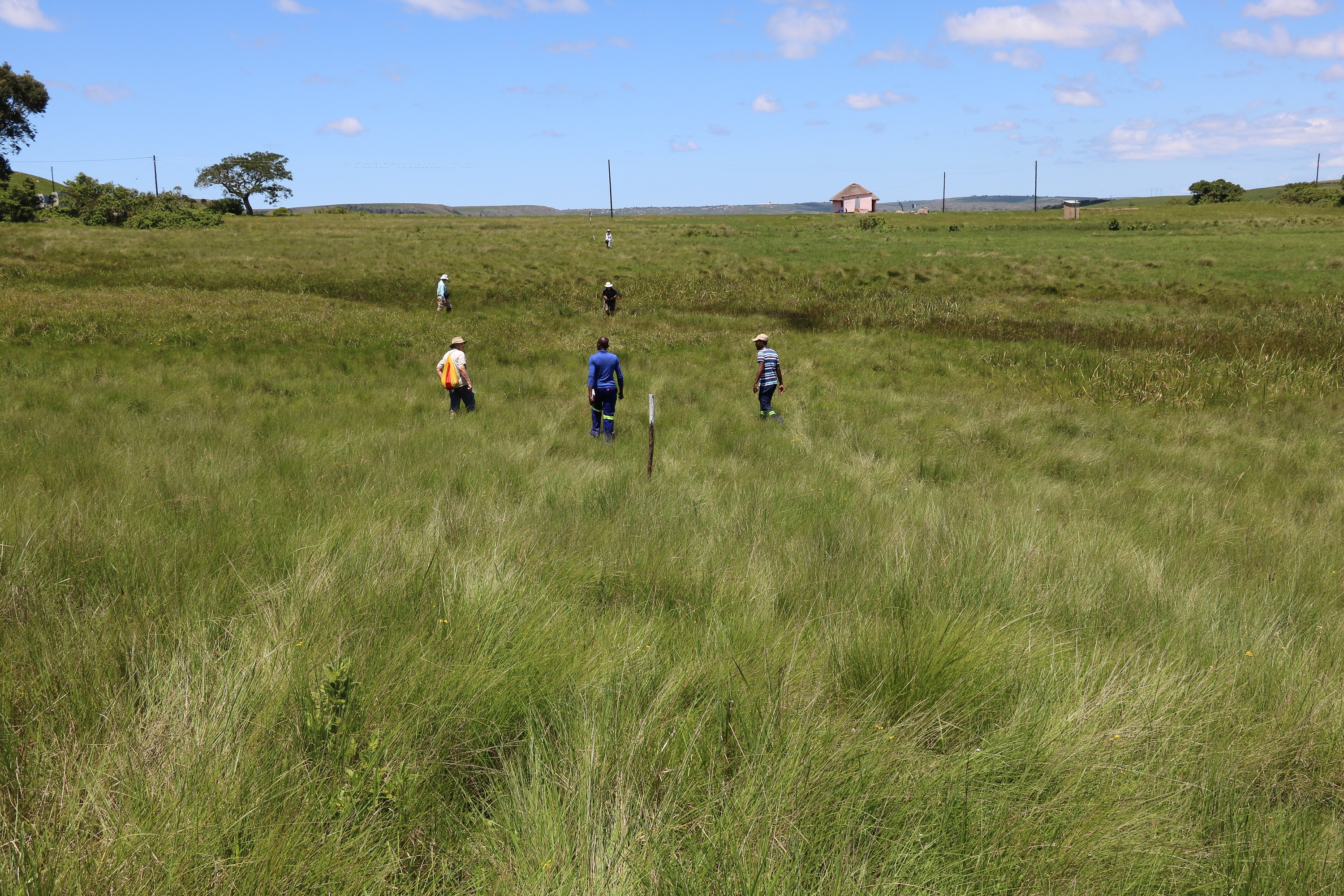
The Msikaba North and South Plant Search and Rescue team collect
important indigenous/endemic species within the road reserve,
to increase plant numbers at the temporary holding sites.

The Msikaba Bridge site plant search and rescue team has developed a comprehensive plant rescue database that is being maintained, daily, documenting the exact dates and quantities of species collected, together with their preferred habitat conditions and GPS locations of rescue on the Msikaba North and South sites.

About 13 850 plants have been rescued so far: 4 460 plants from the Msikaba (North) site and 9 390 plants from the Msikaba (South) site.

Msikaba (South) has yielded nearly twice as many plants as Msikaba (North), and also has greater species diversity. The rescued plants at both holding sites are showing signs of healthy growth and foliage, with some species even flowering prolifically.

More jobs for O.R.Tambo district

SANRAL will over the next three years undertake more than 150 road construction projects in the Eastern Cape with at least 37 of those located in the O.R. Tambo District Municipality. These projects are expected to create over 8 000 jobs and see approximately R2.8 billion flow to small, medium and micro enterprises (SMMEs), the bulk of which will be from the local area.

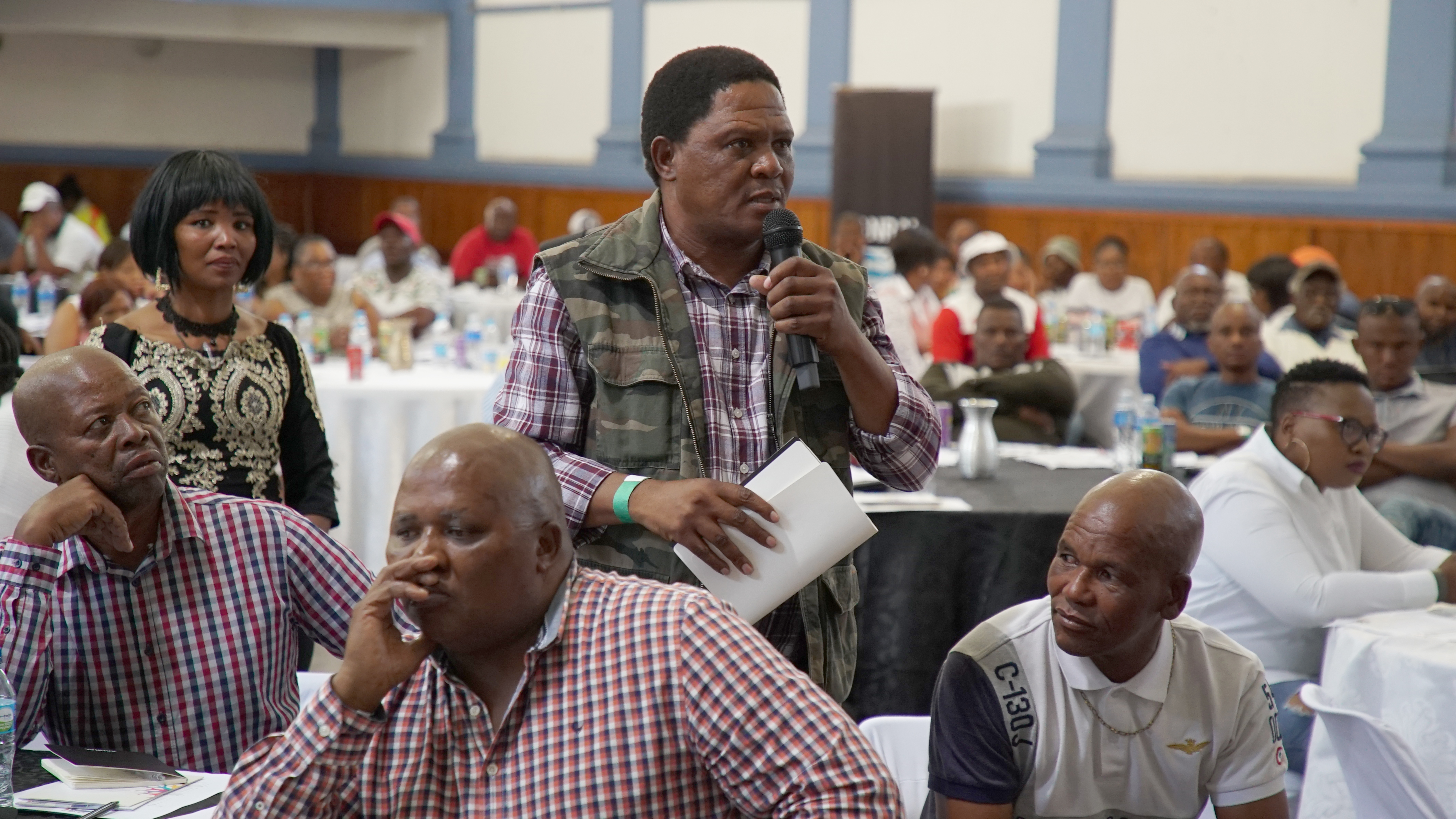
This was the message at SANRAL’s recent stakeholder engagement event in O.R. Tambo region in Mthatha, with Traditional Leadership, SMMEs, provincial and local government, business and civil society at large. In her opening address to a packed venue, Executive Mayor of O.R. Tambo District Municipality, Councillor Thokozile Sokhanyile

expressed gratitude for the economic lifeline that SANRAL’s road infrastructure projects inject into the regional economy, and also cautioned SMMEs to ensure that they are 100%

compliant in order to tender for these economic development opportunities. All unskilled labour, and as far as possible skilled and semi-skilled labour, will be sourced locally, as will local SMME contractors and suppliers of goods and services needed to meet the required contractor participation goals on SANRAL projects. To ensure social and economic inclusion for the people of O.R. Tambo District, SANRAL’s projects are guided by a commitment to its Transformation Policy that seeks to advance black business, SMME training and mentoring, a 14-point plan that prioritises community engagement and an overall strategy that is aligned to the Government’s National Development Plan. SANRAL Southern Region Manager Simon Peterson said: “We understand that before we build roads as economic arteries in our communities, we have a responsibility to make sure people are at

the forefront of our development plans. We are particularly driven to break down barriers of entry for broad-based participation by black South Africans. We do however need a concerted commitment from all our stakeholders to cooperate within the parameters of the structures that are put in place, specifically the composition of Project Liaison Committees (PLCs). While not every entity can serve on the PLC, this body is mandated to act in the

interests of all stakeholders.” In the spirit of consultation and cooperation, SANRAL continues to take its flagship programme, ‘Taking SANRAL to the People’ country-wide, engaging with communities and creating a platform to foster meaningful dialogue.

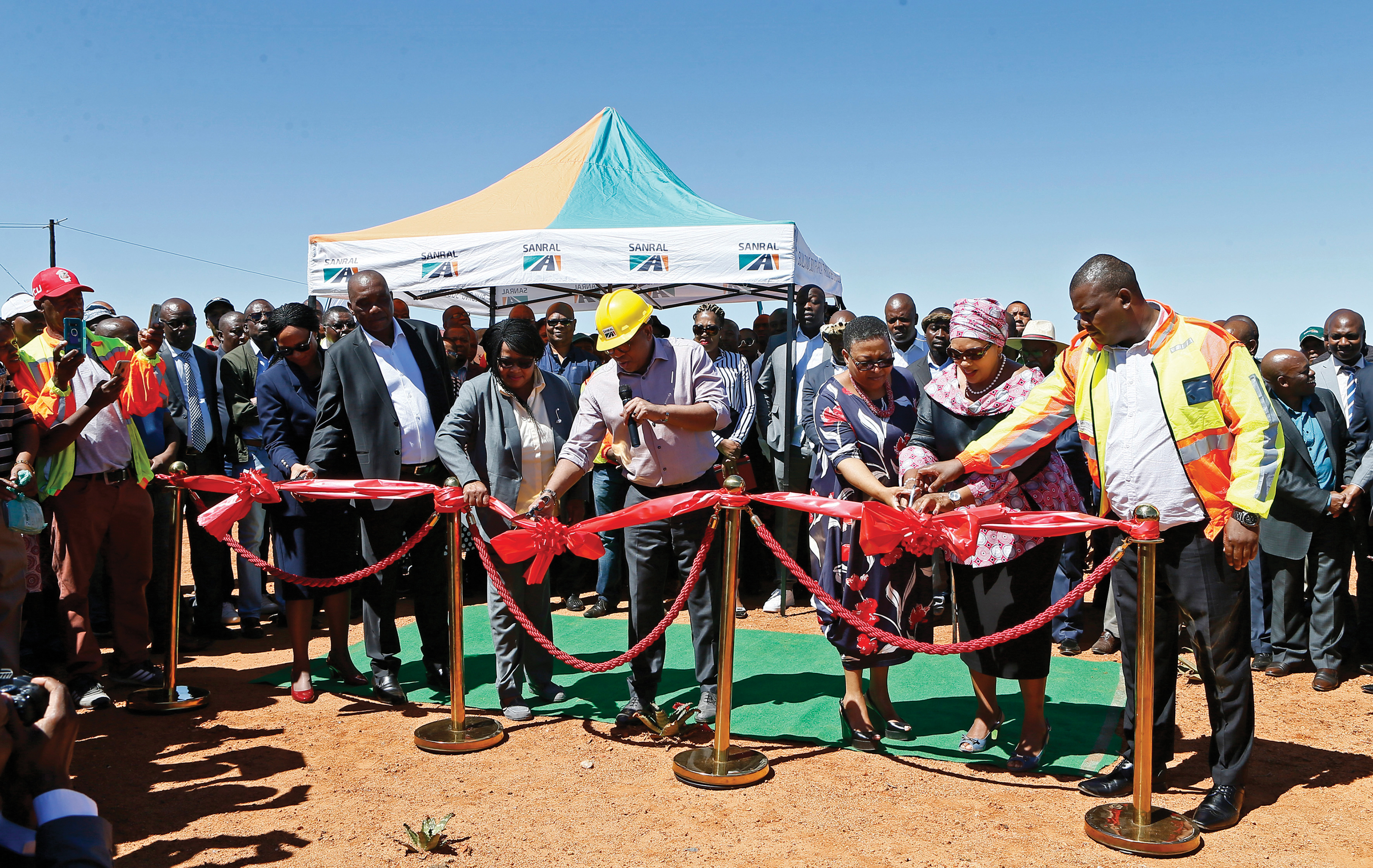
Moloto Road now a national road

Its official, the Gauteng portion of Moloto Road is now part of the  South African National Roads Agency (SANRAL) road network, which means that all 162 km of the R573, traversing three provinces – Limpopo, Mpumalanga and Gauteng – is now a national road. Minister of Transport Fikile Mbalula said government had listened to the pleas of local communities and road users and responded by transferring the road to SANRAL and allocating more resources for its upgrade. Government has allocated almost R4.5bn to this project over the next 5 years.

The Mpumalanga and Limpopo sections of Moloto Road were incorporated into the SANRAL network in July 2015 and construction of the first phase of those sections is nearly complete, Mbalula said. The scope of work for the first phase included construction of four traffic circles, three in Mpumalanga and one in Limpopo. Other phases in Limpopo and Mpumalanga are currently either at design stage or had just started prior to lockdown.

Benefits of the upgrades include reduced travel time between destinations, and improved safety through state-of-the-art traffic management features. The upgrades link seamlessly with broader transport plans and the Moloto Development Corridor Initiative, attracting new investments and broadening the economic base of the surrounding districts.

“When we build new or upgrade existing roads, we are always mindful of the economic impact. We have no doubt that Moloto Road will draw more economic activity into the area, enable small farmers to bring their produce to markets, be a route for tourists who want to visit game reserves and natural attractions and facilitate the movement of people, products and services,” the Minister said. He emphasised that upgrading a road must bring tangible economic benefits to the communities who live alongside that road. “Development must reach our people regardless of who they are and where they are,” the minister said. “People cannot simply be spectators when infrastructure development is being rolled out in their communities and not benefit therefrom. It is for this very reason that local procurement and participation are part of government’s policies aimed at empowering the historically disadvantaged.”

About 12 500 job opportunities are expected over the course of the project which is scheduled for completion over the next five years. SANRAL CEO Skhumbuzo Macozoma emphasised the inclusion of youth and women-owned businesses, in line with SANRAL’s Transformation Policy, as well as SANRAL’s commitment to the delivery of safe road infrastructure across the country. The event was also attended by Deputy Minister of Transport, Premier of Mpumalanga, MEC for Public Works Roads and Transport in Mpumalanga, Gauteng MEC for Roads and Transport, Acting Executive Mayor of Nkangala District Municipality as well as the Mayor of Thembisile Hani District Municipality.


STATE OF THE PROVINCE ADDRESSES PUT THE SPOTLIGHT ON SANRAL

Quality road infrastructure is the backbone of socio-economic development. Most Premiers shone a spotlight on progress on implementation of road infrastructure projects by SANRAL in their recent State of the Province Addresses.

KwaZulu-Natal Premier Sihle Zikalala indicated that the first of R9bn of the R35bn N3/N2 upgrade project was on the cards in the short term and the balance by the end of 2020/2021. Stakeholder consultations were under way regarding building the lsandlwana Heritage Development, which will support tourism and drive economic development, while the N2 KwaDukuza project will resume.

The N8 Airport Road, Welkom and Wesselsbron Roads in Bultfontein, Cornelia Road in Villiers and Virginia Road in Meloding in the Free State were close to completion. Premier Sisi Ntombela said that 23 projects had been ongoing, with 5 set for completion in the 2020/21 financial year at a cost of R230m. “All this work has created job opportunities for the youth and women. It has also contributed in alleviating poverty and stimulating local economic development”, she said.

SANRAL is rolling out multiple road infrastructure projects in 10 critical trade routes across the Eastern Cape. Premier Oscar Mabuyane reported as follows: “Through SANRAL, the National Department of Transport will inject R11.9bn in the next two years with R5.4bn targeted for projects from Kirkwood, Addo, Port Elizabeth to East London, from Aliwal North to Lady Grey and Barkley East. This year, we will also see the re-establishment of Site for R61 between Baziya and Mthatha Airport. I can also confirm that the long-awaited upgrade of the road between Alice and Fort Beaufort will start in May 2020.”

There were 9 active contracts in partnership with SANRAL in the North West province, covering a road network totalling 2369 km. Premier Job Mokgoro said “We are in the process of procuring contractors for 14 new routine maintenance contracts which are packaged based on Local municipal boundaries. These projects will create opportunities for Local Emerging Contractors to bid for sub-contract work packages, such as pothole patching, fencing and grass cutting. The bid process for the sub-contracts will be overseen by area specific Public Liaison Committees to ensure local participation, fairness and transparency.

“Together with SANRAL, we are implementing three major road rehabilitation projects. We are upgrading the R511 from Brits to Beesterkraal, with a project value of R242m; the rehabilitation of the R53 from Potchefstroom to Ventersdorp, with a project value of R158m; and the N4 Pampoennek to R512, in Madibeng, with a project value of R407m. In the second quarter of 2020, as part of this collaborative partnership between us and SANRAL, we will be awarding three construction contracts for the reseal of the N12 between Wolmaranstad and Bloemhof, costing R120m.”

Northern Cape Premier Dr Zamani Saul reported that SANRAL has committed more than R4bn to road maintenance and improvements in the province over the next 3 years, and that a large portion of this will go to small, medium and micro enterprises (SMMEs). Approximately R500m of this amount is specifically set aside for Routine Road Maintenance (RRM). He said “Between 40% and 60% of this value is specifically targeted at SMMEs, including approximately R50m for entry-level road maintenance subcontractors. Fifteen RRM projects are specifically being rolled out in the Northern Cape, which are expected to generate approximately 1500 jobs over the next 3 years. The restructuring of the RRM projects will enable contractors to embark on skills training and facilitate the development of subcontractors. Furthermore, the targeted enterprises will be assisted to institute a quality assurance system, with provision made for ongoing and adequate training, coaching, guidance and mentoring.”

Taking SANRAL to the people of De Aar

R500m for RRM and approximately 1 500 new jobs over the next three years. That was the message from SANRAL to the people of De Aar.

Through its flagship “Taking SANRAL to the People” stakeholder engagement programme, SANRAL continues to create platforms to engage the road construction industry, the business community, traditional leadership, civil society and local and provincial government, on economic development opportunities associated with its road construction infrastructure upgrades in regions country-wide. The stakeholder engagement session in Upington late last year was the start of a critically important conversation where SANRAL promised to expedite economic relief in the road construction industry, in the form of new tender opportunities. The discussions at that session, led to another stakeholder engagement, this time held in De Aar, to address not only current and future SANRAL projects in the Pixley ka Seme District, but in the greater Northern Cape as well.

The Northern Cape MEC for Transport, Safety and Liaison, Ms Nontobeko Vilakazi, delivered the keynote address and lauded SANRAL for the major economic injection it’s projects bring to the region. These projects, coupled with the current commitments of her department, as well as those of the Department of Roads and Public Works, would create massive opportunities for SMMEs to benefit from subcontracting, while simultaneously ensuring work opportunities for thousands of locals.

The second day of the De Aar visit was the bit that tugged at the heart strings, as nearly 250 learners from various schools in the district were given brand new mountain bikes, courtesy of Transport Minister Fikile Mbalula’s Shova Kalula campaign.

When it comes to road safety, there can be no greater priority than protecting pedestrians, and particularly children. In rural communities, like De Aar, many children walk long distances to get to school every day, often with no adult supervision.

And so, with a visible and audible passion for road safety, Minister Mbalula descended upon De Aar on a bicycle, flanked by Northern Cape Premier Dr Zamani Saul and a few learners from surrounding schools, who had been identified to receive bicycles from the Department of Transport.

Minister Mbalula, joined by MEC Vilakazi, as well as Education MEC Mac Jack, handed over 249 Shova Kalula bicycles to learners from six schools in De Aar. The distributed bikes were among 500 bicycles which will be handed over to qualifying learners across the Northern Cape this financial year.

Over and above the bicycles, many learners received school uniforms to ensure that all children look the same, particularly as abject poverty puts school uniforms out of reach for some children.

The pure elation and ecstasy on the faces of the learners could be seen all over the school grounds. For many boys and girls, this is the first bicycle they have ever owned, and the Minister appealed to them to treasure it and pleaded with parents to help maintain it.

He also reminded the children that the primary use of the bicycle is to get to school and back, which should help to make learning a bit easier. The Shova Kalula bicycle programme is an initiative of the Department of Transport aimed at assisting learners who walk more than three kilometres but less than five kilometres to school daily. Learners who walk more than five kilometres to school qualify for state subsidised scholar transport.

Since the programme’s inception in 2001, the Department of Transport has distributed over 100 000 bicycles to learners throughout South Africa. In the next three years, the department aims to distribute 24 000 bicycles across the country.

While the bicycles are all parked at home now, they will certainly be put to good use once South African schools re-open, following the nationwide COVID-19 lockdown.