
Blog

Tolls are an old way – an 18th Century Tale

The history of tolling in South Africa goes back a long way – as far back as the 18th century – and even then, the funds raised in this manner were used to build, repair and maintain roads – of which there were not too many during the early colonisation of the Cape by the Dutch.

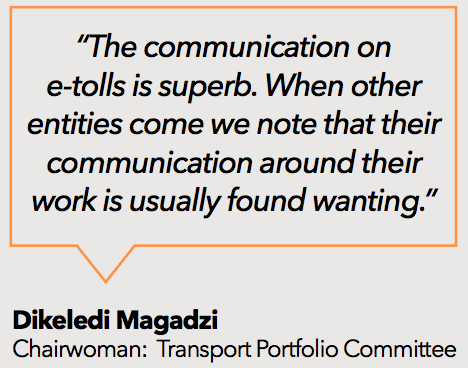
Then, as now, the concept of tolling was not universally popular, often because the populace simply did not and does not understand why such a funding route has to be taken. But communication on tolling in South Africa has improved significantly in the recent past, as was acknowledged in Parliament.
Screenshot 2015-12-17 08.43.53

Different from the approach in many other countries where private initiative stepped into the breach, tolls were erected by the government – initially by the governor of the Cape and much later in the 19th century in the then Natal and Free State.

The best known of the tolls were in the old Transvaal in the 1890s. Its origins were partly due to an attempt to control the trade traffic coming in from Natal and the Cape and to use the income to improve the rather rudimentary roads and bridges in the then independent Transvaal.

But it had a chequered history. There was so much opposition – from the colonial governments, local traders and ordinary people – that the first tolls only lasted from November 1891 to August 1892.

Tolling commenced again at the end of October 1894 but was finally scrapped in December 1896.
The first modern toll was established in the Tsitsikamma between the Crags and Storms River in 1983.

Construction of the road had started in 1980, funded by the then National Road Fund (NRF) but because of the latter’s financial difficulties, experienced from the late 70s, it was decided to charge a toll for the use of the road in order to raise revenue to repay the NRF.

In the 21st century, tolls came into much wider use – not only on national roads but also at Chapmans Peak in Cape Town and the Huguenot Tunnel on the N1 northwards of the Mother City.

Tolls are now mostly on national roads, constituting just over 14 percent of the network. Road users typically get to a toll plaza, stop and pay using cash or a credit card. This is the manual way of paying tolls and is the case with everything manual, it can be time-consuming. There is another more modern and efficient method called e-tolling. With this method, the road user does not stop at a toll point but travels at normal highway speed and the transaction takes place electronically. That is the method that operates in Gauteng.

Tolls accelerate the availability of funding because capital can be accessed from the markets instead of waiting for public coffers to get filled first, which can be a long process in itself. Also, there is no guarantee that once the money is available in the fiscus it will necessarily be used for roads.

There could be other priorities. Thus, tolling makes it possible for roads to be available sooner and means that repairs and maintenance on these roads will be funded by the tolls.

As the pressure on the national budget to increase social spending grows, so will tolls as a funding model also have to grow.

Screenshot 2015-12-17 08.54.56

Hopes for a Safer ???Festive Season

The festive season is generally a happy time, but it comes with its own challenges, as holidaymakers hit the road and unusually high traffic volumes are experienced around the country. Nonetheless, our mandate as SANRAL is to ensure that our roads are always ready to accommodate this kind of traffic and ensure that motorists and other road users have a pleasant experience. We do this by ensuring that our roads are built and maintained to world-class standards.

Screenshot 2015-12-17 08.23.34

However, road users also have a huge responsibility to work with SANRAL and other agencies to ensure their own safety while travelling. Road safety is a collective responsibility – not only the job of law enforcement officials or engineers. Roads are shared spaces for those in cars and trucks as well as pedestrians and cyclists.

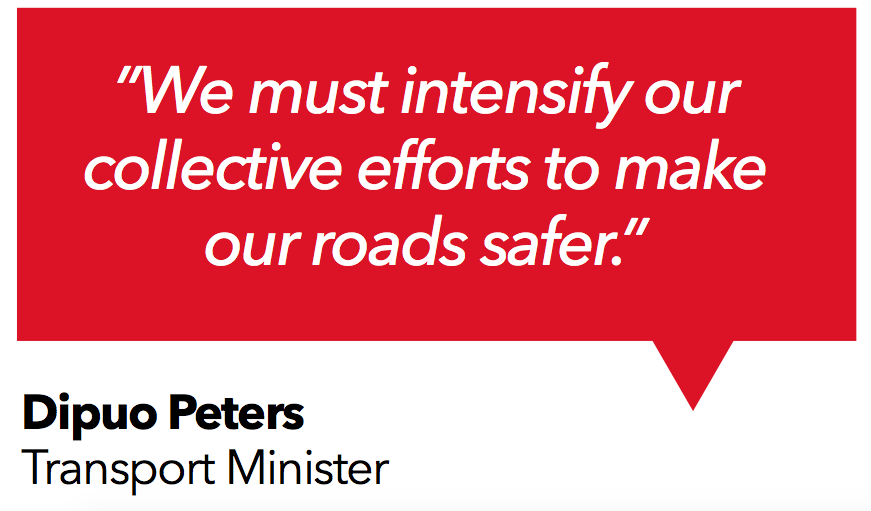
Speaking at the recent annual Road Safety Summit in Cape Town, Transport Minister Dipuo Peters pointed out that South Africa, with about 32 deaths per 100 000 population per year, features high on the list of countries in terms of road traffic-related deaths.

“We must intensify our collective efforts to make our roads safer.”

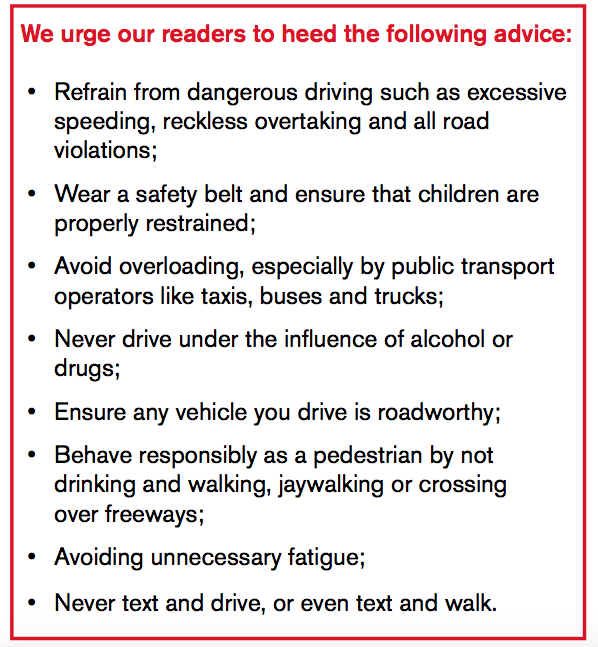
All road users must note that the following actions have been found to be among the most common causes of crashes:

– Speeds that are too high for particular conditions, such as inclement weather and darkness;

– Dangerous, reckless and/or inconsiderate driving, particularly barrier line infringements;

– Abuse of alcohol by drivers and pedestrians;

– Fatigue, particularly for the drivers of public transport;

– Unroadworthy vehicles, worn or damaged tyres and defective brakes; and

– Pedestrian negligence such as jaywalking, crossing over freeways, a lack of visibility at night and negotiating roads and verges after drinking.

Screenshot 2015-12-17 08.32.49

SANRAL will continue to contribute towards road safety by ensuring that all the roads under its control are safe and reliable. We do this through a number of road network modernisation projects that we have planned throughout South Africa. This, together with community education, awareness campaigns, changed behaviour by road users and road safety infrastructure projects, will go a long way towards ensuring that our roads are among the safest in the world.

SANRAL achieves major milestone

SANRAL reached a major milestone when it switched on the automated payment option at its toll plazas on the following routes:

N1 from Pretoria to Musina
N1 between Bloemfontein and Johannesburg
R30 Brandfort
N17 between Johannesburg and Ermelo
N2 South Coast route
N3 Mariannhill.

In addition, the N3 Toll Concession (N3TC) also switched on automated payment on the N3 from Heidelberg to Cedara.

At midnight on 4 December the automated pay system on these existing toll roads became operational. Road users with electronic tags no longer have to stop to pay tolls manually with cash or credit cards.

“We have become one of very few countries in the world with a fully interoperable electronic toll collection system with central transaction clearing, says Vusi Mona, communications manager of SANRAL.

Moreover, it is a choice. Those who use our toll road network will experience the convenience of electronic payment in time for the festive season and this is a help to speed up traffic flows at toll plazas.

Automated payment is done automatically through a tag fitted to the vehicle to identify the account holder, debit their toll account with the appropriate toll fees and automatically open the toll boom – without the need to stop and pay manually. This automated option will not incur any additional costs to the road user.”

SANRAL has thereby responded to its customers’ needs – a survey done during August and September this year showed beyond doubt that 70% of customers want to make use of tag technology for improved convenience at toll plazas.

“We continuously strive to make improvements in the way that we manage our road network and make driving on our roads as safe and easy as we can achieve through engineering and world-class technology. Automated payment is one such a way.

Moreover, it is in line with our Government’s commitment to improve road infrastructure that underpins the competitiveness of the South African economy.”

Blasting between Majola Tea turnoff and Tombo in the Eastern Cape

SANRAL would like to notify travellers that blasting is scheduled to take place at the Majola Tea turn off on the R61 Section 8, tomorrow, on Tuesday 1 December 2015 at 3pm.

The road will be closed approximately 49 km from Mthatha CBD or 35.5 km from Port St Johns, between 2:55 pm to 3:45 pm on Tuesday.

Residents are requested to vacate all houses near the blast area up to a radius of 400m by 2:45 pm.

Stop and Go sections are planned for the section of the road and motorists are requested to plan their trips accordingly.

Mount Edgecombe Interchange to get a historical makeover

A historical moment in bridge construction will occur in mid-2016 when the longest incrementally launched bridge in South Africa is completed.

The one-kilometre-long bridge will form part of the improvements being undertaken by SANRAL at the N2/M41 Mt Edgecombe Interchange north of Durban, connecting Phoenix and Umhlanga with Durban and the North Coast of KwaZulu-Natal.

Incremental launching is a method of building a complete bridge in segments that saves time, money, space, reduce disruption and requires less work while easing access and delivering a high-quality finish.

Corne? Roux, Project Manager for SANRAL Eastern Region, said due to the growth of the Umhlanga and La Lucia Ridge areas, the existing interchange is operating at capacity with vehicles backing up on the M41 and onto the N2 in peak hours.

“An additional 40 000 vehicles enter or leave the N2 from the M41 daily resulting in substantial queuing of vehicles during the day.

This, together with expected future expansions and anticipated development of the Cornubia area, required the existing interchange to be upgraded in order to improve the flow to and from the N2 and M41 to the supporting road network.”

Roux said the new four-level interchange facility will provide at least two lanes on each of the major movements. The upgrade includes the implementation of directional ramps, which will eliminate the need for controlled signalisation, thus ensuring the free flow of traffic in all directions.

To provide for the safety of pedestrians, a bridge will be constructed over the N2 and connect to new footways.

The construction of the interchange is jointly funded by SANRAL and the KwaZulu-Natal Department of Transport.

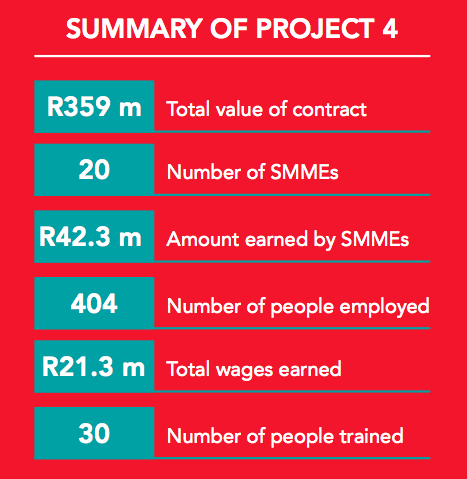
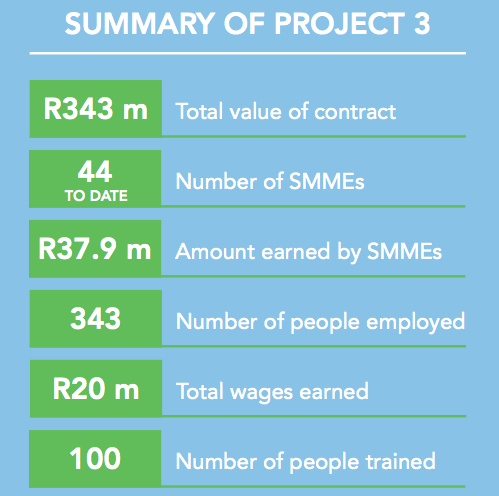
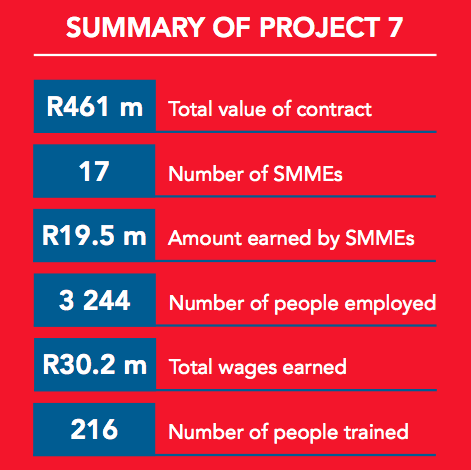
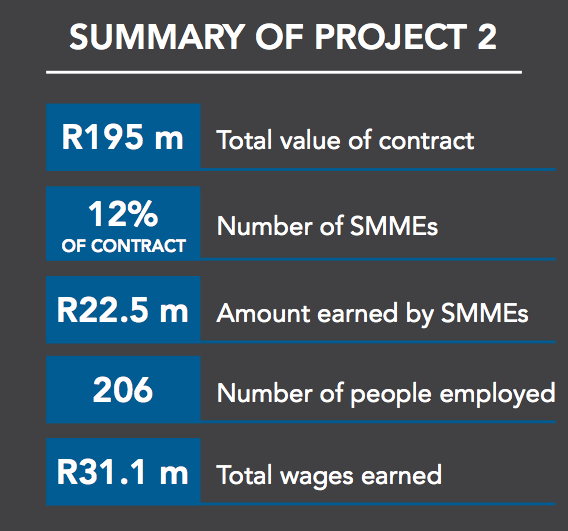
The SMMEs working on the Mt Edgecombe Interchange project would benefit from gaining invaluable experience and transfer skills.

Henk Kaal, the engineer from SMEC, who is overseeing the N2/M41 Mt Edgecombe Interchange, said the main advantages for using the incremental launching method rather than other traditional methods, are the minimal disturbance to environmentally sensitive areas; the need for a smaller assembly zone; less disruption to traffic; and greater safety for motorists and pedestrians during construction.

He said two incrementally launched bridges are being built as part of the interchange upgrade. One bridge, which is 948m long, joins the Mt Edgecombe side of the M41 with the N2 South. The other bridge is 440m long and joins the Umhlanga side of the M41 with the N2 North.

The 948m bridge will have 23 piers and two abutments and is being built from two ends – one portion is being launched on a curve and the other on a straight and they are expected to meet in the middle of next year – 2016. The 440m bridge will have nine piers and two abutments.

Speaking of the benefits derived by SMMEs working on a project such as the Mt Edgecombe Interchange, Frans Boraine, who works for a sub- contractor, said by giving SMMEs the opportunity to be part of a large contract, big business provided invaluable experience and transfer skills.

“South Africa needs jobs. SMMEs create more than 50 percent of all employment opportunities in South Africa, while contributing 45% of the country’s gross domestic product.

Also, SMMEs cannot afford to purchase all the materials needed on a site and big business helps in this regard. Big business also makes available expensive equipment and provides advice and mentorship.”

Boraine also said big business needed SMMEs for their BEE ratings because a component of the contract with SANRAL dictates that a certain percentage of the work must be done by BEE/ SMME contractors.

The project is anticipated to be completed in October 2016.

Road to Kransvleikloof made safer for tourists

The N7 between Citrusdal and Clanwilliam is one of the most picturesque roads in South Africa, winding its way along mountainous terrain at the edge of the Cederberg wilderness area.

The road is not only important from a tourist point of view but forms a vital transport link between the Western Cape, the Northern Cape and South Africa’s northern neighbour, Namibia.

The increase in the volume of heavy vehicle traffic on the N7 as well as the age of the road necessitated the upgrade.

The stretch of road running between the Cederberg/Algeria T-junction and Kransvleikloof over a distance of about 20km is being upgraded. Work on the project started in August 2013 and is expected to be completed in the first quarter of 2016.

Renaldo Lorio, Project Manager, says the project entails the improvement of the existing road by re- aligning and widening the cross-section of the road surface and the provision of climbing lanes on steep sections. “It is designed in such a way as to carry traffic safely for at least the next 20 years.”

Part of the project includes the construction of seven major culverts and a new bridge over the Kransvlei River to replace the current narrow bridge. The new bridge deck will accommodate three
lanes with surfaced shoulders and provide for a right-turn lane on the approach to the Paleisheuwel intersection, adjacent to the bridge.

Screenshot 2015-11-26 10.12.19

?Dual carriageway for Mthatha

SANRAL passed the half-way mark on the R61 Mthatha Sprigg Street to Ngqeleni project in June this year.

The project remains on schedule for delivery next year and the estimated date for completion is towards the end of 2016.

It consists of the construction of a new 7.3km dual carriageway between Mthatha and the turn off to Ngqeleni. The eastbound carriageway will be newly constructed while the westbound carriageway entails upgrading of the existing road infrastructure.

As a result of the new carriageway five new bridges, one over the Mthatha River, another over the Corana River, a pedestrian overpass bridge and a new bridge at the Ngqeleni Interchange, are currently under construction. A smaller bridge will also be constructed over the Sidwadweni River on Bernard Schultz Drive.

Through the programme, the safety of the road users and pedestrians will be improved through the closing of unsafe intersections, a new interchange at Ngqeleni turn-off and the construction of formalised and channelized intersections.

This is also an integrated road safety programme which aims to decrease the road hazards, which may lead to accidents and motor vehicle accident (MVA) related deaths.

Many accidents on the R61 between Mthatha and Ngqeleni involve motorists hitting stray animals. In fact, between December 2014 and January 2015, local traffic authorities impounded 266 stray animals including goats, cattle, sheep and donkeys.

To address the problem, SANRAL is busy constructing two agricultural underpass culverts.

The project has already injected a salvo of benefits to members living in villages from Mthatha to Ngqeleni.

“SANRAL has delivered 31 new replacement houses to residents whose dwellings fell under the construction footprint, and in the process replaced poorly constructed homes.”

The project has also brought meaningful initiatives of social development to residents and communities.

Training and skills development initiatives are also advancing members of the local community. Technikon students from the community are being offered an opportunity for on-site experiential training in order to obtain their diploma qualification.

Local SMMEs were mentored in the construction of relocation houses to National Home Builders Registration Council (NHBRC) standards, and also participated in several courses which include construction tendering, basic computer literacy skills, site administration and monitoring.

The workers have been provided with, amongst others, road safety and environmental awareness training.

Ngozwana said the work is carried out in a heavily trafficked and densely populated built-up area, and within a confined construction zone involving the simultaneous construction of earthworks, structures, and the relocation of services.

“The interface between formal and traditional land tenure systems for land acquisition and relocation of communities has produced unique challenges which SANRAL solved through proper planning and continuous stakeholder engagement.”

He said the project is also part of a master plan to unlock the economic potential of the Wild Coast, opening it up for both development of tourism and other long-term mega projects in this region.

The R61 Mthatha Sprigg Street to Ngqeleni project is also one of several projects each with different starting and completion dates in a mega road infrastructure development and safety programme for the R61 which commenced in 2011, and which will be completed by 2020.

This project also links up with other programmes including the conversion of Sprigg Street and Madeira Street in Mthatha’s central business district (CBD) into one-way streets to help improve traffic flow.

Screenshot 2015-11-26 08.17.51

A Better Road To Swaziland

There are two projects on important link roads in Mpumalanga near Swaziland of which one has been completed while construction on the other is ongoing.

The R570 between the N4 and Jeppe’s Reef in the Greater Nkomazi Municipal area is under construction while the R571 from the N4 to Esibayeni was completed in February 2015.

The R570 forms an important link in the national road network connecting the eastern parts of South Africa with Swaziland at the Jeppe’s Reef border post. The existing road needed urgent attention due to deterioration and a drop in levels of safety due to increasing volumes of traffic.

Safety was also a major concern and this was taken into account by providing passing lanes and climbing lanes as motorists were becoming frustrated by blockages caused by slow- moving heavy laden trucks.

Apart from the rehabilitation of pavement layers for 41 kilometres of existing road and the construction of these lanes to cater for the increase in volume of traffic, the following works will be done:

• Demolishing existing drainage culverts and installing new and wider culverts
• Installation of subsoil drains
• Widening of four bridges, replacement of joints and parapets
• New road markings, road studs, road signs and fencing
• Finishing off the road reserve
• Establishment of borrow pits and a hard rock quarry
• Landscaping and rehabilitation of grass
• Desurfacing of the road, and
• Adding of additional lanes.

Tumelo Nkosi of the black-owned sub-contracting firm said:

“I would like to thank my partner for the opportunity given to me and the community of Buffelspruit in particular.

They have granted me the opportunity to work with them and a chance to change many lives by creating job opportunities and reducing unemployment in the community. I would also like to thank SANRAL for making all this possible”.

Stuart Tanner, Site Agent for the contractor, had only praise for Nkosi.

“Tumelo approached us when we started our establishment for the site camp on the R570 project in January 2015. We gave him a go and he produced good results, no task or operation requested of him was too big or too small.

It is a pleasure working with a contractor that is hard working with a focus on high production and good quality of work.”

Screenshot 2015-11-25 21.43.02

The R571 from the N4 to Esibayeni (28km) also forms an important link in the national road network and provides mobility for transport of sugar cane to the mills in the area, and for international travelers moving between Mozambique, South Africa and Swaziland.

The improvements include the partial reconstruction of pavement layers for 20km of existing road and the following:

• Upgrading of storm water drainage and installation of prefabricated culverts
• The installation of new guardrails
• The erection of new fencing
• Construction of new road markings, road signs and road studs
• Finishing off the sites, roads and road reserves.

Rustenburg’s R24 Becomes an Urban Arterial

Traffic flow in Rustenburg is about to improve. The R24 on the west side of the town is being upgraded.

It is currently a single-lane road that has recently been incorporated into the national road network. It serves as a link between Rustenburg and other towns and provides access to the N4, Rustenburg’s industrial area as well as various smallholdings along the road.

Rustenburg has experienced significant growth in recent years. A great deal of the development occurred along the R24, which has changed the road’s status to an urban arterial.

Hennie Kotze, SANRAL’s Senior Project Engineer for this upgrade, said the North West province has identified the need to upgrade the R24 from a single to a dual carriageway in order to cater for the increased traffic volumes as a result of numerous developments in the area. He said:

“The increased capacity will also reduce heavy congestion during peak hours that is currently being experienced on the road and also on feeder roads as a result of the lack of capacity of the R24.”

Screenshot 2015-11-25 21.17.28

The scope of work involves the construction of new road works, structures and road lighting as well as the rehabilitation of the existing road.

The project started in March 2013 and will be completed in October 2015. Kotze said as part of the contract, SANRAL requires that the contractor allocates work to local SMMEs and employment of local labour – a move which will contribute to job creation and skills development in the area.

Screenshot 2015-11-25 21.37.17

These upgrades are done in part to create improved accessibility to adjacent properties, businesses and the potential for further development on vacant land which will have a major impact on economic growth in the area.

Advertising Standards Authority dismisses e-toll ad complaint

SANRAL has welcomed a ruling by the Advertising Standards Authority of South Africa (ASASA), dismissing a complaint regarding a SANRAL advert flighted to create awareness around the 60% discount on the new e-tolling dispensation.

“We are pleased with ASASA’s decision to dismiss the complaint,” said Vusi Mona, spokesperson for the roads agency.

“SANRAL has seen a concerted campaign against its adverts over the last 20 months or so by those opposed to the e-toll system. This is clear as complaints are laid only against our e-toll ads.

Despite this, we have an obligation to communicate with the public and will continue doing so in order to balance what is read, heard and seen by road users.”

Mona said that the 60% discount is an important next phase of the new dispensation. It has so far brought relief through the implementation of a uniform rate of 30 cents per kilometre for light vehicles, a 50% reduction in the monthly maximum for registered account holders and now for those with outstanding e-toll debt incurred from 3 December 2013 until 31 August 2015. All have been given a six-month period to settle their accounts, or make payment arrangements.

“We urge motorists to take up the 60% offer. Check your debt. You may be surprised to learn that it is not as much as you fear.”