
Blog

SANRAL announces roll-out of 2nd phase of the new e-toll dispensation

60% discount on debt now available.

Road users on the Gauteng freeway network are eligible for a 60% reduction of their historic e-toll debt in arrears. The Department of Transport announced this in Government Gazette 39306. This once-off discount applies to all unpaid e-tolls levied on GFIP roads from 3 December 2013 up to and including 31 August 2015.

The new e-toll dispensation announced by Deputy President Cyril Ramaphosa in May is being phased in and changes have been made to the electronic systems to ensure a seamless transition, says SANRAL’s Head of Communications, Vusi Mona.

Among the changes that are already in place are a uniform rate of 30 cents per kilometre for light vehicles and a 50% reduction in the monthly maximum for registered account holders.

Road users with outstanding e-toll debt incurred from 3 December 2013 until 31 August 2015 now have six months to settle their accounts, or make payment arrangements.

“This is not an amnesty or a debt write-off. It is a special discount offered to road users in terms of the new dispensation. Road users can contact the dedicated toll-free number 087 353 1490 or send an SMS to 43360 with their ID number to find out how much they owe.

They can then pay their dues over the counter at all First National Bank branches, or at any FNB ATM, or via the internet or EFT.”

Detailed information on all payment options available can be found on the special website www.less60.co.za.

Mona says the best option for road users is still to register for e-tags and benefit from the reduced tariff and a monthly maximum that has been cut in half from R450.00 per month to only R225.00, for light vehicles, since the beginning of July.

“Government has listened to concerns from Gauteng road users about the affordability of the e-toll fees and responded by reducing toll fees and making it easier for those who do not have an account with SANRAL to settle their debt.”

Traffic Advisory for R72 Port Alfred and Fish River

SANRAL would like to notify road users of travel delays on the R72, due to blasting at the Shaw Park quarry that will commence from 15h00 onwards Tuesday 27 October 2015. The road will be closed and motorists can expect a delay of approximately 30 minutes.

The Shaw Park quarry is situated next to the R72, near the intersection of the R72 with the gravel road leading to Shaw Park. The quarry extends from the SANRAL kilometre markers 20,800 to 21,200.

Motorists are requested to plan their trips accordingly and be cautious when making use of the road.

SANRAL scoops top engineering awards for road projects

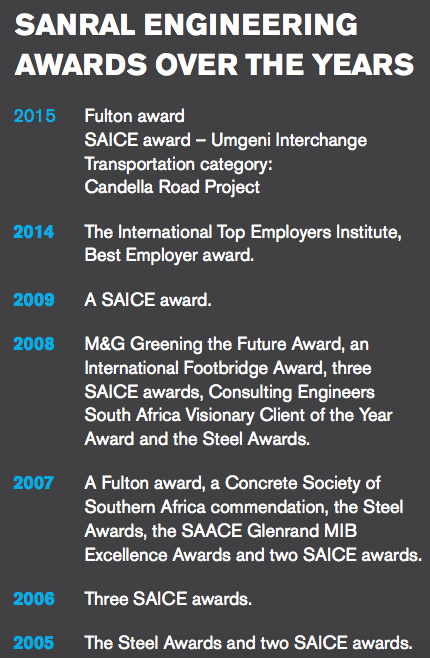
SANRAL has received the highest accolades awarded by the South African Institution for Civil Engineering for two major road development projects in KwaZulu-Natal.

Vusi Mona, spokesperson of the South African National Roads Agency SOC Ltd (SANRAL), says the recognition by SAICE confirms the agency’s reputation as a world-class manager of road construction projects. Both projects have been recognised for their innovation and contribution to excellence in the engineering sector.

The Umgeni Road Interchange on the N2 just north Ethekwini will be opened by the Minister of Transport, Dipuo Peters, this week. Construction started in March 2011 and one of the primary challenges was to continue with work while the road was still carrying traffic.

Prior to the upgrade, up to 16,000 vehicles were travelling through a conventional diamond-shape interchange, controlled by traffic signals, during morning and evening peak hours. This led to chronic congestion on the freeway and in Umgeni Road, a vital artery for communities in Ethekwini.

The project included the building of four new road bridges and two pedestrian bridges, the widening of Umgeni Road / M19 and the construction of ramps onto the freeway.

An innovative construction method, known as incremental launch, was used to build the bridges. This method entails the building of the entire bridge from one end of the structure and sliding sections of the deck into position through the use of specially designed ball bearings.

The new interchange has already resulted in a significant reduction in traffic congestion and journey times and will contribute to improved road safety for pedestrians and motorists on a road that was previously known for its high number of accidents.

The Umgeni project also won the top accolade given by the KwaZulu-Natal branch of SAICE and the prestigious Fulton Award from the Concrete Society of Southern Africa.

The Candella Road Project was celebrated by SAICE in the Transportation category. The project forms part of SANRAL’s “green roads” initiative designed to reduce the long-term environmental impact of road construction.

An ultra-thin layer of asphalt was laid over the 8.5km section of the N3 between Candella Road and Paradise Valley. This innovation makes the road safer for commuters because it increases skid resistance.

Mona says both the projects contributed to SANRAL’s commitment to create job opportunities and use the services of emerging SMME contractors. On the N2 more than R57-million was allocated for labour and 265 people were trained in various skills. The Candella Road project used the services of 50 small and local companies and more than R7-million was spent on salaries and wages.

Off the beaten track in Kwazulu-Natal – Top 5 highlights

You name it, and KZN has it. And you can get there on some of the world’s best roads. From the N2, N3 and N11 you can get to most of the spectacular places in this, the Zulu Kingdom. And if not, a provincial road off the national route will do it.

These are national roads, SANRAL roads, built and maintained to world standards. The N2 runs from Cape Town through the Eastern Cape via Durban in KwaZulu-Natal up to Ermelo in Mpumalanga where it connects with the N17 to Mbabane and Johannesburg and also the N11 which runs to the Botswana border and Ladysmith in KZN.

This highway is one of the busiest in the country as it carries some 10 000 trucks a day. Major upgrades and improvements have been undertaken and some are still a work-in-progress. It enters KZN from Mpumalanga at Volksrust.

The N3 is arguably the most important economic link in the country – taking traffic from the economic hub of South Africa to its biggest port, or put differently, tying its biggest city (Johannesburg) to the third biggest (Durban). The road is tolled as it is managed on behalf of SANRAL by a concessionaire N3TC.

The region lies between the warm Indian Ocean in the east and the majestic Drakensberg in the west, borders on the Eastern Cape in the south and Mozambique in the north with year-round warm weather just the place to visit to experience the unique mixture of indigenous culture which has met European and Indian influences.

When one says KZN, many people think Durban, Maritzburg, Margate, fine dining, enjoying the beaches, waiting for the sardine run in June/July, and surfing.

It also is home to a series of nationally important sporting events: the Comrades Marathon, an 88 km run between Durban and Maritzburg; the Midmar Mile, the world’s biggest open-air swimming event; Dusi Canoe Marathon, one of the toughest in the world; the Amashovashova Cycle Race, along the basic Comrades route from Durban to Maritzburg and then there is the country’s premier horse racing event, the Durban July.

And coming your way in 2022, are the Commonwealth Games, to be held in Durban. It is a first for South Africa and is expected to boost the local, provincial and national economy. So, to attend in person, book now!

The choice of what to do is wide and will appeal to all tastes. But you can do something different, something away from the madding crowd.

Like heading to these top 5 destinations:

1. Ukhahlamba Drakensberg Park

shutterstock_68749657

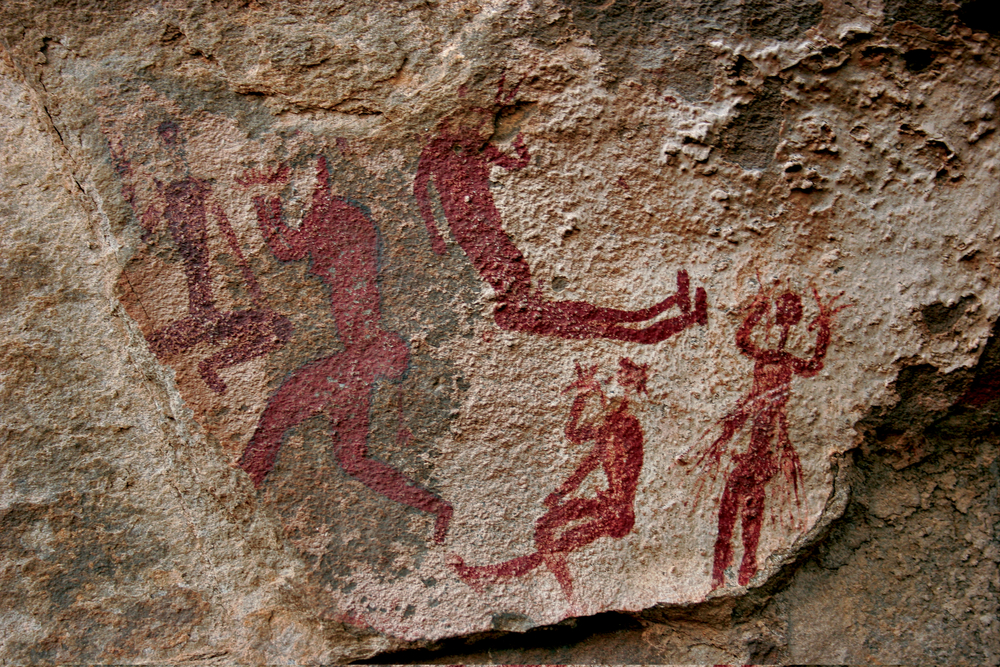
Two hours north of Durban along the N3 lies the Ukhahlamba Drakensberg Park – a UNESCO World Heritage Site, which it describes as having “exceptional natural beauty in its soaring basaltic buttresses, incisive dramatic cutbacks, and golden sandstone” and its diversity of habitats protects a high level of endemic and globally threatened species as well as caves and rock- shelters with the largest and most concentrated group of paintings in sub-Saharan Africa.

And you can also go hiking, swimming, fishing, boating, bird watching and so much more – with a great variety of accommodation. Of course, wonderful rock climbing too.

2. Isandlwana and Rorke’s Drift

shutterstock_77670190

Further along to the north/west  to Isandlwana and Rorke’s Drift where two of the most incisive battles of the Anglo-Zulu war took place. Include the Anglo-Boer War sites at around Ladysmith, Colenso, Estcourt, Newcastle and Spioenkop.

There are self-drive routes through the battle sites, museums, memorials, and graveyards. But also available are knowledgeable tour guides to make your understanding of this crucial period of the country’s history more complete.

3. Midland Meander

shutterstock_297981149

Along the road as you go back to Durban to travel some 275 km north to St Lucia and the iSimangaliso Wetland Park, you can first enjoy the Midland Meander, which extends from Curry’s Post in the east to Fort Nottingham in the west, also known as the arts and crafts route.

There are more than 160 places where you can eat, sleep, play, shop and share in the amazing range of home crafts: weavers, wood crafters, potters, leather workers, beer crafters, herb growers, cheese makers – to name just a few.

4. Wetland Park

shutterstock_256079926

This is the country’s first World Heritage Site and consists of three major lake systems, eight inter-linking ecosystems, swamp forests, 25,000-year-old coastal dunes, more than 5,000 bird species and the largest estuarine system.

Unusually, there are whales, dolphins, marine turtles but also black and white rhinos, buffalo, leopard and elephant.

5. Hluhluwei Mfolozi Park

shutterstock_136701680

Near Wetland Park is the Hluhluwei Mfolozi Park, which is the best place to see the Big Five and is famous for its rhino population – the largest in the world.

Professional rangers are on hand for game drives and for the more adventurous and fit – walking trails. It is recognised worldwide as one of the game reserves to see.

So, go do it. KZN does have it all!

Blasting between Majola Tea turnoff and Tombo in the Eastern Cape

SANRAL would like to notify travellers that blasting is scheduled to take place near the Xezi S.P. School on the R61 Section 8, between the Majola Tea turn off and Tombo tomorrow, Friday, 16 October at 3pm.

The road will be closed approximately 56.5 km’s from Mthatha or 28 km’s from Port St Johns, between 2:55pm to 3:45pm.

Residents are requested to vacate all houses near the blast area up to a radius of 400m by 2:45pm.

Stop and Go sections are planned for the section of the road and motorists are requested to plan their trips accordingly.

Safety Above ALL

Allow us to express our deepest condolences with the families and loved ones impacted by this tragedy.

SANRAL has not commented on the tragic incident yesterday afternoon on the M1 near the Grayston off-ramp as it is not in our jurisdiction.

However, this terrible incident highlights the importance of adherence to safety standards set when undertaking any construction project.

We reiterate our sincere condolences to the bereaved families and wish those who have been injured a speedy recovery.

Vusi Mona
General Manager: Communications
South African National Roads Agency SOC Ltd

Road Safety Family Day at the EcoMobility Festival

Closing the first week of the EcoMobility Festival in Sandton on Sunday, 11 October, was Road Safety Family Day and the Freedom Ride, where over 4,000 cyclists took part to ride the streets of Johannesburg in memory of Nelson Mandela.

SANRAL took part in the Road Safety Family Day by setting up a children’s road safety awareness stand in West street, the main axis of Sandton CBD, and participated in the Freedom ride by handing out water to the cyclists.

The day included performances by Zahara and Maleh, as families enjoyed the day under gazebos and stands.

IMG-20151010-WA0000 IMG-20151011-WA0003 IMG-20151011-WA0004 IMG-20151011-WA0006

Road closure on the N2

SANRAL would like to notify travellers that the West Bound (N2) off-ramp and on-ramp on Kragga Kamma interchange will be closed to traffic from 07:00 until 18:00 on Sunday, 11 October 2015.

Adequate signage and flagmen will be used to guide traffic.

The road will be closed for repairs and will be available for use Monday 12 October.

Motorists are requested to plan their trips accordingly.

Road closure on the N2

SANRAL would like to notify travellers that the West Bound (N2) off-ramp and on-ramp on Kragga Kamma interchange will be closed to traffic from 07:00 until 18:00 on Sunday, 11 October 2015.

Adequate signage and flagmen will be used to guide traffic.

The road will be closed for repairs and will be available for use Monday 12 October.

Motorists are requested to plan their trips accordingly.

Gauteng Highways a Boon for All

Roads are an essential part of the life of individuals as well as businesses. They become such a part of everyday life that the benefi ts they bring are seldom recognised. But the benefi ts are enormous, particularly on modern, safe, wellconstructed and well-maintained roads.

These benefits form part of the Gauteng Freeway Improvement Project (GFIP) which deals with the highways in inner Gauteng. The benefits impact both individuals and the economy as a whole, and in so many ways that they are simply never taken into account.

Gauteng, where these improved highways are, is the economic heart of the country. A quarter of the country’s people live in this province and it contributes 36% towards the country’s GDP. Therefore it is vital that as much as possible should be done to boost the province’s economy.

And this is exactly what the GFIP does. The Graduate School of Business at the University of Cape Town found that international research experience suggests that in addition to normal accessibility improvements, businesses in a growing economy like Gauteng would benefit from increased efficiencies in their labour markets.

These benefi ts include reduced vehicle operating costs and reduced travelling times. The upgrades on the highways and the improved interchanges have led to property developments, which have been a catalyst for economic growth, job creation and densification.

In a wider context, and over time, the improved highways encourage trip sharing, discourage urban sprawl, promote the use of public transport and discourage road usage during peak hours.

There are other hidden advantages – less time spent on the roads means more time for yourself, your family, less tension sitting in traffic and increases your overall wellbeing.

A very real advantage of the project that not many take note of is the sophisticated Freeway Management System (FMS). This provides both a rapid response in case of an incident and thus keeping the flow of traffic as smooth as possible. Incidents could be a crash, a stranded vehicle, a breakdown or a need for medical assistance.

The first sixty minutes of an incident is called the “golden hour” – it is the most critical time in which lives can be saved and injuries minimised which is exactly what the FMS provides. Towing vehicles, incident and medical response vehicles, “medics on bikes’ – all staffed with personnel who are experienced in medical and incident management – are ready to react as soon as an incident is reported.

Not only is the GFIP a boon to all in Gauteng and those who use it, the system used to pay for the debt incurred to construct and maintain it, is fair: if you don’t use these highways, you don’t pay. If you live in Upington or Oudtshoorn, the tolls will not affect you.

It is a win-win situation for all.

Source: The New Dispensation Plan