A blasting operation is scheduled to take place between the Winburg Interchange and the Winburg Station on the N1 between km 80.840 and km 80.900 on Monday 27 June at approximately 3pm.
The N1 will be closed approximately between 2.30pm and 3.30pm. However, the blasting time may need to be adjusted depending on weather conditions on the day. If need be, a second notice with information of the new time will be made available.
Traffic will be diverted through Winburg for the duration of approximately 1 hour.
SANRAL apologises to the motoring public for any inconvenience caused and thanks them for their patience during road construction.
The Agency takes seriously its mandate from government to manage and maintain the national road network.
In so doing, the safety and wellbeing of road users and the communities in which it operates are paramount.
The South African National Roads Agency Ltd (SANRAL) would like to notify travellers that a blasting operation is scheduled to take place between the Winburg Interchange and the Winburg Station on the N1 between km 81.720 and km 82.120 on Wednesday 22 June at approximately 3pm.
The N1 will be closed approximately between 2.30pm and 3.30pm. However, the blasting time may need to be adjusted depending on weather conditions on the day. If need be, a second notice with information of the new time will be made available.
Due to the close proximity of the blast site to the Winburg interchange, it will be necessary to close the Winburg interchange to all traffic during the blast operation.
However, steps will be taken to ensure that the N1 is closed for the shortest possible time.
Meanwhile, motorists can make use of the R30/R34 toll road between Glen Lyon and Kroonstad as an alternative route during the N1 closure.
The patience and co-operation of motorists will be appreciated.
SANRAL apologises to the motoring public for any inconvenience caused and thanks them for their patience during road construction.
The Agency takes seriously its mandate from government to manage and maintain the national road network.
In so doing, the safety and wellbeing of road users and the communities in which it operates are paramount
The South African National Roads Agency SOC Ltd (SANRAL) has not re-advertised tender NRA-N.004 -010-2016/1F.
The supposed re-advertisement was issued by a David Walker with the closing date of 23 June 2016 and a non-refundable bid document fee of R1 000. SANRAL confirms that the agency does not have a David Walker on its staff complement. This is fraud and the public is urged not to respond to the advert.
A complaint had been laid with the police to investigate.
“There are tell-tale signs that the public can look for to distinguish a request from SANRAL and a fraudulent one. For instance, SANRAL will never use a gmail account for official business. The agency’s internet domain is nra.co.za. SANRAL does not charge any fee for tenders,” said Vusi Mona, General Manager: Communications at SANRAL.
The referenced tender has in fact been awarded and the contract is effective 01 March 2016.
“It must be noted that SANRAL did not issue this request. The public must contact SANRAL directly to verify any requests for quotation on 012 844 8000,” concluded Mona.
SANRAL, committed to developing skills of students interested in studying and building a career within the engineering and road Infrastructure environment, has in addition to its youth programmes increased its contract participation goals for the youth.
The Construction Industry Development Board (CIDB) statistics indicates that out of 33 270 Civil Engineering registered enterprises, 10 112 (30.39%) are youth owned.
“We have presented revised contract participation goals (CPGs) to our Board of Directors in order to increase the participation of youth labour and youth-owned business on all SANRAL contracts. The revised CPGs will be applied to all contracts whether major, routine road maintenance (RRM), or community development (CD) projects,” says Vusi Mona, spokesperson for the roads agency.
The new CPGs for major and RRM projects require that 20% of small-, medium- and micro-enterprises (SMMEs) sub-contracted to SANRAL projects must be youth-owned, while 40% of SMMEs on Community Development projects must be youth-owned. As for the youth labour component, 30% of the labour CPGs for major and RRM projects must be allocated to the youth, while 40% of the labour CPGs for CD projects must be allocated to the youth.
In addition, SANRAL has a number of youth programmes that encourage the youth to pursue careers in the engineering industry. These programmes expose students and graduates to the workplace (in-service training) where they acquire the experience, competencies and proficiencies required in order to adhere to the stringent standards to register as professional engineers.
“At SANRAL we are passionate and committed towards development and training. We provide intensive in-service training programmes to ensure that our graduates are competent and at the top of their respective divisions. We provide guaranteed exposure to a broad variety of disciplines in the civil engineering and built environment,” says Mona.
The in-service training programmes are carried out under the guidance of engineering mentors who assist graduates to perform to their full potential. Coenraad Claassens, Northern Region Trainee Project Manager, believes that getting an education has empowered him more than he could have imagined. He received a bursary from SANRAL and is currently exposed to in-service training at SANRAL’s Centre of Excellence in Port Elizabeth.
“Working at SANRAL has opened a lot of opportunities for me, especially because it requires me to register as a professional engineer within in five years. I wouldn’t have received the necessary exposure at most other engineering firms,” he said.
“We provide an opportunity for bursary recipients to use the workplace as an active learning environment. Opportunities are provided to graduates who acquire skills that make them employable. These programmes provide SANRAL with an opportunity to compile a database of prospective engineers for future recruitment purposes,” Mona explained.
Naa’ilah Mia, a trainee project manager, said that receiving the bursary had the added advantage of employment by SANRAL. “So many of my friends struggled to find work after completing their university studies, but I didn’t have that issue,” she said.
Consideration is given to students who have successfully completed their first year of undergraduate study, or those currently registered for second, third and fourth year as well as those enrolling for post-graduate studies. In addition, grade 12 learners who average at least 70 percent for mathematics and science and who have applied to a university to study engineering are also invited to apply.
Mona says SANRAL granted bursaries worth over R11-million to 105 tertiary students in the 2014/15 financial year, this in addition to 172 scholarships given to high school students.
Ongoing roadworks on the N2 from Wilsonia to the N6 outside East London are set to continue.
The South African National Roads Agency Ltd (SANRAL) would like to advise motorists that lane closures are scheduled this week between 8:30 and 16:00. The closures are as follows:
Tuesday, 21 June
Closure of the East bound fast lane between km 9.2 and km 13.2.
Wednesday, 22 June
Closure of the West bound slow lane between km 9.2 and km 13.2.
Thursday, 23 June
Closure of the West bound fast lane between km 9.2 and km 13.2.
Please be advised this is a dual carriageway, thus one lane will remain open to traffic. The R102 may be used as an alternative.
“Motorists are asked to plan their trips accordingly, and to be cautious when making use of the road,” said Mbulelo Peterson, SANRAL Southern Region’s Regional Manager.
THE South African National Roads Agency Ltd (SANRAL) would like to advise motorists of roadworks taking place in Port Elizabeth this week.
The roadworks will include:
NIGHT WORK
The Kempston Interchange will be closed at the East bound on-ramp on the following nights (19:00-05:00):
Tuesday, 21st of June
The Burman Interchange will be closed at the East bound off-ramp on the following nights (19h00 – 05h00):
Tuesday, 21st of June
Wednesday, 22nd of June
Thursday, 23rd of June
The M4 on ramp to the N2 from Summerstrand will be closed on the following nights (19h00 – 05h00):
Tuesday, 21st of June
Wednesday, 22nd of June
Motorists are notified that although the closures will be taking place, access and exit routes to the identified intersections and bridges via ramps will remain in place while the work is ongoing.
DAY WORK
The following works will be ongoing during the course of this week and the week after:
Pre-marking of the road to continue between Kempston Interchange and Neptune Interchange. Lane restrictions WILL NOT be implemented.
Concrete drain construction is to continue past Bluewater Bay Interchange in an Easterly direction. Lane restrictions WILL be implemented.
Please note that the speed limit in all the construction areas will be set at 60km/h and must be upheld to keep our workers safe.
“Motorists are asked to plan their trips accordingly and to use caution when making use of the road,” said Mbulelo Peterson, SANRAL Southern Region’s Regional Manager.
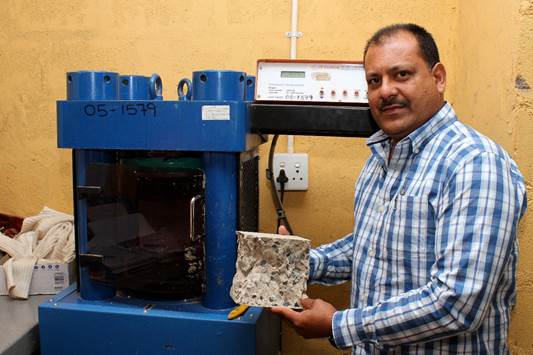
SAFETY TESTING: Rajesh Dookie, a SANRAL Eastern Region materials specialist undertakes regular audits of laboratories to ensure construction materials testing of the concrete and other constituents is conducted appropriately to provide verification that the project is being constructed in accordance with the engineer’s design for material requirements
On 3 July 2014, a steel and concrete bridge in Belo Horizonte, Brazil collapsed while under construction for the 2014 FIFA World Cup, killing two people and injuring 22. Construction error was to blame.
On 27 September 2014, a motorway bridge collapsed during construction in Copenhagen, Denmark, injuring several workers. Again construction error was the cause.
On 14 October 2015, a temporary bridge that was part of a construction project collapsed onto the M1 highway in Sandton, Johannesburg, killing two people and injuring 21 others. An investigation into the cause of the collapse is yet to release its finding.
Once a bridge is completed, one can confidently expect that the structure will last for its intended life span and perform its intended job. Bridges should always be safe so we don’t think twice about driving over them.
Bridge design and engineering has advanced significantly in the latter half of the past century because bridge designers and engineers have applied lessons learned from a series of bridge failures.
But how can the structural safety of a bridge be guaranteed?
On South Africa’s national roads network, the responsibility for the safety of bridges is vested with the South African National Roads Agency SOC Limited (SANRAL) whose mandate is to finance, improve, manage and maintain the national road network – the “economic arteries” of South Africa.
Ravi Ronny, Planning, Design & Construction Manager – SANRAL Eastern Region, said South Africa is right up there with the best in the world in terms of design and construction of bridges.
“No expense is spared to ensure the highest degree of scrutiny during every stage of a bridge building project.
“Only the best people with the necessary capability and depth of experience are involved because safety of a bridge is paramount.”
He said the recently built Chota Motala Interchange straddling the N3 in Pietermaritzburg and the Umgeni Road Interchange on the N2 in Durban which are already proving a boon to motorists subscribe to world-class safety standards.
The R816-million N2/M41 Mt Edgecombe Interchange which will make history in mid-2016 when the longest incrementally launched bridge in South Africa is completed, also incorporates SANRAL’s stringent safety audits during its current construction.
So too will the two mega-bridges to be built across the Msikaba and Mtentu river gorges on the Wild Coast toll road at a cost of R1.2-billion and R1.3 billion respectively. These bridges will be larger than the Garden Route bridges, such as the Storms River and Bloukrans structures.
Ronny said these two bridges will probably be the bridges with the largest spans in Africa and possibly the southern hemisphere.
He said before construction of a bridge takes place, a consulting engineering firm or consortium with an experienced bridge engineer is appointed during the design phase to undertake the designs of structures.
As part of their quality systems, these consulting firms also undertake internal reviews of the bridge designs. On major projects incorporating medium to large span bridges, a tender is put out for a peer review of the design by SANRAL.
The reviewing firm will also have experienced bridge engineers that will undertake the review of the bridge design and any constructability issues that may be of concern. All bridge designs must comply with TMH7 bridge loading and design code.
In addition, SANRAL has its own code of practice for the design of highway bridges and culverts in South Africa, which all bridge designers need to follow. Particular emphasis is placed on the safe load capacity of the bridge.
Thereafter the contractor that is appointed must build according to the Committee of Land Transportation Officials (COLTO) standard specifications for road and bridge works, which is used exclusively by road authorities. COLTO, which now operates under the COTO (Committee of Transport Officials) acronym, is published through the Department of Transport.
A tender is also put out for an independent site laboratory that is registered with the South African National Accreditation System (SANAS). The laboratory conducts construction materials testing to ensure quality of the concrete and other constituents and provides verification that the project is being constructed in accordance with the engineer’s design for material requirements.
SANRAL appoints a consulting firm to undertake the construction supervision, which comprises a site team of engineers and other support staff to supervise the project and to ensure the construction complies with the COLTO standard and project specifications.
A senior materials and laboratory specialist within SANRAL undertakes random audits on the site laboratory to ensure compliance with the laid down specifications as well as with the laboratory contract.
Ronny said SANRAL had a bridge network headed by bridge specialist engineer Edwin Kruger who resides at SANRAL’s head office in Pretoria. He interacts with design engineers in all aspects of bridges from concept planning through to detail design.
Dennis Rossmann, SANRAL’s materials specialist at SANRAL Eastern Region, plays a similar role as Kruger but on aspects of materials for road and bridge design and construction as well as pavement design and construction.
SANRAL’s bridge management system, which incorporates regular inspections by qualified inspectors, aims to ensure the safety of the public crossing over or under bridges and major culverts.
All bridges and major culverts are inspected by accredited inspectors every five to six years and any repair work is prioritised based on risk.
Several bridges have bagged SANRAL top awards from the South African Institution for Civil Engineering and the Concrete Society of Southern Africa for their innovation and contribution to excellence in the engineering sector.
“These awards are testimony to the high standard of work on SANRAL projects and help increase public confidence in the safety of the structures,” said Ronny.
The roads agency’s first bond auction since April this year was a success despite prevailing market conditions, according to its Chief Financial Officer, Inge Mulder.
“We postponed our monthly bond auctions twice as we were awaiting the decision on the country’s sovereign credit rating by major rating agencies Moody’s and Standard & Poor. Our prudent approach proved to be the right one as our return to market today yielded an oversubscribed auction by more than two times what we asked for,” she said.
A total of R600 million was allocated and all of it at mark-to-market:
Hway34: R75 million @ 110bps
Hway33: R525 million @ 63bps (CPI linked).
Mulder hailed the success of the auction as indicative of the confidence that investors have in SANRAL’s business and its going concerns, saying: “Our financials are healthy and the management of the entity is another factor that plays a big role in investor confidence. Investors are known for being prudent and focused on the long term, and this is why our bonds are a good investment.
“It is clear that policy certainty around the user-pay principle and our commitment to collect on e-toll debt is bearing fruit. We will continue to make every effort to collect to continue to prove to our investors and ratings agencies that we will do what is necessary to realise the potential e-toll income stream.”
Major construction work to completely overhaul the R573 Moloto Road will soon be undertaken by the South African National Roads (SOC) Limited (SANRAL) in August 2016. This was announced by Transport Minister Dipuo Peters during a sod-turning ceremony at Kwa-Mhlanga.
The Minister, together with top officials from the roads agency, visited the Nkangala District in Mpumalanga as part of an ongoing outreach programme to engage with stakeholders living along the Moloto Road. However, the engagement was an assurance by the Minister and SANRAL that real construction work to upgrade and modernise the road would commence in August this year.
The road, which has been dubbed the “road of death” due to the high number of accidents that have happened on it over the years, was incorporated into the SANRAL road network on 3 August 2015 by the Department of Transport. An amount of R1 billion was allocated for the upgrade over a three-year period.
The 160km stretch of the Moloto Road runs through the provinces of Gauteng, Mpumalanga and Limpopo, and is used by close to 60 000 commuters on a daily basis. The road has not been upgraded for many years and has had to cope with increasing traffic in recent years. Statistics taken from a period of 29 months – January 2012 to May 2014 – show that there were 489 crashes on Moloto Road, resulting in 158 fatalities and 594 serious injuries.
Speaking at the event, Ms Peters promised the community that once completed, the Moloto Road would become a symbol of more than just a safer road that enable its users to travel from one destination to another without being concerned about accidents or fatal injuries. She also said the road would also bring more economic activity to the district, enable small farmers to bring their produce to markets, be used as a route by tourists who want to visit game reserves and natural attractions in the region and facilitate the movement of people, products and services.
“I want to emphasise the fact that road projects undertaken by SANRAL across the country are always accompanied by opportunities for job creation and training that benefit the wider community. In the past financial year SANRAL allocated contracts to the value of more than R2.4-billion to emerging companies owned by black entrepreneurs, women, the youth and people with disabilities,” she said.
The Minister said the commencement of the project to upgrade the R573 was a clear demonstration of how the government had listened to the concerns raised by communities and road users about the safety of the road. “For a long time, the state of this road has been a blight on the region. The Moloto Road has become synonymous with road crashes, bus accidents, injuries, and deaths. It has robbed communities of breadwinners and beloved mothers. Parents had to stand at the open gravesites of their children. I know this all too well because as Minister of Transport I often attend the funerals of crash victims and have to respond to the unacceptable carnage on our country’s roads,” she said.
Touching on partnership agreements between the three different spheres of government, Peters said partnerships have been created between the Department of Transport, the provincial governments of Gauteng, Mpumalanga and Limpopo to realise commitments made in the Presidential Infrastructure Coordinating Commission (PICC). The Moloto Road project falls under Strategic Integrated Project 1, Unlocking the northern mineral belt with Waterberg as the catalyst.
Since incorporation, SANRAL has since started with a wide range of interventions in terms of road maintenance that includes the repairing of potholes, the cleaning of drains, the trimming of foliage on the side of the roads and the introduction of new road signs and line markings.
The modernisation of this road forms part of the Moloto Road Development Corridor, initiated by the government, which will also include the much-needed investment in passenger rail to offer commuters a safer, faster and more accessible connection between Mpumalanga and Gauteng.
Although the road will be upgraded to the same standard as other SANRAL national roads, it will not be tolled.
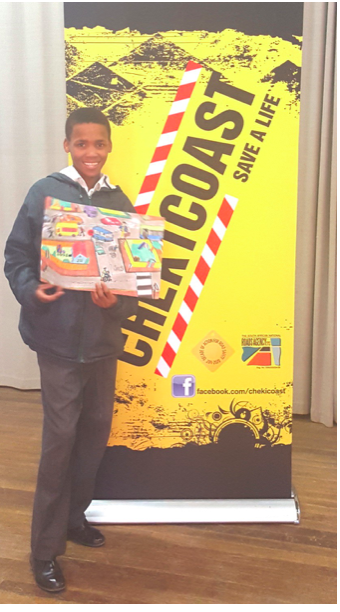
Fifteen-year-old JohntraPersens from the Brandvlei Primary School in the Northern Cape was namedthe winner in the category for grades 4-6in the annual SANRAL ChekiCoast road safety art competition. The theme of the 2015 competition highlights the dangers of using mobile devices for pedestrians and drivers. Johntra’s painting portrays a colourful street scene, drawn in three dimensions, and show pedestrians and vehicles in different unsafe and dangerous situations.
The learner said he was very excited about his prize, a R5 000 voucher“This is really awesome and I will definitely continue with my drawings. My parents are very proud and so am I with this achievement. I felt so honoured and on top of the world when I received my prize! Thank you SANRAL, you’re the best!!”
Johntra’s art teacher, Sandra Louw, says that he has great talent and she is very proud of him and will encourage him to continue developing it.Mr Sybrand de Beer, headmaster of the Brandvlei Primary School says his school is grateful to SANRAL for its road safety initiative and the opportunity it has created for the school to help develop its learners.
Ms Imelda Julies, Project Manager at SANRAL in the Western Cape who presented Johntra with his prize, says the competition is just one of SANRAL’s many road safety initiatives – and this one is aimed at engaging pupils and students to help promote road safety through art.
“The art competition is aimed at engaging the youth to express their thoughts about responsible road behaviour and using roads in the safest way possible.”
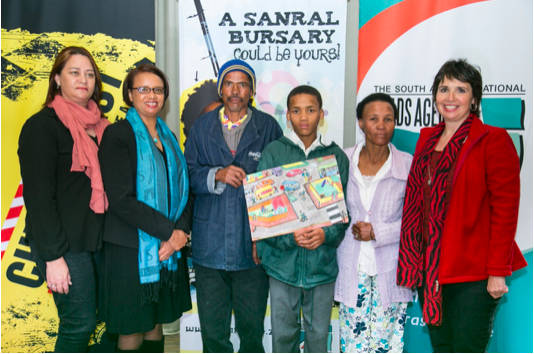
A learner from Brandvlei Primary School was a category winner of SANRAL Road Safety Art competition. In the picture from left: Alta Groenewald and Imelda Julies from SANRAL, Mr Persens, father of the winner Johntra Persen;, Mrs Persens (mother); and Mrs Sandra Louw, Johntra’s art teacher.Johntra Persens, a Grade 7 learner of Brandvlei Primary School in the Northern Cape shows off his winning entry. He is a category winner of the SANRAL road safety art competition for which he received a R5000 voucher.