
Blog

Upgraded N14 freeway opened

N14-inside
Phase 1 of the N14 project entailed the rehabilitation of 20km of the dual carriageway starting from Hendrik Potgieter Drive and extending up to Diepsloot.


Gauteng MEC for Roads and Transport, Dr Ismail Vadi has officially opened the upgraded N14 freeway from Krugersdorp to Diepsloot.

The R306-million, 18-month-long project, launched in July 2015 together with Gauteng Premier David Makhura, was completed on time and within budget.

The MEC explained that Phase 1 of the N14 project entailed the rehabilitation of 20km of the dual carriageway starting from Hendrik Potgieter Drive and extending up to Diepsloot near Centurion, in Tshwane.

“We’ve basically given a new lease of life to a very busy freeway and there will be no toll fees,” said Vadi.

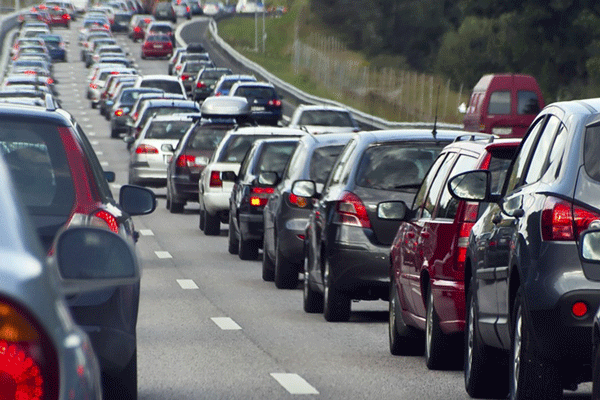
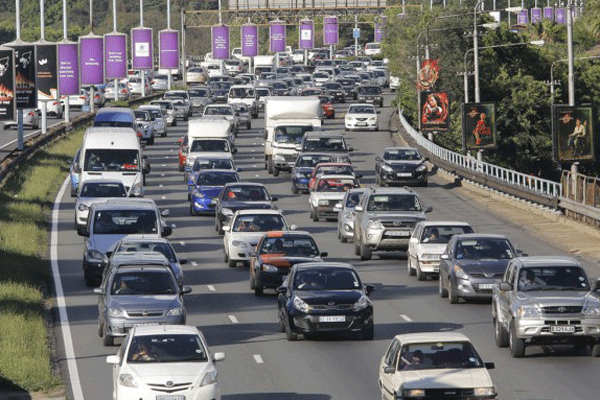
The N14 is a high traffic volume freeway that was under severe stress. It had an annual traffic growth rate of 3.2 %. It had degraded over the years and needed urgent rehabilitation.

It is a major provincial arterial road from the southern and western regions of Gauteng to the north and is used for workplace travelling and freight traffic. It also serves as an economic link to the Western corridor of the province.

MEC Vadi pointed out that the freeway links Lanseria Airport, the Cradle of Humankind and North West Province and is expected, in future, to play an important role in kick-starting the development of a new city around Lanseria Airport.

“This project has completely repaired 20kms of N14 and given it a new design life of 20 years. It provided employment and skills development training during construction to over 300 local employees; enabled economic empowerment of local contractors and improved the road safety features on the freeway,” added Vadi.

He thanked motorists for their patience during the construction period and announced Phase 2 of the upgrade will be launched in 2017.

Gauteng Roads and Transport annual report

During the 2015/16 Gauteng Roads and Transport annual report announcement, Vadi spoke on how the department remains focused on achieving “an integrated and efficient transport system in Gauteng that promotes sustainable economic growth, skills development and job creation, fosters quality of life, socially includes all communities and preserves the environment”.

Vadi said: “Urbanization and urban densification help to provide a transport solution as it reduces the home to work trips over long distances. All sectors of our economy and our people at large benefit when there is an integrated approach to spatial and transport planning. Essentially, what we’re talking about is creating smart cities in the Gauteng city-region that are supported by good public transport systems. Simultaneously, we have to keep our feet firmly on the ground to meet the commitments made in our Annual Performance Plan.

“We are pleased to report that Gautrain received a clean audit, and both the Department and g-Fleet achieved unqualified audit opinions from the Auditor-General. We are encouraged by the progress made in getting the financial statements of gFleeT on the proper footing. Our challenge now is to sustain the progress made at the entity and to ensure that the department gains a clean audit.”

SANRAL fights HIV/Aids

HIVAids-1
More than 2000 SANRAL workers on their Routine Road Maintenance (RRM) projects nationally are recipients of its Wellness Programme.


World Aids Day is celebrated worldwide every 1 December and the South African National Roads Agency Limited (SANRAL) has stepped up its efforts to fight the scourge of the HIV/Aids pandemic.

The roads agency has substantially stepped up its commitment with its landmark wellness programme now accessible to more than 2000 workers on their Routine Road Maintenance (RRM) projects nationally.

The national construction industry is adversely affected by the depletion of skills most notably caused by HIV/Aids and opportunistic infections such as tuberculosis to the degree that SANRAL is championing the workers in the industry which are amongst the most-at-risk given their work circumstances and taken a landmark step to eradicating the scourge on its Routine Road Maintenance (RRM) workers.

The Wellness Programme

The implementation of this national programme is designed to assist with their general wellness management by providing tools, one-on-one counselling with a wellness champion as well as a hotline which they are able to call. The programme training subject matter varies from substance abuse and alcoholism, lifestyle diseases management and prevention as well as broader wellness communication campaigns and Wellness Days.

Kobus van der Walt, SANRAL’s Western Cape regional manager, said: “As a key role player in the roads construction industry, SANRAL has an important role in leading the sector in promoting the wellness of our workers through education and providing opportunities for them to the being regularly tested for HIV/Aids, TB and maintaining a treatment programme post diagnosis.”

In part the nationwide programme focuses on HIV/AIDS awareness and treatment campaign as a key identifier against the spread amongst those most vulnerable to infection. This comes in the wake of good news that South Africa recorded a slight decline in the number of infections between the period of 2005 and 2015. However, as high levels of poverty and drug abuse which are key leading factors leading to infection it still means that about 8,4-million South Africans have HIV and about 155 000 died from AIDS last year alone.

Van der Walt said: “Poverty and the lack of access to proper healthcare in rural areas means that people aren’t always aware of the dangers of ill-health of the impacts that it has for the broader community. The increase in infections means that the AIDS pandemic is not over, is not limited to individuals anymore but is fast becoming societal as families lose bread winners.

“This means that we are not able to break the poverty cycle. It also prevents South Africa from closing the industry’s already widening scarce skills gap with essential jobs like graders and digger-loader operators.”

The prevalence of HIV/AIDS, tuberculosis and preventable substance abuse is often a result of poor social awareness and is linked to structural factors inherent in the construction sector such as solitary work environments, extended periods spent away from home and inadequate access to health care services.

The programme now covers all construction workers, including sub-contractors and their immediate families, working on SANRAL’s roads maintenance projects nationally.  Workers from both the Western and Northern Cape provinces have already benefitted from the programme over the past three years as part of an initial pilot project which was successfully run in the two provinces.

Now all RRM workers will be provided with free training, counselling and testing for a range of illnesses as well as provide access to healthcare professionals for treatment.

To this end some 17 Wellness Champions have already been appointed and undergone SETA-accredited peer educator training during the pilot project.

The roads agency has appointed CareWorks HIV Management because of its proven track record in carrying out wellness programmes in South Africa to manage and facilitate the programme within the Western and Northern Cape region. They will be responsible for, amongst others training outcomes, ensuring that all HIV and TB-positive staff gain access to life-saving treatment and that HIV and TB-negative employees acquire adequate knowledge to be able to manage their status.

SANRAL brings jobs to communities

construction-1
An estimated 230 jobs were created with the upgrading of the N1 Great North Toll Road including the Eastern Ring Road.

The South African National Roads Agency Limited (SANRAL) is upgrading the N1 Great North Toll Road including the Eastern Ring Road and naturally, locals will benefit.

An estimated 230 jobs for locals is expected to be created for the upgrading.

Vusi Mona, SANRALs spokesperson, said: “These jobs will be in the form of builders and labourers from the city and surrounds, to assist in the completion of the project.”

The National Route N1 is the link between South Africa and the rest of Africa and forms an essential link to stimulate economic growth in Sub-Saharan Africa as well as local economic development in the metropolitan area of Polokwane.

Upgrading progress

Sanral recently upgraded sections between Makhado and Musina, and is currently upgrading the section between Beit Bridge and Musina. Furthermore, planning for a ring road at Musina is far advanced, leaving the section of the N1 at Polokwane as the only section that is not free flowing on the N1 north.

As a result, Polokwane experiences a mix between local and through traffic in the CBD, resulting in pedestrian conflict, as well as damage to pavements. Taking through traffic out of the CBD will have a positive effect on road user safety, the ambience and nature of the CBD.

Sanral proposes to complete the approximately 6.5 km section of the Eastern Ring Road by March 2018.

The proposal includes the construction of interchanges at crossroads such as the Burgersfort (R37), Tzaneen (R71), and R81 roads, which will also improve accessibility to Moria.

Moria is The Zion Christian Church’s headquarters and hosts the largest Christian gathering in South Africa twice a year, in Easter and again on December.

Sanral completed the financial feasibility study of the project and is currently progressing with the geometric design for the project. The bulk of the land has been acquired. The environment impact assessment (EIA) commenced in August 2007.

Bottelary interchange construction begins

Bottelary-Road-R300-interchange-1
MEC Donald Grant, Mayor Patricia De Lille and SANRAL Regional Director Kobus van der Walt at the SOD turning of the R300 interchange.


The South African National Roads Agency Limited (SANRAL) enhances South Africa’s National Development Plan’s (NDP) ambition to have an efficient, competitive and responsive infrastructure network.

The NDP, also known as Vision 2030, seeks to eliminate poverty and reduce inequality by 2030. According to the plan, South Africa can realise these goals by drawing on the energies of its people, growing an inclusive economy, building capabilities, enhancing the capacity of the state, and promoting leadership and partnerships throughout society.

With the NDP in mind, the construction of the new Bottelary Road/R300 interchange in Kuils River, Cape Town, will make it easier to travel to and from Stellenbosch, the N1, N2 and the airport.

The sod turning ceremony was held earlier this year to mark the start of the construction. Since then a large amount of development has taken place.

Brett Herron, the City’s Mayco member for Transport for Cape Town (TCT), said: “The bridge structure over the Kuils River is complete. The on- and off-ramps to and from the R300 freeway are already on a sub-base level with two more layers, which consist of the base course and asphalt to follow, in order to reach the final finished road level.

“The intersections on Bottelary Road are nearing completion with the estimated opening time in March/April 2017, if all goes as planned.”

The initial deadline for the project by the City of Cape Town and its partners, the Western Cape Government Department of Transport and Public Works and SANRAL, was set at mid-2017.

Traffic alleviation

Last week Herron confirmed the project was on track with the estimated date of completion being the end of March and April 2017, “pending any unforeseen delays”.

Peak hour traffic congestion on Van Riebeeck is especially bad at the Kuils River Hospital and in the area near the R300 Bridge. Thanks to a combined budget of R60-million for the Bottelary Road/R300 project, this will hopefully soon be something of the past.

Of the R40-million the City has allocated for road congestion projects in the 2015/16 financial year, R10-million is being spent on this interchange. The city is the largest contributor to the project, contributing R31-million to the construction costs. Provincial government will be spending R29-million, while SANRAL purchased the land for the interchange.

A huge distribution centre for Shoprite across from the interchange is due for completion towards the end of 2017. The interchange also borders on the Brackengate Business Park.

KNOW YOUR WHOA

Aloe Simii: Saving our endangered plant

aloe-simii-1
Aloe Vera produces two substances used for medicine: The gel is obtained from the cells in the centre of the leaf, and the latex is obtained from the cells just beneath the leaf skin.

The aloe simii species of plants is listed as critically endangered and the South African National Roads Agency (SANRAL) is making sure to preserve it during road construction.

South Africa’s National Development Plan (NDP), or Vision 2030, guides SANRAL towards the protection and enhancement of our environmental assets and natural resources.

The aloe simii which grows only in a very small natural geographic range thrives in Mpumalanga, from Sabie southwards to White River and around Nelspruit.

Populations are also declining due to the drying out of the aloe’s wetland habitat. This is caused by adjacent plantations and water extraction, alien plant invasion, urban expansion and rural development.

Conservation measures

SANRAL has proposed measures that include seed harvesting and propagation as conservation tactics while it constructs the Mbombela P166 link road to the R40 south, between White River and Mbombela.

The harvesting and propagation has been undertaken successfully in the South African National Biodiversity Institute (SANBI) Lowveld Botanical Garden with germination rates in excess of 90%.

Another option is SANRAL partnering with a tertiary institution to enhance scientific information and research on aloe simii, which will contribute to efforts to save the species from extinction in the wild.

Benefits of Aloe Vera

Aloe Vera produces two substances used for medicine: The gel is obtained from the cells in the centre of the leaf, and the latex is obtained from the cells just beneath the leaf skin.

Most people use aloe gel as a remedy for skin conditions, including burns, sunburn, frostbite, psoriasis and cold sores.

It’s also used as a natural remedy for asthma, stomach ulcers, diabetes and for soothing side effects of radiation treatment.

Aloe vera contains many vitamins and minerals vital for proper growth and function of all the body’s systems. Here’s an easy explanation of Aloe Vera’s active components:

  • aloe vera contains antioxidant vitamins A, C and E — plus vitamin B12, folic acid and choline.
  • aloe vera provides sugars, such as monosaccharide’s (glucose and fructose) and polysaccharides.
  • The hormones called auxins and gibberellins are present; they help with healing wounds and have anti-inflammatory properties.
  • Minerals such as calcium, copper, selenium, chromium, manganese, magnesium, potassium, sodium and zinc are also present in aloe vera.

New road laws welcomed

bakkie
New road laws for South Africa will prohibit the transportation of school children carried within the load-bay of a bakkie and introduce new speed regulations for heavy goods vehicles.

Government has published two amendments to the National Road Traffic Regulations in its National Gazette (No. 40420).

Read the full amendments here: http://www.gov.za/sites/www.gov.za/files/40420_gon1408.pdf

According to Arrive Alive: “It appears that what has been closed was that the private operators using bakkies as a form of transport for scholars should end as scholars may not be transported “for reward” (i.e a paid service). It is not a total ban on scholars being transported on a bakkie but will force these ‘scholar transporter’ to use safer vehicles for such purposes.

“These vehicles were also often part of the hazardous practice of the overloading of bakkies with young learners. The stipulation with regards to speed governors are also aimed at those operating public transport and heavy goods vehicles and might assist towards greater safety of our commuters on buses and minibus taxis.”

According to the transport department:

Please note the Department of Transport has published the 24th amendment to the National Road Traffic Regulations in Gazette No. 40420 of 11 November 2016.

  1. Regulation 250 is amended to specifically state that school children may not be transported for reward in the goods compartment of a vehicle. Other persons may also not be transported in the goods compartment for reward unless it is done in terms of the NLTA – Implementation date 6 months from 11/11/2016 (11/5/2017).
  2. Regulation 293: Goods vehicles with a gross vehicle mass (GVM) of more than 3500kg up to 9000kg are now limited to a maximum speed of 100 km/h – Implementation date – 11/11/2016. The maximum general speed limit of 120 km/h was applicable to the vehicles up to 11/11/2016.

Note the provisions on speed governors that will come into force on 1 December 2016 (Regulation 215, as published in the government gazette 38142 https://www.westerncape.gov.za/assets/departments/transport-public-works/Documents/nrta_am_national_road_traffic_regs_nov_14.pdf on 31 Oct 2014).

Speedometers

Regulation 215.  (1)  No person shall operate on a public road a motor vehicle which is designed for or capable of reaching a speed of 60km per hour or more on a reasonably level road, unless such vehicle is equipped with a speedometer which is in a good working order.

(1A)   No person shall operate a – minibus; midibus; bus, or goods vehicle the gross vehicle mass of which exceeds 3500kg, first registered after 1 December 2016, unless such minibus, midibus, bus or goods vehicle is fitted with a speed governor, restricting the speed of such motor vehicle to the speed limits as contemplated in regulation 293.

Expanding on the laws

Howard Dembovsky from Justice Project South Africa said:

If it is meant that the provisions contemplated in regulation 250 (paragraph 2 of that notice) as is contemplated in that gazette shall come into force six months after the publication of the gazette in question, then this means that with effect from May 12, 2017 the transportation of schoolchildren for reward in the goods compartment of bakkies or trucks will be unlawful, regardless of whether such person possesses a permit issued in terms of the National Land Transport Act, 2009 (Act 5 of 2009) to do so or not.

Subsection (2) of regulation 250 however prohibits any person from conveying persons (children and adults) in the goods compartment of a bakkie or truck for reward unless they possess a permit issued in terms of the National Land Transport Act, 2009 (Act 5 of 2009).

Neither of these provisions forbids the conveyance of persons in the goods compartment of a bakkie or truck, regardless of whether they are children or not, if they are conveyed without any charge being levied for that conveyance.

The amendments with respect to regulation 250 of the National Road Traffic Regulations are actually less restrictive than the existing Regulation 250 which states that “No person shall on a public road carry any person for reward in the goods compartment of a motor vehicle”.

The effect of regulations 250 (1) and (2) will therefore be that no-one may transport school children in the back of a bakkie for reward, but transport operators may apparently acquire an operating permit in terms of the National Land Transport Act to transport persons in the back of a bakkie in areas where the roads are so bad that only 4x4s can drive there.

School kids can and must walk unless a benevolent parent transports them to and from school in the back of his or her 4×4 bakkie at no charge to other parents. This will be with effect from May 12, 2017.

Regulation 293

There is no commencement date contemplated for the amendment of regulation 293(1) (b) of the National Road Traffic Regulations which will effectively set a vehicle class speed limit of 100km/h which is applicable to any goods vehicle with a GVM of more than 3500kg but less than 9000kg and a combination of vehicles comprising a goods vehicle and one or two trailers with a gross combination mass (GCM) of more than 3500kg but less than 9000kg.

Because there is no commencement date contemplated for regulations 293(1)(b)(iv)(aa) and (bb), there is no indication when these specific vehicle class speed limits will come into effect, not that minibus taxis and buses obey this limit in any case.


N2 Wild Coast Toll Road key to unlocking Wild Coast’s community-based tourism potential

n2-toll-1


Undulating hills, jagged cliffs, wild beaches, indigenous cultures and a diverse array of fauna and flora make the Wild Coast a place renowned for its rich heritage and natural beauty.

Yet, behind popular romantic visions of a rural traditional paradise, numerous communities of the Wild Coast are faced with an ongoing and dehumanising poverty crisis. Indeed, a lack of economic opportunities, together with limited access to electricity, clean drinking water, sanitation, medical amenities and education has led to a poor quality of life for many people in the region.

Since the UN World Tourism Organization (UNWTO) has endorsed tourism as an economic development and poverty reduction tool in developing countries, an increase in tourism related activities may arguably provide an inclusive, sustainable answer to economic growth and improved quality of life in this part of the country. In particular, community-based tourism (CBT), stands out as an important, yet underutilised, area of potential.

CBT refers to tourism activities which directly involve local communities and their natural and cultural assets. Largely focused on the heritage of an area or region, this form of tourism, when managed effectively, promotes local and rural economic and community development. Indeed, various studies have found that since CBT is aimed at empowering people living within disadvantaged contexts, it has the potential to create significant socio-economic development opportunities for many marginalised groups. As such, as a growing tourism niche for both international and domestic markets, CBT may offer important opportunities for unlocking the tourism potential of the Wild Coast’s natural and cultural heritage.

In addition to its socio-economic benefits, the ICOMOS International Cultural Tourism Charter’s Principles and Guidelines for Managing Tourism at Places of Cultural and Heritage Significance has highlighted tourism as an essential vehicle for cultural exchange and understanding. This means that instead of simply providing tourists with a form of ‘staged authenticity,’ which perpetuates colonial ideas of ‘African’ traditions, CBT encourages tourists to immerse themselves in the lived experiences and cultures of the communities that they visit.

As a result, not only will CBT allow tourists to gain a greater understanding of both the heritage and contemporary cultural practices of Wild Coast communities, people of the Wild Coast will also be given the opportunity to interact with, and learn about, people from other cultures.

In short, by focusing attention on the sustainable development of heritage resources in the area, this form of tourism can open up greater opportunities for socio-economic development in the area, while at the same time contributing towards the conservation and enhancement of its natural and cultural assets.
In a study published this year in African Journal for Physical and Health Sciences, researchers discussed the challenges and opportunities for CBT in the Wild Coast. Researchers highlighted the Department of Tourism’s suggestion that the Wild Coast is made up of numerous zones in which community-based tourism could thrive. Despite these opportunities, however, they noted that development continues to be restricted as a result of a lack of transport infrastructure. In particular, they found that much of the road infrastructure in the province is underdeveloped, and as such, hampers possibilities for tourism development in the largely unexplored area. In relation to these findings they argued that good infrastructure, including roads, is key for CBT to develop in the region.

While the above study focuses on a South African example, the importance of roads and infrastructure for tourism development has similarly been recognised internationally – especially in developing countries where tourism is seen as a crucial sector for economic growth. Indeed, various empirical studies from Southeast Europe, China and Africa have highlighted transport infrastructure, and particularly, good roads, as playing an essential role in the development of local tourism.

As such, notwithstanding the prospects for CBT along the Wild Coast, and the sustainable opportunities to advance social and economic paradigms that come along with it, a lack of infrastructure in the region has led to limited access to, and development of, this cultural landscape.

The upcoming N2 Wild Coast Toll Road (N2WCTR), and the related upgrade of connected secondary and local road infrastructure, will offer an answer to these infrastructure challenges.

Indeed, by significantly improving access to this area the N2WCTR will unlock the Wild Coast’s CBT potential. That is, as part of the larger Integrated Wild Coast Development Programme, the road – which has been proposed as the backbone of the government’s development plans for the area – will play an important role in opening up the region’s untapped tourism potential.

To be sure, while ecotourism is present on a small-scale, an inadequate road network along with various additional infrastructure and service related issues have left this industry’s potential stunted at best. However, as roads improve and access to the communities and natural and cultural heritage of the region begins to grow, opportunities for long-term tourism developments are set to increase – opportunities that will play a significant role in the reduction of poverty and economic marginalisation in the area.

By Dr. Mongezi Noah, Community Development Specialist – SANRAL Southern Region.

Eastern Region gets new Operations and Maintenance Manager

Nkabinde-1
Dumisani Nkabinde attributes his elevation to hard work, a passion to succeed and excellent mentorship.

The South African National Roads Agency Limited (SANRAL) is proud to announce the appointment of the new Operations and Maintenance Manager of its Eastern Region, which covers Free State and KwaZulu-Natal.

Dumisani Nkabinde, a former senior Projects Manager, takes over the reins from Manuel de Sousa who has retired after 41 years of service.

He attributes his elevation to hard work, a passion to succeed and excellent mentorship.

Nkabinde said: “I will have very big boots to fill. Mannie has had four decades of experience and is so knowledgeable on almost all aspects of road design, construction, operations and maintenance.

“However, I have worked with him and many other experts within SANRAL for some time and will accept my new responsibilities as a challenge.”

He also acknowledged his supervisors’ Dennis Rossmann, Ravi Ronny and Stewart Wilson who were instrumental in developing his career path.

Logashri Sewnarain, SANRAL Eastern Region manager said: “We congratulate Dumisani on his appointment as Operations and Maintenance Manager and we have faith that he will continue to uphold the high standards.

“We’ve seen Dumi grow over the years and we are very pleased at the progress he has made. His passion for the development of SMMEs will ensure that SANRAL achieves its socio-economic objectives on the ground.”

In his spare time, Nkabinde is an avid cyclist and long-distance runner, having completed two Comrades Marathon and many other ultra-marathons.

Background profile

Nkabinde matriculated from Kanyekanye High School in Paulpietersburg and went on to graduate with a B.Sc. degree in civil engineering from the University of KwaZulu-Natal. He also has an MBA degree and a diploma in project management.

His first job was at Eyethu Consulting Engineers, a national consulting engineering firm which he joined in 2003 as an intern engineer and worked his way up to graduate engineer and eventually design engineer.

In 2007 he joined SANRAL as a Projects Manager in the Eastern Region.

However, one of his first projects was in Gauteng – SANRAL’s Northern Region – where he oversaw the widening of the Golden Highway; and design of a pedestrian bridge near Grasmere Toll Plaza and a 10km barrier wall on the N1 adjacent to Orange Farm.

In the Eastern Region, Nkabinde managed the design and construction for the interchanges on the N2 freeway at Kwambonambi and Nkodibe. He then worked on major construction and crushing contracts on the N1 between Glen Lyon and Zandkraal.

Thereafter he had to contend with multiple challenges during the upgrading of 40 kilometres of the N2 from Pongola to the Mpumalanga border. There is a long list of projects that Nkabinde has managed over the years including community development projects, road safety projects, routine road maintenance contracts and road rehabilitation/upgrades projects.

More recently he has managed the construction of an interchange and roads upgrading at Mtubatuba on the N2 North; construction of an interchange and overload control centre at Eteza on the N2 north; and development of a quarry to provide stone requirements on four road construction projects on the N1.

Nkabinde has a special interest in pavement and materials and is chairman of SANRAL’s Pavement and Materials Cluster.

What his new position entails

Nkabinde’s new position will see him take charge of four toll contracts – Mariannhill, N2 south and N2 north in KwaZulu-Natal and N1 south in Free State – and overload control centres.

He will also be responsible for all routine road maintenance contracts in the region relating to, among other services, grass cutting, repairing damaged guardrails, cleaning drains, repairing potholes, road signs, road markings and street lighting.

The maintenance division also takes care of the intelligent transportation system (ITS) and variable message system (VMS) designed to optimise traffic flow, improve road safety and enhance traffic management on the road network.

The ITS monitors traffic flow using 146 cameras in KwaZulu-Natal alone, and collects data. The VMS warns motorists of incidents in real time.

In his new role, Nkabinde would like to foster greater synergy between the design and construction teams and the operations and maintenance teams.

“Operations and maintenance is a role that naturally extends from design and construction. Hence I see the need for greater collaboration and interaction,” he said.

Swartkopfontein Bridge eases freedom of movement

Swartkop-bridge-1
Botswana’s Minister of Transport and Communications, Onkokame Mokaila and South Africa’s Minister of Transport, Dipuo Peters, officially open Swartkopfontein Bridge.


Movement between Botswana and South Africa has been eased with the opening of the Swartkopfontein Bridge, which will also strengthen economic ties between the two countries.

The bridge was constructed by the Department of Transport and the South African National Roads Agency Limited (SANRAL)

The bridge was opened by Transport Minister Dipuo Peters and she was supported by her counterpart in Botswana, Minister of Transport and Communications Onkokame Mokaila at the Swarkopfontein Bridge in the North West Province.

Peters said: “The opening of the Swartkopfontein road and bridge linking South Africa and Botswana should be a celebratory occasion, more so, at a time in global history where populist movements in other parts of the world are clamouring for restrictions on the movement of people and the building of walls to isolate and separate communities who live in the same region.

“This whole project of the road and bridge construction cost R78.5 Million, and 51 full time jobs were created over the 23 month contract period. The labour was sourced between the two countries with most of the construction material used coming from Botswana.”

The Swartkopfontein entry point is located between the commercial border posts of Kopfontein and Skilpadshek and now offers a convenient alternative for commuters who make the journey.

“I have no doubt that it will relieve the pressure on traffic between Zeerust in South Africa and the towns of Gaborone, Lobatse and Ramotswa in Botswana. This will lead to a safer travel experience for commuters within the region,” said Peters.

The project

The gravel road was upgraded to an asphalt surface and includes the construction of the 80-meter long Notwane River Bridge.

The construction of the road and bridge to link the border posts of Swartkopfontein comes after a memorandum of agreement was signed in July 2014, in which the governments of the two countries agreed to promote cross-border trade, economic activity and regional integration.

Part of the agreement included a practical initiative to upgrade roads, bridges and other physical infrastructure.

Peters said: “We build bridges in the spirit of the great Nelson Rolihlahla Mandela who spoke of a continent of Africa ‘that is at peace with itself,’ a united Africa ‘where its leaders combine in its efforts to solve the problems of this continent’.

“Thus, at a time when some countries in the North are dreaming up schemes to build physical walls to separate neighbours and raising barbed wire fences to keep people out, we are standing in a small village in rural Southern Africa to celebrate the construction of a road and bridge that connects communities and opens up opportunities for people.”