Engineering jargon can often be difficult to understand, so we’ve listed a few helpful words to keep you in the conversation.
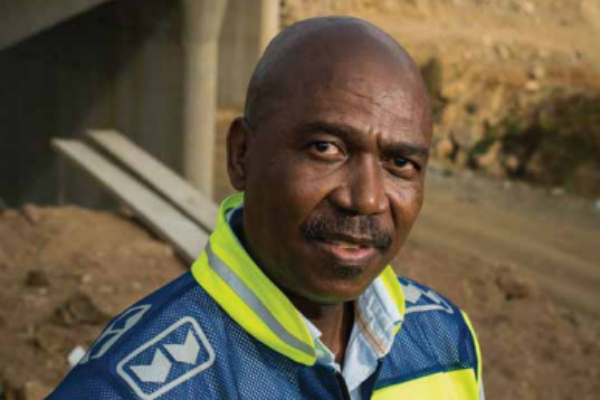
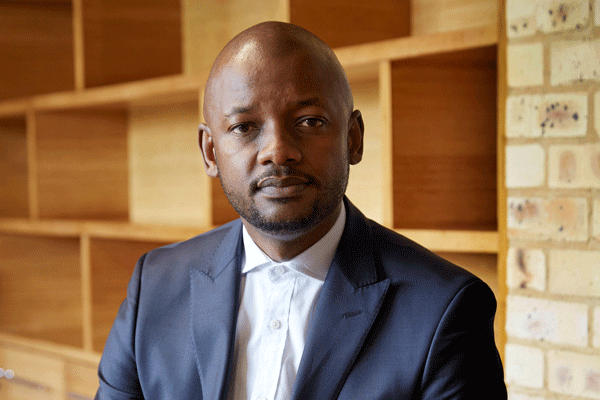
Engineer and SANRAL project manager Thabiso Ngozwana.
Road stud – Not a travelling breeding horse. Commonly known as a cat’s eye, a reflector or a delineator, a road stud is the coloured object (white, red or yellow) attached to a paved surface marking out the road’s centreline and edges. Road studs are a safety measure for people travelling on the roads at night as they reflect vehicles’ headlights when it’s dark.
Shoulder – Not a body part. The shoulder is the area of the road beyond the yellow line. It can sometimes be made of gravel and is used for emergency stops.
Footing – Not something you can lose in high heels. Footing is a flat, shallow foundation for built structures. It serves a similar function to actual feet, providing support and balance. And whether we’re talking about dancing in stilettos or erecting a structure, a firm footing is always required in slippery conditions.
Bedding – Nothing to do with thread-count. Bedding is a specially prepared surface of natural gravel and/or processed material used as a platform for laying pipes and structural components. Typical examples of bedding material are stone, gravel and sand. A good, firm bed is necessary for a decent rest.
Apron – Kiss the cook? Not quite. An apron is a smooth surface, generally made of concrete, between a culvert and the stream channel. It’s meant to reduce erosion and improve capacity.
Slab – Just like chocolate, a slab here is a flat, broad piece of structure. Unlike chocolate, it’s made of concrete or wood and is used as a floor or a roof.
Tar road – There is no such thing as a tar road. No, really. The black sticky stuff used in road construction is actually bitumen, a by-product of oil. Tar, a by-product of coal, was discontinued for environmental and safety reasons a long time ago – it’s carcinogenic and causes warts.
Professor Kim Jenkins, the SANRAL Chair in Pavement Engineering at the University of Stellenbosch, writes about the transformative role the national roads agency plays in education.
Professor Kim Jenkins, the SANRAL Chair at the University of Stellenbosch, said the postgrad programme in pavement engineering has gone from strength to strength over the past 17 years.
One of the many valuable statements that passed from Madiba’s lips was: “Education is the most powerful weapon that you can use to change the world.” The world has struggled to internalise and embrace it.
When the South African National Roads Agency (SOC) Limited (SANRAL) decided to depart from investing in inanimate road infrastructure only and turned to funding the Chair in Pavement Engineering at the University of Stellenbosch, it was clear that Madiba’s wisdom had taken root on home soil. This was especially the case given SANRAL’s primary objective of developing human capital and building capacity in the field of pavement engineering.
The inception of the SANRAL Chair in Pavement Engineering in 2001 came at an opportune time, with foundations laid by the preceding pavement academics and Sabita (Southern African Bitumen Association) Chairs at Stellenbosch University. However, only a handful of pavement engineering graduates were being fed into the industry annually. There was a glaring need to create a critical mass of postgraduate researchers. The SANRAL Chair rose to the challenge.
The stimulus needed to get more postgrad researchers involved can be generated in several different academic spheres, attracting experts into the programme from time to time to assist in presenting good-quality courses, innovative research that breaks boundaries and product and model development that benefits industry.
At the same time, a redress of the diversity profile in pavement engineering was required. Through teamwork, the pavement engineering group at Stellenbosch University has managed to achieve growth in the key areas of tertiary education. The growth brought with it unprecedented diversity, both from within South Africa and beyond its borders.
Within five years, the postgraduate profile was transformed from isolated candidates of colour to between 40% and 60% of students emanating from historically disadvantaged communities – a trend that has been maintained for 10-years.
The postgrad programme in pavement engineering has gone from strength to strength over the past 17 years.
Among the defining features is the Chair’s cooperation with international universities in Rwanda, Brazil, China, The Netherlands, Germany, Italy and the US. With regard to outputs, seven doctoral and 51 Masters degrees have been awarded under the study leadership of the Chair. More than 1 000 student courses have been completed in the same period, with the total number of course delegates exceeding 1 600.
Undergraduate activities have also flourished, with inputs from the SANRAL Chair into transportation science, advanced design, research projects and materials science in second- to fourth year courses.
Statistics alone do not capture the essence of an academic chair, nor do they give true meaning to nurturing and mentoring. An old African proverb says “It takes a village to raise a child”.
Within all of the activities of the SANRAL Chair lie mentors who bridge gaps between academic teaching, postgraduate knowledge and undergraduate learning; industry volunteers who present courses, examine theses and moderate standards; industry sponsors and benefactors who help initiate research projects and procure equipment for the university; and students themselves, who volunteer to inform and prepare scholars for careers in engineering.
With such inspiration from our future engineers, there is no doubt of our conviction that the SANRAL Chair will continue to build human capital in pavement engineering.
This is an opinion piece by Professor Kim Jenkins, the SANRAL Chair at the University of Stellenbosch.
Technological developments in improving road safety are leading to newer and better methods of road monitoring.
SANRAL is piloting a panoramic CCTV camera at the N2/ R300 Swartklip Interchange, in Cape Town, which is notorious for high rates of incidents.
The introduction of a panoramic camera and other new technological developments may soon improve freeway incident detection on South Africa’s roads.
The South African National Roads Agency (SOC) Limited (SANRAL) is piloting a panoramic CCTV camera at the N2/ R300 Swartklip Interchange, in Cape Town, which is notorious for high rates of incidents.
The camera uses multiple image sensors and stiches different videos together to get 360° coverage. This is done by analysing the edges of adjacent videos, looking for similarities, and then stitching them together where they overlap.
This technology will give the Freeway Management System (FMS) operator an immersive view of the area.
With increased visibility, operators will be able to monitor the whole area from a bird’s-eye view, providing vital and real-time information to emergency personnel on-scene.
Operators will then also be able to predict potential secondary incidents that may impact traffic flow negatively.
The project is being run by SANRAL’s Technical Innovation Hub.
LEDs better than cat’s eyes
Reflective road studs, known as cat’s eyes, have been used for more than 40 years to improve visibility and provide guidance to motorists travelling at night on South Africa’s roads.
The problem is that they rely on a car’s headlights for illumination. This means they only assist a driver when they are lit up by the vehicle’s headlights. Light emitting diode (LED) road studs, on the other hand, use stored energy to light up in low visibility. Motorists are able to see them up to 1 000m ahead.
LED road studs make use of small solar (photovoltaic) panels to charge during the day. When the light on the panels is reduced at night, during mist or heavy rain, the road studs will turn on. They do not require special timers, reacting to the light conditions in their immediate location.
The use of LED road studs greatly improves a driver’s reaction time to potential hazards or sudden changes in road alignment.
Drones
Engineering-grade surveys can be conducted using remotely piloted aircraft systems (RPAS Photogrammetry) – better known as drones. This allows for the accurate, comprehensive capture of geospatial, topographical and engineering survey data along roads.
This in turn helps engineers design safer roads.
Drones are also well suited for use in the management of incidents that have an impact on roads such as fires, floods and earthquakes. They can assist in the detection, intervention and post-incident monitoring of such incidents.
Because drones can be equipped with all kinds of sensors and equipment such as chemical sensors and infrared cameras, they are also useful in monitoring traffic trends such as the level of service, intersection operations, origin destination flows and real-time traffic data.
Engineer and project manager Thabiso Ngozwana gives us a glimpse into his work for the South African National Roads Agency (SOC) Limited.
Thabiso wishes he was involved in the building of the Golden Gate Bridge in San Francisco. “It’s such an iconic structure,” he said.
What is the best part of what you do?
The most fulfilling part has to be my contribution to improving the socio-economic conditions of communities. You can often see measurable changes in people’s lives – better houses being built, the presence of public transport where previously there was none, public facilities springing up and the acquisition of cars in the neighbourhood.
What’s the worst?
The worst part of the job is being caught up in project disruptions, which are sometimes due to things that may have nothing to do with the project and are totally beyond my control.
Bridge or intersection?
I prefer bridges. Each one is unique and that’s what makes it special. Bridges have character – that’s why they’re given names. Also, bridges generally have the greatest impact on society, in that they connect communities and provide safe crossings over natural and man-made obstacles.
Which structure in the world do you wish you had designed?
It has to be the Golden Gate Bridge in San Francisco. It’s such an iconic structure. It was known as the “bridge that could not be built”, because of complications like high winds and tides. Plus, it’s beautiful! It’s one of the Seven Wonders of the Modern World and, though it was built way back in the 1930s, it remains a landmark to this day.
Any myths around engineering you’d like to bust?
That engineering is boring and complicated. Engineering concepts are based on the laws of nature and common sense, so it’s not actually that difficult to understand. It involves building things that meet the everyday needs of people – like water, roads and shelter. Engineers are certainly not boring and most of us have a wicked sense of humour.
What made you decide to become a civil engineer?
I suppose it started with a childhood fascination with breaking things down and then remaking them. I used to marvel at all the big earth-moving machines that could literally move mountains and carve order out of chaos. I also began to appreciate the role of civil engineering in the development of society.
What’s the biggest project you’ve worked on for SANRAL?
My biggest SANRAL project is the R61, section 8, from Mthatha to Ngqeleni, worth R550-million. It involved the construction of a dual carriageway road and bridges.
This project, which is in the OR Tambo District Municipality, straddles the King Sabata Dalindyebo and Nyandeni local municipalities (Mthatha being the main town).
So who is Thabiso Ngozwana when he’s at home?
I’m a single parent of twin boys. I enjoy reading news, hiking and watching Formula 1, cricket and soccer. I settled in Port Elizabeth in 2013. I’m originally from the small Eastern Cape town of Matatiele in the western foothills of the Drakensberg Mountains, next to the borders of KZN and Lesotho.
Where did you study?
I obtained a Bachelor’s and Master’s degree in civil engineering from institutions in the US (South Dakota School of Mines) and Australia (University of New South Wales), respectively.
Do you travel a lot for work?
Well, the majority of my allocated projects are in the former Transkei, so I’m on the road for about one week out of every month.
The public should not be misled by false claims that government has decided to scrap outstanding e-
toll debt.
Statements that debt has been written off are misleading and may lead to consequences for people
who still owe money for travelling on the Gauteng e-toll network.
This means that all monies owed to the state must be paid and no debt has been written off. E-toll
debt was reported as impaired, but an impairment is not a write-off.
An impairment assessment is required in terms of International Financial Reporting Standards (IFRS).
It is an accounting methodology to consider the time value of money (how long will it take to collect)
and the probability of collection.
SANRAL’s CFO Inge Mulder states: “The most crucial thing to understand is that no debtor has
received a credit note reducing their debt.
“It is a judgement call, and if you look at the detail you would note that we have basically provided for
accounts with a value of less than R500, where the chances of us pursuing that debt in the short-term
is small – so the time-value of money calculation then reduces the debt to the net present value.
“We have also impaired debt of entities in business rescue.
“There is an argument which says the opportunity to lay a civil claim prescribes after three years,
which means from 3 December 2016 some transactions that have not yet been summonsed could be
prescribed. So, we have provided for this too.
“However, the fact remains that criminal offences never prescribe and failing to pay toll is a criminal
office which means that we will never write off the debt.
“The majority of this impairment is based on our judgement that due to the standard tariff, which was
lowered with the new dispensation to 30c/km, may be considered when settling historic debt which is
at R1.80/km. We have never recognised the alternate tariff as revenue because a discount could be
provided, so our revenue has always been standard tariff. The debtor still owes R1.80/km.”
Creative partnerships between universities and state-owned companies may hold the key to improved
outcomes in maths, science and technology subjects and open more career opportunities for
matriculants.
One such programme is already in place – and achieving results – at the University of the Free State
through an endowment from SANRAL to sponsor a Chair in Mathematics, Natural Sciences and
Technology Education.
The need to train more high school learners in these gateway subjects is well-documented and often
raised by educators, academics and leaders in government, business and civil society. The National
Development Plan has elevated it to a priority. However, the most recent White Paper on post-school
education and training concludes that the country “is still not producing enough science, engineering
and technology graduates to meet its economic development objectives.
The Academy of Science in South Africa – ASSAf – a statutory body established by its first patron,
former President Nelson Mandela, has brought together some of the leading thinkers in this field and
supported research studies and publications that looked at best global practices and innovations that
can be adapted and introduced within the local context.
The good news can be found in the growing number of private and public-sector initiatives that are
reaching school children from early ages – especially in rural and underprivileged communities – with
enrichment programmes and extra classes over holidays and weekends to augment the regular
classroom experience.
Again, SANRAL and the University of the Free State is at the leading edge of such initiatives through
its Family Math and Family Science Programme which reaches deep into rural communities in four
provinces and provides support to both learners, teachers and parents. We produce learning material
and teaching aids to make maths and natural sciences fun and we mobilise parents to encourage
their children to continue with subjects that are often wrongly labelled as “difficult” and “inaccessible.”
The steady improvement in matric pass rates over the past three years – including in the Free State,
which is the best performing province – hopefully indicates that we have turned a corner, but it also
encourages those of us involved in the education sector to redouble our efforts to maintain this
trajectory.
Through the SANRAL Chair in Mathematics, Natural Sciences and Technology Education we take a
few steps further to ensure we make a deep and lasting contribution towards solutions for this national
priority.
There is broad agreement that the challenge to improve the quality of teaching and learning in
science and mathematics require more than just a one-dimensional intervention. The issue that often
eludes us is how to find creative ways to do it.
We follow a multi-pronged approach that combines cutting-edge research in science and maths
education with the training of educators and the recruiting of talented high school students into the
teaching profession.
This dual focus on both research and practice makes the SANRAL chair initiative a truly multi-
dimensional and unique intervention in science and mathematics education.
On the one level we reach into communities by working with provincial and district education
authorities, and providing teachers with support material based on the most recent trends in research
and publications.
Through the programme we help to train teachers, support student-teacher interns and incentivise
education results so that participating schools become centres of excellence on their own – and
talented learners no longer have to migrate to better-resourced schools to access quality education.
In addition, our objective is that the learners who benefit from this initiative will become part of a talent
pool from which the next generation of engineers, teachers, artisans and technicians will be drawn.
At the other end of the curve we have already supported and produced 15 doctoral and six Master’s
graduates in the four years since the Chair was established in 2014. A further 43 post-graduate
students are currently in the pipeline. Many of our graduates and current students occupy key
decision-making positions at universities and education departments within the Southern African
region.
For example, the education director of the Fezile Dabi district, the best performer in the country for
two years in a row, is a final year doctoral candidate in the SANRAL Chair. Our first female doctoral
candidate in mathematics education, Dr Mamiki Maboya, currently serves as the Deputy Director
General of Basic Education.
I have no doubt that through this programme we are influencing the way in which science and maths
teaching taking place throughout the region and that our impact will become increasingly visible in the
years to come.
It is no exaggeration to claim that the SANRAL chair is making a valuable contribution to change the
landscape of science, mathematics and technology education in Southern Africa. The logical next
step might be to establish a regional centre of excellence to service the entire SADC-pool of
countries.
The partnership between SANRAL as a state-owned entity and the University of the Free State has
already produced copious benefits and can serve as a proven and successful model that can be
studied and replicated elsewhere in our region.
Through this initiative we as public-sector entities are making tangible contributions to society and
providing solutions to one of the most pressing needs in the education system.
Prof Jita is the Dean of the Faculty of Education at the University of the Free State.
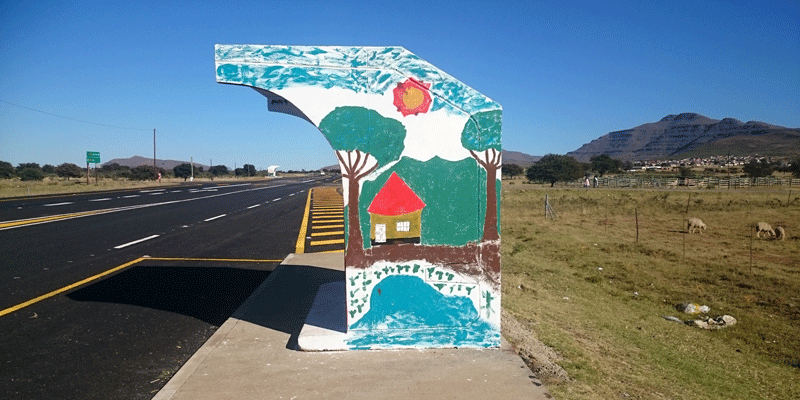
Primary and high school learners showed off their art skills, painting murals on more than 40 dilapidated bus stops in their area.
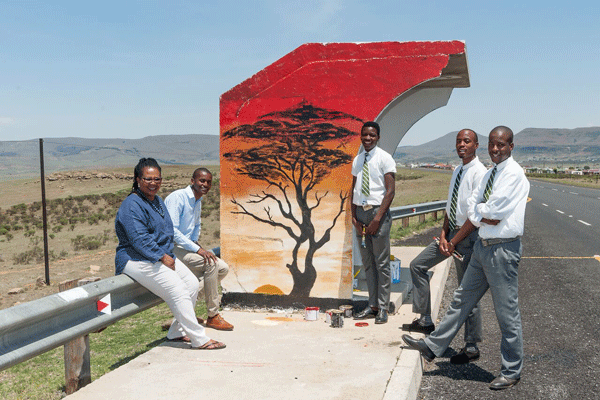
First place went to Bathandwa Ndondo Senior Secondary School located in Mnxe Village. Painted in the beautiful colours of an African sunset, with a silhouette of the bushveld, the bus stop mural they created can be seen 48.6km along the route.
Learners from 12 Eastern Cape schools have helped beautify 40 run-down bus stops along the R410 national road between Lady Frere and Quiba.
The schools took part in a mural competition run by South African National Roads Agency (SOC) Limited (SANRAL) as part of a community involvement initiative to uplift and inspire ownership of the recently rehabilitated R410 road.
The 36 learners, from both primary and high schools, were provided with the paints and brushes needed to decorate the bus stops, while the road agency put traffic calming and safety measures in place on the days that the painting took place.
“Forty-four bus stops located within the project limits that were found to be in poor condition were included in the initiative,” SANRAL southern region manager, Mbulelo Peterson, explained.
“Competition participants were given a timeframe in which to complete the murals and the winning murals were selected by the project engineer, project manager and contractor.”
Winners
First place went to Bathandwa Ndondo Senior Secondary School located in Mnxe Village. Painted in the beautiful colours of an African sunset, with a silhouette of the bushveld, the bus stop mural they created can be seen 48.6km along the route.
Second place went to Nompumelelo Junior Secondary School from Percy Village in Lady Frere, while Ntlalontle Junior Secondary School, also in Lady Frere, took third place.
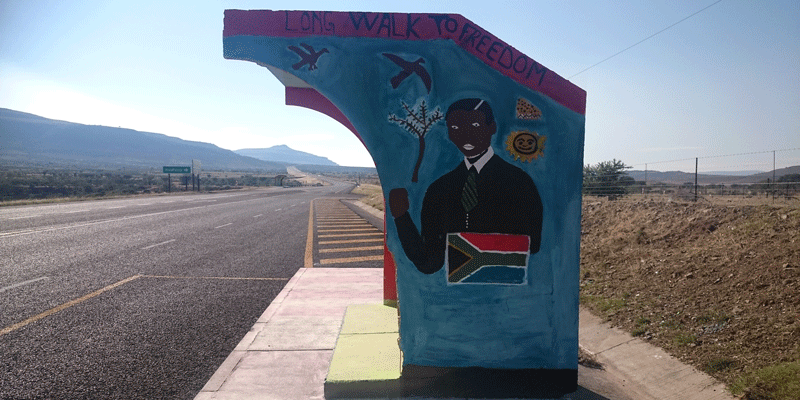
Their bus stops were adorned with symbols of the country: one included the South African flag and a depiction of a young Nelson Mandela and reference to his book Long Walk to Freedom, while the other showed a typical rural scene replete with familiar hills in the distance and a homestead surrounded by trees and dam.
“I am so proud of how well the children at our school do in visual art as a subject,” says Bathandwa Ndondo Senior Secondary School principal, Busisiwe Gqweta. “The children are so happy they won. The money will be used to buy material for painting.”
Sibaphiwe Manyingiza, a Grade 12 learner at Bathandwa, said this was the first time he had participated in a competition. “This was such a wonderful experience. Winning the competition means so much to us,” he said.
Another Grade 12 learner, Mthetho Matomela, dreams of being a professional artist one day and wants to study art after high school.
Grade 11 Buhle Gomba is passionate about art and was happy to have been part of a winning team. “We need more people to come to our school and work with us on art projects,” he added.
Taking ownership of local facilities
“The finished bus stops add to the aesthetic of the completed road and beautify the area through which this portion of the R410 traverses,” Peterson said.
The initiative assisted the community take ownership of the facilities that they make use of on a daily basis, according to Peterson, and this would help ensure the bus stops were not vandalised in the future.
A recurring theme in the murals was one of road safety, indicative of the impact that such a road has on local communities. “It is hoped that the completion of this project, including the safety improvements that were undertaken, will contribute to improved road safety for those that live and work along this section of the R410,” Peterson said.
The community involvement initiative followed the completion of SANRAL’s periodic road maintenance project on the R410.
The R60-million project included maintenance on the existing roads in the area, repairing potholes, fixing cracks and replacing stones. Road safety signage and pedestrian safety measures were also improved.
“SANRAL is looking to implement similar community involvement initiatives across the region,” Peterson concluded.
South Africa’s national road agency is going all out to make sure black businesses in the construction sector are supported by everyone involved.
Macozoma said the roads agency was unwavering in its commitment to ensure inclusive participation of black South Africans in opportunities generated by SANRAL.
The national roads agency is unwavering in its commitment to the inclusive participation of black South Africans in opportunities generated by its investment in the construction sector and related industries.
Established businesses with existing contracts with The South African National Roads Agency (SOC) Limited (SANRAL) – particularly white-owned businesses – should assist the agency to realise its transformation objectives if they wished to continue doing business with the agency.
This was the resounding message from SANRAL CEO Skhumbuzo Macozoma at a business function held recently at the East London International Convention Centre.
Macozoma said the roads agency was unwavering in its commitment to ensure inclusive participation of black South Africans in opportunities generated by SANRAL: “We are geared up to roll out the policy on 1 April 2018.” The implementation date of the policy depends on approval by the Minister of Transport and the Cabinet.
More than 100 delegates attended Macozoma’s presentation, including kings, traditional leaders and representatives of the provincial Congress of Traditional Leaders of South Africa’s (Contralesa) youth wing, as well as delegates from the South African National Civic Organisation (Sanco), South African Women in Construction (SAWIC), EC Black Contractors Association, Small Enterprise Development Agency (Seda), youth business chambers and individual contractors from across the Eastern Cape.
SANRAL’s commitment to transforming the construction sector was commended by those in attendance.
SANRAL in the Eastern Cape
SANRAL manages 4 952km of roads in the Eastern Cape – 22% of the total 22 190kms that traverse all nine provinces.
The agency’s Eastern Cape flagship development is the N2 Wild Coast project, a 410km stretch of road from East London to the Mtavuna River on the border between the Eastern Cape and KwaZulu-Natal.
In addition to the N2 Wild Coast project, SANRAL has a further 116 projects in the initiation, design and construction stages in different parts of the province over the next three years.
Inclusive participation
Since 2009, SANRAL has injected R33.3-billion into the provincial road network. Of this, R11.7-billion was allocated over the past two years; R5-billion in 2016/17 and R6.7-billion for the financial year ending in March 2018.
However, only 10% of SANRAL’s national R20-billion expenditure in 2016/17 was spent on black SMMEs.
“Changing this trend is non-negotiable,” Macozoma said. “We want to see more black women, youth, people with disabilities and military veterans getting a sizeable increase in our spend and participating in our bursary and scholarship programmes, internships and [Port-Elizabeth based] Technical Excellence Academy.”
The success of SANRAL’s transformation policy rests on six levers:
Ownership buy-in from the large construction sector;
Equitable access to contracts across the Construction Industry Development Board grades;
Community empowerment, with an emphasis on local sourcing;
Supply chains that provide black businesses with access to equipment and materials;
Healthy competition, including toll operations and other supporting sectors in SANRAL’s business; and
The South African National Road Agency (SOC) Limited is working with Buffalo City to review the costs of the proposed Buffalo River Bridge.
The proposed Buffalo River Bridge and arterial road link between the N2 and R72 has been a long-time in the planning.
The South African National Road Agency (SOC) Limited (SANRAL) and the Buffalo City Metropolitan Municipality have been in talks over the proposed Buffalo River Bridge city bypass.
The proposed Buffalo River Bridge and arterial road link between the N2 and R72 has been a long-time in the planning. This development would reduce congestion in East London’s central business district, providing road-users with a bypass to the west of the city.
SANRAL had agreed to assist in review the feasibility study – including the costs, said head of spatial planning and development at Buffalo City, Nonceba Mbali-Majeng. This would help in raising funds for the project.
Talks were held between SANRAL and the metro in May and July 2017, and a progress report was recently tabled before council. Other stakeholders involved in the project are the East London Industrial Development Zone (IDZ), the Airports Company of South Africa (ACSA) and the Border-Kei Chamber of Business.
Initially an estimate for the construction of the bridge and bypass was set at R300-million in 1998, and was now an estimated R615-million, if the project was divided into phases. “Should the project be phased into four contracts, the cost is estimated at R793-million if one assumes a 5% increase per annum,” said Mbali-Majeng.
More stakeholders would be identified during the feasibility study review period, Mbali-Majeng said.
Border Kei Chamber of Business chairperson Les Holbrook said there were a number of roads the chamber wanted the roads agency to take over. “We have seen that the only way to get the roads in good condition is when SANRAL takes over.”
The chamber had held a meeting with SANRAL in May 2017, and had also been lobbying for the project to be government funded, he added. “There are various funding tools that can be used; one of them is the municipal infrastructure grant. They must apply for those.”
A long time coming
“We have been asking for this road for more than 15 years,” Holbrook said.
Buffalo City revived the plan in 2016 and roped in SANRAL, with the intention of SANRAL taking over the project and redefining it on their own terms and conditions.
All parties agreed the project should be phased and all resources be directed to the first phase to get the project to the implementation stage, Mbali-Majeng said.
“SANRAL [has] committed to redo the analysis of whether the proposed route is still cost effective due to the time lapse between 2004 and 2015.”
The agency had agreed to review the project and its associated costs and “thereafter the revised costs would be used to request contribution to project by the various affected stakeholders”, Mbali-Majeng added.
SANRAL is in the process of preparing a project implementation plan for the route analysis which will be presented to Buffalo City at its next progress meeting.
Stakeholders in construction and related industries met SANRAL in 34 workshops in more than 30
cities and towns across the country. Here individuals, companies and organisations that might be
affected by SANRAL’s new direction discussed their future roles and contributions. These sessions
were based on the road agency’s long-term vision, Horizon 2030 and its draft transformation policy.