More than 300 SMMEs graduate from SANRAL training programme in the Eastern Cape.
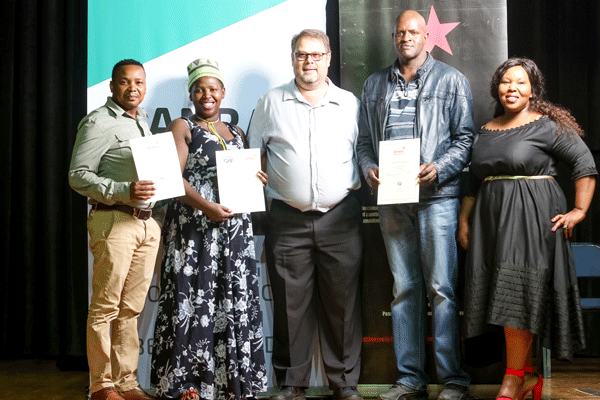
Sean Strydom, SANRAL Southern Region Project Manager (centre) and Lulama Jakavula, director and training specialist at Kwezi Skills Training congratulate some of the SMMEs who completed a training programme, from left Simphiwe Jama from Kangelani General Trading, Siphokazi Sikelwa of Fathuse Trading Pty Ltd and Bongile Dom of Bay Ngwane Trading (Pty) Ltd.
The South African National Roads Agency (SOC) Limited (SANRAL) has handed out certificates to 384 small, medium and micro-sized enterprises (SMMEs) after they completed a training programme that formed part of the R75 Port Elizabeth to Despatch interchange road rehabilitation project.
The two-week training course focussed on tendering, preparing construction documentation and business skills training.
The 384 women, youth and male-owned SMMEs whose CIDB levels are between 1CE and 4CE, received their certificates at a hand-over ceremony held at the Nangoza Jebe Hall in New Brighton on 15 March 2018.
SANRAL are committed to supporting local businesses close to projects. Sixty percent of the SMMEs are from the 10 wards adjacent to the R75, while the remaining 40% are from the greater Nelson Mandela Bay’s SMME Targeted Enterprises.
Sean Strydom, SANRAL Southern Region Project Manager, said: “Through proper consulting, a prequalification tender process was held to determine who should be selected for the training programme. The trainees were then chosen from that pool.
“The training was necessary to assist the SMMEs with the skills needed to complete tendering and construction documents. The SMMEs now have the knowledge to be able to compile competitive tenders for SANRAL projects.”
Of the SMMEs who graduated, 23 have already started working on the rehabilitation project. This includes erecting guardrails, picking up litter, building subsoil drains, erecting anti-climb fencing, building open-line concrete drains, erecting palisade fencing and building prefab culverts.
Accreditation certificates will “open doors”
Siphokazi Sikelwa of Fathuse Trading Pty Ltd started working on the six-month litter cleaning project in January.
“The training I received is important especially because it is an accredited training course. This will help me greatly with compliance. I do have other qualifications but these are not accredited,” Sikelwa said.
Bongile Dom of Bay Ngwane Trading (Pty) Ltd, who does not have a tender to work on the R75 project, also completed the two-week training course, and believes it will assist the growth of his company.
“This certificate means a lot to me as I only have a matric. I was appointed as a sub-contractor on other construction projects for another company before, and did kerbing and pre-mix. This is the first time I have received training on a project and I believe the certificate will open doors for my business,” Dom said.
Simphiwe Jama from Kangelani General Trading has also been involved with the litter cleaning project in January, employing 10 workers.
“I have a matric and now that I also have the national certificate I am motivated to study further. Because of the training I received, I know how to calculate and price tender documents, and have learned the importance of health and safety. These are important skills when you have your own business,” Jama said.
Maintenance contracts spurring black business
The SANRAL Southern Region awarded road maintenance contracts to 147 black-owned SMMEs during 2015/16. The region was responsible for the management of 18 routine contracts for the maintenance of 4 559km of road, constituting 23% of the SANRAL network.
Routine road maintenance spending for 2015/16 amounted to approximately R400-million.
More work on the R75 project will be rolled out during May 2018 and May 2019.
The implementation of road safety measures and rehabilitation of the National Route R75 Section 1, constitutes 13km and will create work for a minimum of 37 local SMMEs between 1CE PE and 6 CE PE CIDB grading within the Nelson Mandela Bay.
This two-year project should be completed in May 2019.
The new bridge will join communities and make a safe passage for learners going to school in George.
The N2 will need to be reduced to a single lane in each direction for short periods of time during construction.
The South African National Roads Agency (SOC) Limited (SANRAL) will soon begin construction of a pedestrian bridge over the N2 in George, east of Nelson Mandela Boulevard.
The bridge will provide a link between the communities of Thembalethu and Ballotsview and will facilitate the safe passage of pedestrians, particularly school children, who regularly cross the N2 at this point. The project will also include the construction of approximately 2km of pavements to tie in with the recently completed pedestrian facilities.
The construction of the bridge has been designed to ensure there is minimal disruption to traffic. However, the N2 will need to be reduced to a single lane in each direction for short periods of time during construction.
A temporary, surfaced bypass cross-over will be built in the median to divert traffic from one carriageway to the other during these periods, and two-way traffic will be maintained at all times. The cross-over will be indicated with temporary signage and flagmen will be deployed to control the traffic as the need arises.
Speed restriction signs will be applicable when approaching the construction area. Road users are encouraged to be cautious at all times and to adhere to the relevant speed limits when using the temporary cross-over.
The contractor is currently setting up the construction site and with work due to start at the end of March. The project is scheduled to be completed early in 2019.
Contact details for emergencies will be displayed on the signage in the construction area. SANRAL apologises for any inconvenience caused during construction.
Learners from Eastern Cape schools exposed to the science of road building as a career path.
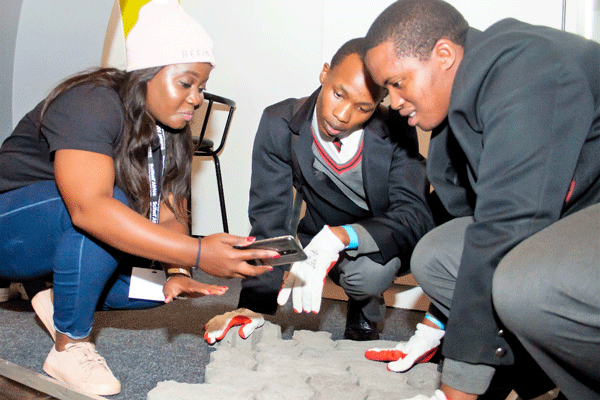
At this year’s SciFest about civil engineering, SANRAL’s exhibit explained the importance of building good roads, the different road signs and what line markings are. It also highlighted scholarship and bursary opportunities available to learners in primary and high schools.
The South African National Roads Agency (SOC) Limited (SANRAL) exhibition at Scifest Africa 2018 proved to be a hit with school children in Grahamstown this month.
Established by the Grahamstown Foundation in 1996, SciFest Africa is South Africa’s national science festival, promoting public awareness, understanding and appreciation of science, technology and innovation in South Africa. The festival celebrated its 22nd anniversary event from 7-13 March 2018 in Grahamstown.
At this year’s SciFest about civil engineering, SANRAL’s exhibit explained the importance of building good roads, the different road signs and what line markings are. It also highlighted scholarship and bursary opportunities available to learners in primary and high schools.
Michelle Ah Shene, SANRAL marketing and communications representative, said: “There has been an influx of learners enquiring about the scholarships and bursary programmes. The younger learners were also very excited about what makes line markers glitter and what civil engineering entails.”
Learners can apply for the SANRAL scholarship programme, which supports academically deserving applicants from grades 10 to 12. The minimum requirements are an overall average of 75% with subject choices that include maths, physical science and English. For further information on the bursary and scholarship programme visit www.nra.co.za
“Approximately 122 students at tertiary institutions are pursuing their academic goals with the support of SANRAL bursaries and about 196 high school learners have received scholarships,” Ah Shene concluded.
Learners inspired to help communities
Likhona Duba, an 11-year-old grade six learner at Sinako Lower High Primary School, had enjoyed the experiments and “really liked learning more about road signs and knowing the difference between permanent and temporary ones”.
For Paul Papiso, a teacher at Sinako Lower High Primary School, the road signs part of the SANRAL exhibition was important as road signs form part of the natural science and technology syllabus.
Aviwe Nzema, a 16-year-old from Khulani Commercial School in East London, would like to be a pilot or civil engineer someday: “I love doing things for my community and think building bridges and roads so that people will have quicker access to clinics or schools is a good way of helping the community.”
Sakhile Ndaba, an 18-year-old matric learner at Butterworth High School, said his first time visiting the SciFest had been important: “I believe what we learn at the SciFest will help us with our school work. I would like to be a civil engineer like my brother who inspires me.”
Aphiwe Nogqala, 18, also in matric at Butterworth High School, also wants to follow in his aunt’s footsteps who is a civil engineer based in Cape Town: “There will always be a need to build roads to make trips shorter between towns and cities. Building better and safer roads can reduce road accidents.”
SANRAL has been engaging locals in road construction improvements in their areas.
Through its draft transformation policy, SANRAL intends to allocate tenders to black-owned and women-owned enterprises beyond the current legal thresholds.
The transformation of the construction industry and job creation for local communities on road construction projects were discussed at a meeting convened by SANRAL in Mpumalanga in early March.
The session, attended by more than 150 members from small business owners, entrepreneurs and community leaders was held in KwaMhlanga, located next to Moloto Road (R573), which is currently being upgraded to improve road safety and mobility in the area.
Ismail Essa, the Transformation Manager of SANRAL, said: “We are using this event to update smaller contractors and local communities on how they can participate in road construction contracts – not only on the Moloto project but also on future SANRAL activities.”
Horizon 2030
The South African National Roads Agency (SOC) Limited (SANRAL) has embarked on a countrywide roadshow to explain its new long-term strategy – Horizon 2030 – and its draft transformation policy introduced in November 2017.
Since then it has hosted some 40 sessions in all nine provinces and informed communities about opportunities that will open up for joint ventures with small and medium enterprises.
The Moloto road is a national priority that has been fast-tracked by SANRAL to address safety issues on a corridor that carries 50 000 daily commuters and passes through 33 communities in Gauteng, Mpumalanga and Limpopo.
Essa said: “Our approach to job creation and the participation of small business in major projects is a good example of how SANRAL wants to transform the construction and engineering sectors.
“Our objectives are to empower small businesses, allocate a growing portion of major projects to emerging contractors and transfer skills and experience so that these contractors will, in future, be able to become major players in their own right.”
Through its draft transformation policy, SANRAL intends to allocate tenders to black-owned and women-owned enterprises beyond the current legal thresholds.
“We play a pivotal role in the engineering and construction sectors, and we want to use this leverage to maximise the participation of contractors owned by women, the youth and the disabled,” said Essa.
Current construction work
The current phase of the construction work in Mpumalanga involves the upgrading of four intersections at a tender amount of R106-million.
The work is shared as a joint venture between a major contractor with a Grade 9 recognition from the Construction Industry Development Board (80%) and joint venture partners with CIDB gradings 5-7.
Twenty percent of the work is allocated to small and medium enterprises and, within this target, 20% must to go towards both women-owned and youth-owned businesses. For future phases of construction, the allocation to SMMEs will be raised above 30%.
Essa added that the Moloto Road project also contributes towards job creation in communities that live in the vicinity of the construction.
SANRAL has created a database of people seeking employment opportunities where workers are selected through a raffle system. Some 160 people from all 32 wards in the Thembisile Hani Local Municipality have been selected and 79 recruited to date. Similar processes will be used during the next phases of the 139km project in Mpumalanga, Limpopo and Gauteng.
Another element of SANRAL’s transformation policy is to ensure skills training and the transfer of knowledge and experience to contractors and labourers. The joint venture partners will benefit from on-the-job experience and training and learnerships are provided to subcontractors and local SMMEs.
All of the work done for the duration of the five-year construction period will make use of labour-enhanced construction methods designed to utilise members of local communities and ensure they acquire new skills.
Further improvements at the iconic Mount Edgecombe interchange will see an easing in traffic congestion.
The Mt Edgecombe interchange upgrade has changed the landscape of the area forever and is sure to become a well-known landmark in years to come.
There will be a further opening of new ramps at the Mt Edgecombe Interchange during the next week.
From Thursday 15 March, weather permitting, traffic travelling on the M41 from uMhlanga Ridge towards the N2 North and the King Shaka International Airport will be diverted onto the newly-constructed fly-over ramp, bypassing the current traffic lights on the M41.
The first ramp was opened to traffic on Monday 5 March, when motorists from Phoenix and Mt Edgecombe heading south towards Durban began using the one-kilometre long bridge.
Corné Roux, SANRAL Eastern Region project manager for the Mount Edgecombe Interchange, said that from Saturday 10 March, the traffic traveling on the N2 from Durban towards uMhlanga Ridge had been diverted onto part of the newly-constructed loop ramp, also enabling them to avoid the traffic lights on the M41.
Only one lane of the loop ramp will be open to traffic for the meantime.
Roux said: “Rehabilitation of the existing pavement layers in the slow lane of the M41 east bound is currently taking place. This work is expected to be completed in three weeks, weather permitting.”
He urged motorists to proceed with caution and to adhere to speed limits when using the new ramps as some lanes were still under construction.
Connecting the roads of the north
The iconic Mt Edgecombe Interchange forms part of the improvements being undertaken by the South African National Roads Agency (SOC) Limited (SANRAL) at the N2/M41 Mt Edgecombe Interchange in the north of Durban, connecting Phoenix and uMhlanga with Durban and the North Coast of KwaZulu-Natal.
The interchange, which is one of the largest projects presently being undertaken by SANRAL in KwaZulu-Natal, is more than just a masterpiece of award-winning architecture, it is a vital artery of the greater eThekwini metropolitan highway system for easing traffic, relieving congestion and, thus, also becoming a significant business enabler.
Due to the expansion of the uMhlanga and La Lucia Ridge areas, the existing interchange had been operating at capacity, with vehicles backing up on the M41 and onto the N2 in peak hours.
An additional 40 000 vehicles enter or leave the N2 from the M41 daily resulting in substantial queuing of vehicles during the day.
This, together with expected future expansions and anticipated development of the Cornubia area, required the existing interchange to be upgraded in order to improve the flow to and from the N2 and M41 to the supporting road network.
More than just an interchange
The Mt Edgecombe interchange upgrade has changed the landscape of the area forever and is sure to become a well-known landmark in years to come.
The new four-level interchange facility provides at least two lanes on each of the major movements. The upgrade includes the implementation of directional ramps, eliminating the need for controlled signalisation, thus ensuring the free flow of traffic in all directions.
The construction has been jointly funded by SANRAL and KwaZulu-Natal Department of Transport.
Bridging the gap
Two bridges, which are being incrementally launched, are part of the interchange upgrade. One of the bridges, which is 948m in length – the longest incrementally launched bridge in South Africa – joins the Mt Edgecombe side of the M41 with the N2 South. The other bridge spans 440m and joins the uMhlanga side of the M41 with the N2 North.
The 948m bridge has 23 piers and two abutments, and was built from two ends – one portion launched on a curve and the other on a straight.
To provide for the safety of pedestrians, a pedestrian bridge has been constructed over the N2 and will connect to new footways.
In addition, lighting will be installed to ensure the whole interchange is illuminated at night for increased safety.
SANRAL has explained irregular expenditure to SCOPA, after an unqualified audit report from the Auditor General.
SANRAL CEO, Skhumbuzo Macozoma, said the road agency recognises the problem of irregular, fruitless and wasteful expenditure, and are committed to eliminating these and take heed of the committee’s recommendations in terms of their accountability and the application of legislation.
The South African National Roads Agency (SOC) Limited (SANRAL) appeared before the Standing Committee on Public Accounts (SCOPA) on 7 March 2018 to clarify incidents of “irregular, fruitless and wasteful” expenditure.
SANRAL received its 14th consecutive unqualified audit report from the Auditor General in 2017.
This means the agency achieved 32 out of its 37 targets related to corporate performance, which translates into an 86% achievement.
A Roll-over
Some of the irregular expenditure is a roll-over from 2015, such as routine road maintenance (RRM) contracts. These contracts are in effect on all of Sanral’s network.
These contracts are a great incubator of small, medium and micro enterprises (SMMEs), and in line with SANRAL’s policy of ensuring that a significant amount of work is awarded to them. RRM contracts are awarded for three years and renewable for two years, subject to satisfactory performance.
The finding of irregularity was made because neither the Preferential Procurement Policy Framework Act (PPPFA) nor its regulations define the lowest acceptable price, and SANRAL had, in the past, used a method to determine a viable lowest price that would be acceptable.
SANRAL’s outgoing Board Chair, Roshan Morar, said: “As a result, SANRAL developed and introduced a statistical method to establish the lowest acceptable price for each RRM contract. This method is independently calculated by the University of Pretoria for every contract. It allows for the appointment of a contractor with the most realistic rates at which SMMEs can do the work and be financially viable.”
A 63% decrease in irregular expenditure
The Preferential Procurement Policy Framework Act was in use for over 11 years with the AG’s knowledge of the rationale. During this time, there were no findings from the AG or complaints from contractors. However, in 2013 the AG declared the method non-compliant with the PPPFA.
Morar said: “We have been rectifying the irregularity in a phased approach as we had contracts in place that we left to run their course in order not to incur cancellation claims. The last contracts concluded in 2017, but the expenditure is still reported as irregular.
“It should be indicated that the 2017 irregular expenditure of R424-million is a 63% decrease from the R1.1-billion irregular expenditure of 2016. Of course, we are working hard to reduce it to zero. Considering we have a cumulative irregular expenditure of R10-billion from March 2012 to March 2017, we are beginning to see our corrective measures reversing this trend.”
Morar added that SANRAL had applied for condonation each year (from March 2012) to National Treasury but only received correspondence for the first time, in the first week of March 2018, requesting more information.
The committee also raised concerns about the frequency and extent of variations and deviations, as well as reiterating the urgency for transformation within SANRAL.
Skhumbuzo Macozoma, SANRAL CEO, said: “We take cognisance of the procurement deficiencies that may exist within our organisation, as pointed out by Scopa during a robust session. We also wish to put on record that SANRAL remains 100% committed to operating within the legislative prescripts of the PPPFA, which guides our actions.
“As SANRAL we recognise the problem of irregular, fruitless and wasteful expenditure, and we are committed to eliminating these as we take heed of the committee’s recommendations in terms of our accountability and the application of legislation. As such, we have already embarked on interventions to improve compliance, strengthen the institution and prevent non-compliance in our supply chain management processes. We are making concerted efforts to reduce variations and deviations, and intensify our appeal for cabinet to approve our transformation policy. In taking this approach, we can move from an unqualified audit, to a clean audit.”
The Project Liaison Committee (PLC) for the Hammarsdale interchange upgrade is in disagreement
with the basic SANRAL policy on localising labour and SMMEs. The PLC members also developed
internal dissent. Several attempts to resolve the issues have failed. SANRAL had to instruct that the
works contract be temporarily suspended.
Upgrading of the N7 started in March 2015 and will be completed in the beginning of 2019. The
section between Melkbosstrand intersection and Malmesbury will see the single carriageway become
a dual carriageway, the Darling Road interchange and pedestrian crossings are being improved.
Work on the construction of the Mtentu Bridge, near Lusikisiki, started on 11 January 2018. The
R1.63bn project will take 40 months and is expected to be completed by May 2021. The second
tender for the Msikaba Bridge went out in November 2017 and closed on 9 March 2018.
Construction should start towards the end of 2018.
There are several planned upgrades along the R573 for 2018. Three more construction work
packages for Limpopo and five for Mpumalanga will be rolled out, plus three community development
projects in Limpopo and another five in Mpumalanga, targeting CIDB grade 1 SMMEs who are
seeking opportunities.