SANRAL-facilitated research provides greater understanding of road user behaviour that will be used to increase safety.
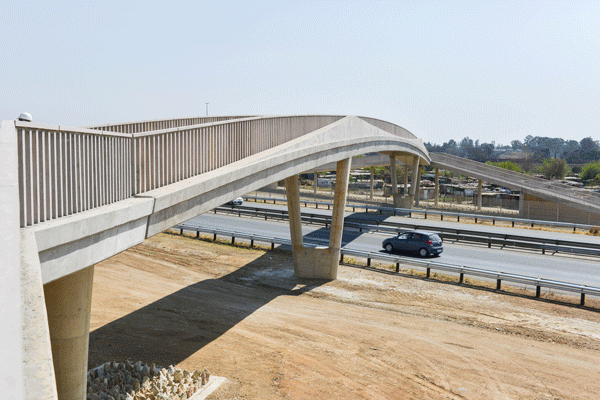
SANRAL recently constructed three new pedestrian bridges on the N17 between Springs and Johannesburg, which promise to reduce the risk of pedestrians and cyclists being run over by cars when crossing the busy highway.
Research conducted on the Cape Town freeway network is shining more light on why pedestrians cross busy highways, braving the potential danger of being involved in an accident with fast-moving vehicles, despite the presence of pedestrian bridges.
Coordinated by Professor Marion Sinclair of the University of Stellenbosch’s Department of Civil Engineering and Prof Mark Zuidgeest of the Centre for Transport Studies at the University of Cape Town, the study adds to a greater understanding about pedestrian behaviour and will have an impact on the provision of road infrastructure, traffic law enforcement and education and awareness campaigns targeting specific road user behaviour.
The research was facilitated by the South African National Roads Agency (SOC) Limited (SANRAL), which commissioned the pedestrian count and provided the data for analysis.
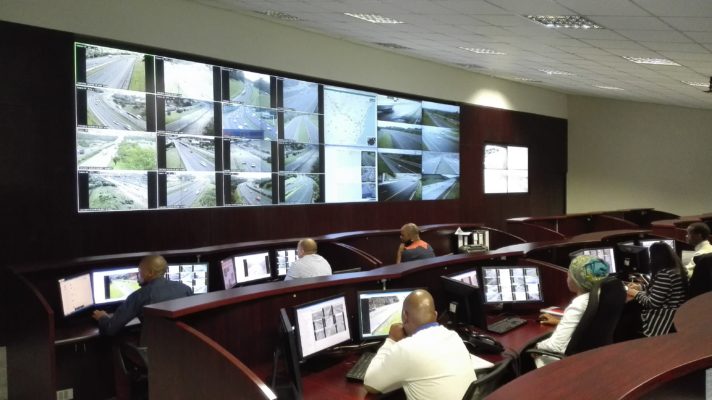
CCTV cameras on Cape Town freeways monitor the activities of pedestrians, with up to 30000 pedestrian activities being observed on a regular week day.
Crime and time amongst reasons
SANRAL has built several pedestrian bridges across the roads. Part of the research was aimed at determining whether people make use of these bridges and what can be done to influence their choices.
The study found that time saving and a fear of criminals were among the top reasons why pedestrians decided to cross the road, both in instances where bridges were close by and where they were absent.
Many pedestrians were prepared to take the risk of venturing onto the road rather than becoming victims of crime on, or close to, the bridges.
Among the recommendations are that more pedestrian bridges should be erected, but that they cannot be provided without reliable security systems that ensure the personal safety of pedestrians who use them.
This will require partnerships between road authorities and law enforcement in implementing sustainable solutions.
A good example of this is the deployment of additional CCTV cameras as part of the Freeway Management System, located specifically at known hotspot pedestrian bridges.
These cameras are monitored 24/7 by law enforcement operators on the lookout for suspicious behaviour or potential danger.
SANRAL works with experts, education and local authorities to developeducational materials and implement programme.
Elna Fourie, SANRAL’s Manager: Road Safety Education and Awareness, said: “The teaching material is designed and developed to support teachers, especially in rural communities, who do not have ready access to resources.
Teachers and parents across the country will soon have access to innovative teaching aids that will enable them to convey vital road safety messages at schools and in family settings.
The South African National Roads Agency (SOC) Limited (SANRAL) is developing these educational materials based on extensive research conducted over the past five years and with the aid of experts in the fields of education, road safety and graphic design.
SANRAL is working closely with the Department of Basic Education, provincial and local transport authorities in the implementation of this road safety education programme.
The resource box will be provided to schools that participate in SANRAL’s road safety education and awareness programmes, and were selected for the agency’s behavioural research project.
Elna Fourie, SANRAL’s Manager: Road Safety Education and Awareness, said: “The teaching material is designed and developed to support teachers, especially in rural communities, who do not have ready access to resources.
“Basic road safety education is included in the curriculum in Grades 1 to 6, but it is expected of teachers to develop their own learning opportunities (lessons) that fit in with the development stages of their learners.”
The SANRAL material helps to fill those gaps.
Included in the resource box are colourful education aids that can assist in teaching children various aspects of basic road safety, explaining the importance of road signs, traffic lights, pedestrian zebra crossings and much more, supplemented by road safety tips and basic information on good road behaviour.
It consists of transparencies, flash cards, posters and signs, and contains ideas on how teachers and learners can design and make their own material.
Teachers also receive manuals and documents they can use in the presentation of the lessons, as well as suggestions for activities that can take place in the classroom or outdoor settings.
SANRAL is working closely with the Department of Basic Education, provincial and local transport authorities in the implementation of this road safety education programme.
System on strategic KwaZulu-Natal road sections provides real-time information to road users on possible obstructions.
SANRAL first embarked on the implementation of the FMS on strategic road sections in KwaZulu-Natal during 2009 following the successful pilot FMS implementation on the Ben Schoeman Highway in Gauteng.
Motorists using KwaZulu-Natal freeways can make smart decisions to remain safe and avoid congestion, thanks to the implementation of the Freeway Management System (FMS).
The system relays real-time information to alert motorists about incidents that could be unsafe and are likely to cause build-up of traffic and subsequent delays.
Dumisani Nkabinde, Eastern Region manager for the South African National Roads Agency (SOC) Limited (SANRAL), said: “A freeway can have six lanes but a single incident, such as a breakdown or a collision, can have a major impact on the flow of traffic in both directions.”
Nkabinde said the FMS consisted of technologies and strategies to monitor, control, and manage freeway traffic more effectively.
Safer roads and quicker travel times
SANRAL first embarked on the implementation of the FMS on strategic road sections in KwaZulu-Natal during 2009 following the successful pilot FMS implementation on the Ben Schoeman Highway in Gauteng.
The FMS system entails the active management of road networks using Intelligent Transport Systems (ITS) technologies. ITS involves the integrated deployment of communications technologies, traffic management software and control devices such as closed-circuit television cameras (CCTV), variable message signs (VMS) and traffic detectors to enable the active management and monitoring of freeways.
“The many benefits to the road user on such a managed network include improved congestion management, faster detection, verification and response to road incidents such as accidents, road obstructions and road hazards, as well as the provision of real-time traveller information to road users.
“These benefits directly result in safer roads, savings in travel times and fuel costs, as well as contributing to a cleaner environment,” said Nkabinde.
Detection time of 76 seconds per incident
The FMS in KwaZulu-Natal currently covers around 120km of the busiest sections of the N2 and N3 – from the Prospecton interchange on the N2, northward to the Watson Highway interchange, and on the N3 from the Candella Road bridge to the Market Road.
Further expansions are in the process of being implemented from Market Road to the Cedara Interchange, which includes the high-accident zone at Town Hill.
These freeway sections are equipped with 147 CCTV cameras, 26 VMS units and 57 radar vehicle detection units, all linked through a fibre optic communications backbone to a Traffic Management Centre (TMC) located at the SANRAL offices in Pietermaritzburg.
Nkabinde said incident detection and verification of times in KZN were impressive, with the average detection time down to 76 seconds.
“This is in large part accomplished by an efficient TMC operations team and an effective performance monitoring regime.
“The TMC works closely with and provides real-time traffic and accident information to the various authorities involved in road incident management, such as police and emergency services.
“To further improve the response to traffic incidents, officers from KZN provincial police are currently collocated at the TMC.”
The SANRAL TMC operates on a 24/7 basis and has 23 staff involved in road network monitoring and incident management.
It deals with an average of 800 traffic-related incidents every month. Stationary vehicles on the network (mostly heavy motor vehicles) account for just over half of all the traffic incidents detected.
Approximately 17% of the total traffic-related incidents are vehicle accidents, which equates to an average of 140 accidents per month. Most of these accidents (over 70%) involve light motor vehicles either in single or multiple vehicle collisions.
The freeway sections around the EB Cloete systems interchange (Spaghetti Junction) and the Umgeni interchange on the N2 record the highest number of traffic incidents.
SMS and Twitter alerts
A traveller information website www.i-traffic.co.za is also available to the public and provides useful information such as traffic conditions, road works, road conditions, congestion and traffic alert information.
Users can also register on site and subscribe for free SMSes and email traffic alerts. There is real-time viewing of the various camera feeds along the routes.
Traffic information is also posted via social media such as Twitter. Messages are posted via the @i_trafficKZN twitter account, which currently has around 175 000 followers.
SANRAL takes steps to enhance traffic and pedestrian safety on the N2 and N3 in KwaZulu-Natal.
The fencing, which stands at almost 2,5m high, is manufactured from galvanised pressed high-density mesh panels with anti-cut dimensions and galvanized spikes bolted along the top.
To prevent the further unnecessary loss of lives, vandal-proof fences are being erected at additional vulnerable sections of the N3 and N2 in KwaZulu-Natal.
Pedestrians have been hit by vehicles when they attempt to cross freeways instead of using overhead bridges in the vicinity.
The South African National Roads Agency (SOC) Limited (SANRAL) is presently erecting fencing between Chota Motala Bridge and Chatterton Rd on the N3 Pietermaritzburg Bypass.
Fencing is also being installed over a 2km section of the N3 at Cliffdale and a 2km section of the N2 at Kwa Mashu.
SANRAL has previously erected fences on the N3 near the Mariannhill Toll Plaza to prevent hawkers from gaining access to the toll.
Fences have also been put up on the N3 Pietermaritzburg Bypass in the median between Chota Motala Bridge and Ohrtmann Road, and in the median opposite the BP Oasis service station at Cato Ridge.
Pedestrians need to play their part
Bruno Cullen, SANRAL Eastern Region project manager, said pedestrians vandalised the fencing material that had previously been used along certain sections to prevent them from crossing the busy highway.
“We have experimented with vandal-proof fences, which have so far proven to be most effective in preventing people from crossing and causing an unsafe environment.”
The fencing, which stands at almost 2,5m high, is manufactured from galvanised pressed high-density mesh panels with anti-cut dimensions and galvanized spikes bolted along the top. It is not possible to climb this type of fence and it is also difficult to cut.
Cullen said it is a well-known fact that approximately 40% of all deaths on South African roads are pedestrians.
“Pedestrians are the most vulnerable group of all road users and road safety is an important priority for SANRAL.
“We invite the cooperation of pedestrians to ensure lives are not placed at jeopardy through the deliberate and wilful destruction of the fencing,” said Cullen, adding while walking to a bridge may take a while longer, it could mean the difference between life and death.”
Future road safety plans will be adapted to ensure closer alignment between provinces and national agencies responsible for enforcement and awareness, said Transport Minister Nzimande when he released the 2018 Easter road statistics. A total of 510 lives were lost on the roads. This represents an increase of 14% from the comparable period last year. Dr Nzimande said the Road Traffic Management Corporation and the provinces will use the data to develop a road safety plan, focusing on the main contributory factors of crashes such as pedestrians, impaired driving, dangerous driving and occupant safety.
Aveng Strabag JV the contractor appointed for the 40-month R1.64 billion Mtentu gorge bridge contract started construction in January 2018. The retender for the nearby Msikaba gorge mega cable-stay bridge closed in April 2018. The award is expected to be announced in late 2018 and work on the Msikaba bridge should start in 2019.
Construction on the R573 Moloto Road is progressing steadily. SANRAL, and contracted companies, are working around the clock to ensure that all work undertaken is in accordance with plan and is completed within the stipulated five to seven years. The aim is to make it safer and better for pedestrians and motorists. There are several planned upgrades along the R573 for 2018.
Masakhane Project Managers win R54-million supplier contract for Mtentu Bridge.
Managing Director and Founder of Masakhane, Ayanda Notshweleka, was born and raised in Flagstaff. His experience in the construction industry spans over a decade, as he has worked for companies including Murray and Roberts, WBHO and Ugu Municipality.
A black-owned construction company, Masakhane Project Managers (Masakhane), is seeing the positive socio-economic effects anticipated from the South African National Roads Agency (SOC) Limited’s (SANRAL) N2 Wild Coast Road (N2WCR).
Masakhane has recently been appointed as one of the suppliers for a major project in the second phase of the greenfield portion of the N2WCR project.
After winning a tough competition between four potential companies, Masakhane will supply aggregate for the Mtentu Bridge construction, a contract estimated at R54-million.
They will be responsible for mining and processing rock from their dolerite quarry at Dudumeni Village in Ward 8 of the Mbizana Local Municipality under Ntlenzi A/A, which is between Bizana and Flagstaff.
All the aggregate for the Mtentu Bridge piers and deck will be sourced from this single quarry to ensure a consistent quality and appearance of the concrete.
The highest bridge in Africa
Situated in a remote location across a deep gorge of the Mtentu River, which is a boundary between the rural municipalities of Mbizana and Ingquza Hill, the Mtentu Bridge forms an essential component of the greenfield section of the N2WC project. It is set to provide road users with an 85km shorter route and will deliver travel time savings of up to three hours.
Once completed the 1,1km long, 223m high Mtentu Bridge will be the highest bridge in Africa and the Southern Hemisphere.
Masakhane has been subcontracted by the main contractors of the bridge, Aveng Strabag Joint Venture (JV), which is comprised of partners Aveng Grinaker-LTA, a major South African-based construction company, and Strabag, a leading construction company in Europe with extensive experience in major balanced cantilever methodology bridge construction.
A son of the soil
Managing Director and Founder of Masakhane, Ayanda Notshweleka, was born and raised in Flagstaff.
His experience in the construction industry spans over a decade, as he has worked for companies including Murray and Roberts, WBHO and Ugu Municipality.
As a quantity surveyor, he founded Masakhane Project Managers, which deals with construction, project management, civil and building, property development, cost consulting and quarry mining in 2004.
Speaking on the 40-month aggregate supply contract will boost his company, Notshweleka said he currently hires equipment for his projects and that a contract of this magnitude enables him, as a black quarry miner, to approach banks for financing to purchase plant equipment, which can cost upwards of R30-million.
“Quarry mining is white-dominated sector in the Alfred Nzo and OR Tambo region. Initiatives such as this by SANRAL to support black quarry mining companies, contribute largely to transformation of the industry,” said Notshweleka.
Locals will benefit
Approximately 45 direct job opportunities are expected to be created through the Masakhane sub-contract. Fifteen locals will be appointed for operations at the quarry.
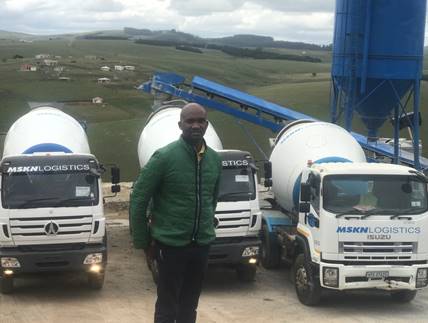
“Masakhane has subcontracted the transportation of the material from the quarry to the bridge site to three local trucking cooperatives from Bizana, Flagstaff and Lusikisiki. Each trucking cooperative will supply five trucks, with each to be operated by two people, a driver and assistant, working out to 30 additional job opportunities,” Notshweleka said.
“We also plan to launch a training programme through a local driving school where 15 young women from the neighbouring villages of Khanyayo, KwaMadiba and Dudumeni will obtain learners and drivers licences.”
The aim is to appoint these women as trainee drivers with the respective trucking associations upon completion of the training programme.
Notshweleka added that locals have largely been subjected to the steep prices of building materials because of transport costs from quarries outside the region. “One other spin-off this project presents is that local contractors and the community at large will be able to access building materials at more affordable rates as the high cost of transportation will be lessened when materials are sourced locally.”
SANRAL General Manager of Communications, Vusi Mona, said: “SANRAL will require several additional local quarries to be expanded or established to supply the quite considerable amount of aggregate and crushed rock material required for the construction of the rest of the nine major bridges and 110km of road making up the greenfield section of the future N2 Wild Coast Road.
“The Mtentu Bridge aggregate contract is therefore only the first of many similar contracts for local quarry owners that will be realised over the next few years.”
A boost for theregion
The Mtentu Bridge site is located on the border between the Mbizana Local Municipality and Ingquza Hill Municipality, whose population is 98% rural, comprising the towns of Bizana, Lusikisiki and Flagstaff, and numerous villages.
Poverty is prevalent in the area with the unemployment rate at 43.6% for the 282 000 Mbizana populace and 51.6% for the Ingquza Hill population of 278 000. Key economic drivers, which include agriculture, tourism, mining and the ocean economy, are said to be underdeveloped.
The Masakhane offices are in Seaview (ward 8), Mzamba, a village just over 20km from Bizana towards Port Edward.
Work on the construction of the Mtentu Bridge started in January. It will continue over a period of 40 months and is expected to be completed by May 2021.
Road Incident Management System oversees efforts between emergency services and traffic officials during incidents.
Essential services, such as traffic authorities, the SA Police Service, emergency medical, fire and rescue services, are connected to RIMS to ensure coordinated action and the implementation of standard operating procedures.
When a crash occurs on any major road in South Africa, the first priority is to assemble emergency services and traffic management teams to the scene.
Emergency services can help save the lives of crash victims, while traffic officials must manage the traffic flow and prevent any further incidents.
These processes are coordinated by the Road Incident Management System (RIMS), which is in place on major roads in the country.
The South African national Roads Agency (SOC) Limited (SANRAL) has been mandated by the Department of Transport to establish and implement RIMS.
The system sets in motion a sequence of coordinated activities when an incident or crash occurs. The intention is to minimise the direct and secondary effects of the incident, and to restore traffic to normal operating conditions as soon as possible.
Essential services, such as traffic authorities, the SA Police Service, emergency medical, fire and rescue services, are connected to RIMS to ensure coordinated action and the implementation of standard operating procedures.
RIMS is already implemented on all national roads and will be rolled out to provincial roads as a priority project. Coordinating systems have been established in each province.
This includes centralised communication centres that receive emergency calls from the public and dispatch emergency teams to the scene of an incident.
SANRAL is constantly working on methods to improve the speed of detection and response to support crash victims, manage traffic flows and remove obstructions that might cause further incidents.
RIMS also facilitates the training of members of emergency services to ensure coordinated actions take place according to the correct protocols. Detailed debriefings and assessments are done after major crashes to determine the cause of the incident and evaluate the action of the responders.
Comprehensive statistics are fed into the RIMS system and the data is analysed to identify incident trends and hazardous locations.
This information enables SANRAL to introduce road safety interventions that mitigate the risk of serious injury and fatal crashes in future.
Agency calls on law enforcement agencies to act decisively on those who destroyed property and endangered safety.
Skhumbuzo Macozoma, SANRAL CEO, regretted the negative impact and inconvenience the violent incidents had on those travelling through the toll plaza.
The South African National Roads Agency (SOC) Limited (SANRAL) condemned the violent and destructive protests at the Mooi River toll plaza, which took place over the long weekend in April, in the strongest terms.
SANRAL CEO Skhumbuzo Macozoma said: “There is a right to protest, but that does not include the right to destroy public or other property, nor to endanger life and limb. Clearly the ugly protests at the Mooi River toll plaza over the long weekend violated this principle.
“We strongly condemn such actions and call on law enforcement agencies to act decisively and see to it that those guilty of breaking the law are brought to book.”
The agency would not speculate as to the cause of the violent action, but deplored the fact that protesters resorted to intimidation and destruction to make their point.
Macozoma said: “This was not a matter in which the roads agency was directly involved, but it endangered the safety of those using the N3, damaged tourism prospects in the province and hurt the image of South Africa. Nothing was gained from the protest.
“The violence that often characterizes demonstrations and protests is deplorable and can never be justified. There are other ways to settle disputes, and we ask that those involved find each other to resolve the outstanding issues.”
Macozoma regretted the negative impact and inconvenience the violent incidents had on those travelling through the toll plaza.
He called on all South Africans to heed the call made by President Cyril Ramaphosa in Port Elizabeth during a workers’ day rally: “Let us exercise our right to protest in a way that is going to make sure that one, will look after the vulnerable, two, that will look after the assets of our nation.”