
Blog

“Pay your tolls!” is the call from the new Minister of Finance

Tito Mboweni singled out the road network as a vital element that “supports growth and development” in an economy that is dependent on land transport. 

Minister of Finance, Tito Mboweni, singled out the road network as a vital element that “supports growth and development” in an economy that is dependent on land transport. 

A strong commitment to prioritise the country’s road network and a passionate plea to South Africans to “pay our tolls” were important features of new Finance Minister Tito Mboweni’s first Medium-Term Budget Policy Statement. 

This is vital to restore a culture of payment in the country, instil confidence in investors and ensure sustainable service delivery. 

The Minister also highlighted SANRAL’s partnerships with concessionaires as examples of how the public and private sectors can work together to deliver vital infrastructure.  

“These kinds of partnerships will be accelerated,” he announced. 

Speaking in Parliament, Mboweni devoted considerable time to announce steps taken to revitalise the country’s infrastructure as a core element of broader plans to attract investment, stimulate economic activities and create jobs. 

He singled out the road network as a vital element that “supports growth and development” in an economy that is dependent on land transport. 

“Over the medium term, funds are reprioritised to enable the strengthening and rehabilitation of the national non-toll road network – of which about 75% is beyond its design life,” he said. 

User pay principle 

Mboweni also committed to the user-pay principle as “the most efficient and effective way to ensure that the direct benefits of services are paid for by those who use them”. 

“If we want road transport that works, we need to pay our tolls,” he said. 

“We need to restore a culture of payment in this country to ensure the sustainability of our services and to give confidence to those institutions who invest in our bonds.” 

In the Medium-Term Budget Policy Statement – released together with the Minister’s speech – Treasury committed itself to the allocation of R5.8-billion to SANRAL for 2018/19.  

This amount is shifted to SANRAL within the adjusted budget for the Department of Transport (Vote 35). 

It notes that SANRAL has government guarantees of R38.9-billion, but there is a risk that the guarantees might be called in because it is not generating enough cash from the Gauteng Freeway Improvement Project to settle redemptions falling due over the medium-term period. 

Mboweni’s speech built strongly on the recent announcements by President Cyril Ramaphosa to prioritise infrastructure and revitalise state-owned companies.  

It was delivered on the eve of the National Investment Summit in Sandton where the President announced details on government’s progress to attract both local and foreign investment in the economy. 

The current reconfiguration of state-owned companies requires the country “to take a hard look at how they operate”.  

It also presents “an opportunity to demolish the walls that exist between the private and public sectors,” Mboweni said. 

Successful partnerships with the private sector – such as on the N3 highway and the N1/N4 Platinum Road – are examples of how service level agreements can be put in place to define relationships between the two sectors. 

Eight highlights from the 2018/19 Medium-Term Budget: 

  1. SA’s growth forecast has been revised down from 1.5% to 0.7%, but is expected to pick up to over 2% by 2021 “as confidence returns and investment gathers pace”. 
  2. The National Development Plan will occupy a central place in government policies and planning. This includes a commitment to strong, inclusive and sustained growth to sharply reduce unemployment, poverty and inequality. 
  3. Almost R16-billion of the 2018/19 Budget has been reprioritised towards infrastructure programmes and initiatives to support industrialisation. Investments in roads and transport infrastructure will improve access to social and economic facilities and help to attract investment, particularly in township economies. 
  4. Development finance institutions, multilateral development banks and private banks will be roped in to design, finance and implement infrastructure projects. Government will develop a framework and implement regulatory reforms to enable long-term investors to commit funds that will lead to returns on investment. 
  5. National Treasury will work with other department to deal with financial misconduct in all spheres of government. This will include the “employment of qualified, competent and incorruptible officials”. 
  6. No additional funds will be allocated for the implementation of the public service wage agreement. National and provincial departments will have to absorb these costs within their compensation baselines. 
  7. Treasury will work with the Auditor General to reduce fruitless, wasteful and irregular expenditure across the public sector and law enforcement agencies “will act against those implicated in wrongdoing”. 
  8. Government is working with the Johannesburg Stock Exchange to strengthen debt listing requirements for state-owned companies. This will lead to increased transparency and improved governance in this sector.
Tshwane Mayor urged to check his facts

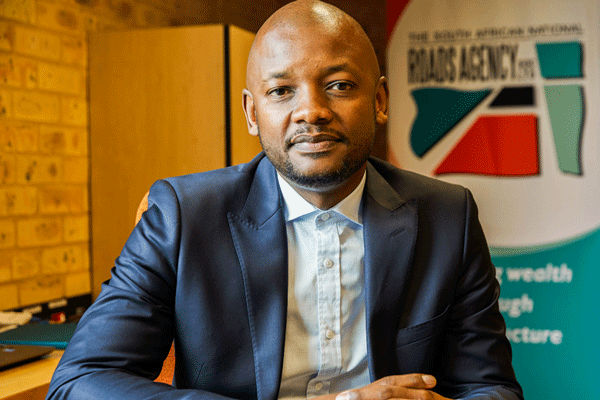
SANRAL CEO Skhumbuzo Macozoma has echoed Finance Minister’s passionate plea to South Africans to pay road tolls.


SANRAL has achieved its 15th consecutive unqualified audit, as was revealed in its annual financial statements. The report includes a concern with respect to the future funding of roads. 

Following on Finance Minister Tito Mboweni’s backing for the user pay principle, Skhumbuzo Macozoma, CEO of the South African National Roads Agency (SOC) Limited (SANRAL) has sought to correct the “e-toll facts” given by Tshwane mayor Solly Msimanga. 

A strong commitment to prioritise the country’s road network and a passionate plea to South Africans to pay tolls were important features of new Finance Minister’s first Medium-Term Budget Policy Statement.  

This is necessary to restore a culture of payment in the country, instil confidence in investors and ensure sustainable service delivery. 

He singled out the road network as a vital element that “supports growth and development” in an economy dependent on land transport.  

The Minister committed to the user pay principle as “the most efficient and effective way to ensure that the direct benefits of services are paid for by those who use them”. 

Macozoma said: “Paying tolls is the law until decided otherwise. We urge motorists not to listen to calls for an e-toll boycott – this is how debt grows until when it is time to pay, motorists will find themselves short on funds.” 

Macozoma pointed out that the Tshwane Mayor’s “e-toll facts” were misrepresentations of the truth. 

Facts vs Fiction 

Msimanga: “R5.70 per litre of fuel and licence fees are not spent on road maintenance.” 

Fact: The fuel levy and vehicle licence renewal fees accrue to the national fiscus and are not ring-fenced for allocation to SANRAL. SANRAL’s allocation from Treasury is not linked to the fuel levy or vehicle licence fees. 

Msimanga: “93% of all e-tolls fees are leaving SA – only 7% is being used for maintenance of the road.” 

Fact: The e-toll operator is only paid for services delivered on the electronic toll collection system, as per tendered rates. Maintenance is not linked to the operator’s fee. 

Msimanga: “SANRAL has irregular, fruitless and wasteful expenditure of over R10bn.” 

Fact: Regulations define “irregular expenditure” as “expenditure incurred where there was non-compliance with any law or regulation”.
In the case of SANRAL, in 63% of cases the term “irregular” is used because of a disagreement with the Auditor-General (AG) over the interpretation of “the lowest acceptable price”.  

Neither the Public Finance Management Act (PFMA) nor the regulations provide a definition of what exactly “acceptable” means.  

SANRAL applied a statistical model designed by the University of Pretoria to determine this value for every tender.  

This was done to ensure sustainable pricing for SMMEs, who may otherwise be vulnerable to undercutting. This method was used for more than 11 years, during which there were no findings from the AG, nor complaints from contractors.  

In 2013 the AG declared the model non-compliant with the Preferential Procurement Policy Framework Act (PPPFA). Once the AG declared this methodology “irregular expenditure”, it was immediately abandoned and the absolute lowest price was accepted. 

Contracts already awarded based on this model could conclude because in all cases they represented good value for money. The contracts concluded in the 2017/18 financial year, but remain in the cumulative balance. 

Msimanga: “The system is corrupt and SANRAL must be investigated.” 

Fact: This claim is patently false. It has been publicly disproved many times. The former Public Protector, Thuli Madonsela, investigated SANRAL and there were no adverse findings. There were successive court actions. In no instance were there any negative findings on issues relating to governance at SANRAL and the e-toll project. 

Healthy finances 

SANRAL has achieved its 15th consecutive unqualified audit, as was revealed in its annual financial statements. The report includes a concern with respect to the future funding of roads. 

In the Medium-Term Budget Policy Statement (MTBPS) – released with the Minister’s speech – Treasury allocated R5.8-billion to SANRAL for 2018/19. This amount is shifted to SANRAL within the adjusted budget for the Department of Transport (Vote 35). 

“To call this a bail-out is mischievous; 87% of SANRAL’s finances are healthy, with the 13% toll portfolio under strain,” Macozoma said.

Warm asphalt is becoming the industry standard

When compared to hot mix asphalt, warm mix asphalt cools has less impact on the environment and is safer for workers. 

Warm mix asphalt is produced using temperatures up to 50 degrees Celsius lower than what is used for traditional hot mix asphalt. Less energy is needed to heat the warm mix asphalt, so it uses less fuel, decreasing the plant’s carbon footprint.

The benefits of using warm asphalt as opposed to hot asphalt on South Africa’s national highways have been lauded at an international roads conference in Durban. 

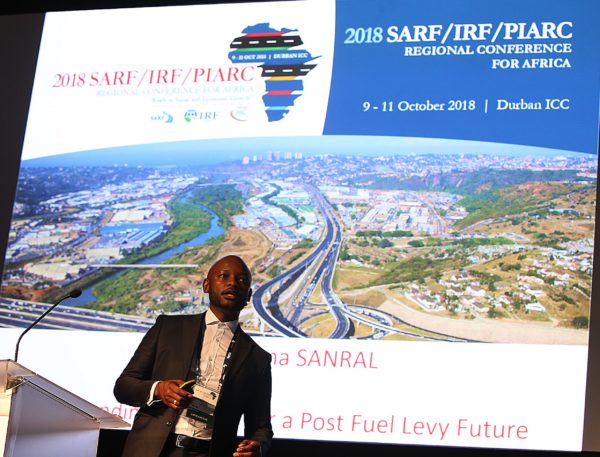
Krishna Naidoo, a Material and Pavement Specialist at the South African National Roads Agency (SOC) Limited (SANRAL) Eastern Region, said the roads agency was working towards ensuring that its stand-alone asphalt supply plants produced only warm mix asphalt (WMA). 

“In this way SANRAL will be leading the charge in worker safety as well as reducing its carbon foot-print in providing sustainable infrastructure. We are indeed more than roads,” Naidoo said. 

He was addressing delegates attending the conference themed, “Roads to Social and Economic Growth”, arranged by the South African Road Federation (SARF) in association with the Washington-based International Road Federation (IRF) and the Paris-based World Roads Association (PIARC). 

Less environmental impact 

Warm mix asphalt is produced using temperatures up to 50 degrees Celsius lower than used for traditional hot mix asphalt. Less energy is needed to heat the warm mix asphalt; thus, it uses less fuel, decreasing the carbon footprint. 

It is a greener process that has less impact on the environment, with reduced hydrocarbon emissions and greenhouse gases. Due to its lower temperature, it is also safer for construction workers to use. 

WMA’s journey in South Africa started about a decade ago with the formation of the country’s Warm Mix Asphalt Interest Group, led by Naidoo being elected the national coordinator. 

The WMA Interest Group led three major national trials that culminated in the publication of the South African Bitumen Association (Sabita) Best Practice guidelines and specifications for warm asphalt. 

“Through the process of these trials, the asphalt industry renewed its commitment to excellence, quality and efficiency. 

“But more importantly, it was the most tangible step by the entire asphalt industry, including clients, contractors and manufacturers, towards improving worker safety as well as reducing environmental impact,” said Naidoo. 

Hot versus warm mix 

Naidoo said: “When compared to hot mix asphalt, warm mix asphalt cools at a lower rate, so the paving season is extended, allowing road repairs and construction to finish more quickly. 

“This benefit helps save time and money on labour and equipment, as workers and tools are needed for a smaller span of time and projects can be finished more quickly. It also lessens the impact on traffic as projects finish faster and there are less interruptions to roadways.”   

The benefits of WMA, Naidoo said, were now being realised by more client’s country-wide and have also been included in the draft revision of COTO – Standard Specifications for Road and Bridge Works. 

“To date South Africa has successfully produced and paved over a million tons of WMA. 

“The latest success story has been the 370km haul of asphalt to a SANRAL job in Harrismith,” said Naidoo. 

He added that with the impending implementation of the Carbon Tax Bill, WMA will help contribute to offset the tax.

Rumble strips keep drivers on the right track and save lives

The strips, which replace traditionally smooth painted road markings, cause a tactile vibration and audible rumbling. 

International studies have shown that run-off-road (ROR) crashes can account for a large majority of the fatal single-vehicle crashes. 

There is nothing like a sudden rumble to alert inattentive drivers of potential danger when they drift from their lane. 

Hence the South African National Roads Agency (SOC) Limited (SANRAL) has authorised rumble strips – also known as sleeper lines, alert strips and wake-up calls – to be painted on the shoulder lines and between undivided dual carriageways of the N2 and N3 around Durban. 

Vibration and audible rumblings 

The rumble strips, which replace traditionally smooth painted road markings, cause a tactile vibration and audible rumbling to be transmitted through the wheels into the vehicle interior. 

The rumble strips are little balls of plastic paint dropped onto the road surface, which create a whining or humming noise when traversed by a vehicle tyre. 

International studies have shown that run-off-road (ROR) crashes can account for a large majority of the fatal single-vehicle crashes. 

ROR crashes are due to inattention, speeding, traction loss, over-reaction, crash avoidance and mechanical failure. Rumble strips only prevent ROR crashes due to inattention. 

New Zealand began using rumble strips since the late 1980s and has reported a reduction in ROR crashes by up to 80%. 

Hugh Brooks, SANRAL Eastern Region project manager, said rumble strips were used where there were very high volumes of traffic and where driver concentration was crucial. 

“Centreline rumble strips are used on undivided highways to reduce cross-over incidents and the resultant head-on collisions. 

“Shoulder rumble strips are used primarily to reduce run-off-road collisions. They alert distracted or drowsy drivers that they are leaving the roadway or crossing the centreline of the road,” he said. 

Joos Joubert of Lanino Traffic Markings, which has applied the rumble strips, said the innovative warning system was developed in Norway. 

Rumble drop markings 

He said the textured marking called Rumble Drop Markings (RDM) cause a noise when you drive over it and can be seen in the rain at night. 

Joubert said: “RDM consist of 25 to 50mm thermo-plastic drops that are 3mm high. Normal road markings provide only day-time visibility. If there are no street lights, the road markings are almost invisible. 

“On national and provincial roads, glass beads are applied on top of the wet paint and provide night time visibility. This effect is accomplished by the refractive index of the beads sending light rays back to the light source. 

“These road markings provide very good visibility during day time and night time, but as soon as any rain falls on the road markings the water covers the beads and the markings will not be visible at night.” 

With RDM the water drains instantly off the road markings and protruding beads, providing visibility at night and in wet conditions. 

He said there had been no complaints about the rumble strips – only compliments.

SANRAL-Wirtgen MoU levels the playing field for smaller contractors

Memorandum of Understanding will afford small to medium construction contractors’ full access to the Wirtgen Group’s full suite of leading equipment brands, as well as financing, training and logistics.    

From left to right: Wirtgen sales manager Waylon Kukard, SANRAL Transformation Manager Ismail Essa, Wirtgen South Africa MD Henrich Schulenburg, SANRAL Engineering Executive Louw Kannemeyer, SANRAL Northern region Planning Design and Construction Manager Willem van der Merwe; SANRAL CFO Inge Mulder, SANRAL Head of Strategy Thabiso Malahleha, Wirtgen KZN branch manager Anwar Hoosen.

The South African National Roads Agency (SOC) Limited (SANRAL) and Wirtgen Group South Africa have signed a Memorandum of Understanding that will give small enterprises better access to the road construction machinery they need to execute major SANRAL-owned projects. 

The agreement will afford small to medium construction contractors’ full access to the Wirtgen Group’s full suite of leading equipment brands, as well as financing, training and logistics.    

“This is an important step in the broader national aim to transform the construction and engineering sectors and enable emerging black contractors, including enterprises owned by women and the youth, to participate more fully in major projects,” said Louw Kannemeyer, Engineering Executive at SANRAL. 

“Infrastructure development will be a major contributor to the efforts to attract investment to the country and was singled out at the recent Job Summit for its ability to create employment and stimulate economic activity. 

“We are delighted that a global leader in construction such as Wirtgen is stepping up to fill major gaps in the industry that constrain the growth of smaller contractors and impose barriers on their ability to tender for major work packages,” said Kannemeyer. 

Waylon Kukard, National Sales Manager at Wirtgen South Africa, said: “Equipment is one of the major success factors for contractors in the execution of their projects. If contractors are not well equipped, the country also faces the danger of sub-standard road infrastructure.  

“The agreement will afford upcoming contractors’ greater access to all Wirtgen Group equipment brands, namely Wirtgen, Vögele, Hamm, Kleemann, Benninghoven and Ciber.” 

Changing the landscape 

The agreement with Wirtgen is part of a process introduced by SANRAL to open the engineering and construction industries through its tender and enterprise development initiatives. It will greatly benefit smaller contractors who will now have access to the company’s range of equipment. 

Through its leading brands, Wirtgen offers a wide range of equipment, all the way from rollers, bitumen spreaders, sweepers, milling machines, recyclers, slipform pavers, modular asphalt pavers, to mobile asphalt plants and crushers and screens. 

Emerging contractors will be able to purchase or lease the sophisticated machinery required to meet the high standards that are in place within the South African road construction environment. 

This move will open new doors for Wirtgen to collaborate with small contractors by offering them access to finance, technical assistance, mentoring and logistical support. SANRAL and Wirtgen will also collaborate on issues such as training, supply chains and access to information about tendering processes. 

“We are confident that this MoU will increase the number of participants across the value chain of the road construction sector and contribute to fair competition,” said Kannemeyer.

Creating access through access roads

SANRAL opens doors into the construction industry through road projects. 

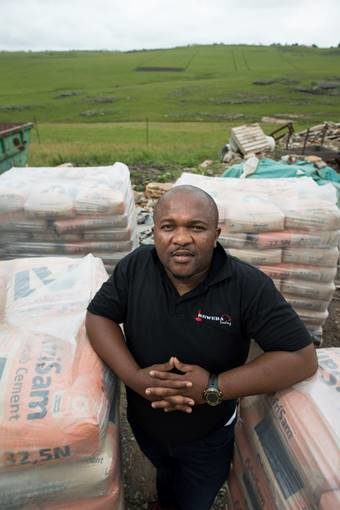
Mncedisi Twantwa said Aveng, the company that sub-contracted Krweba Trading, have been very helpful with regards to providing his company with assistance and advice on the project. 

Mncedisi Twantwa is not only happy that his company is responsible for building a slip road in Msikaba, but also that through the project he has been able to create 32 much-needed jobs. 

In terms of experience, yes, I can say we benefited as a company as this was my second time building a slip road, and yes I’m happy with the outcomes and hopefully we’ll get more work from SANRAL.” said Twantwa, owner of Krweba Trading, an SMME contracted to do work on the Msikaba South haul road project near Lusikisiki in the Eastern Cape. 

Twantwa said before working on this project his company built access roads. 

“This is the second slip road that I’ve done, and it is quite a challenge because there aren’t many concrete roads in this area,” he said. 

SMME inclusion 

Twantwa said Aveng, the company that sub-contracted Krweba Trading, have been very helpful with regards to providing his company with assistance and advice on the project. 

“They have assisted us on how to put together the steel fixing and we’ve done a lot more concrete work,” he said. 

“I’ve learnt to build a slip road. They also taught us how to do the side drains,” he said. 

He is also proud to be able to help create employment opportunities in this part of the country where unemployment is high. 

“I have about 32 people working for me and they come from different areas,” he said, adding that he initially had just 12 employees. 

Working on the project has added invaluable experience to his company that he hopes it will stand it in good stead going forward. 

He said getting more work from SANRAL would also ensure more people remain employed, benefiting the local economy and community at large.

Creating jobs through road construction

SMMEs benefit from the construction of haul and access roads. 

Emmanuel Sisanda’s company, First Building Construction, has helped to create much-needed jobs in the Msikaba area where they are contracted to help build a haul road for the construction of the N2 highway.

The Msikaba North haul road is nearing completion after early delays necessitated by relocation of families and graves. 

Irvin Khoza, assistant resident engineer on the project, said the road is being built to help transport material for the building of the N2 Msikaba bridge. 

The estimated value for the project is R29-million, 30% of which has been allocated to SMMEs. There are no joint ventures appointed on the project, which started in October 2016. 

“This is the first phase of the project. The second phase will be the actual N2 that will run next to the haul road,” says Khoza. 

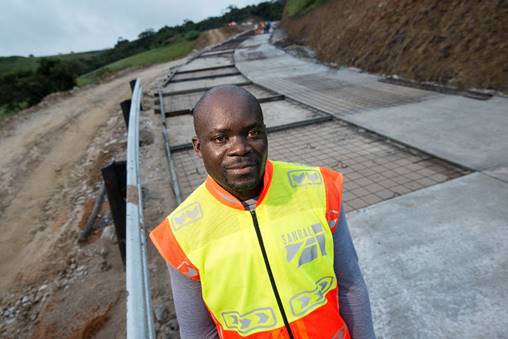
The road features a 140mm deep concrete pavement. 

Khoza said: “With this concrete pavement you’ve got different panels. You have what we call anchor panels. With these panels, instead of having your normal C4, you’d have that as a trench that’s been opened so the concrete can go deeper. This is so it can be that anchor for the road so, that it can hold on to the other to bond with the road itself. 

“Underneath you’ve got mesh steel reinforcement. We’ve also installed guardrails for safety purposes.” 

The first phase was completed at the end of March 2018. 

Khoza said they have managed to work hand in hand with the local SMMEs and offer them guidance on how to help their businesses to succeed. 

SMMEs grow 

Emmanuel Sisanda’s company, First Building Construction, has helped to create much-needed jobs in the Msikaba area where they are contracted to help build a haul road for the construction of the N2 highway. 

Before being contracted on the project, Sisanda worked in the construction sector, building schools and other public amenities. 

He was sub-contracted on the Msikaba North haul road project by Grinaker. The company’s responsibility includes building a concrete pavement and steel fixing. They also supply the concrete used on the project. 

“On this project I have 17 labourers drawn from the local community,” said Sisanda. 

“There is a lot that we are looking forward to. We have always wanted to be a growing company. Working for SANRAL is a good opportunity for getting exposure and people will know about us through the work we do here. 

“We would like to say thank you to SANRAL for what they are doing for us because even as individuals we are benefitting from this project. The community is also benefitting from this so, thank you SANRAL,” he said.

SANRAL’s many roads to transformation

Agency is contributing towards creating a safe road transport network, while extending opportunities for black-owned enterprises to participate in construction projects.  

The new policy sets clearly-defined targets for the participation of black contractors, suppliers and professionals in all projects and procurement commissioned by SANRAL. 

The South African National Roads Agency (SOC) Limited (SANRAL) is changing what so far has been a given – the construction industry is dominated by big corporations with little participation by black-owned companies. 

Many local emerging black-owned businesses do not possess the resources and skills to take on major road construction projects.  

Lack of capital and adequate financial support, as well as access to other resources, such as construction equipment, has them at a disadvantage when tendering for projects. 

A big step was taken in 2017 when SANRAL launched a new strategy – Horizon 2030 – and a draft transformation policy which seeks to increase the participation of black-owned contractors in the construction and related industries. 

The new policy sets clearly-defined targets for the participation of black contractors, suppliers and professionals in all projects and procurement commissioned by SANRAL. 

According to SANRAL transformation manager, Ismail Essa, the transformation policy will soon require contractors wishing to secure tenders from SANRAL to have a minimum of 51% black ownership. 

SMMEs speak 

While welcoming the progress, some SMMEs have expressed their wish that the pace was even faster and the net cast wider. 

Tshireletso Shebi from Dipako Construction is one of the SMMEs subcontracted by Edwin Construction (Pty) Ltd to work on the rehabilitation of the R34 road, a SANRAL project in Schweizer Reneke in the North West province. 

Although he is grateful for the opportunity to work on the project, Shebi believes SANRAL can do more to assist in the development and participation of black-owned companies in projects. 

“We are thankful to SANRAL for the opportunity and for its efforts to transform the industry, but we feel the approach does not go far enough,” said Shebi. 

He feels small contractors are not being exposed to mainstream construction, but they are rather given a small taste of what it takes to build roads. 

Shebi said: “If you give a company 30%, it should be 30% of everything. They should be able to do all the work from earthworks and excavation to construction of road-bed and road surfacing.  

“In this way they can learn the difficulties that comes with building a road, let alone price it. The roads agency should at least allocate a section of the project or some kilometres to participating SMMEs with the main contractor to oversee the work.” 

Shebi believes small contractors should be taught to stand on their own and be encouraged to take on major challenges, rather than settling for drain works or standard routine road maintenance (RRM). 

“Achieving transformation will remain a big challenge if companies are not taught to stand on their own. They should not cut corners, but with proper training and grading they can manage,” he said. 

Capacity building 

According to SANRAL’s Vusi Mona, general manager: communications, the biggest challenge is the issue of capacity. 

“SANRAL’s mandate is to deliver quality roads to meet global standards. Small companies do not have the capacity to deliver the complete package. When we issue tenders, they do not bid for the work or meet the set requirements,” Mona said. 

But, the agency has recognised it must go even further and introduced a joint venture condition that requires big companies to partner with small companies when bidding for projects. 

Mona explained: “Due to the complexity of SANRAL projects, new entrants into SANRAL work require a longer and more intense incubation period. Meaningful joint ventures will go a long way to prepare the new companies to become efficient service providers to the agency. 

“This will help accelerate their growth and improve their grading at the Construction Industry Development Board (CIDB). This also applies to consulting engineers who wish to work for SANRAL.” 

The joint venture condition was first introduced with the awarding of two contracts for the rehabilitation of sections of the R573 Moloto Road, one of South Africa’s busiest routes linking Gauteng, Mpumalanga and Limpopo. 

SANRAL has also signed agreements with two private companies to make the leasing of heavy road construction machinery easier for SMMEs. 

Mona said the agency is strongly committed to providing support to black business development through structured development programmes and partnerships with industry players to ensure meaningful and rapid development and growth of black entities. 

“There is no magic bullet to resolving the issue and fast-tracking transformation. And, remember, we do not intend turning the industry black. The agency has set a new vision for 2030 that will require inclusive participation by all stakeholders to succeed. SANRAL will continue to create opportunities for all to co-exist and get a fair slice of the pie,” he said. 

South Africa must be decisive about how to fund its roads

Skhumbuzo Macozoma, SANRAL CEO, said more suitable funding methods must be found if the road agency was to make roads more efficient at a minimal cost. 

Skhumbuzo Macozoma said questions must be asked about the most suitable funding model for roads infrastructure.

Although South Africa has the 10th largest road network in the world, its need and efficient usage must be interrogated, said Skhumbuzo Macozoma, CEO of the South African National Roads Agency (SOC) Limited (SANRAL). 

He said with the political changes since democracy, employees were living closer to their workplaces. 

“In a modern world of efficient mobility, how much of the South African road network is really needed and useful?” he asked. 

Macozoma was addressing a conference themed “Roads to Social and Economic Growth”, arranged by the South African Road Federation (SARF) in association with the Washington-based International Road Federation (IRF) and the Paris-based World Roads Association (PIARC), in Durban. 

Speaking during a breakaway session on Road Financing, Macozoma said South Africa has a total road network of 750 000km (158?124km paved and 591?876km gravel). Of this SANRAL is responsible for 22?214km of the road system. 

Efficiency and minimal costs 

He said consumers and road users today demand rapid mobility with efficiencies and minimal costs. 

Mixed use commercial and residential developments were giving rise to shorter travel distances, thus raising questions around those roads that previously linked cities to workers in far-flung areas. 

Macozoma said questions must be asked about the most suitable funding model for roads infrastructure. 

He said the fuel levy provided insufficient funding. 

Macozoma said: “The future contribution of the fuel levy to the Central Revenue Fund is uncertain with the projected electric car take-off in 2022 and established vehicle efficiency technologies. 

“In less than five years, electric cars will cost the same as their internal combustion counterparts and that’s the point of lift-off for sales. 

“The total estimated funding requirements to sustain the South African road network, including addressing backlogs in surfacing and capacity expansion is R116.1-billion. The current allocation for the road network is R52-billion. What can we afford and how do we prioritise?” 

He proposed that a funding policy for transport infrastructure and road infrastructure must be driven by National Treasury working with sector departments. 

He said: “Funding strategies must be deliberate and agreed. A suite of funding models is available. South Africa must be decisive about how to fund its roads. 

“The needs, priorities, engineering principles and spending efficiencies must inform future spending allocations.” 

Macozoma said economic and social economic infrastructure differentiation was imperative in determining future funding models. 

“Road users must be directly responsible for economic infrastructure, such as roads. The Government must provide for social infrastructure such as housing, schools and hospitals. 

“Future tax or pricing mechanisms are required for road users. Equity and direct user charging must be embedded in such future funding sources,” Macozoma said.

N2 KwaZulu-Natal North Coast upgrade well on track

The R946-million project is one of the biggest road infrastructure developments being undertaken by SANRAL in KZN and is aimed at coping with the increased traffic volumes on one of the country’s key arterial roads. 

Since the start of the contract 37 subcontractors have been employed by the main contractor, Concor Infrastructure, of which 23 have been SMMES that have been paid R76-million.

The upgrading of 35km of the N2 between Mtunzini toll plaza and Empangeni interchange on the KwaZulu-Natal North Coast, which commenced three years ago, is well on track for its anticipated completion at the end of June 2019. 

The South African National Roads Agency (SOC) Limited (SANRAL) is constructing a new north-bound carriageway with the existing road to become the future south-bound carriageway. 

Corné Roux, Project Manager at SANRAL Eastern Region, said that within weeks the north-bound traffic will be diverted onto the newly-constructed carriageway just after the Mtunzini toll plaza and redirected back to the existing carriageway just before the eSikhawini interchange. 

He said this will allow the start of the repair of the existing road – the future south-bound carriageway – adjacent to the newly-constructed section. 

Roux said: “Work is progressing well despite the challenges posed by the 60-metre deep piles and difficult piling conditions at the Mhlathuze and Umlalazi river bridges, as well as the high rainfall experienced in this part of Zululand.” 

Since the start of the contract 37 subcontractors have been employed by the main contractor, Concor Infrastructure, of which 23 have been SMMES that have been paid R76-million.  

A maximum of 541 labourers have been employed at any one time, with 428 coming from within the local municipal target areas. 

The project 

The engineers on the project, UWP Consulting, have indicated that the structures are largely complete, with only the deck of the Empangeni road-over-rail bridge still to be cast.  

The bulk earthworks and layers have progressed according to plan and outstanding work is concentrated around the Empangeni interchange. 

The R946-million project is one of the biggest road infrastructure developments being undertaken by SANRAL in KwaZulu-Natal and is aimed at coping with the increased traffic volumes on one of the country’s key arterial roads. 

Roux said current traffic volumes on the N2 south of Empangeni exceeded 12 000 vehicles per day, with the highest traffic volumes occurring on the section between the eSikhawini and Empangeni interchanges.  

When the project is complete, four agricultural overpasses over the N2 will have been lengthened; new bridges will have been built at the R34 Empangeni/Richards Bay interchange and at the P537 Port Dunford underpass; two road-over-rail bridges constructed; and 16 major box culverts and numerous minor box culverts and other drainage structures built. In addition, the height of two overpasses would have been increased by jacking up the bridges. 

This stretch of the N2 is on a declared toll road and, therefore, the income generated from the toll plazas on the N2 North will be utilised for funding this project.