
Blog

Construction work halted to ensure trouble-free travel in the holidays

Peak traffic on the country’s national roads might occur earlier than normal because of the days on which December and January public holidays fall.  

Peak traffic on the country’s national roads may occur earlier than usual because of the days on which December and January public holidays fall. 

There will be no road construction works during the coming festive season, ensuring free traffic flow.  

Peak traffic on the country’s national roads may occur earlier than usual because of the days on which December and January public holidays fall.  

In addition, all public schools close on December 12, a Wednesday, and open on a Tuesday, a week after January 1. 

Traffic will begin to pick up in the week of school closures and traffic volumes will become heavy from Friday, 14 December – the beginning of a long weekend as Monday is a public holiday with December 16 falling on a Sunday. It is also when the building industry closes. 

As Christmas falls on a Tuesday, it can be expected that traffic will start peaking on the Friday before (December 21). 

The end of the holiday period is also somewhat different: New Year’s Day is on a Tuesday, as is the day public schools re-open on January 8. This may mean peak traffic on the Mondays before. 

Construction work halted 

Vusi Mona, general manager: communications at the South African National Roads Agency (SOC) Limited (SANRAL), said road construction work has been halted across the 22 214 km of freeways to improve safety and promote trouble-free journeys for people who will travel to holiday destinations. 

The network stretches from the Beit Bridge Border Post in the north to the Cape Peninsula, and from Alexander Bay in the West to the coastlines of Mozambique, KwaZulu-Natal and the Eastern Cape. 

Mona said an analysis of road volume statistics in previous years shows that high volumes of traffic should be expected on the national and provincial freeway system during specific days in December.  

All three public holidays – the Day of Reconciliation, Christmas and New Year – are celebrated on, or close to weekends and this will result in higher volumes in the preceding days as people travel to destinations in time for celebrations. 

The national road network is, however, in good-to-excellent shape and able to handle increases in traffic and even extremely high volumes at certain times.  

The quality of the roads and collaboration between SANRAL, law enforcement agencies, provincial traffic authorities and emergency services will, no doubt, contribute to safer journeys. 

Tools for travel 

Motorists can use a variety of SANRAL tools to help plan their travel better. They can visit the SANRAL website, www.nra.co.za for help in organising their journeys.  

SANRAL has made available a series of videos to help motorists with their journeys – what route to use, what to expect on the road, the estimated expenditure for tolls and rest spots on the route. 

Motorists can also download the SANRAL App for the convenience of topping up their e-tag accounts from the comfort of their cars. 

“The app can be downloaded for free on all Android and iOS devices also offers users information about road conditions, traffic congestion and incidents on the road and enables motorists to plan their journeys in advance,” explained Mona. 

Road incidents can be reported to the National Traffic Control Centre on 012 665 6075 or South African Police Service on 10111. 

  • The busiest toll plazas will be Carousel, Pumulani and Kranskop on the N1 north, Middleburg on the N4, Marian Hill and Mooiriver on the N3 and Tongaat on the N2. 
  • The busiest routes will be the N1 to Beitbridge, N3 to Durban, N4 to Maputo and N2 North Coast.
N7 in good shape for festive traffic

SANRAL urges travellers to be respectful towards fellow road users.

The N7 is a dual carriageway between Cape Town and Philadelphia, and a single carriageway through the remainder of the province and the Northern Cape. 

The extensive upgrades of the N7 between Cape Town and the Namibian border will mean travellers can expect a pleasant journey during the festive season. 

There will be no stop/go sections.  

Vusi Mona, SANRAL’s communications manager, said: “Our engineers have rated the route’s expected condition as fair-to-good, barring any unforeseen major traffic incidents or weather conditions.” 

The N7 is a dual carriageway between Cape Town and Philadelphia, and a single carriageway through the remainder of the province and the Northern Cape. 

Motorists are asked to drive cautiously, especially where there are housing settlements next to the road. 

SANRAL also calls on road users to follow important safety tips when they take to the country’s roads during the festive season.  

“The main message is to remember that a road is a shared space and that you should be respectful towards your fellow road users,” said Mona. 

Speed limits are clearly indicated on the 22 214km of roads managed by SANRAL in all nine provinces. These are maximum limits and drivers should adjust their speed according to conditions such as rain or visibility. Road users are encouraged to take a break during long distance journeys to prevent fatigue and lack of concentration. 

Peak traffic on the country’s national roads may occur earlier than usual because of the days on which December and January public holidays fall.  

In addition, all public schools close on December 12, a Wednesday, and open on a Tuesday, a week after January 1. 

Traffic will begin to pick up in the week of school closures and traffic volumes will become heavy from Friday, 14 December – the beginning of a long weekend as Monday is a public holiday with December 16 falling on a Sunday. It is also when the building industry closes. 

As Christmas falls on a Tuesday, it can be expected that traffic will start peaking on the Friday before (December 21). 

The end of the holiday period is also somewhat different: New Year’s Day is on a Tuesday, as is the day public schools re-open on January 8. This may mean peak traffic on the Mondays before. 

Travel help tools 

Motorists can use a variety of SANRAL tools to help plan their travel better. They can visit the SANRAL website, www.nra.co.za for help in organising their journeys.  

SANRAL has made available a series of videos to help motorists with their journeys – what route to use, what to expect on the road, the estimated expenditure for tolls and rest spots on the route. 

Motorists can also download the SANRAL App for the convenience of topping up their e-tag accounts from the comfort of their cars. 

“The app can be downloaded for free on all Android and iOS devices and also offers users information about road conditions, traffic congestion and incidents on the road enabling motorists to plan their journeys in advance,” explained Mona. 

Incidents should be reported to either the South African Police Services (10111) or the National Traffic Call Centre (NTCC) on 012 665 6075. 


Coastal road in great shape to handle festive season traffic

Road users urged to take a break during long distances to avoid the dangers fatigue brings.

Peak traffic on the country’s national roads may occur earlier than usual because of the days on which December and January public holidays fall. 

The N2, which connects Cape Town with the KwaZulu-Natal North Coast along the eastern seaboard, is in great shape to handle higher traffic volumes during the coming festive season. 

Vusi Mona, SANRAL communications manager, said road users will be able to travel the entire distance without encountering road works or having to wait for construction activities. 

“As a result, our engineers have rated the condition of the stretch between Cape Town and Durban as fair-to-good barring any unforeseen major traffic incidents or weather conditions,” said Mona. 

Take a break 

Road users are encouraged to take a break during long distance journeys to prevent fatigue and lack of concentration. 

Mona said: “Fatigue is one of the major causes of road crashes, especially when travelling over long distances – road users should #KnowYourWhoa #TakeABreakStayAwake. 

“Road user behaviour contributes a lot to road crashes and we appeal to motorists to respect the rules of the road and to also ensure their vehicles are roadworthy.” 

Peak traffic on the country’s national roads may occur earlier than usual because of the days on which December and January public holidays fall.  

In addition, all public schools close on December 12, a Wednesday, and open on a Tuesday, a week after January 1. 

Traffic will begin to pick up in the week of school closures and traffic volumes will become heavy from Friday, 14 December – the beginning of a long weekend as Monday is a public holiday with December 16 falling on a Sunday. It is also when the building industry closes. 

As Christmas falls on a Tuesday, it can be expected that traffic will start peaking on the Friday before (December 21). 

The end of the holiday period is also somewhat different: New Year’s Day is on a Tuesday, as is the day public schools re-open on January 8. This may mean peak traffic on the Mondays before. 

Motorists can visit the SANRAL website, www.nra.co.za for help in planning their journeys.  

SANRAL has made available a series of videos to help motorists plan their journeys – what route to use, what to expect on the road, the estimated expenditure for tolls and rest spots on the route. 

Motorists can also download the SANRAL App for the convenience of topping up their e-tag accounts from the comfort of their cars. 

“The app can be downloaded for free on all Android and iOS devices and also offers users information about road conditions, traffic congestion and incidents on the road enabling motorists to plan their journeys in advance,” explained Mona. 

Incidents should be reported to either the South African Police Services (10111) or the National Traffic Call Centre (NTCC) on 012 665 6075.

Trouble-free holiday journeys expected on N3 from Gauteng to the coast

Travellers will not experience delays due to road works during the December holidays. 

The N3 freeway between Gauteng and the KwaZulu-Natal coastal resorts is in good condition and travellers will not experience any delays caused by road works during the coming festive season.

Peak traffic on the country’s national roads might occur somewhat earlier than normal because of the days on which December and January public holidays fall this holiday season.  

All public schools close on December 12, a Wednesday, and open on a Tuesday, a week after January 1. 

Traffic will begin to pick up in the week of school closures and traffic volumes will become heavy from Friday, 14 December, the beginning of a long weekend as Monday is a public holiday with December 16 falling on a Sunday. It is also  when the building industry closes. 

As Christmas falls on a Tuesday, it can be expected that traffic will start peaking on the previous Friday, on December 21. 

The end of the holiday period is also somewhat different. New Year’s Day is on a Tuesday and so is the day public schools re-open on January 8. This may mean peak traffic on the Mondays before. 

No delays 

The N3 freeway between Gauteng and the KwaZulu-Natal coastal resorts is in good condition and travellers will not experience any delays caused by road works during the coming festive season. 

Vusi Mona, general manager: communications of the South African National Roads Agency (SOC) Limited, said road conditions are good and holiday makers can expect trouble-free journeys throughout the route barring unforeseen traffic incidents or adverse weather conditions. 

Mona also calls on road users to keep road safety in mind when they take to the country’s roads during the festive season.  

“The main message is to remember that a road is a shared space and that you should be respectful towards your fellow road users.” 

Speed limits are clearly indicated on the 22 214 km of roads managed by SANRAL in all nine provinces.  

Mona said: “These are maximum limits and drivers should adjust their speed according to conditions such as rain or visibility. 

“Speeding and driving under the influence of alcohol are some of the major causes of road crashes – road users should heed the call to #DontDrinkDrive & #KnowYourWhoa. 

“Road user behaviour contributes a lot to road crashes and we appeal to motorists to respect the rules of the road and to also ensure their vehicles are roadworthy.” 

Helpful tools 

Motorists can use a variety of SANRAL tools to help plan their travel better. They can visit the SANRAL website, www.nra.co.za for help in planning their journeys.  

SANRAL has made available a series of videos to help motorists plan their journeys, from what route to use, what to expect on the road, the estimated expenditure for tolls and rest spots on the route. 

Motorists can also download the SANRAL App for the convenience of topping up their e-tag accounts from the comfort of their cars. 

“The app can be downloaded for free on all Android and iOS devices, and also offers users information about road conditions, traffic congestion and incidents on the road and enables motorists to plan their journeys in advance,” explained Mona. 

Incidents should be reported to the South African Police Services (10111), the National Traffic Call Centre (NTCC) on 012 665 6075   or to the N3 route patrol customer care line on 0800 203 950.

Survey contradicts perceptions on e-tolls

More than half of respondents would be happy to pay for e-tolls in Gauteng, according to poll results.

The bi-annual survey is done in partnership between the Gauteng provincial government and the Universities of Johannesburg and the Witwatersrand.


The growth in the number of Gauteng residents who are willing to pay for e-tolls shows that this remains a viable option to fund road infrastructure in South Africa’s economic heartland. 

Vusi Mona, general manager: communications of the South African National Roads Agency (SOC) Limited (SANRAL), said the findings of the Quality of Life Survey 2017/18 released by the Gauteng City-Region Observatory (GCRO) show that more than half of the respondents would be willing to pay for e-tolls. 

This is 10% higher than the comparative figures in the survey conducted in 2016. 

Mona said: “The survey results clearly contradict the perceptions created by special interest groups that there is overwhelming resistance against e-tolls in Gauteng or that it in an issue which is uppermost in the minds of residents. 

“The findings will, no doubt, contribute to a more nuanced and constructive debate about the value that road infrastructure brings to a region’s economy and on the range of funding options that are available.” 

Some 25000 respondents polled 

The bi-annual survey is done in partnership between the Gauteng provincial government and the Universities of Johannesburg and the Witwatersrand.  

It polled the opinions of some 25 000 respondents across every municipal ward in the province. 

On e-tolls the respondents were asked the question whether they agree with the statement: “I will never pay my e-tolls.”  

Some 51% of the participants either “disagreed” or “strongly disagreed” with this statement. This is a discernible growth from the 40% who agreed when the question was asked in 2016. 

Strong opposition to e-tolls also declined from 12% to 9% in the corresponding period. 

Christina Culwick, the senior researcher at the Gauteng City Region Observatory, said that 43% of respondents in the lowest income brackets indicated that e-tolls are not an issue for them because they do not use the freeways.  

“This suggests that e-tolls are a relatively progressive payment option for the freeway upgrades.” 

Mona said this finding confirms the wisdom of government’s decision to make e-tolls more affordable for Gauteng residents by lowering the tariffs and exempting registered public transport, taxis and buses from paying. 

The survey also shows that issues related to spatial inequalities – unemployment, crime and access to opportunities – are uppermost in the minds of Gauteng residents.  

The availability of a well-funded and well-maintained road infrastructure can contribute to solutions for these pressing problems. 

“Government is busy with a comprehensive review of its policy on road infrastructure funding and the use of tolling as an option,” said Mona.  

“The GCRO survey results will, no doubt, add to the quality of information that is available to government and result in decisions that will balance the need for well-funded roads with the capacity of users to pay.”

From a wheelbarrow to a wheelchair

SANRAL’s Wellness Programme makes a dream come true for 78-year-old Eastern Cape grandmother. 

SANRAL launched its Wellness Programme in 2011 and rolled the programme out to different parts of the country. In 2016, the programme was introduced into the Eastern Cape. 

Receiving a wheelchair was a life-changing experience for Ntakimba Mamkone, an elderly woman who, for years, had endured being pushed in a wheelbarrow for over 12-kilometres to and from a local clinic in Cwele, a village nearby Mthatha in the Eastern Cape Province.

Her dream of owning a wheelchair turned into reality after her plight was identified through a SANRAL wellness programme.  

Nombuso Feke, a wellness programme participant and female-owned Small Medium and Micro Enterprise (SMME) working on the South African National Roads Agency (SOC) Limited’s (SANRAL’s) R61 Routine Maintenance project, took it upon herself to assist and donated the wheelchair.

“In 2014, my mother had her leg amputated due to diabetes. This awakened me to the hardships people in her community face and I always wished I could do more to assist, especially when it came to Mamkone,” said Feke. 

Bringing healthcare closer to workers

SANRAL launched its Wellness Programme in 2011 and rolled the programme out to different parts of the country. In 2016, the programme was introduced into the Eastern Cape.

The purpose of the programme is to bring healthcare closer to workers and their families, to promote a healthy lifestyle and improve the wellbeing SANRAL’s Routine Road Maintenance (RRM) project teams.

Xoliswa Chubana, SANRAL Southern Region’s Community Development Specialist, said: “The programme does not only concentrate on HIV/AIDS awareness, but also on the holistic wellbeing of all employees working on RRM contracts. The Wellness Champion creates awareness around certain symptoms and prevention of communicable and non-communicable diseases. HIV Counselling & Testing (HCT) and health screenings are conducted bi-annually on site.” 

There are 18 Wellness Champions throughout all SANRAL’s RRM sites in the Southern Region.

“The Wellness Champions on all projects are encouraged to carry out outreach programmes on their sites. The R61 Mthatha to Port St Johns was one of them driven by Buli Dlutu,” Chubana said. 

Ma Mamkone is 78-years-old, lives with a physical disability and has 12 grandchildren. One of her granddaughters dropped out of school to take care of her. She would transport Ma Mamkone on a wheelbarrow to and from the clinic for her appointments.

Feke said; “After SANRAL appointed me as an SMME on the R61 Section 8, not only was I able to support my own family but Ma Mamkone, whose situation I was able to relate closely to because of the personal struggle and suffering of my mother’s experience”.  

Feke is glad to have helped her community and is looking forward to helping more families.

Chubana said: “SANRAL and SMMEs are working together to ensure better lives for each one in South Africa through the continuation of promoting and creating awareness about healthcare to the workers and their families. Family members also participate in the programme.  

“The Wellness programme also provides family visits by the Wellness Champions and talks are given about the current wellness topic of the month. During HIV counselling and testing the workers are allowed the opportunity to bring up to five of their families.”

Minister officially opens iconic Mt Edgecombe Interchange

This upgrade has forever changed the landscape, and will no doubt become a recognizable landmark. 

Overhead view of the completed Mt Edgecombe Interchange.

Five years after the first pile was driven into the ground for major upgrading, the iconic Mount Edgecombe Interchange was officially opened by Minister of Transport Blade Nzimande, a fitting end to the 2018 October Transport Month. 

He described the interchange as “a veritable civil engineering work of art” and said it was a fine example of infrastructure development that has multifarious spin-offs: it contributes greatly to easing traffic congestion, promotes road safety and is also a significant business enabler. 

“Today’s ceremony comes between the stimulating announcement last Friday of the promised inflow of investments totalling R290-billion that will jump-start the economy, and the drawing to a close of October Transport Month 2018, which has showcased the country’s transport infrastructure development and services,” he said. 

The South African National Roads Agency (SOC) Limited (SANRAL) awarded the contract for upgrading of the intersection of the N2 and M41 to ease chronic congestion. 

SANRAL CEO Skhumbuzo Macozoma said the R1,1-billion interchange, which is one of the largest projects undertaken by SANRAL in KwaZulu-Natal, is more than a masterpiece of award-winning architecture – it is a vital artery of the greater eThekwini metropolitan highway system and has greatly contributed to SMME development. 

He said: “Due to the expansion of the uMhlanga and La Lucia Ridge areas, the existing interchange had been operating at capacity with vehicles backing up on the M41 and onto the N2 in peak hours. 

“An additional 40 000 vehicles were entering or leaving the N2 from the M41 daily resulting in substantial queuing of vehicles during the day.  

“This, together with expected future expansions and development of the Cornubia area, required the existing interchange to be upgraded in order to improve the flow to and from the N2 and M41 to the supporting road network.” 

A changed landscape 

This upgrade has forever changed the landscape, and will no doubt become a recognisable landmark. 

The new four-level interchange facility provides at least two lanes on each of the major movements. The upgrade includes the implementation of directional ramps, eliminating the need for controlled signalisation, thus ensuring free flow of traffic in all directions. 

The construction was jointly funded by SANRAL and KwaZulu-Natal Department of Transport and was undertaken by the South African branch of Italian construction company CMC di Ravenna. 

Two incrementally launched bridges are part of the interchange upgrade. One bridge, which is 948m long – the longest incrementally launched bridge in South Africa – joins the Mt Edgecombe side of the M41 with the N2 South. The other bridge is 440m long and joins the uMhlanga side of the M41 with the N2 North. 

The 948m bridge has 23 piers and two abutments and was built from two ends – one portion launched on a curve and the other on a straight. 

To provide for the safety of pedestrians, a pedestrian bridge has been constructed over the N2 and will connect to new footways. 

In addition, lighting has been installed to ensure the whole interchange is lit at night for increased safety. 

Engineering achievements 

The multiple engineering achievements behind this mammoth project are testimony to the exceptional skill and abilities of the entire construction team.  

The project engaged 80 designers at the peak of the design phase. Not a single road was closed permanently during construction. 

The improvement of roads has knock-on effects – it helps to develop SMMEs and create jobs. 

The maximum number of persons employed at a time by the Mt Edgecombe Interchange contractor and sub-contractors was 803 of which 724 were from the eThekwini target area, with a total of R240-million spent on wages to date. 

A total of 31 sub-contractors have been employed with work to the value of R59-million performed by 21 SMMEs to date. 

Resident engineer Henk Kaal said although there was a lot of skepticism about the completion date of the project, motorists are now beginning to smile as they start enjoying the improved flow of traffic.

Roads bring opportunity and upliftment to Mzamba

The project is part of the community development and small, medium and micro-sized enterprises (SMME) training programme.  

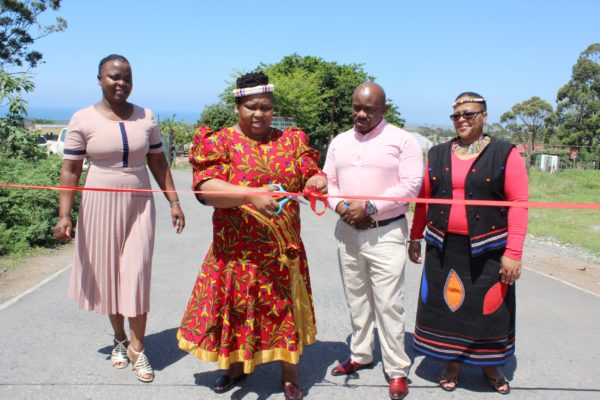
Mbizana Local Municipal Mayor Councillor Daniswa Mafumbatha (second from left) during a ribbon cutting ceremony of the completion of the community access roads in Mzamba, Eastern Cape. Mayor Mafumbatha was joined by Welekazi Ndika, SANRAL Southern Region Stakeholder Relations Coordinator (left), Ntsizakalo Ngalo a Senior Facilitator for MAJV, and Hilda Cwele a Community Development Worker on the project.

Ten SMMEs received their SAQA accredited NQF certificates at the announcement of the completion of the construction of a 4.5km community access road in Mzamba in the Mbizana Local Municipality. 

The road construction project, which started in June 2016 and took two years to complete, is part of the community development and small, medium and micro-sized enterprises (SMME) training programme, which forms part of small business support strategies to optimise local economic development through the N2 Wild Coast Toll Road (N2WCTR) development in the Eastern Cape. 

Welekazi Ndika, SANRAL Southern Region’s Stakeholder Relations Coordinator, said: “The area has benefitted from the contract as the improvement of skills and knowledge has been critical to the built-environment capacity development within the municipality to assist the municipality to be able to support the provision of Sustainable Rural Local Economic Development.” 

In addition to the completion of the access roads, the community hall was also refurbished. 

Locals voice appreciation 

Chief Lunga Baleni said he was happy the project had been completed.  

“I hope this relationship with SANRAL will continue. I would like to encourage SANRAL to continue with their community development programmes in our area,” he said. 

Mbizana Local Municipal Mayor Councillor Daniswa Mafumbatha said they were happy to see the “great work” that was done by the SMMEs. 

“The roads built are beautiful. We can see that the money was spent well. We can see the growth in our SMMEs. I would like to take this opportunity to appreciate the job opportunities that were created on this project. We like what we see. The certificates handed out are not given to people because of their associations, but for their hard work and training,” said Mayor Mafumbatha. 

Mafumbatha added that it was “through the collaboration between the Municipality and SANRAL that the hall was also refurbished”. 

Dr Mongezi Noah, SANRAL Southern Region Community Development Specialist, said there more projects were on the cards and that the completion of the community access roads was just the beginning. 

“I encourage SMMEs to tender to work on other projects. The municipality can utilise the SMMEs from the area that have been developed,” Noah said. 

Ward 24 Councillor Ntlahla Hlebo said the community was “very happy” the road had been completed and the hall refurbished. 

Hlebo said: “Before this new road our road was gravel. During floods in the past, there would be big potholes. During heavy rains it was difficult for an ambulance to drive to a house, instead, people had to arrange for a lift or push someone in a wheelbarrow to the R61 and meet the ambulance there.  

“The training the SMMEs received has made them employable. They can look for work anywhere.” 

SMMEs benefit 

Nombali Hlongwe, a co-owner of Pumlani Construction, was elated with her certificate. 

“Now that the project is complete, I am looking at upgrading to CIDB level and am now looking at tender opportunities. Now that I have completed the project and received the certificate, I feel that the world has opened a lot of opportunities for me. The project has been successful for all of us,” said Hlongwe. 

Sethu Sibeni from Ngxathi Trading was very happy to have received his NQF level 3 certificate. Sibeni worked as a supervisor on the project. 

“The community appreciates the new road.  During heavy rains it was not easy to travel on this road. Having a tarred road means that public transport can now access the communities easier. The completion of the access road also means there is quicker access to the R61,” said Sibeni. 

Sibeni’s goal is to own a block yard and supply local businesses with material. 

The two-year project created opportunities for 50% women-owned Small Medium and Micro Enterprises (SMMEs), 70% youth-owned SMMEs and jobs for 130 people from the local community. 

Fifty of the local community members were also trained and received SAQA accredited NQF Level 2 certificates in road construction, while the remaining 80 received certificates for technical skills gained on the job.  

Sixty-four local SMMEs who did not qualify to be part of the construction project, received tendering training for construction contracts. 

Upgrading contractors 

Following the completion of the project, it is anticipated that Construction Industry Development Board (CIDB) upgrades will take place, with ten Grade 1CEs upgrading to Grade 2CE contractors. 

The training project entailed five phases, including: 

  • assessment of site conditions, socio-economic conditions of the area, and the availability of resources; 
  • design of approximately 4500m of community access road; 
  • local SMME participation through open tender process – 10 subcontracted on the construction of the haul roads; 
  • theoretical and practical training of the local SMMEs;  
  • construction of community access roads using labour-enhanced construction methods; 
  • CIDB Grading 4 local sub-contractor was used to construct earthworks and layerworks, while other suppliers were used to supply kerbs, water, sand and various materials to the project; 
  • Community policing forum was used for security on site; 
  • Various service providers used for catering and supply of toilets. 

“The community has benefitted from the contract as the improvement of skills and knowledge is critical to the building of capacity within the community. This will assist the Municipality in supporting the provision of Sustainable Rural, Local and Economic Development,” said Gcobani Socenywa, project manager for SANRAL Southern Region.

SANRAL develops knowledge economy with all-weekend Hackathon for youth

The Hackathon challenged participants to use the data and technology available to them to come up with tangible solutions for the road user. 

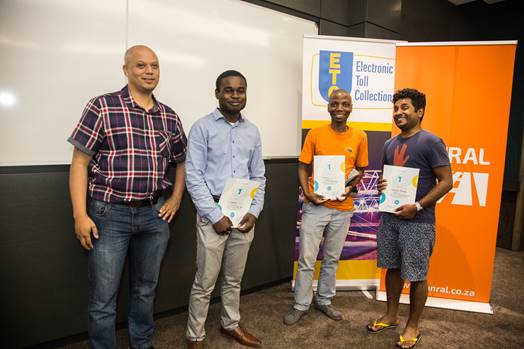
Darawees Taliep from ETC (left) congratulates the members of Team “On the Road Again” for their winning mobile solution.

The South African National Roads Agency (SOC) Limited (SANRAL) understands the importance of and is fully committed to developing South Africa’s knowledge economy, using the pillars of knowledge sharing, skills transfer, collaboration and innovation.  

SANRAL and Electronic Toll Collection (ETC) recently partnered with WhereIsMyTransport to host the ETC Hackathon in Cape Town. 

With the theme of Collaborate & Innovateparticipants in the Hackathon were invited to create innovative smart mobility applications utilising both Gauteng Freeway Improvement Project (GFIP) toll gantry data and WhereIsMyTransport public transport related data. 

SANRAL has been innovative  

SANRAL, manages the tenth-largest national road network in the world and has, for some time, been operating in the digital space with its Freeway Management System that deploys dedicated cameras on 520km of the busiest freeways across the country.  

Here, real-time traffic data is collected and used to determine how best to respond to an incident, dispatching the relevant response entity and ultimately saving lives on our roads. 

Randall Cable, SANRAL’s Western Region Manager, officially opened the Hackathon challenging the participants to use the data and technology available to them to come up with tangible solutions for the road user. 

“It is encouraging to see the low average age of the participants (under 25 years) and how committed these young South Africans are to be part of the change they want to see in our country,” said Cable. 

The Hackathon was sponsored by ETC, which was established in 2009 to supply and manage an integrated tolling system on behalf of SANRAL. 

According to Darewees Taliep from ETC, the system handles 550 000 transactions per hour, which equates to 155 transactions every second. ETC made a random selection of transactional data available to the participants for them to create a mobile solution to aid safe and improved road user experiences.  

Some of the proposed avenues included drawing usage/behaviour patterns, analysing traffic volumes, customer service centres and identifying foreign vehicles. 

“It is believed that 90% of the world’s big data was gathered in the last two years only. Big data analytics and building solutions using this data is definitely where the world is headed,” said Talliep in his briefing session to the participants. 

Innovation in mobility 

In Cape Town, 50% of all public transport trips occur in minibus taxis and involve primarily women and children under the age of 13.  

They do so without a schedule or the ability to plan according to a timetable, yet they must get to work and to school on time. This is according to WhereIsMyTransport, who facilitated and provided expert tech and data support during the weekend. 

The role of innovation in mobility for our emerging cities was the background against which they encouraged the participants to think out the box when developing public transport solutions that would make life easier for the ordinary man on the street, to navigate from point to point. 

Through their public transport API, they gave participants access to all the main public transport platforms, ie. bus, taxi, train, walking routes, etc, and these could be integrated to best achieve usable public transport solutions for the public. 

The winning team, which conceptualised a mobile solution that delivers turn-by-turn public transport directions via SMS or WhatsApp, walked off with a R20 000 cash prize and a year’s worth of free access to the WhereIsMyTransport Public Transport API. 

Cable said: “SANRAL firmly believes in the ability of the youth to add value to the broader transport industry. We have invested in a Technical Innovation Hub, which is thriving with young engineers exploring the extent to which technology can improve road user experiences, particularly as we head in the direction of smart cities, which demands smart mobility and disruptive thinking.  

“We are incredibly excited about the different solutions the Hackathon participants came up with to challenge the status quo, and we look forward to seeing some of these ideas come to fruition.”

Less traffic congestion for Hartbeespoort Dam

Motorists will enjoy a free flow of traffic and there will be a better link to the North West Province from the west of Pretoria and Johannesburg once the project is completed. 

Challenges faced during construction mainly relate to the quality of the in-situ material from the cutting slopes in the Magalies Neck, and the supply of suitable fill material locally.

Traffic flow in the Hartbeespoort Dam is set to improve with construction work on the R512-PWV3 making good progress.  

The estimated completion date is December 2019.   

Once the project is completed, motorists will enjoy a free flow of traffic and there will be a better link to the North West Province from the west of Pretoria and Johannesburg.  

Alex van Niekerk, Planning, Toll and Transport Manager of the South African National Road Agency (SOC) Limited (SANRAL), said: “The completion of the project will also ensure that long distance movements do not interfere with local traffic. The road stretches from the R512 to the west of the dam, through Pampoennek to the connection with the N4 to Rustenburg.” 

Details of the project 

Challenges faced during construction mainly relate to the quality of the in-situ material from the cutting slopes in the Magalies Neck, and the supply of suitable fill material locally. The project was originally scheduled to be completed in October 2019, but this has been extended due to changes made to the Game Underpass, which resulted in a larger structure being erected and thus requiring more time to complete.                                                                                               

The excavations at Pampoennek are progressing well and are approximately 80% completed.   

The contract must comply with the environmental authorisation and management plan issued by the Department of Environmental Affairs.  

As part of the plan, indigenous flora was rescued from the affected areas and will be reinstated into its natural environment on the cutting slopes in the Magalies Neck. 

As part of SANRAL’s project objectives to actively promote the development of small, medium and micro enterprises (SMME) and job creation, the contractor has created 165 jobs and utilised 21 SMMEs to date.  

SANRAL will continue to work on reducing traffic congestion in the area said Van Niekerk.  

“We look forward to successfully completing this project without harming the environment,” he said.