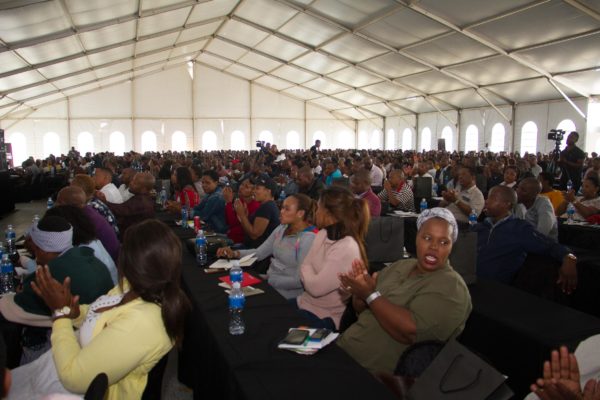
Scheduled stakeholder engagements are yielding positive results for SANRAL in the Free State.
SANRAL’s Eastern Region was instrumental in the resuscitation of the provincial Transport Forum, a body sanctioned by the National Department of Transport.
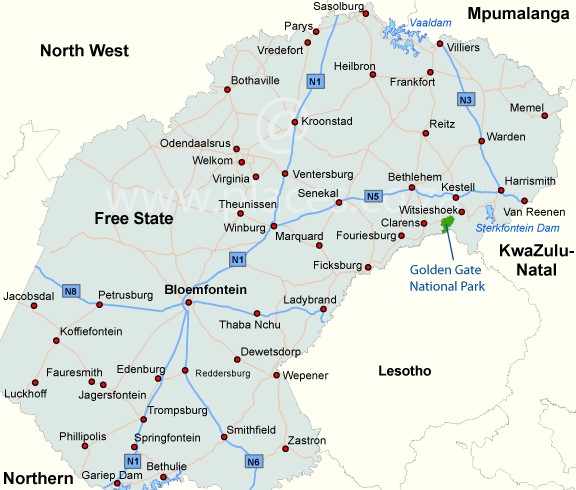
The Free State Province is literally in the middle of South Africa, with boundaries with seven provinces, and it has the highest number of (N) national roads leading into and out of it.
Therefore, it is important that the agency serves on the provincial Transport Forum, a body sanctioned by the National Department of Transport.
SANRAL’s Eastern Region was instrumental in the resuscitation of this forum and serves on three of its subcommittees.
Monageng Mokgojwa, SANRAL Eastern Region stakeholder engagement coordinator, said: “To date, we have hosted a hugely successful career expo and ‘Taking SANRAL to the People’ event. We were able to host these events as a result of a sustained Stakeholder Management Action Plan we have put in place.
“This plan revolves around availability, high exposure and accessibility. A calendar for engagements with the Free State Department of Police, Roads and Transport has been devised.”
Mokgojwa said these interactions also put SANRAL in touch with other stakeholders in the province, notably the Construction Industry Development Board, which has been a helpful partner, particularly with holding joint meetings so that they can educate stakeholders on their areas of operation and regulations/policies they oversee in the construction sector.
“Our initial strategy of planned scheduled stakeholder engagements is yielding positive results as we are now on par with most stakeholders in the Free State province.
“We enjoy mutual respect with the Free State Provincial Government and the Free State Department of Transport. We are a model state-owned company that respects and listens.
“More is still to come from the centre of the country,” said Mokgojwa.
SANRAL has been involved in contributing to educational and social aspects of communities and encourages its contractors to do likewise.
During upgrading of the N1 road between Winburg Interchange and Winburg Station in the Free State, the contractor WBHO Roads & Earthworks (Pty) Ltd, was involved in several community projects.
Developing and uplifting communities is part of the SANRAL ethos.
The roads agency does not just develop physical infrastructure in the form of roads and bridges – it also ensures that the communities along the country’s roads develop socially and economically as well.
Since its establishment two decades ago, SANRAL has ensured that a significant portion of its work benefits the local labour force, including SMMEs, situated close to the national road network.
SANRAL has also been involved in contributing to educational and social aspects of communities and encourages its contractors to do likewise.
Community development
During upgrading of the N1 road between Winburg Interchange and Winburg Station in the Free State, the contractor WBHO Roads & Earthworks (Pty) Ltd, was involved in several community projects.
“A big lesson we learned on the project was that giving back to the community does not always have to be big things – even the small things can put a smile on faces,” said Sarel van der Walt of WBHO.
“We got to know ‘Sweet Revenge’ in Winburg, which is the name of a netball team that did not have any netball gear and played with an old deflated ball.
“We sponsored a netball kit and a new ball. Seeing how happy they were even with such a small act of kindness changed our day more than it changed theirs.”
Another community project that WBHO sponsored was a group of women calling themselves “Ke le mong” who trained women in sewing.
WBHO allowed the women to use their training venue for five months and donated two sewing machines to the group. The women are now making uniforms for a school in Winburg.
When children in the area struggled to get to school during the rainy season as they had to cross an area that was prone to flooding, WBHO built a walkway through the area with culverts.
Legacy
Another WBHO project was a community water pipeline that pumped water from a borehole west of the N1 to the community on the eastern side.
“The aim of the pipeline was to avoid people crossing the N1 to get water and putting themselves at danger with the moving traffic.
“Strong winds damaged the windmill and we had to replace it, but before replacing it, we got the children of the community to make imprints of their hands on the windmill blades with paint. We hope that it will remain there as a reminder of the unity we had on the project, and what we can achieve when working together,” Van der Walt said.
SANRAL CEO believes Outa as a special interest group with a thinly disguised party-political agenda has led an illegal civil disobedience campaign against e-tolls for almost a decade.
SANRAL CEO, Skhumbuzo Macozoma, said a lack of investment in road infrastructure at this juncture will inevitably lead to crippling congestion, less productivity, increased commuter frustration and more accidents down the road.
When an organisation funded by donations from the public embarks on a willful and deliberate campaign to encourage people to break the law there is every reason to call them to account.
Outa as a special interest group with a thinly disguised party-political agenda has led an illegal civil disobedience campaign against e-tolls for almost a decade. They don’t disguise this fact. On the contrary they use this as a marketing tool at every turn to wring money from their support base.
The consequences for the country and the economy is quite clear. They create an atmosphere of lawlessness. If this continues unchecked it will eventually spread to boycotts against other services, further non-payments for electricity and water and a broader tax revolt.
It is for this reason that I have warned that government must hold Outa to account. It is not a benign civil society organisation which only lobbies for the best interests of their members.
It is a small, albeit vociferous, special interest group which advocates disregard of the law and thwarts future investment in road infrastructure. Despite boasting few successes, they manage an inordinate amount of media coverage.
The consequences of their campaigns are already visible in the fact that we cannot proceed with the construction of phases 2 and 3 of the Gauteng Freeway Improvement Project.
It will, without a doubt, have a long-term impact on the economy of a province where close on 90% of all goods are transported by road.
A lack of investment in road infrastructure at this juncture will inevitably lead to crippling congestion, less productivity, increased commuter frustration and more accidents down the road.
Wayne Duvenage’s recent piece in the Daily Maverick is proof enough that he is not concerned about any of these issues.
Let me put aside, the condescending nature of his writing, or the patronising references to me as “Mr Skhumbuzo”, and focus on the holes in his arguments.
He may be a past expert on rental cars, but he knows next to nothing about the costs of road construction, about tendering processes and about the financial aspects of toll road management.
About three years ago Outa released a so-called “position paper” on the construction costs of GFIP. It was riddled with errors. It confused billions with millions. It disregarded decimal commas. It made calculation errors of a magnitude of almost 100 000%. It compared the construction costs of rural roads in Botswana with that of a modern freeway in Gauteng.
In short…it was an embarrassing mess. At the time we submitted a list of more than 400 questions and requests for clarifications to Outa. They are yet to respond… but they have admitted to “typing errors.”
Some of this content has now resurfaced in a new Outa report designed to sway the views of the working group appointed by the President to consider the future of e-tolling. And we must assume that Duvenage is still relying on his discredited arithmetic.
But it is on the issue of law that Outa and Duvenage are at their most misleading. They keep referring to future court cases that may, or may not, become reality. But they steadfastly refuse to admit that they have not won a single lasting judgment on the legality of e-tolls when it came before the courts in the past.
I know this truth is inconvenient to Outa and Duvenage, so let me remind them:
August 2012 – the Constitutional Court sets aside an interim interdict issued by the Pretoria High Court and finds the following: “… tolls are a revenue collection mechanism to fund the road upgrades, The National Executive Government has adopted the funding policy that revenue should be garnered from motorists who use the upgraded roads…”
Score: Truth and justice 11 – Outa 0
December 2012 – Judge A. J Vorster rejects an application in the Pretoria High Court to review the decision to introduce toll roads on the basis of insufficient public consultation. He finds: “The publications in the Government Gazette and newspapers circulating in the areas in question were clearly adequate to inform interested persons of the proposed toll declaration.”Outa’s case was dismissed with costs.
Score: Truth and justice 12 – Outa 0
September 2013 – a full bench of the Supreme Court of Appeal refused an appeal against the Vorster judgment and reaches the following conclusions: “By all accounts these upgraded roads are truly magnificent. The advantages are enjoyed primarily by the motorists of Gauteng, but they also benefit the economy of the country as a whole… The clock cannot be turned back to when the toll roads were declared, and it would be contrary to the interests of justice to attempt to do so.”
Score: Truth and justice 17 – Outa 0
December 2013 – Justice J Jansen in the Pretoria High Court rejects – with costs – an urgent application by the TolhekAksiegroep, a fraternal organisation of Outa, to prevent the launch of e-tolls.
Score: Truth and Justice 18 – Outa & friends 0
March 2014 – the Western Cape Division confirms the lawfulness of the SANRAL Amendment Act and the right to declare national roads as toll roads. The Democratic Alliance is refused leave to appeal against the judgment.
Score: Truth and Justice 19 – Outa and alliances 0
If Outa were a sports team Coach Duvenage and his entire support staff would have been fired in disgrace five years ago. Yet, it continues tilting at legal windmills … and doing it with money solicited from an unsuspecting public.
And this is where the red lights should start to flicker brightly. At the end of August, the Department of Social Welfare reported that a staggering 56 000 non-profit organisations (NPO) have failed to submit their annual reports and verifying documentation. This, according to the Department, is a criminal offence in terms of the NPO Act.
It should come as no surprise that Outa is chief among the offenders. In a letter to the Department, Outa states that it will not make the required submissions and intends to deregister as an NPO.
And the reason given for its wilful non-compliance with the law is that Outa realises “… that financial and narrative reports submitted to the director for non-profit organisations are accessible to the public”
In short this means that Outa does not want the public – even its own members who donate so generously towards futile legal battles – to scrutinise their affairs and examine their books.
A so-called watchdog organisation that wants to expose corruption runs for cover and hide their own books.
By its own admission it has already fleeced more than R130-million from donors over the seven years since its inception. Where that money goes is anybody’s guess but the answers are not provided in the rather amateurish graphic on Outa’s annual report or the nine-line table on its website.
And once it deregisters as an NPO its financial affairs will become even more opaque and its donors will have even fewer opportunities to scrutinise the quality of its administration and corporate governance.
Thus, it should be quite clear. SANRAL as an organisation with decades of experience in road management and with 15 successive unqualified audits to its name will not take engineering or financial advice from an organisation that encourages the breaking of the law and hide its own affairs from public scrutiny.
My original response was in relation to Outa’s reaction to the award of a R7-billion loan to SANRAL by the New Development Bank.
This is a positive story: the funds are much needed to unlock stalled toll projects other than the e-toll scheme, but as a result of the e-toll scheme challenges. SANRAL is seeking approval from both the Department of Transport and National Treasury to finalise this deal – accountability to the public is guaranteed in this transaction.
Unlike Mr Duvenage, the GFIP e-toll scheme is not a crusade for me, this is a matter for SANRAL, a matter for Government and a matter for the sustainability of South Africa’s economic hub which is in the interest of all South Africans.
If left unresolved or blindly scrapped without carefully considering the consequences, it is this country and its citizens, especially of Gauteng that will suffer the consequences.
SANRAL is happy this matter is now being led at the right political level by the Minister of Transport together with the Minister of Finance and the Premier of Gauteng.
We expect that Government will now demonstrate unity on this matter, even in the face of attacks from the likes of Outa. We continue to support our political principals and look forward to their pronouncement on this very important matter.
SkhumbuzoMacozoma is the CEO of the South African National Roads Agency Limited.
Quality of national roads vital for country’s future growth.
SANRAL received a record 15th consecutive unqualified audit report and it is on track to achieve a clean audit opinion by 2020/21.
The South African National Roads Agency (SOC) Limited (SANRAL) is a great example of what can be achieved in the transformation of state-owned entities and a creation of a capable state.
The country’s focus will increasingly be on massive investment in infrastructure and the national road network will be the catalyst for growth and socio-economic transformation, said the Chairman of the Board, Themba Mhambi.
The 2018/19 Integrated Report of SANRAL highlights the achievements and challenges of the agency in a financial year “in which funding constraints for road construction worsened.”
Achievements and challenges
SANRAL received a record 15th consecutive unqualified audit report and it is on track to achieve a clean audit opinion by 2020/21, said Mhambi.
Irregular expenditure was higher due to two contracts amounting to R282-million.
The first was for additional expenditure of R103-million on a construction contract that required the pre-approval of National Treasury, which was only given 7 months after the application was submitted.
The second was for a property, acquired with the approval of the Assets and Liabilities Committee, a sub-committee of the Board, and subsequently confirmed by the Board, for R179-million.
Even though SANRAL had the first right of refusal to buy the property, the AGSA ruled that this was a deviation from normal procurement processes and should have been approved, rather than merely confirmed by the full Board.
The decision by National Treasury to reallocate R5.75-billion from the non-toll portfolio to the toll portfolio resulted in a 27% reduction in expenditure in the construction of road infrastructure.
After some delay in incorporating the new regulations for the 30% subcontracting and SANRAL Transformation policy, SANRAL has started with the advertising of tenders from April 2019.
Mhambi said the resolution of the e-toll impasse “is absolutely critical and crucial for the future of our roads and the country’s economy”.
He welcomed the current initiative announced by President Cyril Ramaphosa and said it recognises the centrality of adequately funded roads for sustainable growth.
The Chief Executive Officer, SkhumbuzoMacozoma, said the prevailing economic climate is compelling SANRAL to utilise existing resources during a lean period.
“Our decisions during this time would determine how well we would be positioned to take advantage of opportunities when the financial situation recovers.”
The priority was to keep the programme of construction on toll and non-toll roads moving forwards with little delays and to protect road assets through essential road maintenance work.
Spending on routine road maintenance remained consistent over the past three financial years and are critical to prevent premature deterioration of the country’s 22 214km primary road network managed by SANRAL.
The agency’s objective is “to achieve a balance between contributing to rural development and greasing the wheels of the urban economy,” said Macozoma.
Through its urban freeway management systems, it kept traffic flowing and saved lives by attending to more than 77 000 incidents and 10 600 collisions.
In addition, more than 75% of spending on capital projects and road maintenance was devoted to non-toll roads which reach into more remote rural areas.
An example of this is the green fields section of the N2 Wild Coast Route which will draw isolated and impoverished parts of the Eastern Cape into the economic mainstream.
Transforming the industry
Macozoma said SANRAL is using its contracting power to enable black contractors to participate in the construction industry.
A lack of access to capital and difficulties in purchasing equipment have, in the past, been solid barriers which prevent emerging contractors to secure major contracts.
SANRAL decided to “break the asphalt ceiling” by facilitating partnerships between major industry players and black contractors. Four such partnerships were concluded in the past year.
Through its tendering system, more than 70% of contracts – representing 61% of contract value – were awarded to black-owned companies. Some 25% of total contract value were secured by companies owned by black women.
However, the financial difficulties experienced by some large construction companies raised the possibility of their demise and an associated loss of high-level expertise to the sector.
“Without sufficient and sustainable funding, it is inevitable that the quality of the national road network will suffer and, given the dominance of road transportation in this country, this would have an adverse economic impact,” said Macozoma.
About 75% of total freight in South Africa are transported on roads and 70% of this volume moves along the national road network.
The Integrated Report notes that SANRAL recorded a profit of R2.4-billion in 2018/19. Overall spending on capital projects and road maintenance decreased by 19% in 2018/19 and by a total of 22% over a two-year period.
Because of the transfer of R5.75-billion the non-toll operating division shows a loss of R96-million and toll portfolio shows a profit of R2.52-billion.
Among the major projects initiated by SANRAL in the past financial year are:
The strengthening of the R511 between Brits and Beestekraal in North West;
The construction of the cable-stayed bridge across the Msikaba River on the green fields section of the N2 Wild Coast Road;
The upgrading of the N11 from Newcastle to Madadeni, east of Ladysmith in KwaZulu-Natal; and
The construction of pedestrian facilities on the N2 between Umlaas Canal and Wandsbeck Road in eThekwini.
The upgrading of the Senekal and Kroonstad Traffic Control Centres is part of SANRAL’s commitment to address the problem of vehicle overloading.
The Senekal Traffic Control Centre has been upgraded to a more technologically advanced weighbridge.
The upgrading of two traffic control centres at Senekal and Kroonstad by SANRAL in partnership with the Free State Department of Police, Roads and Transport will help curb extensive overloading of trucks which has resulted in a marked deterioration of the provincial road network.
Overloading not only causes serious damage but also contributes to the problem of maintaining road safety.
Overloaded vehicles become a road hazard, especially because the vehicle’s braking system is put under strain and additional braking distance is required.
Senekal Traffic Control Centre
The Senekal Traffic Control Centre has been upgraded to a more technologically advanced weighbridge.
Illegally loaded vehicles are identified through weigh-in-motion equipment installed on the N5. Vehicles are then diverted to be weighed on static scales at the traffic control centre for mass certification and, in cases of overloading, prosecution.
Damage to roads as a result of overloading leads to higher maintenance and repair costs and shortens the life of a road which in turn places an additional burden on the state as well as law abiding road users who ultimately must carry the costs of careless and inconsiderate overloading.
The upgrading of the Senekal and Kroonstad Traffic Control Centres is part of SANRAL’s commitment to address the problem of vehicle overloading.
Kroonstad Traffic Control Centre
The Kroonstad Traffic Control Centre on the N1 has been upgraded with the installation of state-of-the-art weighing equipment.
This facility will provide roadworthy testing of vehicles and prosecution for those that are found to be on the wrong side of the law.
On the N1, which is a strategic route as it carries cargo from the ports in Cape Town, Port Elizabeth and East London to various parts of the country’s inland areas, especially Gauteng, overloading has caused deterioration of the road infrastructure.
AyandamabhacaChagwe, SANRAL Eastern Region Project Manager: Design & Construction, said a stern warning is issued to motorists violating the rules of the road.
“The freight industry and motorists generally are warned to keep within the confines of the law or face the music should they be found to be on the wrong side. SANRAL is doing its best to provide a safe and well-maintained road network for the country’s socio-economic wellbeing and it is for every road-user to ensure that road assets are kept in good condition.”
A major reason for the improvement had been the high volume of traffic between QwaQwa and Harrismith.
SANRAL left the historical single-lane Hamilton Bridge over the Wilge River intact and instead constructed a new double-lane bridge next to the current one on Murray Street.
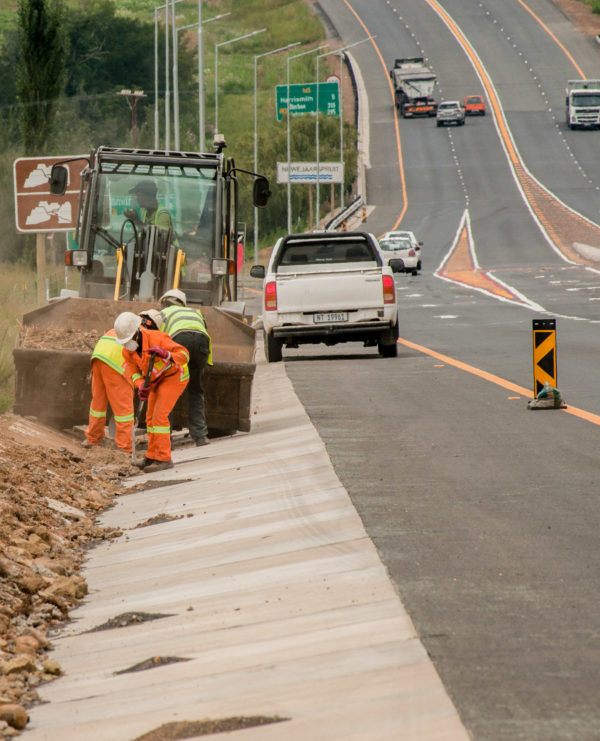
While the big yellow machines have moved off site upon completion of the upgrading of the N5 between Harrismith and Industriqwa, a legacy of empowerment remains with scores of youth and women who have benefited from jobs during the construction.
Women and youth earned more than R11.2-million during construction. And 17 sub-contractors (SMMEs) from the community undertook some of the construction works under the supervision of the main contractor.
The original tender amount was R292-million. The final contract amount was R343-million due to relocation of services and delays caused by inclement weather.
The contract involved a 6km section of the N5 from the N3/N5 interchange to Industriqwa. The project included the construction of a new interchange where Murray Street links the N5 to the Harrismith CBD.
SANRAL Eastern Region Project Manager Andrew Ssekayita said a major reason for the improvement had been the high volume of traffic between QwaQwa and Harrismith.
The project, which commenced in October 2015, involved grade separation and new interchange ramps at the N5/Murray Street intersection; widening the road to four lanes and corresponding widening of four bridges; construction of a new two-lane bridge over the Wilge River at Murray Street; closure of an intersection on the N5 and provision of a new access road from Murray Street; as well as provision of taxi lay-bys and pedestrian facilities at the interchange.
SANRAL left the historical single-lane Hamilton Bridge over the Wilge River intact and instead constructed a new double-lane bridge next to the current one on Murray Street.
Funding constraints for road construction worsened during the past financial year because of a downturn in the global economy and a stagnant local one. Both have dampened the outlook of the South African construction and related industries.
One of the greatest challenges to the sustainability of the roads agency, writes SANRAL board chairman Themba Mhambi in this year’s Integrated Report, is the gradual expansion of the national road network in a constrained funding envelope.
In addition, low levels of payment of e-tolls have led the Treasury to approve the reallocation of R5.75bn from the non-toll portfolio to the toll portfolio that resulted in a 27% reduction in expenditure in the construction of road infrastructure.
Mr Mhambi states that the agency sets an example of what government wants to achieve in the transformation of state-owned entities and the creation of a capable state. It achieved its 15th consecutive unqualified audit report and is working towards a clean audit for 2020/21.
Highlights include:
201 SMMEs benefitted from community development projects, all black-owned;
targeted development of black industrialists;
continuous strides to better reflect the country’s diversity in the staff complement;
and a range of projects to transfer skills.
The Chief Executive Officer, Mr Skhumbuzo Macozoma, writes in the Integrated Report that the prevailing economic climate is compelling SANRAL to utilise existing resources during a lean period. “Our decisions during this time would determine how well we would be positioned to take advantage of opportunities when the financial situation recovers.”
The first priority was to keep the programme of construction on toll and non-toll roads moving forward with little delays and to protect road assets through essential road maintenance work.
It also prioritised stakeholder relations, consensus-building in the planning and construction of roads, facilitation of economic participation and achieving a balance between the rural and urban economy.
Mr Macozoma stressed that the agency’s black empowerment agenda meant that emerging contractors were actively involved in the construction industry, small businesses were favoured, often rural ones.
The constraints of lack of access to capital, difficulties in purchasing equipment and building expertise, were addressed by leveraging partnerships with important role players in the construction industry.
More than 70% of contracts went to black-owned companies, of which 25% were owned by black women.
During 2019 it ensured that there was no need to sacrifice its commitment to social justice and economic transformation in spite of fiscal constraints. This included its investment in human capital, road safety and the development of rural communities.
The ratings agency Moody’s has changed SANRAL’s outlook from negative to stable.
This follows on the government’s decision to grant additional funding to SANRAL to make up for the continuing under-collection of e-tolls. This had caused cash-flow problems but now the roads agency will be able to fund its operating requirements as far as its e-toll operation is concerned.
But, says Moody’s: “The rating is constrained by very high debt levels, high capital expenditure requirements as well as ongoing liquidity pressure related to low cash collections on the Gauteng Freeway Improvements Projects (GFIP).”
The ratings agency added that an upgrade is dependent on the government introducing an alternative funding model which will include collection and enforcement strategies for GIFP – if this results in an improvement of SANRAL’s cash flows.
What government’s approach on this matter is, was to have been announced at the end of August but it has since been delayed and was not known at the time of publishing of this edition.
Moody’s made it clear that it kept the roads agencies debt rating unchanged but its outlook had improved. This could be downgraded if there was a change in the level of government support – which it did not expect.
Another R2.2bn a year was set aside for SANRAL in the 2019-2022 toll budget to compensate for the low-level of e-toll payment compliance. Moody’s avers that “the decision to stabilise SANRAL’s outlook reflects the SA government’s decision to earmark additional funding” and this “re-affirms the strategic importance of SANRAL” and its close link to the government on the operational and financial level.
The modernising of network industries – including transport – is essential if South Africa is to achieve higher and sustainable growth that can contribute to economic transformation.
This is one of the issues highlighted in a comprehensive strategy document released by Finance Minister, Tito Mboweni. The document, “Towards an Economic Strategy for South Africa” sets out far-reaching structural reforms.
However, South Africa cannot fully harness the productivity benefits due to the absence of efficient economic regulation, backlogs in infrastructure investment and maintenance, lack of access to quality services and poorly managed state-owned companies.
Economic institutions that support growth require a capable state as well as a functional relationship between the state and the private sector.
A new compact is required between the government, the private sector and social partners. Government must prioritise the strengthening of the capability of the public sector and state-owned entities and achieve the right balance between policy progress and certainty to ensure the economy is able to attract foreign and domestic investment.
Competition and private sector participation in the transport sector can increase investment and improve service delivery without weighing on the balance sheets of state entities. This will encourage the development of new and small firms in the infrastructure space and promote economic transformation.
The direct impact of more competition on the balance sheets of SOEs will be outweighed by the efficiency gains in the rest of the economy.
Economic transformation and inclusive growth must be accompanied by an emphasis on building an economy that is globally competitive. For example, prioritising local procurement by state-owned entities can boost economic transformation and inclusive growth, but the short-run impact on competitiveness will not be neutral if local industries are unable to supply the designated products at the same price as their international counterparts.
Road freight transport continues to have a market share of about 70%.
The Treasury document supports the Department of Transport’s Green Paper which proposes:
Stricter enforcement of traffic laws
Full cost recovery from road freight operators
Related external environmental costs
Major improvements in rail services
While a road-to-rail shift may not have a direct impact on economic competitiveness, it will improve the efficiency of the transport system and support the viability of Transnet’s rail business.
The document calls for the finalisation of the Economic Regulation of Transport Bill which includes provisions to create a transport regulator who will oversee the entire sector including entities such as SANRAL, Transnet, Prasa and Acsa. “Several unregulated areas that are dominated by large state-owned entities or the government should have their economic activities regulated by independent agencies,” the document concludes.
In August SANRAL started issuing major road construction tenders to the value of more than R40bn. This will continue over the next two to three years.
“We expect a surge in road construction projects over the medium-term framework as part of the broader national efforts to invest in economic infrastructure,” says Louw Kannemeyer, Engineering Executive.
“We are confident that this investment will help to boost the construction sector which has been under severe pressure in recent years, and also cascade down to black-owned and emerging enterprises which will receive much larger shares of tenders in future.”
Treasury has allocated about R21.5bn per year for the maintenance and improvement of SANRAL’s 19 262km non-toll network. This will go towards a total of 940 projects, of which 325 are already under construction.
Kannemeyer says the new projects will include some 90 major capital works projects larger than R500m each which will go out to tender during the three year medium-term period.
Tenders to the value of R8.3bn for construction work on the N3 between Durban and Pietermaritzburg will go out to tender during the current financial year. This is financed through the infrastructure stimulus package announced by President Cyril Ramaphosa in 2018.
This will include seven major tenders on the N3 which will be issued within the next months once the regulatory approvals have been received and land acquisition finalised.
Smaller tenders related to routine road maintenance and periodic maintenance across the entire SANRAL network and in all nine provinces are also being issued. The more than 50 tenders will be released in a controlled manner so as not to flood the market.
Major tenders will be issued for work in Mpumalanga, Limpopo and North West – Moloto Road, the Thembisile Hani and Ephraim Mogale municipalities as well as Rustenburg.