Blog

Image of rich heritage reflected in modern bus station

The design of new bus stations for the Tshwane Rapid Transit System blends the historic significance of buildings in the capital with needs for a modern transport system. SANRAL has managed the design and construction of the bus stations and a competition was held to select the most functional designs submitted by architects.
Tshwane Rapid Transit (TRT) Old Synagogue 'Memory Box' station; Paul Kruger St, Pretoria; 15 September 2015 - Photo by Brett Eloff.
One of the new stations is located next to the Old Synagogue in Paul Kruger Street, close to Church Square. The Old Synagogue is an important heritage building dating back to the first decade of the 20th Century. It was later converted into a makeshift court house and used as the venue for security-related trials during the apartheid years, including the Rivonia Trial, at which Nelson Mandela was sentenced to life imprisonment.

The modern “Memory Box” design by Mathews & Associates blends the requirements of a functional bus station for Tshwane’s A Re Yeng system with the backdrop of an important heritage site. The glass exterior blends in with the historical importance of the inner-city precinct and reflects the image of the Old Synagogue back to the viewer.

The station is one of 50 on the Tshwane Rapid Transit System. Hannes van der Merwe, the SANRAL project manager and architect, Pieter Mathews from Mathews & Associates visited the new station prior to its official opening later this year.

Building a new bridge, preserving the old one

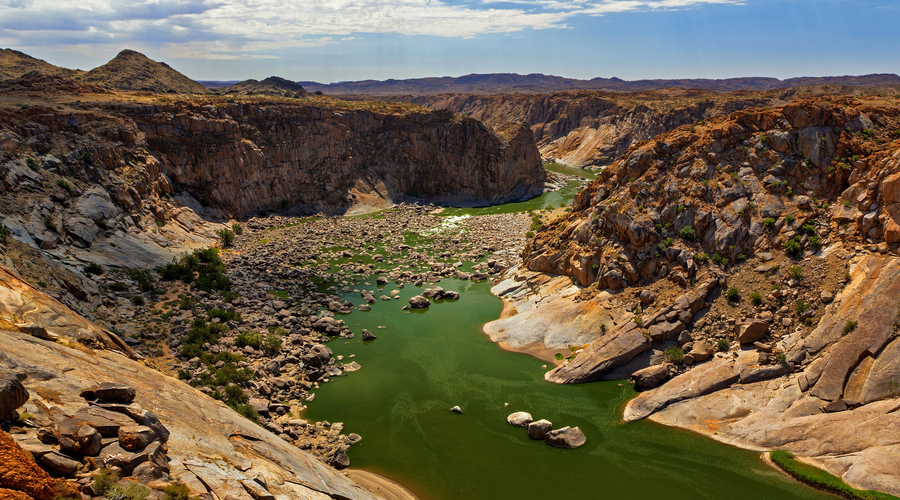
Building, upgrading, maintaining roads is what SANRAL does – but it is always very careful to take the environment into account, as was done with the construction of a new bridge over the Vaal River near Warrenton in the Northern Cape and the consequent realignment of the N18 to Mafikeng and Botswana.

Roads are usually seen as being negative for environmental biodiversity by fragmenting natural habitats. Increasingly, though, roads are recognised as potential and crucial biodiversity corridors, linking islands of bio-diverse habitats formed as a result of agricultural and urban development.

“A comprehensive botanical specialist study is part of the essential planning. Frequently, innovation is required, which may include a realignment of the planned road upgrade.

That is what we do everywhere we build or upgrade a road or construct a bridge. We believe in a sustainable road network where there is a balance between the needs of the road user and the environmental and socio-economic interests.” – Vusi Mona, SANRAL’s communications manager.

This bridge over the Vaal is a prime example of this approach.

The original low-level bridge was frequently under water during the rainy season, posing a hazard to vehicles, pedestrians and cyclists crossing and resulting in costly diversion of traffic. It was decided that a new bridge is needed, which resulted in the re-alignment of the N18 with pedestrian sidewalks.

Many factors had to be taken into account. Where the bridge is constructed is also an important spawning area for several fish species and SANRAL ensured that the habitat is not significantly transformed by construction activities.

Also, soil erosion along the river banks was a possibility and measures to minimise or prevent this were necessary. Support pillars for the bridge were designed so that the potential for floating debris to be snagged is minimised while energy dissipaters and rock-packed mattresses were used to minimise any possible erosion. Silt fences were used on the riverbanks for the same purpose.

Odd as it may sound, says Mona, the rocks that were removed to accommodate the construction work have been retained and replaced with reference to the natural features during the rehabilitation phase. The aquatic habitat has been returned as close to its original state as possible to conserve aquatic fauna and flora.

Unnecessary clearing of vegetation was avoided and fishing and hunting of local fauna strictly prohibited. Some Aloe grandidentata were found on-site, relocated and transplanted during rehabilitation so that the ecosystem remains much as it was – this was done despite the fact this specific aloe is not on the endangered list.

As always, exotic vegetation is removed on an on-going basis. But what is unusual about the Warrenton project is that the old bridge was not demolished. It was opened in 1931 and has thus been a feature for over 80 years.

It could only be demolished with approval of the Heritage Resources Agency but during the assessment the community insisted on retaining it. SANRAL has preserved this landmark bridge following talks with the municipality.

Working on a road means land is transformed, water resources are affected, substances emitted, waste generated, there is interaction with local communities – and vegetation may be affected.

“We at the roads agency are very aware of all of this and we work hard at trying to reduce the impact on the natural environment and serve the local community better by providing improved roads.”

Discover the ancient city of Mapungubwe off the N1 this Heritage month

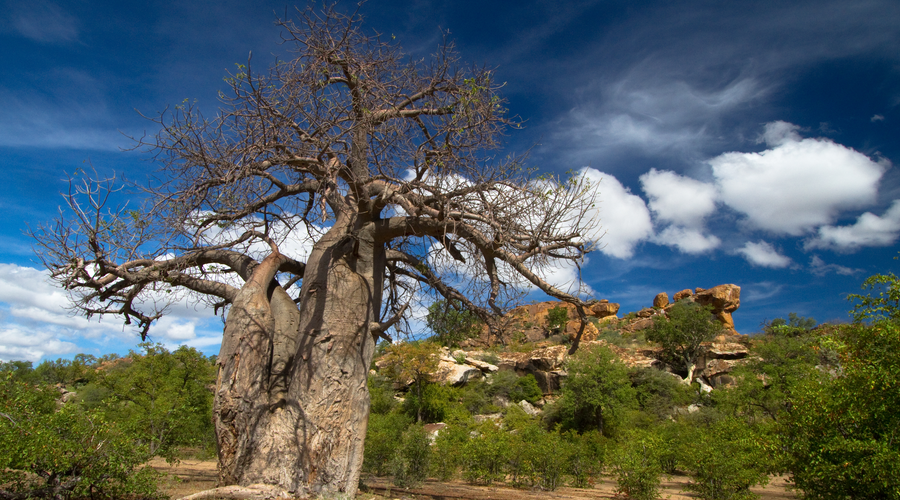
Mapungubwe in Limpopo is a UNESCO World Heritage Site that once was the capital of a country as large as Swaziland. Once an African Kingdom that reigned from Kingdom from about 1050 AD to 1270 AD, this ancient gem can be explored just off the N1.

Archaeologists from the University of Pretoria have slowly been discovering the tale that lies behind the dug up artifacts of the ancient city. Artifacts such as beads, ivory, animal bones and pots have been found alongside human skeletons lying in seated or foetal positions.

As legend has it, the once thriving Kingdom was brought down by a mini Ice Age that diminished many of their resources. The city is said to have had a commercial network that would make today’s globalised traders envious based on the beads found, said to be from India, Egypt, Southeast Asia and the Middle East.

The best time to explore Mapungubwe Hill is March through to October making this heritage month a perfect time to indulge in the heritage of a lost Kingdom.

Getting there is easy too! Drive north on the N1 to the Limpopo town of Musina and turn left (west) on the R572 for about 90-km till you reach the gates of the park.

For more information on this Heritage site contact Mapungubwe National Park on +27 (0)15 534 2014.

How the fuel levy works

People need roads but keeping up with demand is not easy. Since the 1990s, SANRAL’s budget from government has not been enough to start any road expansion or new road construction projects.

South Africa has the tenth largest road network in the world – 750 000 kilometres. Funding for the entire road infrastructure network will continue to be a challenge.

SANRAL is responsible for the national road network which is 21 403 km. Out of these, 18 283 km are non-toll roads and 3 120 are toll roads. The agency receives money to fund its work from the national fiscus for the maintenance of the national non-toll road network, but it is simply not enough.

Toll roads are self-funding through the toll fees collected.
The latest available information (2014) indicates:

• +/- current road backlog of R197 billion, with an annual need of R23.2 billion to the address the backlog over 10 years.
• +/- requirement of R65.8 billion per year to just keep the roads as they are.
• A total need per year of R89 billion.
Backlog is the amount of investment the economy needs to catch up with society’s needs.

Spending on roads in the last year, across all levels of government was R44 billion.

Screenshot 2015-09-23 17.05.37

What is a fuel levy?
A fuel levy is a flat rate tax on petrol and diesel. If you don’t buy fuel, you don’t pay the fuel levy. The annual income collected from road users in the last year was:

Screenshot 2015-09-23 17.05.12

What this shows is that what is collected from road users is given back to them in full, so no additional money is available for allocation. Last year, SANRAL received R11.9 billion and this year it is R12.5 billion.

Building roads through bursaries

SANRAL is a proud sponsor of various educational and career-orientated programmes. Our bursary and intern programmes groom and train young beneficiaries to become skilled and employable engineers. Cornelius, Daniel and Lemuel are prime examples. Here are their stories.


sanral_blog_post_graphic_separate_01

From the time he was a child, Rustenburg native Cornelius has known that engineering was his future. Years later, Cornelius chose electronic engineering as his discipline and has since received a bursary from SANRAL, which has helped him realise his childhood dream. The bursary has provided him with funds to study at the University of Pretoria.

“The advantage the bursary gave me was that because I would have to work back my studies, I would gain work experience at the same time.”

Cornelius says that although he would ultimately like to branch off into software development and robotics, his work at SANRAL has provided him with a valuable career growth opportunity.

Cornelius believes that South Africa needs more innovators and be able to develop its products instead of being an exporter of raw materials.

“What I would like to do is use my knowledge to contribute to the development of our infrastructure as well as help in some way to improve our manufacturing capabilities.”


sanral_blog_post_graphic_separate_02

A high school outing to the longest bridge in South Africa, located on the John Ross Highway between Richards Bay and Empangeni is an experience that will always be etched in Daniel Govender’s memory.

Soon after the outing, a poster on the school notice board with a SANRAL bursary application guide caught his attention.

“This is one of the few professions where one can be involved in the entire project’s life cycle namely conceptual, feasibility and detailed design whilst still being able to partake in the construction phase.”

He said he derived much insight from the induction programmes and wishes to delve more into his duties as an engineer whilst also learning more about SANRAL’s organisational structure.

His long-term goals are to be registered as a professional engineer and further his studies.

“I have deep gratitude and appreciation for SANRAL. I would like to thank SANRAL for putting me in the best position possible for me to thrive in my career.”


sanral_blog_post_graphic_separate_03
In a limited space of time, Lemuel Short’s engineering career has taken him far beyond his hometown of Middelburg in Mpumalanga. He is currently working on various sites around the country as a SANRAL Trainee Project Manager.

The road to engineering proved not to be a smooth one for Lemuel, but hard work and perseverance paid off. Funding his studies was yet another challenge, but it was one that led to Lemuel’s first encounter with SANRAL.

“I was told about the SANRAL bursary advert by a family member and decided to apply. I went for the interview and got awarded a bursary. I was over the moon.”

Lemuel says that one of the things he hopes to learn at SANRAL is more about the tolling infrastructure in South Africa. Overall, Lemuel looks forward to contributing to the expansion of open road tolling which could pave the way to more untolled roads being maintained and upgraded.

“I would like to have my own successful consulting engineering company. Somewhere in between that, I would like to complete my honours, followed by my masters, and also complete a number of courses that would benefit my career.”

Upgrading of the national route between Grahamstown and Fish River Pass

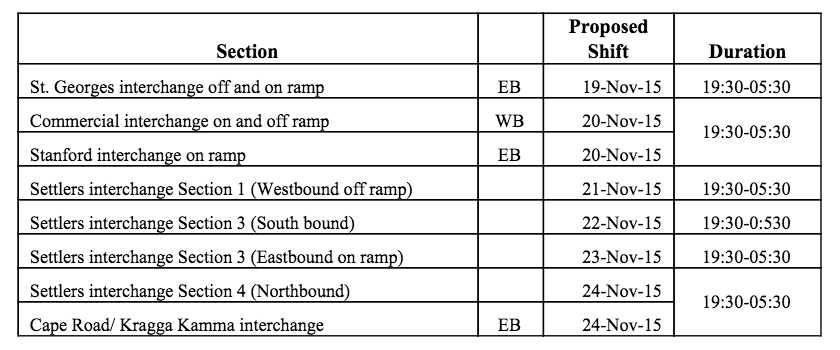
THE South African National Roads Agency Ltd (SANRAL) would like to notify travellers that blasting is scheduled to take place on the N2 between Grahamstown and Fish River Pass on Monday, Tuesday, Wednesday and Thursday, until 7 December. Blasting will generally be timed for 4pm and the road will be closed to traffic from 3pm to 5:30pm.

Blasting for today (23 September) is scheduled to take between from 1pm to 3pm.

The road closure is between the R67 intersection to Fort Beaufort (east of Grahamstown) to the Coombs intersection, which is between km 62 and km 79 on the N2 Section 13.

Motorists are requested to plan their trips accordingly and to be patient and be cautious when making use of the road.

Improvements on R37 between Burgersfort and Lydenburg near conclusion

It has been announced that reconstruction of the road between the Marconi intersection and Lydenburg is almost done.

The project will enter its final phase next month [subs: October] and be concluded in December this year.

This phase entails sealing the surface. It will improve the skid resistance of the surface whilst protecting the base layer from water seepage.

In December final road markings will be done and road signage erected.

The road could only be sealed once the winter embargo period – annually from May to September – was over. During the embargo no seal work can be done due to low winter temperatures; this includes seal aggregate to the existing surfacing.

The final seal surface will ensure a uniform surface over the full length of the road for a safe and durable surface for the road user.

Several safety improvements have also been done with one being the installation of additional guardrails in the mountain pass area. However, as a result of the improved road, motorists’ speed has increased.

“This deeply concerns us. We urge road users to obey traffic signs and markings – they are there for your safety. We ask you to be considerate of others who use the road – their safety depends on you,” says Vusi Mona spokesperson for SANRAL.

“We ask the public to be patient during the remaining phase of the construction work and to obey traffic signs, road markings and adhere to the speed limits at all times.

“We thank them for their patience thus far and apologise for the inconvenience and inevitable time delays during construction.”

Blame game by the City of Cape Town against SANRAL reaches a new low

The latest statement by the City of Cape Town blaming SANRAL for using the Cape High Court Interdict as an excuse not to do repair work on the N1 and N2, is outrageous, shameful and certainly not in the interests of road users in the Western Cape.

Vusi Mona, General Manager: Communications of the South African National Roads Agency SOC Ltd (SANRAL) says what makes the statement of Clr Brett Herron even more scandalous is that all parties yesterday agreed to a plan to improve safety on the N2 in view of the increase in criminal activity.

“There is nothing cheap about this so-called publicity stunt unless one regards human life as cheap.”

Mona stressed that the City of Cape Town’s court interdict against SANRAL prevents any works which fall under the scope of the N1 N2 Winelands Toll Project, from proceeding.

“Why should road-users be held at ransom by the City of Cape Town?”

Mona pointed out that much-needed upgrades including the street lighting on the N2, which was to form part of the N1 N2 Winelands Toll Project, could therefore not proceed.

He points out that Clr Herron does not understand the difference between maintenance and new installations, upgrades and infrastructure:

“The implications of the City’s actions are in fact extremely damaging and far-reaching. SANRAL’s plans to upgrade the N1 and N2 – which includes vital infrastructure such as street lighting, a centre median barrier and realignment of the N2 through Somerset West – have for all intents and purposes been halted by the City’s legal action.

These are the simple facts. We can see the carnage and severity of crashes from the Freeway Management System CCTV footage, much of which could have been prevented through the provision of appropriate road infrastructure.”

Mona clarified that nine kilometres of the road are the responsibility of the Cape Province, with 17km being looked after by SANRAL.

He said that over the past five years there had been more than 10,500 crashes on Cape Town’s busiest highways, 528 involving pedestrians and 44% resulting in death. SANRAL spends about R250 000 a month just to fix vandalised fences while thieves also targeted street lights.

“The question must be asked, how many more lives should be lost. Cape Town is a growing City, with growing traffic demands

The reality is that safe and appropriate road infrastructure is simply not keeping pace with this demand. Instead the City has opted for a legal battle that only benefits short term political ambitions. The City’s interdict against SANRAL is therefore ill-conceived and most regrettably, many road users will continue to pay the ultimate price for this.

Goodwill, common sense and sticking to the facts of a matter are vital ingredients in any attempt at solving a problem when different parties are involved. Unfortunately, neither is present in the approach of the City of Cape Town on the vexed question of road safety along major routes in the province.”

Empowering local communities in uMuziwabantu

The construction of access roads in the uMuziwabantu Local Municipality, KwaZulu-Natal forms part of SANRAL’s Community Development programmes and includes infrastructure upgrades and pedestrian safety improvements.

It entailed construction management and training services for the upgrade of access roads D911 and D912 from gravel surface into blacktop surface, using labour-intensive construction methods. These roads serve as a strategic link to the provincial roads P327 and P59.

By using labour-intensive construction methods, SANRAL ensures that the benefits derived from the project will be retained within the local communities.

The skills transfer will increase the probability of local residents getting meaningful employment in the construction sector, beyond the duration of the project. Thus, comprehensive classroom and on-site training, accredited by the Construction Education and Training Authority (CETA), are essential delivery requirements of the project.

To align with SANRAL’s social imperatives, the scope of the work included the selection of learners to undergo training at levels 2 and 4 of the National Qualification Framework (NQF), continuing mentorship of learners employed on the project, the identification of life-skill needs within the communities and the implementation of an appropriate training plan.

Almost 150 people were employed during the duration of the project, including 59 women, 114 youth and 6 persons with disabilities.

An additional objective was to source material from the local area. Fourteen 100% black-owned local suppliers are involved and the expenditure on SMME suppliers has reached R3.48 million.

project_in_numbers

SMME Programme: Kumshile’s story

For several years, FS & W Contractors, owned by Kumshile Nuku, was a dormant company until a golden opportunity to work on a project SANRAL presented itself in 2010. Located in the Eastern Cape, Kumshile employs 15 people and has expertise in road maintenance and construction of houses.

13a4c2f

“We are most grateful to SANRAL for having confidence in us and entrusting us with an exceptional project that helped get us off the ground. It has been a dream come true to move from a staff complement of just a handful of people to where are now.”

Over time, Kumshile’s company learnt from SANRAL how to perform tasks in an orderly and systematic manner. Gradually, the team gained confidence and good time management became second nature.

Kumshile believes education is a must for developing SMMEs wanting to make it big in the industry. He also said dedication, commitment and hard work should be guiding principles for growth.