A regional roads agency within SADC – based on the SANRAL model – was envisaged by Transport Minister, Dr Blade Nzimande, in Parliament.
The Minister made the remarks at the conclusion of his department’s briefing to the Portfolio Committee on Transport. This was his first meeting with the committee since his appointment to the Cabinet in February. He was accompanied by Deputy Minister, Sindiswe Chikunga,
According to media reports he said a regional agency for the Southern African Development Community – SADC – could help with regional economic integration and the development of infrastructure.
He told the committee that the department is considering the role it can play and the initiatives it can implement to achieve the objective.
In her response to the comments the chairperson of the committee, Ms Dikeledi Magadzi, reportedly said a Southern African SANRAL “is a step in the right direction.” The Development Bank of Southern Africa – DBSA – and the African Bank could get on board for this to work in line with the ideals of the African Union.
Dr Nzimande told the Committee that he is concerned about the funding of road infrastructure for the next 15 to 20 years.
“One of the bigger issues I have been thinking about – which is an ongoing issue – arises from GFIP. How do we move forward in the next 15 to 20 years? How do we raise finance for road infrastructure,” he asked.
“We will have to come up with a strategy of funding road construction and maintenance programmes on a sustainable basis.”
Referring to the “user pay principle” as a source for road funding he said that it would be inappropriate to scrap it entirely. “Those who can afford to pay, must pay,” he is quoted as saying, adding that there were complexities that should be considered for the way forward.
Priority should be placed on the maintenance of roads, which are often so run-down that they have to be rebuilt from scratch. “The lack of maintenance costs us dearly.”
Road maintenance also has the potential to create jobs and support local economic development, especially in rural areas. Service delivery should be more integrated to involve local communities, the Minister said.
Three accomplished professionals with extensive experience in the engineering and transport sectors were appointed to senior leadership positions in SANRAL.
Dumisani Nkabinde is the new Regional Manager for SANRAL’s Eastern Region, Randall Cable will be responsible for the Western Region and Progress Hlahla will lead the agency’s Northern Region. Their appointments took effect beginning of April.
Skhumbuzo Macozoma, the CEO of SANRAL, says the new appointments will strengthen SANRAL’s senior management team at a time when the organisation has embarked on a new stage of its journey to manage and maintain the country’s primary road network.
“We are also committed to the comprehensive transformation of the construction and engineering sectors through the greater participation of black- and women-owned companies in major projects,” he says.
SANRAL is proud that all three senior appointments were made from within the ranks of the agency which demonstrates the success of its internal transformation and leadership development programmes, Macozoma says.
Dumisani Nkabinde is a professional engineer with more than 14 years’ experience in the civil and construction sectors. He joined SANRAL in 2007 as a project manager based in Pietermaritzburg and has, subsequently, been responsible for key projects in the region which covers KwaZulu-Natal and the Free State.
He has a BSc-degree in Civil Engineering from the University of KwaZulu-Natal, an MBA and a Master’s degree from Stellenbosch. He served on the executive of the World Road Association and is currently part of an international committee to rewrite global standards for road and bridge construction.
The new Western Region Manager, Randall Cable, joined SANRAL in 1999 shortly after obtaining a Master’s degree in traffic and transportation engineering from Texas A&M University in the United States.
He has published research and papers on traffic management and the utilisation of technology and infrastructure to improve road safety and served on technical commissions to revise the World Road Association’s road safety manuals. SANRAL’s Western Region stretches across the Western Cape and Northern Cape.
Progress Hlahla is the new Regional Manager responsible for Gauteng, Limpopo, Mpumalanga and the North West. Prior to joining SANRAL in 2016 he gained experience in the private sector in the South African, Zambian, Mozambican and Zimbabwean project engineering environments.
He holds an MSc-degree in project and construction management from the University of the Witwatersrand and is a member of several professional bodies in South Africa and the United Kingdom.
SANRAL halts realignment due to contractor failing to meet standards of contract.
In order for SANRAL to ensure that a reliable and resilient road has been constructed, quality control is of utmost importance.
The realignment of the N2 at the Umhlali and Umvoti River Bridges has been delayed because the contractor had failed to source materials as specified in the contract.
South African National Roads Agency (SOC) Limited (SANRAL) said the safety of road users is paramount and will not be compromised through the use of sub-standard material or the poor performance of service providers.
The final decision to terminate the contract was because the contractor filed for business rescue, which ended up with the firm being sequestrated.
For several months angry motorists have vented their frustration in the media at the delay in the completion of the upgrading of the N2 at the northern ends of the Umhlali and Umvoti River Bridges, where sharp curves were to be flattened to reduce the number of crashes.
Ridhwaan Mahomed, SANRAL Eastern Region project manager, said the agency’s primary purpose is to provide a safe and efficient national road network for the benefit of all.
“In order for us to ensure that a reliable and resilient road has been constructed, quality control is of utmost importance. SANRAL has to ensure that all construction activities follow the specifications as set out in the contract to ensure that construction is undertaken to the highest standards,” said Mahomed.
“The contract documents also specify, amongst others, the minimum test results required to be achieved from various quality tests undertaken by an accredited laboratory.”
Mahomed said the constructed pavement layer, using material from local suppliers on the N2 project, did not meet the required specifications.
“There are three probable reasons why the pavement layer failed. Firstly, the supplier may have supplied incorrect material; secondly, the contractor could have contaminated the material while processing and placing it on site; and thirdly, the material could have broken down during compaction of the layer.”
New tender process for entire contract
He said SANRAL had attempted to assist the contractor with a revised pavement design to limit the contractor’s additional cost for removing and replacing the material.
However, SANRAL was made aware towards the latter part of 2017 that the contractor was placed under business rescue.
The original appointment value of the contract was R57.4-million. SANRAL only pays service providers for acceptable completed work. The contractor had only completed 27% of the original contracted work and was only paid for that amount of work.
Mahomed said when the contractor subsequently faced liquidation, a termination letter was sent.
“We are currently busy with a new tender process. The feedback from the National Treasury is that we have to re-tender and cannot appoint the tenderer with the second-highest points, which was SANRAL’s initial recommendation as an attempt to expedite the process.
“We have to re-tender the entire contract and hopefully we will have a new contractor on site by September. Meanwhile we humbly request all motorists to bear with us as we are trying our utmost best to resolve the situation.”
SANRAL invests R90-million for three new bridges across the N17.
All the bridges have rest points for the elderly and disabled, while concrete bollards at the entrances prevent cars from driving on the surfaces.
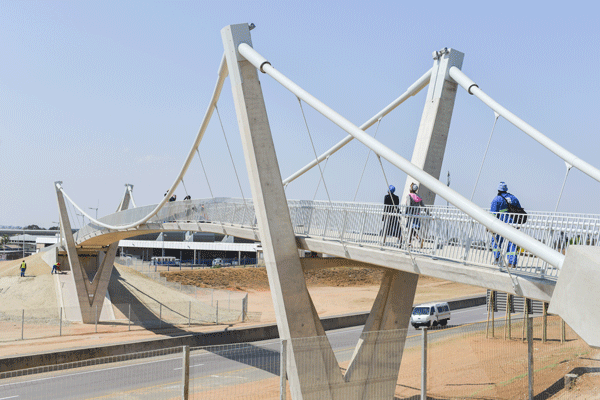
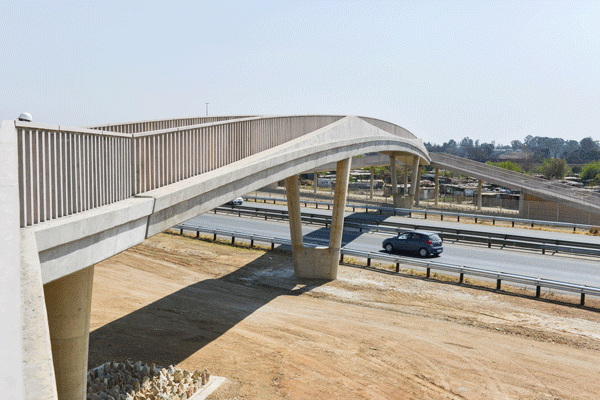
The safety of pedestrians on the East Rand has improved significantly with the construction of three new pedestrian bridges across the busy N17 between Springs and Johannesburg.
The three bridges constitute a R90-million investment in road safety and engineering excellence by the South African National Roads Agency (SOC) Limited (SANRAL), which is responsible for the management of this important regional road.
The N17 is a national toll route that runs from Gauteng, through Mpumalanga, to the Swaziland border. Pedestrian safety has been a major concern in the urban areas of Ekurhuleni and eastern Johannesburg.
Several pedestrians and cyclists trying to cross the busy double-carriageway have been hit by vehicles in recent years. SANRAL’s solution was to construct three new pedestrian bridges across the freeway – in line with its commitment to provide safe road infrastructure.
The new bridges were completed in August 2017.
Safety needs of pedestrians and cyclists paramount
SANRAL Project Manager Tshidi Lethale said: “An important part of our work is to ensure our roads are safely engineered for all road users.
“Pedestrians are the most vulnerable road users. That is why the safety needs and requirements of pedestrians and cyclists are considered in the planning, design and implementation of road infrastructure.”
No details were spared during the design and construction phases. The bridges are maintained and inspected rigorously.
All the bridges have rest points for the elderly and disabled, while concrete bollards at the entrances prevent cars from driving on the surfaces.
In the Springs/Brakpan area, an 82.4m-long pedestrian bridge was constructed to cross the freeway at an angle. Stone pitching was placed beneath the bridge to prevent people from making fires that could compromise safety and cause the bridge to deteriorate.
Slightly to the west, another bridge now connects KwaThema with Springs and Brakpan. Closer to Johannesburg, the N17 passes close to busy public facilities such as Wemmer Pan, City Deep and the Joburg Market.
The new KwaThema pedestrian bridge will address major safety concerns related to people crossing the freeway at a stretch that carries a lot of traffic.
The new self-anchored suspension bridge has a main span of 57m, with a reinforced concrete deck suspended from stress bars. The new SANRAL bridges are welcome additions for the communities whose lives are being improved.
“The bridge changed our lives,” said Sibongile Sibiya, the ward committee member representing the Mkhancwa informal settlement in the Springs/Brakpan area. “Before the pedestrian bridge was constructed, there were multiple deaths.”
Women from Eastern Cape communities complete a life-changing training programme with SANRAL.
The group will undergo further training through a business skills programme that will take place in early June.
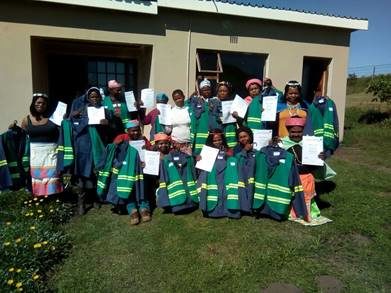
Twelve women from the Mtentu and Lusikisiki communities (OR Tambo and Alfred Nzo Districts) in the Eastern Cape, recently completed a training programme with the South African National Roads Agency (SOC) Limited (SANRAL).
The programme equipped them with the skills needed to sew overalls for contractors and labourers working on the Mtentu Bridge construction project.
The group of trainees comprised five females and one male from Mtentu in the North Bank of the bridge as well as seven females and one male from Lusikisiki in the South Bank.
The group will undergo further training through a business skills programme that will take place in early June.
Contractor Training Executive, Robert Simelane of Aveng Grinaker-LTA, the main contractors on the construction of the bridge said: “The plan is to set the group up as two cooperatives that will be tasked with branding protective equipment as well as sewing overalls for the contractors and Mtentu Bridge project labourers.
“We are currently setting up the site with equipment, which should be done by August. Leading up to that, we aim to deliver a training programme on business skills as we want this group to be self-sufficient when the Mtentu Bridge project concludes. After this, they will go on site and start with the work.”
A lasting legacy
Iphulo Lamampondokazi Primary Cooperative, a local cooperative comprised of three beadwork trainers and two sewing trainers, was subcontracted by Aveng Grinaker-LTA to deliver the training programme.
Lead trainer Buyiswa Mdontso said the group had been quick to learn.
“For some, it was their first interaction with a sewing machine. The training covered sewing techniques for tracksuits and overalls. This training will present the trainees with an opportunity to generate additional income through sewing tracksuits for local schools,” she said.
Dr Mongezi Noah, SANRAL Southern Region Community Development Specialist, said the trainees were selected by the Project Liaison Committee because of their reputation for quality work.
“The community was consulted and agreed these are the type of people they could send for training. These individuals are not working and the only thing that helps them
put food on the table is sewing. But living in rural areas where people seldom use their services makes them suffer even more,” he said.
“The intention is for them to continue using the skills they have learnt, thus expanding it to tourism by supplying traditional garments and many other things that would provide stock for an envisaged tourist centre at the bridge. Not forgetting to mention that they will create more job opportunities for the AmaMpondo community,” added Dr Noah.
Trainees look to the future
Nompumelelo Nokoni, one of the female trainees, said the programme contributed towards her independence as a woman to provide for herself and her family.
“Through this programme I gained a lot of knowledge and experience because I did not even know how to operate a sewing machine before and now I can operate it with ease,” she said.
Reflecting on how she plans to utilise her new skill beyond the Mtentu Bridge construction project, Nombuyiselo Phiwayo said:
“The aim is to do well on this project and impress SANRAL so they hire us as permanent employees and I can take care of myself and my family.”
Sibongiseni Ntsema, a local well known for his sewing work, was selected to ensure people living with disabilities would also benefit from the project. Ntsema is wheelchair bound.
“In the past I could only sew traditional clothing, so I now have an added skill. They have also promised to get me an arm roller sewing machine to make things easier for me when we get started with the work,” he said.
Mtentu Bridge to be the highest in Africa
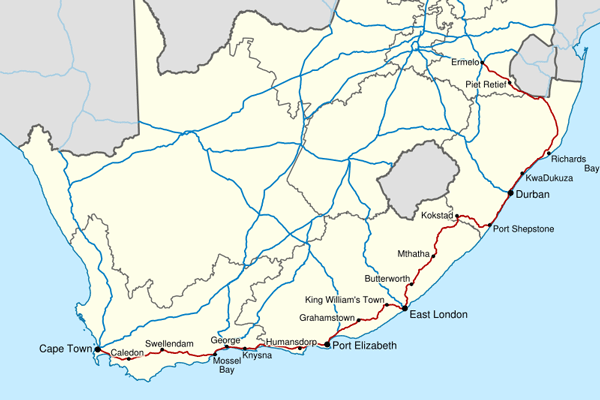
The Mtentu Bridge project forms part of the green fields portion of SANRAL’s N2 Wild Coast Road project. It extends over 560km from the Gonubie Interchange in East London to the Isipingo Interchange south of Durban and is set to save road users up to three hours of travelling time upon completion.
To date, approximately R4-million has been spent on local sub-contractors, SMMEs and local suppliers in the Mtentu Bridge construction project, a considerable contribution to the local economy and job creation.
At the end of the 40-month construction period, the 1.1-km long Mtentu Bridge will break records as the highest bridge in Africa and the Southern Hemisphere at 223m high.
‘Average speed’ system encourages adherence to limits on the nation’s roads.
Through the implementation of Asod, traffic authorities can move away from the “surprise” method of speed limit enforcement and encourage safe and sensible behaviour among road users.
The introduction of innovative technology to curb speeding on major highways has resulted in a significant reduction in contraventions.
Average Speed over Distance – Asod – is a growing global trend in speed enforcement. In the Western Cape, where it has been installed since 2013, it has contributed to a significant drop in speeding, said Randall Cable, the Engineering Manager for SANRAL’s Western Region.
“This collaboration with the Western Cape Department of Transport is an example of how partnerships and cutting-edge technology can offer solutions for some of the country’s most pressing safety issues, particularly road fatalities caused by speeding,” he said.
Through the implementation of Asod, traffic authorities can move away from the “surprise” method of speed limit enforcement and encourage safe and sensible behaviour among road users.
Asod is a method of speed enforcement where the system calculates the average speed of a vehicle, measured from the time it passes a camera, until it reaches a second camera at a fixed distance further down the road.
The cameras are carefully calibrated and the technology can recognise the vehicle’s number plate. Time-stamped pictures are taken at both locations. Should the vehicle pass the second camera in a shorter time than what is determined by the speed limit, it indicates that the driver was exceeding the posted limit.
The system has been installed on portions of the N1, N2 and R61 routes in the Western Cape. There are ample warning signs informing road users they are about to enter a monitored stretch of road with accompanying messages to encourage adherence to the speed limits.
Higher level of compliance with speed limits
Cable said the Asod measurements are routinely used as evidence in prosecutions for speeding, but the real benefits of the technology are its ability to change speed behaviour.
“The concern is that road users only adhere to the speed limits to avoid punishment. We must focus our efforts more on the encouragement of good behaviour rather than on punishment for transgressions,” said Cable.
“Our experience with Asod shows that most drivers are willing to follow this approach, while the technology ensures transgressors are identified and suitably punished.”
The statistics support this approach. According to Cable, there are higher levels of compliance with speed limits on the roads where the system is installed and a concurrent reduction in fatal crashes.
However, speed remains a major contributor to road crashes and fatalities. Global and local evidence shows a direct relationship between increased vehicle speeds and increased severity of injuries.
In addition to enforcement systems such as Asod, engineering and technology initiatives have been introduced by SANRAL to address the issue. These include measures such as speed-calming road designs and the introduction of intelligent transportation systems, which include CCTV camera surveillance.
Interaction with industry players and communities avital part of SANRAL’s Horizon 2030 strategy.
Progress Hlahla said he understands there are high expectations about SANRAL’s future plans within the built and engineering environments – especially among small- and medium-sized contractors.
Progress Hlahla, recently appointed as the new manager of the South African National Roads Agency (SOC) Limited’s (SANRAL) Northern Region, is looking forward to engaging with professional bodies, contractors, small- and medium enterprises and communities on the impact of future projects.
SANRAL intends to extend its consultation and communication with industry players in the built and engineering environments to ensure a greater understanding of its strategic objectives.
Hlahla’s appointment comes at a time when SANRAL has adopted Horizon 2030, a new long-term strategy to redefine its objectives at the start of its third decade as the agency responsible for the design and management of South Africa’s primary road network.
SANRAL has also just completed a stakeholder roadshow across all nine provinces during which it explained the aims of Horizon 2030 and its plans to accelerate the transformation of the construction and engineering sectors.
Hlahla said he understands there are high expectations about SANRAL’s future plans within the built and engineering environments – especially among small- and medium-sized contractors.
“SANRAL’s role goes beyond road design, engineering and project management. Roads are a public good because they unlock economic value within the country and the region,” said Hlahla.
“If you don’t provide people with sufficient access to economic opportunities through quality roads you fail to unlock this economic value.”
Hlahla says his first objective is “to get a bird’s eye view” of all SANRAL projects in the region and to interact with his colleagues in the Northern Region.
“I am very fortunate that I will be working with a great team. My role is to create an environment where we can all participate meaningfully to achieve shared objectives,” he said.
A better understanding
Through effective communication and consultation SANRAL wants to ensure there is a greater understanding about construction projects, especially among communities affected by new or upgraded roads.
“The last thing we want to see is that a project is stopped or delayed because of a failure to communicate. We have to talk to communities and industry participants and inform them about where a specific project fits into SANRAL’s broader strategy,” said Hlahla.
Hlahla realises there are great expectations from SANRAL in terms of job creation, transformation and the generation of opportunities for emerging contractors. These aims are also highlighted in the agency’s transformation strategy.
“SANRAL is governed by legislation, including the Public Finance Management Act,” he said.
“In addition, we have to identify the best ways to bring emerging contractors on board and to involve them in projects where the work is often of a very specialised nature.”
One solution might be to package future projects differently, in ways both large and small contractors and communities can participate in projects without compromising quality.
These are among the issues that Hlahla wants to discuss in his future engagements with industry players and professional bodies in the construction, engineering and transportation sectors.
Extensive experience
Hlahla, a professional engineer with wide experience in construction, road network planning and transportation, succeeds Ismail Essa, who was appointed as SANRAL’s Transformation Manager.
The 34-year old, who holds a Master’s degree in Project and Construction Management from the University of the Witwatersrand, now heads up SANRAL’s operations in Gauteng, Mpumalanga, Limpopo and the North West.
Prior to joining SANRAL in 2016, Hlahla gained extensive experience in the broader engineering and construction fields.
He served as Deputy Chief Engineer in the Gauteng Department of Roads and Transport, participated in transport planning for the 2010 Soccer World Cup and was involved in the Gauteng Freight Implementation Strategy.
During his career in the private sector he was the project leader for the Polokwane bus rapid transit system and oversaw projects on the Gautrain network and Greenpoint Stadium, as well as projects in Zimbabwe, Mozambique and Zambia.
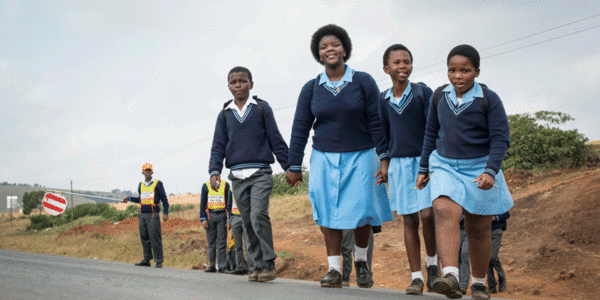
Education and good examples play a vital role in influencing safe road behaviour among children from an early age.
Education specialists are developing learning opportunities containing road safety messages that can be used in mainstream subjects such as languages, mathematics, science, geography, arts and culture.
Children are easily influenced while young and parents should take advantage of this to teach them road safety rules.
“Children follow the example set by their elders and the behaviour they will themselves display as adults is determined at an early age,” said Elna Fourie, SANRAL Manager: Road Safety Education and Awareness.
The global trend in road safety education and awareness campaigns is to create partnerships between road authorities, law enforcement, civil society and communities in the broader efforts to reduce crashes and the number of fatalities.
SANRAL’s own programmes are in line with the Decade of Action for Road Safety launched by the United Nations and the World Health Organization.
In its objective for “safer road users”, the UN Action Plan calls for increased awareness about road safety risk factors and campaigns that can help change attitudes and opinions.
“Knowledge gives power,” said Fourie. To this end SANRAL has already built a strong partnership with the districts of the Department of Basic Education (DBE), provincial and local transport authorities, as well as individual schools that are part of its ongoing research and road safety education programme.
Teaching road safety to a broader audience
This year will see the roll-out of specially developed teaching aids and course material, which will be supported by workshops and mentoring programmes for teachers. But the aim is to reach a broader audience and include parents – and even grandparents – in the workshops that will be held in the communities around identified schools.
The intention is to equip them with knowledge about the specific road safety risks associated with children – especially as pedestrians and passengers using public transport that ferry them to and from schools.
Once parents are aware of the risks, they will be able to work on their own behaviour and set a good example to learners.
Fourie said SANRAL’s programmes are based on a longitudinal research project that was conducted in communities located close to hazardous locations on the national road network.
This links to an ongoing evaluation of data and feedback from educators and researchers on the impact of programmes.
New learning opportunities for teachers have been developed to reflect the experience gained over the past few years.
The research conducted by SANRAL concluded that road safety is a transversal subject. One of the objectives is to integrate road safety awareness into the broader education curriculum – especially in the later primary and secondary stages.
The education specialists are developing learning opportunities containing road safety messages that can be used in mainstream subjects such as languages, mathematics, science, geography, arts and culture.
“We want to reach a stage where all the information that is offered to learners through teachers, parents, civil society and social media lead to changed behaviour and safer road use,” said Fourie
New leaders announced for SANRAL’s Eastern, Western and Northern Regions.
Dumisani Nkabinde, the new manager of the Eastern Region, has a wealth of experience in the civil and construction sectors.
The South African National Roads Agency (SOC) Limited (SANRAL) have appointed three accomplished professionals to leadership positions in three regions, strengthening the Agency’s senior management team.
Dumisani Nkabinde, the new manager of the Eastern Region, has a wealth of experience in the civil and construction sectors. Randall Cable, who will be responsible for the Western Region, and Progress Hlahla, who will lead the Agency’s Northern Region, have extensive experience in the engineering and transport sectors.
Their appointments took effect at the beginning of April.
Promoting senior management from within
SANRAL CEO Skhumbuzo Macozoma said the new appointments will strengthen SANRAL’s senior management team at a time when the organisation has embarked on a new stage of its journey to manage and maintain the country’s primary road network.
“We are also committed to the comprehensive transformation of the construction and engineering sectors through the greater participation of black- and women-owned companies in major projects,” he said.
Macozoma added that SANRAL is proud that all three senior appointments were made from within the ranks of the agency, which demonstrates the success of its internal transformation and leadership development programmes.
A wealth of experience
Nkabinde is a professional engineer with more than 14 years’ experience in the civil and construction sectors.
He joined SANRAL in 2007 as a project manager based in Pietermaritzburg and has, subsequently, been responsible for key projects in the region, which covers the provinces of KwaZulu-Natal and the Free State.
He has a BSc in Civil Engineering from the University of KwaZulu-Natal, as well as an MBA and master’s degree from Stellenbosch. He served on the executive of the World Road Association and is currently part of an international committee to rewrite global standards for road and bridge construction.
Cable joined SANRAL in 1999 shortly after obtaining a master’s degree in traffic and transportation engineering from Texas A&M University in the United States.
He has published research and papers on traffic management and the utilisation of technology and infrastructure to improve road safety and has served on technical
commissions to revise the World Road Association’s road safety manuals. SANRAL’s Western Region stretches across the Western Cape and Northern Cape provinces.
Hlahla is the new Regional Manager responsible for Gauteng, Limpopo, Mpumalanga and the North West.
Prior to joining SANRAL in 2016 he gained experience in the private sector in the South African, Zambian, Mozambican and Zimbabwean project engineering environments.
He holds an MSc in project and construction management from the University of the Witwatersrand and is a member of several professional bodies in South Africa and the United Kingdom.
Four arrested for stealing drains and fences on highways, potentially putting road users in danger.
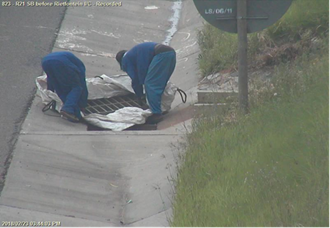
Two men in blue overalls were spotted on the R21 southbound after Griffiths Road stealing drain grids, leaving a huge unprotected hole on the side of the highway.
Teamwork and swift reaction between the Gauteng Traffic Management Centre (TMC) and law enforcement officials resulted in the arrests of four men caught in the act of stealing fixtures on two of the province’s highways.
The four, in two separate incidents, were captured on the cameras of the TMC, their actions endangering the lives of road users.
Two men in blue overalls were spotted on the R21 southbound after Griffiths Road stealing drain grids, leaving a huge unprotected hole on the side of the highway.
The TMC immediately notified the Ekurhuleni Metro Police and SANRAL’s On-Road Services. They responded immediately and caught the perpetrators in the act, stopping the theft.
In another occurrence, two men in a white bakkie stopped on the side of the N1 southbound after the Proefplaas Interchange. The camera showed them stealing a palisade fence, thus making it possible for pedestrians to walk across the highway, endangering their lives.
The TMC alerted the Tshwane Metro Police who chased the men. They eventually pulled them over at Rigel Avenue and arrested them.
These are but two of the high number of incidents, other than accidents, which occur along the highways in Gauteng. This can be seen from the fact that during the last financial year only about a quarter of all incidents were related to crashes.
Incidents cover a wide variety of occurrences on the roads, including stranded vehicles, attempted theft of SANRAL property, dangerous driving, illegal parking on the side of the road and others.
‘Critical success factor’
The integrated annual report of the roads agency describes the on-road service unit in Gauteng as “a critical success factor” – it comprises 10 incident response units, 10 light towing units, six heavy recovery units and 12 medical response units.
Close collaboration with the relevant metro police units of cities along the highways is vitally important.
“Road safety is important to SANRAL, as is the safety of motorists who may be stranded or need help. Rapid response is vital in all cases and the TMC is a vital cog,” said Vusi Mona, SANRAL’s General Manager: Communications