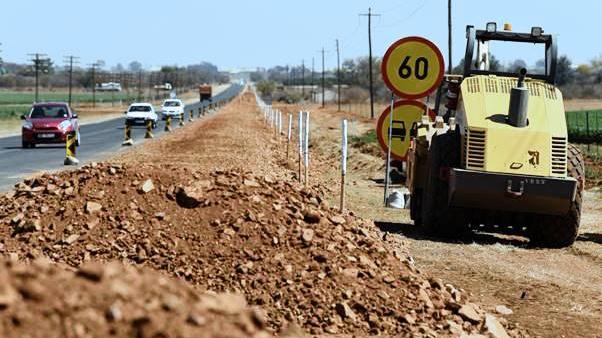
Moloto Road runs north-eastwards from Pretoria, traverses three provinces and ends at the N11 near Marble Hall.
The Gauteng section will be funded by the Gauteng provincial government.
Construction of the first phases of the upgrading of R573 Moloto Road, a 137km stretch from Gauteng to Mpumalanga and Limpopo, is nearly complete.
The project officially started in 2015.
The South African National Roads Agency (SOC) Limited (SANRAL) has invested R3.7-billion in the project over a period of five to six years.
The budget is for the Mpumalanga and Limpopo sections only. The Gauteng section will be funded by the Gauteng provincial government.
Thirty percent of the project value will be awarded to SMMEs.
The scope of work for the first phase (Mpumalanga and Limpopo) included the construction of four traffic circles; three in Mpumalanga – at Vlaklaagte 1 & 2 and Tweefontein – and one in Limpopo – at the intersection of the N11 and R573 in Marble Hall.
No work has gone out to tender for the Gauteng section of the project, as the project is still in the design phase.
The butterfly intersection Mathys Zyn Loop was also constructed, which included widening road lanes to 3.7m with a 3m shoulder on both sides.
There are three phases currently at the design stage, which will go out to tender during 2019.
SANRAL will continue to keep communities updated on all relevant information regarding the project. Alternatively, more information can be accessed on the SANRAL website www.nra.co.za
Local communities are asked to respect beacons placed by surveyors that indicate the national road reserve.
Not only is this illegal, it’s a safety hazard. Consumers flocking to the area run the risk of being hit by fast-moving cars when crossing the road.
Encroachment and erection of illegal structures close to the road reserve on R573 Moloto Road continues.
The South African National Roads Agency (SOC) Limited (SANRAL) has partnered with local municipalities and consulted local traditional authorities to address this, but the problem persists.
At the start of the project, SANRAL embarked on a roadshow to educate stakeholders on statutory control issues and the allocation of tribal land to communities, but it’s an uphill battle.
Mostly, the culprits are individuals who erect informal businesses close to the road reserve and start trading.
Not only is this illegal, it’s a safety hazard. Consumers flocking to the area run the risk of being hit by fast-moving cars when crossing the road.
SANRAL is committed to community development and supporting local business.
However, it cannot risk the lives of others and be at the mercy of illegal hawkers.
SANRAL appeals to communities and stakeholders for their cooperation, in particular those encroaching on the road reserve and ignoring building restrictions.
Community members are requested to follow proper procedures in acquiring land.
Local communities are asked to respect beacons placed by surveyors that indicate the national road reserve.
Headmen/chiefs must not allocate stands inside the road reserve.
SANRAL’s investments will bring relief to the broader construction sector, which is currently experiencing a downturn in business after a difficult 18 months.
All SANRAL construction projects will now include community development programmes and initiatives to support the transfer of skills to SMME companies.
The South African National Roads Agency (SOC) Limited (SANRAL) is ramping up its investment in road infrastructure back to familiar levels through its R70-billion medium term budget allocation to implement construction and maintenance projects across the country.
SkhumbuzoMacozoma, the CEO of SANRAL, said: “This increased investment will rejuvenate the construction and engineering sectors, create jobs and support the growth of small and medium enterprises.”
Infrastructure investment
SANRAL’s 2019/20 budget for the construction of roads, rehabilitation and maintenance projects is set at R24.4-billion.
This will grow at an average rate of 5.1% over the medium-term framework reaching a total of R70-billion. This budget includes the R3.5-billion stimulus package allocation that was recently announced by the Minister of Transport.
Macozoma said this ramp up on road infrastructure spending follows a difficult 18-month period of subdued expenditure.
“We are happy that most of the challenges we experienced with National Treasury, which affected our tender processes, have been addressed. SANRAL affirms its commitment to comply with applicable procurement regulations, while ensuring inclusive participation in its projects.”
SANRAL’s investments will bring relief to the broader construction sector, which is currently experiencing a downturn in business. There are projects in the pipeline and this will contribute to an upswing in construction activities.
This budget allocation provides a perfect opportunity for SANRAL to roll out its Horizon 2030 strategy, support the objectives of the National Development Plan, and contribute to the successful implementation of the Strategic Integrated Projects (SIP) and Special Economic Zones.
“The projects planned for the MTEF also have a strong focus on community development across all nine provinces, in both urban and rural centres,” said Macozoma.
“Roads contribute to balanced economic development, empower communities, facilitate the movement of people and goods and create equitable access to vital services. The prioritisation of community projects will be done jointly with communities to ensure that real and relevant benefits are left in communities after completion of the projects.”
The projects will comprise a spread of road works including:
The improvement in key corridors such as the N2 Corridor, N3 Corridor and N1Corridor;
Expansion of key pieces of infrastructure including dual carriageway construction, interchange improvements and single carriageway cross section improvements;
Bridge and storm-water infrastructure improvements;
The expansion of Intelligent transport systems to a larger part of the road network;
Road safety improvements and public transport enablement.
These 740 new construction projects are spread across the entire 22 214km of the primary road network managed by SANRAL.
Communities and SMMEs benefit
Communities from Rustenburg in the North West to Giyani in Limpopo, to the Karoo and the Northern Cape will benefit from construction activities and the provision of safer and more accessible roads.
Macozoma said SANRAL’s investments in infrastructure will greatly benefit emerging enterprises and new players in the construction and engineering sectors.
“All new tenders will be published in line with the new Transformation Policy at SANRAL, which seeks to increase the participation of black business and the development of SMMEs. Tender requirements will also increasingly demand the targeted focus on enterprises that are owned by women, youth and people with disabilities.”
Some 7 810 SMMES will benefit from SANRAL projects over the next three years with plans to create an estimated 81 000 jobs on road construction and maintenance projects.
All SANRAL construction projects will now include community development programmes and initiatives to support the transfer of skills to SMME companies.
Macozoma said: “SANRAL will soon establish supplier development desks at its regional offices to ensure structured assistance to suppliers including contractors, consultants and material suppliers. This will be enabled by the numerous partnership agreements that SANRAL is pursuing with big industry players in the areas of equipment supply, mentoring, material supply, business and financial management.”
It is important to understand that stakeholders must not only be involved in all the steps but must understand why these steps are being taken.
Siphiwo Mxhosa, SANRAL Stakeholder Relations Manager, believes the roads agency has embarked on a vigorous process of contributing to the transformation of the construction industry through, among others, its procurement policy, which favours black- and woman-owned SMMEs.
The message is a simple one, but it is getting more urgent than ever: stakeholders must be taken along step-by-step in any development.
Though SANRAL has always had this stakeholder approach, recent events underscore just how significant this is.
It is important to understand that stakeholders must not only be involved in all the steps but must understand why these steps are being taken. We always follow the correct legal route when dealing with development projects.
Equally important, we emphasize that the broader community’s participation and input is significant.
It’s not only the provincial and local authorities who are important stakeholders to us, but also traditional and community leaders.
While state-owned enterprises (SOEs) serve all the people of the country and are not tied to a ruling political party, it is an inescapable fact that the broad strokes of that party’s policy, which obviously becomes government policy, provide the background against which an SOE like SANRAL operates.
It is exactly this that has made much more stakeholder engagement necessary. Economic transformation is the current watchword.
Understandably, this has raised expectations among the broad public. SANRAL is an enthusiastic proponent of economic transformation.
We have developed a new strategy, known as Horizon 2030, and a Transformation Policy, aligned with the government’s policy and the overarching National Development Plan.
The roads agency has embarked on a vigorous process of contributing to the transformation of the construction industry through, among others, its procurement policy, which favours black- and woman-owned SMMEs.
But SANRAL has done much more. We have realised that lack of capital and expensive road construction machinery is a problem for small companies.
So, we have partnership agreements with big companies who deal in this machinery to give SMMEs a leg-up.
What continues to challenge us is that on many of our construction sites, previously disadvantaged South Africans appear and demand a slice of the pie without following the required procurement processes put in place by the National Treasury.
Some even go outside of the rules, ignoring that the minimum contract requirement of 30% has been reached.
The lesson SANRAL takes from this is that we need more stakeholder engagement, it should begin earlier, and it must last throughout the contract lifetime.
This is an opinion piece by SiphiwoMxhosa, SANRAL Stakeholder Relations Manager.
Learners from Eastern Cape schools exposed to the science of road building as a career path.
Makhosandile Nondinyana (left) a KSD TVET College civil engineering student who is doing his internship on SANRAL’s project in Cradock was explaining to learners how the periodic table help civil engineers use elements in material design.
The South African National Roads Agency (SOC) Limited (SANRAL) exhibition at Scifest Africa 2018 proved to be a hit with school children in Grahamstown this month.
Established by the Grahamstown Foundation in 1996, SciFest Africa is South Africa’s national science festival, promoting public awareness, understanding and appreciation of science, technology and innovation in South Africa. The festival celebrated its 22nd anniversary event from 7-13 March 2018 in Grahamstown.
At this year’s SciFest about civil engineering, SANRAL’s exhibit explained the importance of building good roads, the different road signs and what line markings are. It also highlighted scholarship and bursary opportunities available to learners in primary and high schools.
Michelle Ah Shene, SANRAL marketing and communications representative, said: “There has been an influx of learners enquiring about the scholarships and bursary programmes. The younger learners were also very excited about what makes line markers glitter and what civil engineering entails.”
Learners can apply for the SANRAL scholarship programme, which supports academically deserving applicants from grades 10 to 12. The minimum requirements are an overall average of 75% with subject choices that include maths, physical science and English. For further information on the bursary and scholarship programme visit www.nra.co.za
“Approximately 122 students at tertiary institutions are pursuing their academic goals with the support of SANRAL bursaries and about 196 high school learners have received scholarships,” Ah Shene concluded.
Learners inspired to help communities
Likhona Duba, an 11-year-old grade six learner at Sinako Lower High Primary School, had enjoyed the experiments and “really liked learning more about road signs and knowing the difference between permanent and temporary ones”.
For Paul Papiso, a teacher at Sinako Lower High Primary School, the road signs part of the SANRAL exhibition was important as road signs form part of the natural science and technology syllabus.
Aviwe Nzema, a 16-year-old from Khulani Commercial School in East London, would like to be a pilot or civil engineer someday: “I love doing things for my community and think building bridges and roads so that people will have quicker access to clinics or schools is a good way of helping the community.”
SakhileNdaba, an 18-year-old matric learner at Butterworth High School, said his first time visiting the SciFest had been important: “I believe what we learn at the SciFest will help us with our school work. I would like to be a civil engineer like my brother who inspires me.”
AphiweNogqala, 18, also in matric at Butterworth High School, also wants to follow in his aunt’s footsteps who is a civil engineer based in Cape Town: “There will always be a need to build roads to make trips shorter between towns and cities. Building better and safer roads can reduce road accidents.”
Spin-offs will include employment, Eco-tourism and economic development.
The N2 West Coast road aims to connect Eastern Cape and KwaZulu-Natal and create economic opportunities for the communities living on the Wild Coast.
The construction contracts on the green-fields portion of the new N2 Wild Coast route are projected to spend over R400-million in wages and create approximately 8 000 direct jobs from the main contractors.
With almost R3-billion projected to be spent on SMME suppliers and sub-contractors as well as the turnover effect of wages, a huge boost in indirect jobs in the local region can be expected.
The new route will bring:
Regional economic development
Significantly faster delivery times and lower transportation costs between KZN and EC;
Shorter and flatter route will result in a 1½ to 3 hours saving in travel time, particularly for heavy vehicles;
About R1.55-billion per year in time cost savings to the economy.
Local economic development
Positive impact on the local economies of Port St Johns, Lusikisiki and Mzamba, as well as Flagstaff, Bizana and Holy Cross.
Major eco-tourism and conventional tourism opportunities
Over 600 000 additional tourists over 10 years projected;
Wild Coast will be a viable weekend destination for KZN residents;
New route will open a potential tour bus or self-drive route from Port Elizabeth to Durban;
Strict environmental legislation will ensure only a limited number of coastal nodes can be developed commercially and will ensure that the Wild Coast will remain ‘wild’;
The two mega bridges, particularly the Msikaba cable stay bridge, will be tourist attractions in their own right. A tourism visitors centre is planned for the Msikaba bridge;
The numerous spectacular waterfalls between PSJ and Port Edward can be developed into a ‘waterfall route’.
Local socio-economic development
Improved access to healthcare, education and other social and economic opportunities;
Improved access to agriculture and other local economic activities.
A weight limitation has been placed on the bridge, with no abnormal vehicles allowed.
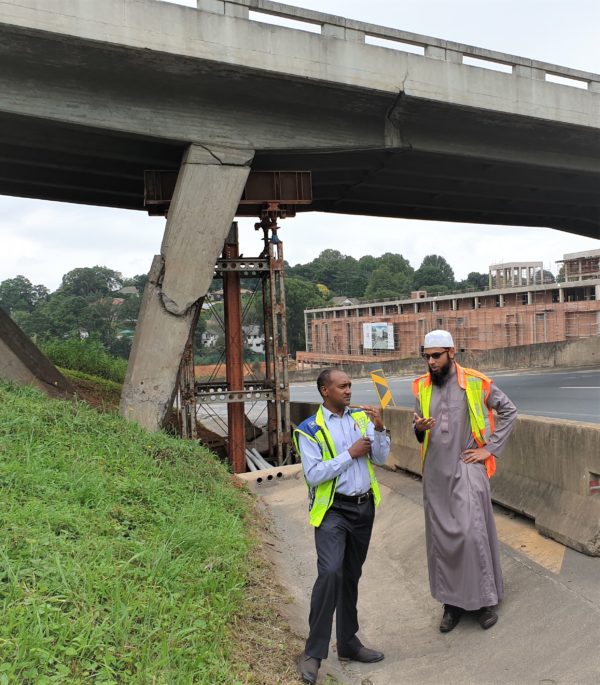
Ravi Ronny, SANRAL Eastern Region Design Planning and Construction Manager and SANRAL Eastern Region Project Manager and Structures specialist Mohammed Parak at the bridge.
Engineers have declared the Peter Brown bridge in Pietermaritzburg safe for use.
Following a site visit by engineers from the South African National Roads Agency (SOC) Limited (SANRAL), the bridge across the N3 has been considered safe to be used by normal vehicles.
The bridge was damaged when a truck collided with it in 2016, damaging one of the structural columns.
SANRAL Eastern Region Project Manager and Structures specialist Mohammed Parak said temporary steel frames had been erected to adequately support the bridge in place of the damaged column.
Regular inspections
“The safe load restriction for the surrounding roads is 20 tons and therefore the same weight limitation has been placed for the bridge. The bridge is inspected regularly by SANRAL engineers and any areas of concern are attended to as quickly as possible,” said Parak.
Ravi Ronny, SANRAL Eastern Region Design Planning and Construction Manager, said the bridge is monitored by SANRAL’s routine road maintenance team daily.
“The estimated cost of upgrading the bridge, which only requires a few months to fix, is between R3 to R5-million,” he said.
He added abnormal vehicles were not allowed to use the bridge.
After the installation of the temporary steel frame structure, the bridge was surveyed and a complete repair design was completed by structural design consultants, GIBB Engineering and Architecture.
SANRAL Eastern Region project manager Hugh Brooks said: “As with any road construction site, abnormal vehicles should obey the adequate load restriction signs that are in place along the N3 leading up to the bridge.
“There has been a delay in the finalising of the construction tender document to ensure maximum participation of black SMMEs in the contract in line with the new PPPFA regulations.”
Brooks concluded that the bridge is structurally safe to accommodate vehicles that adhere to the restriction measures applicable to the local roads in the area.
SANRAL has placed this project high up on the regional tender timetable for the 2019/20 financial year.
The expo seeks to expose rural schools to SANRAL’s career opportunities, internships, and scholarship and bursary programmes.
HARD WORK PAYS OFF: Businesswoman and motivational speaker Bongiwe Mafani and actor Moshe Ndiki were speakers at SANRAL’s Career Expo in Mdantsane in the Eastern Cape.
The South African National Roads Agency SOC Limited (SANRAL’s) national Career Expo kicked off in Mdantsane in the Eastern Cape recently, with more than 1 000 Grade 9 learners from nine high schools attending.
The learners were addressed by motivational speaker and businesswoman BongiweMafani, actor Moshe Ndiki and SANRAL Southern Region’s research associate and PhD candidate Keith Nare.
The two-day expo, hosted by SANRAL in partnership with the Eastern Cape Department of Education (EC DoE), was held at the Dr WB Rhubusana Building in Mdantsane and the Mdantsane Public Library in Nu 14 on Thursday 28 February and Friday 1 March respectively.
Bringing rural schools’ options
The expo seeks to expose rural schools to SANRAL’s career opportunities, internships, and scholarship and bursary programmes. It is also aimed at increasing SANRAL bursary and scholarship beneficiaries in the province.
During the 2017/18 financial year, 161 students received SANRAL bursaries to pursue higher education and 203 high school learners were enrolled in the roads agency’s scholarship programme.
“SANRAL aims to contribute towards strengthening the country’s expertise in engineering and construction through its development programme and through the bursary and scholarship programmes. These programmes enable young people to further their studies,” said WelekaziNdika, SANRAL Southern Region’s Stakeholder Relations and Communications Coordinator.
Sydney Swazi, deputy chief education specialist from the EC DoE, said: “We are humbled by this partnership. Our children are being exposed to alternative career choices to empower them to decide wisely.”
Lunga Mnyatheli, deputy chief education specialist from the EC DoE, said: “We feel honoured by the level and quality of presentations made by all the speakers. We are determined to make this an annual event.”
BongiweMafani, originally from Butterworth, reminded learners of the vital role education plays. “Keep a positive mind and know you can achieve anything,” Mafani said.
Moshe Ndiki, the programme director on day two of the expo, encouraged learners to follow their passion. “Push your passion more than anything,” he urged.
Ndiki, who hails from Mdantsane said, “for you to become the best in maths and science you need to practice. Also, seek help if you struggle.”
SANRAL’s Keith Nare encouraged the learners saying: “With passion, hard work and commitment you can achieve anything. Your roots do not have to determine your future.”
SANRAL’s Ndika said Grade 9 learners were invited because they must make subject choices in Grade 10. “We want to encourage them to take maths and science as these are the main subjects required when applying for a SANRAL scholarship or bursary.”
“Through our internal and external bursary programme, the scholarship programme and SANRAL’s training of communities in areas close to our major road projects, we are committed to building a competent skills base in South Africa to support the objectives of the National Development Plan, whilst achieving SANRAL’s transformation goals,” Ndika said.
Learners Speak
NoluvuyoNtayiya, 14, a Grade 9 learner at Sinethemba High School, said she hopes to become a doctor.
“This expo has motivated me and given me an opportunity to learn more about what SANRAL does,” Ntayiya said.
QhamokuhleToyiya, 16, a Grade 9 learner at Vulamazibuko High School, said he plans to study nursing or architecture.
“The speakers inspired me to work harder. I am glad SANRAL has told us more about the scholarship and bursary programmes,” Toyiya said.
OkuhleMzileni, 12, a Grade 9 learner at Sandisiwe High School, aspires to become a doctor.
“Being here left me feeling more motivated to study further,” Mzileni said.
AphiweZembetha, 15, a Grade 9 learner from Sakhisizwe High School, wants to become an engineer.
“I am now more eager to invest time in my studies. Listening to Mrs Ndika speak about what SANRAL does and their scholarship offering has made it easy for me to decide on a career choice.”
The scholarship programme, in its tenth year, will consider applicants with a 70-75% aggregate in Maths and Science, a 65% mark in English and an overall 75% plus pass rate. It pays for school fees, books, stationery, uniform, sports uniform and for hosting the learner at a gala dinner/luncheon.
SANRAL’s bursary scheme was initiated in 2007 and caters for students with outstanding academic performance in civil engineering and related studies in the built environment.
For more information on the scholarship and bursary programmes visit www.nra.co.za.
SANRAL is taking measures to completeconstruction work after it became known that the primary contractor, Basil Read, filed for business rescue.
The roads agency is in discussion with the contractor’s insurance company to find another suitably qualified and experience contractor who could complete the works on behalf of Basil Read.
The South African National Roads Agency (SOC) Limited (SANRAL) is taking alternative steps to ensure the construction of the Polokwane Ring Road is completed as early as possible.
Plans are also in place to minimise traffic disruptions on the section of the N1 between the Shell Ultra City and the R71 (Tzaneen Road), and ensure the safety of commuters travelling on the national road south of Polokwane.
Progress Hlahla, the Regional Manager of SANRAL’s Northern Region, said certain measures had to be taken to complete construction work after it became known that the primary contractor, Basil Read, filed for business rescue.
The original expectation was that Basil Read might be able to get its finances back on track and resume work on the second phase of the Polokwane Eastern Ring Road. It has since become clear that this will not be achieved.
SANRAL’s options
Hlahla said there are two alternatives open for SANRAL.
The roads agency is in discussion with the contractor’s insurance company to find another suitably qualified and experience contractor who could complete the works on behalf of Basil Read.
SANRAL will also try to ensure that any new contractor would continue with the labour and SMME companies involved in the project.
If this process is successful work can recommence in the second quarter of 2019 and current estimates are that it can then be completed within 15 months of resumption.
The alternative option requires SANRAL to call for formal tenders for the completion of the outstanding work.
This tender process will take at least six months to be drafted, advertised, evaluated and awarded.
SANRAL is aware that the suspension of the project has created disruption to traffic and inconveniences for road users.
“The plans we are putting in place are designed to address the problem quickly and ensure work can continue at the earliest possible stage,” said Hlahla.
Safety assessment are done on a regular basis and measures will be implemented to ensure the safety and convenience of all road users, including motorists and pedestrians.
Prior to commencing construction, 60 varieties of plant species were carefully removed and then replanted.
The majority of the rescued plants were Fynbos and bulb species, which were temporarily housed in nurseries before being re-introduced into a 22-hectare receptor area adjacent to the N7.
When the South African National Roads Agency (SOC) Limited (SANRAL) started construction on the N7 in 2016, it made sure that its efforts to improve connectivity through an improved road network would not harm the natural environment.
This project involved the upgrade of the N7 section 1 between Philadelphia and Kalbaskraal, from a single to a dual carriageway freeway.
This section of the road runs through the Malmesbury Renosterveld and is home to an extensive range of indigenous vegetation.
Environment does not suffer
Prior to commencing construction, the team carefully removed nearly 60 varieties of plant species, the majority of which were Fynbos and bulb species, which were temporarily housed in nurseries before being re-introduced into a 22-hectare receptor area adjacent to the N7.
Freddie Henning, Resident Engineer from ERO Engineers, said: “SANRAL’s agreement with environmentalists entailed a trade-off, where for every hectare of indigenous ground that would be used for the widening of the N7, SANRAL would give six hectares of receptor area back to Cape Nature.”
As construction is completed, plants are systematically reintroduced to their natural environment and where the space in the road reserve does not permit this, the plants were translocated to the receptor area.
Large quantities of alien vegetation were cleared to make room for indigenous plant species in the receptor area.
Highest levels of care taken
“A major challenge was the nearly non-existent rainfall. However, with some creativity and the use of water collection tanks, we were able to water the plants only when necessary, to ensure their survival,” said Ian Anderson, Rehabilitation Specialist from Vula Environmental Services, who worked with SANRAL to ensure the highest levels of environmental responsibility at all times.
“The plants were translocated during winter, in order for them to adjust to the new environment so that they are strong and able to thrive during the hot summer months,” said Anderson.
“It is important that we maintain a healthy balance that will ensure that infrastructure upgrades like these can co-exist harmoniously with our natural environment. I believe that we are doing just that, and I am proud of SANRAL’s excellent track record in working with environmental specialists, to make sure we always give back to the environment, way more than we ever take out,” said Randall Cable, SANRAL Western Region Manager.