
Blog

Off-peak closure of the Huguenot Tunnel

The timing for the upgrades is scheduled for September, October and November 2019. 
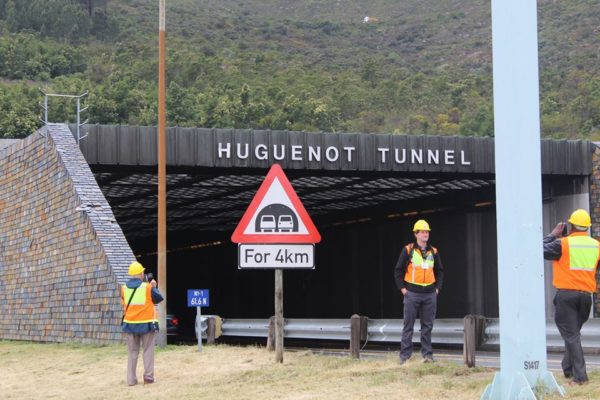
During specific upgrades to the ventilation system, the tunnel will be completely closed to all heavy vehicles, for five days in each direction, 10 days in total. These dates will be confirmed closer to the time. 

Following extensive research and planning, the South African National Roads Agency (SOC) Limited (SANRAL) has put together an operations plan for the much-needed upgrades to the Huguenot Tunnel.  

After 31 years of continuous and safe operation, the electrical and mechanical systems have neared the end of their operational life spans and need replacement to ensure compliance to international safety standards. 

At an engagement session held in Worcester, SANRAL’s regional leadership presented the operational requirements and time schedule of the upgrades to stakeholders from local and provincial government, the road freight industry, agricultural sector and local business community. 

“In considering the travel patterns of road users, peak traffic times, the economic impact of a full-scale closure and detour routes, we have decided that commencing in September 2019, the tunnel would be closed to traffic from 10pm to 6am, Monday to Thursday. This means that the tunnel will be fully open from Friday to Sunday for all road users,” said Randall Cable, SANRAL Western Region Manager. 

Holiday traffic considered 

The timing for the upgrades is scheduled for September, October and November 2019. Work will then be suspended during December and early January, to accommodate the increased volumes of holiday traffic that make use of the Huguenot Tunnel.  

Once the schools re-open in January work will resume and the off-peak closure will come into effect again. 

During specific upgrades to the ventilation system, the tunnel will be completely closed to all heavy vehicles, for five days in each direction, 10 days in total. These dates will be confirmed closer to the time. 

Cable said: “We are particularly mindful of the effects the off-peak closure may have on the long-distance freight community and the agricultural sector, where farmers may be transporting goods to Cape Town for export purposes, under nighttime conditions in line with harvesting times.  

“Where transport schedules can be amended to ensure heavy vehicles pass through the tunnel before 10pm, we strongly advise this. However, where this is not possible, one of the various alternative routes should be taken. We are exploring further engagement with the agricultural sector in this regard.” 

Alternative routes 

Alternative routes include PaarlDuToit’s Kloof PassWorcester (±62km), PaarlGouda-TulbaghWorcester (±121km) or Wellington-Tulbagh-Ceres (± 74km.) Depending on origin and destination, the N2 Grabouw to Villiersdorp (41km) is also an option. 

“Where unforeseen changes to the schedule are necessitated, we will communicate these as soon as possible to ensure road users are fully informed of the work being carried out and the effects this may have on traffic flow,” concluded Cable. 

Real-time and accurate Huguenot Tunnel closure information will be made available on www.i-traffic.co.za and the SANRAL website www.nra.co.za to allow road users to plan their journeys accordingly.  

Various other social media platforms will also be used to convey real-time and accurate information to all stakeholders. 

While SANRAL apologises for the inconvenience these upgrades may cause, the safety of every road user passing through the Huguenot Tunnel, is our prime objective. 
SANRAL and SAWIC engage on opening the construction industry to women

Deliberations were around key challenges faced by women in construction and related industries and how SANRAL and its empowerment partners could further assist to advance their interests. 

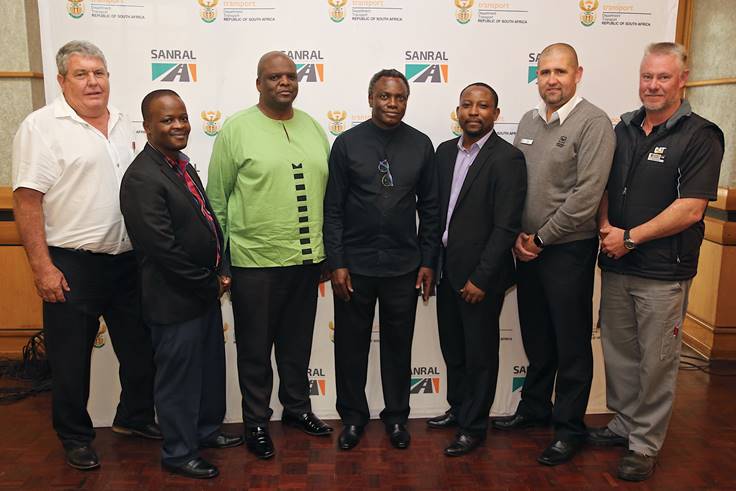
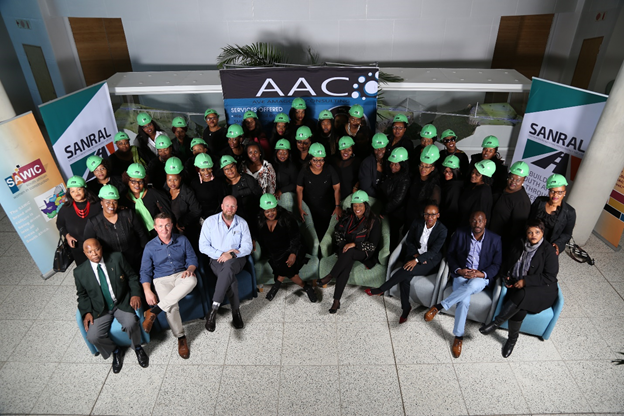
SAWIC members (in black and green) with SANRAL empowerment partners (seated from L-R) Maxwell Bukashe (Purple Sunshine), Mark Revees (Pilot CrushTec), Tom Swartz (Bell Equipment), Phumeza Kate (SAWIC EC Chair), Kile Mteto (SAWIC President), Thabile Dube (Barloworld Equipment), Dumisane Mtsweni (Barloworld Equipment) and Pamela Bukashe (Purple Sunshine).

The South African National Roads Agency (SOC) Limited (SANRAL) held a round table engagement with South African Women in Construction (SAWIC) to deliberate on how the roads agency can further advance interests of women in the construction industry. 

Held at the SANRAL regional office in Baywest, Port Elizabeth, the engagement was attended by SAWIC president Kile Mteto, SAWIC Eastern Cape Chapter chairperson Phumeza Kate and a group of SAWIC members who recently completed a training programme with SANRAL. 

The group of 40 SAWIC women, who received their certificates during the session, undertook a two-week Accredited Training Programme in Construction Management organised by SANRAL Southern Region SMME Unit Coordinator Vanda Nqunqa to empower them to better manage their construction businesses.  

“The training programme came after we identified common challenges faced by SMMEs on SANRAL projects,” said Nqunqa. 

A mutually beneficial relationship 

SANRAL’s Stakeholder Relations Coordinator for the Southern Region, Welekazi Ndika, said this was the first step towards a long and mutually beneficial relationship.  

She outlined construction projects to be undertaken by SANRAL in the province in the next three financial years in which women-owned businesses could look forward to participating. 

Ndika outlined the roads agency’s transformation policy, which aims to ensure participation of marginalised groups in opportunities created by SANRAL. 

“It is very critical that SANRAL’s procurement and supply chain policies be transformation friendly to ensure that our transformation objectives are fulfilled. Our focus should no longer be only on the 30% subcontracting to SMMEs. We should push for 51% black ownership in joint ventures on our projects to ensure tangible growth and transformation,” urged Ndika. 

Empowerment partners speak 

SANRAL’s empowerment partners – Bell Equipment, Barloworld Equipment, Pilot Crushtec and Purple Sunshine  were in attendance to outline the services the group can benefit from, as well as their partnership with SANRAL that allows emerging contractors access to plant equipment and mentorship. 

Pamela Bukashe of tar manufacturing company Purple Sunshine said: “98% of Eastern Cape roads are gravel, so you are in the right space.” 

She shared insights on the use of polymer in construction and advised members to consider participating in this area of the industry as it was not yet congested. 

SANRAL’s Community Development Specialist, Dr Mongezi Noah urged SAWIC members to not only focus on SANRAL’s construction projects.  

“You are not limited to participating in SANRAL’s capital projects. Our transformation policy applies to all our sub-sectors, which are maintenance, operations, ICT, legal, non-core services, finance and audit, human capital, property and marketing, and communications,” said Noah, urging the members to broaden their participation in opportunities in sub-sectors of SANRAL. 

SAWIC President Kile Mteto appreciated the support provided to the Eastern Cape Chapter by SANRAL Southern Region. 

Mteto said: “What is SANRAL going to do to ensure that the investment made through this training yields results? We would appreciate SANRAL ringfencing a budget to place the persons trained into an incubator system in order to see real growth in the next few years.  

“The training should be intentional and done consciously in order to yield results. My proposal is that SANRAL should apply to National Treasury to enable ringfencing of work for targeted enterprises, particularly women in the sector.” 

Mteto advised the certificate recipients that “having knowledge is one thing, but applying the knowledge is where the empowerment is. 

“Thank you SANRAL leadership and management for your continued support. Our members should never take opportunities of this nature lightly. I want to plead with SANRAL in the Eastern Cape to encourage their counterparts in other regions to follow in their path and assist SAWIC chapters in other provinces,” she concluded. 

Deliberations were around key challenges faced by women in construction and related industries and how SANRAL and its empowerment partners could further assist to advance their interests. 

Ndika said that although the task that lies ahead is a mammoth one, some ground is already being covered to ensure that tangible results can soon be realised in the advancement of interests of women in the sector.   

Cashless parking now part of your SANRAL Mobility Account

The new updates will make it possible for e-toll registered road users to take advantage of cashless parking, manage their toll accounts and enjoy additional features.  

ETC has partnered with KaChing, a cashless and ticketless parking system providing road users with an easy-to-use parking service.  

The South African National Roads Agency (SOC) Limited’s (SANRAL) mobile application has received a major design overhaul to improve the user experience and enhance its functionality.  

The new updates will make it possible for e-toll registered road users to take advantage of cashless parking, conveniently manage their toll accounts and enjoy additional features such as viewing frequent user discounts and tracking monthly spend. 

Coenie Vermaak, CEO of Electronic Toll Collection (ETC), the company responsible for managing the Gauteng e-tolling system on behalf of SANRAL, said: “The evolution of the SANRAL mobility app is a part of ETC’s and SANRAL’s continued strategy to deliver hassle-free road and travel services to registered road users across the country.  

“While this app currently supports features mostly related to our e-toll system and conventional plaza accounts, the future vision is to develop this platform to deliver other convenient mobility services to enhance mobility across South Africa with road users opting into their desired service.” 

Easy to use cashless parking 

ETC has partnered with KaChing, a cashless and ticketless parking system providing road users with an easy-to-use parking service.  

There are plans in the pipeline to partner with other parking providers to extend this service offering.  

The new parking feature, which is an optin service on the app, enables users to park at 34 different KaChingoperated parking lots without the need for a paper ticket or cash. 

Through license plate recognition technology, parking garage booms will automatically open for people using the SANRAL Mobility app, with payment being linked to the registered user’s account.  

The cashless parking service is an opt-in service, accessible through the services tab on the app. 

Touch of a button e-toll account management 

Through the SANRAL Mobility app, registered users can view and settle their accounts easily and conveniently from the palm of their hands.  

Users can view their account balances, top up their mobility account/s, view and download account statements and invoices, view their transaction details (which can also be downloaded and shared) and log an enquiry or contact SANRAL’s customer services department.  

This new release also includes in-app notifications, driven by SANRAL’s efforts to enhance road safety. 

“The e-toll features on this app not only save users time but will also give them sight of the frequent user discounts that have been earned and ultimately put extra cents in their pockets,” said Vermaak. 

The app, developed by ETC, is available for both Android and iOS devices 

Biometrically enabled, the app enables users to log in quicker and more securely through fingerprint and facial recognition technology on supported devices. 

Exciting future updates in pipeline 

A future release will enable users to register a mobility account from the app, meaning users will be able to complete the full mobility registration process on the platform.  

ETC is also working on several additional, exciting features including a route planner and i-Traffic integration, a realtime traffic information system run by SANRAL.  

Later this year, users will be able to order e-tags through the app and have them couriered to either a home or work address, as well as add or remove vehicles from their account. 

Gamification features, loyalty programmes and ride-sharing schemes are also planned. 

“All future updates and additions to the SANRAL Mobility App will progress our vision to provide a smart transport solution that promotes seamless mobility for users,” concluded Vermaak. 

The app can now be downloaded from either the Google Play store or from the Apple App store. 

SANRAL manager earns award for “first-of-its-kind programme”

All infrastructure development projects require a professional team of engineers to determine the scope for design, standards for construction and effective project delivery. 

SAICE Transportation Engineering Division chairperson, Jarendra Reddy and Alex van Niekerk: SANRAL Toll and Transport Project Manager.

To ensure effective infrastructure delivery, serious consideration must be given to simplifying the process of appointing professional teams that oversee projects. 

This is the view of Alex van Niekerk, senior project manager at SANRAL, who has been awarded the prestigious Chairman’s Award from the South African Institution for Civil Engineering (SAICE) – Transportation Division. 

The SAICE Transportation Division is a professional home for transportation engineers, technicians and technologists. Its objective is to advance the study, knowledge and application of transportation engineering. 

A specialist in his field 

Handing over the award at a function in Midrand, SAICE Transportation Engineering Division chairperson Jarenda Reddy said: “Alex has invested in himself to be a specialist in his field, gaining him international recognitionallowing him to contribute to the betterment of transport within an African and global context. This, in combination with his focus and resolve in delivering a contentious, firstofitskind programme – in the opinion of the committee – earns Alex the 2019 Chairman’s Award.” 

Van Niekerk said a major challenge faced by government departments and agencies is the effective procurement of service providers.  

All infrastructure development projects, as a minimum, require a professional team of engineers to determine the scope for design, standards for construction and effective project delivery. 

When this is resolved, meaningful service delivery and effective implementation of large infrastructure projects essential for economic growth and job creation can happen, said Van Niekerk. 

He said: “Anyone entering the debate about road infrastructure funding must do so with the best long-term interest of the public at heart, to not only criticise, but also provide workable solutions.” 

He has learned that roadfunding mechanisms  toll or fuel levy – “stir emotions and are politicised all over the world”. 

“Regardless of challenges such as these, the engineering profession remains one that stirs the intellect and heartsI am grateful for the many opportunities SANRAL has afforded me throughout my career,” concluded Van Niekerk. 

Taking SANRAL to Elias Motsoaledi

SANRAL is guided by the Horizon 2030 strategy and transformation policy that is mindful of the developmental role the agency plays. 

SANRAL Northern Region Manager, Mr Progress Hlahla with Elias Motsoaledi Local Municipality Mayor, Cllr. Julia Mathebe. 

Small businesses in Elias Motsoaledi, which includes Groblersdal, are about to get a boost. 

The South African National Roads Agency (SOC) Limited (SANRAL) has embarked on a process of fundamental transformation that opens the path for inclusive, broad-based economic development in the road construction industry. 

Small, Medium and Micro-sized Enterprises (SMMEs) in Elias Motsoaledi will benefit from SANRAL’s upcoming road upgrade and routine road maintenance projects, said Ismael Essa, SANRAL’s Transformation Manager. 

Both currently in the design phase, two notable road upgrade projects in the municipality (the R573 Moloto Road and the R574 to Morwaneng) are set to begin construction in 2020 and 2021 respectively. 

Attended by local municipality officials and business people, the “Taking SANRAL to Elias Motsoaledi” initiative took place on 30 May. The aim was to address matters of concern raised by local business and the municipality, in addition to educating those in attendance about the opportunities available to them. 

Essa said: “We are committed to supporting the development and participation of businesses owned by women, youth, people with disabilities and military veterans in our projects, especially on our routine road maintenance and community development work packages. 

“As SANRAL, we are guided by Horizon 2030 strategy and transformation policy that is mindful of the developmental role the agency plays in regard to emerging contractors and transformation in the construction industry.” 

Central to the discussion was the upgrade of the R573 Moloto Road, one of the South Africa’s busiest commuter and essential economic routes, which connects Limpopo, Mpumalanga and Gauteng.  

The road is an essential public transport corridor used by approximately 50 000 commuters daily  including buses, taxis and heavy trucks. 

The Limpopo section of this road was incorporated into the SANRAL network in 2015. Since then, SANRAL has embarked on road maintenance activities that include the repair of dangerous wash-aways in the Moteti area, opening and clearing of storm water pipes/culverts, repair of gravel shoulders, repairing potholes and other pavement failures, cutting back vegetation along the road, clearing litter and debris from the road reserve, repairing road signs and improving markings. 

SMME DEVELOPMENT 

SANRAL Northern Region Manager Progress Hlahla reminded those in attendance that SANRAL is committed to providing opportunities for small contractors that have limited experience. This is done through various community development projects. 

“These become legacy projects, which local SMMEs are able to build and maintain for their local municipality. Once they gain the relevant experience, and thus improve their CIDB grading and skills levels through these projects, they are able to take on larger projects and contribute to the country’s drive towards job creation,” Hlahla said. 

As per government policy for SMME development, main contractors are required to subcontract 30% of the contract value to SMMEs of CIDB grading 1-6.  

In some cases, main contractors enter into joint ventures, with a 70/30 split between a 9CE main contractor as the lead partner and lower-grading contractors (5CE, 6CE or 7CE) as the joint venture targeted partners. 

Driven by this commitment, SANRAL has visited all provinces in South Africa with the aim of engaging communities and interested organisations in its transformation strategy, which commits to give suitably qualified emerging enterprises an opportunity to perform some of the work awarded to main contractors. 

Hlahla said his region is determined to work towards ensuring the inclusive participation of local black individuals and organisations in upcoming projects, as well as any spin-offs from such projects. 

Elias Motsoaledi Local Municipality Executive Mayor Cllr Julia Mathebe added that she was grateful SANRAL had chosen to improve the infrastructure in her municipality. 

“Guided by the Public Finance Management Act, SANRAL is determined to empower as many local businesses as possible in a fair and equitable manner.  

As our board chairman, Mr Themba Mhambi, often proclaims: The days of there being only a few construction companies capable of taking on large projects is coming to an end. Instead of hearing about the big five construction companies, we would like to hear about the big 50,” Hlahla concluded. 

Frequently Asked Questions

Read up on some of the most often asked inquiries about SANRAL and its processes. 

SANRAL is a state-owned entity (SOE), category 3A, and is not allowed to make a profit. It is not a business enterprise. It is responsible for a national road network of 22 214km.

WHAT IS SANRAL?  

The South African National Roads Agency (SOC) Limited (SANRAL) was established in April 1998 by an act of Parliament as an independent company to operate South Africa’s national road network.  

It is a public company with share capital within the requirements of the South African Companies Act and is governed by a board of five members. The Minister of Transport is the sole shareholder of SANRAL, representing government.  

SANRAL is a state-owned entity (SOE), category 3A, and is not allowed to make a profit. It is not a business enterprise. It is responsible for a national road network of 22 214km.  

This network is gradually expanding, as a growing number of provinces request the agency to take over the management of their primary roads.  

SANRAL’s role is to be an implementing agency for road planning, construction and maintenance, on behalf of the Department of Transport.  

WHICH ROADS ARE SANRAL RESPONSIBLE FOR?  

Most of the national roads – the “N” roads – with minor exceptions, such as a stretch of the N14 in Gauteng, and the N2 between Cape Town International Airport and the city centre.  

There are also some provincial and municipal roads in the Eastern Cape, Mpumalanga, Limpopo and the North West that have been incorporated into our network.  

WHY DOES SANRAL TOLL ITS ROADS?  

Of our entire network, only 2 948km is tolled. Roads are the arteries of our nation – they connect major cities, towns and villages in rural areas. Roads bring economic growth, tourism, social development and create economic opportunities for all citizens, but they need to be maintained.  

Roads deteriorate over time, due to environmental and other influences, such as traffic flow, weather, ultraviolet radiation, truck overloading, etc. And maintenance is not a once-off occurrence – it is continuous.  

This isn’t just applicable to the road itself, but also to the verges, road markings, grass on the verges and the clearing of debris from incidents, among others.  

The maintenance of roads is extremely expensive, as is upgrading them to keep up with growth and the managing of congestion.  

To fund this, we cannot rely solely on tax. In these instances, the user-pay principle is applied. This decision is never made lightly or rashly.  

WHERE IS SANRAL’S EASTERN REGION?  

KwaZulu-Natal and Free State, and this includes 2 881km of road.  

WHAT IS THE CONDITION OF SANRAL’S ROADS IN THE EASTERN REGION?  

They are generally in a good to very good condition due to continuous maintenance being undertaken. The breakdown is as follows: Fair-25%, Good-35%, Very Good-40%.  

WHAT ARE SOME OF THE MAJOR PROJECTS BEING UNDERTAKEN IN THE EASTERN REGION?   

Upgrading of the N2/N3. The upgrade of the N2 will focus on a 55km length from Lovu River in the South Coast, to Umdloti in the North Coast. The N3 upgrade will focus on an 80km section from Durban to Pietermaritzburg. Dualling the N2 from Mtunzini to Empangeni and Dualling the N1 from Ventersburg to Kroonstad. 

IF I WANTED TO WORK FOR SANRAL, HOW DO I GO ABOUT IT?  

SANRAL offers internal and external bursaries to assist aspiring engineers and technical staff to enter the field of road construction. We also encourage skills development in related fields – community and economic development, project management, marketing and communication and general administration. Please contact our human resources department at 0128448000 or send an email to info@nra.co.za. 

HOW CAN I CONTRACT FOR WORK WITH SANRAL?  

Construction work is only given out on tender. SANRAL’s procurement philosophy is aimed at broad-based BEE. To read the entire Supply Chain Management Policy and Procedure Manual in PDF format and look out for contracts advertised on the SANRAL website, visit www.sanral.co.za  

HOW DO I BRING ROAD CONDITIONS TO SANRAL’S ATTENTION?  

The agency has special maintenance teams in place to respond to unplanned events, such as major accidents or floods, and can respond immediately.  

In addition, we have a 48-hour turnaround time, from reporting to repairing of a pothole on our national roads.  

Should you want to report a problem, simply visit www.nra.co.za for contact details of our regional offices and concessionaires. 

Big brother watching cable thieves

Security measures will be implemented to curb the sabotage of electrical equipment for copper cabling that is subsequently sold to scrap metal dealers. 

A range of security measures will be implemented to curb the sabotage of electrical equipment for copper cabling that is subsequently sold to scrap metal dealers. 

The wanton destruction of electrical installations along national roads in KwaZulu-Natal by cable thieves has led to the South African National Roads Agency (SOC) Limited (SANRAL) putting in place intelligent monitoring systems.  

Millions of Rands worth of transformers, electrical distribution boxes and street light poles have been destroyed by vandals, causing inconvenience for motorists as well as pedestrians at night.  

Zakhele Mthethwa, Electrical Project Manager at SANRAL’s Eastern Region, said SANRAL was committed to ensuring the safety of motorists and pedestrians.  

Hence, a range of security measures will be implemented to curb the sabotage of electrical equipment for copper cabling that is subsequently sold to scrap metal dealers. 

Security measures 

Sensors will be placed in transformers and electrical distribution boxes to pick up any unusual vibration such as when somebody is trying to get unauthorized access. 

The sensors will send a signal to the Traffic Management Centre (TMC) in Pietermaritzburg where dedicated staff will be monitoring the lighting equipment. 

Security personnel will be dispatched to the site to apprehend the thieves who will be handed over to the police.  

Mthethwa said sensors will be rolled out initially to safeguard the electrical equipment at Umgeni Road/ M19 Intersection which has 242 light poles, and the freeway between Umdloti Interchange and Tongaat Town Plaza which has 582 light poles.  

Vandal-proof light poles will replace those that were cut down by cable thieves. Closed-circuit television cameras will also be installed, and these will be monitored around the clock at the TMC to apprehend vandals.  

It is estimated the security features at Umgeni Road/ M19 Intersection and the freeway between Umdloti Interchange and Tongaat Town Plaza will cost about R15-million. 

N7 Tierfontein will leave a legacy

For SANRAL, it is crucial that its projects not only significantly contribute to economic development and job creation, but that a legacy of empowerment is left behind after completion of the construction work.   

This interchange is being upgraded in order to improve the capacity for traffic movement between the western and eastern parts of Malmesbury, situated on opposite sides of the N7.  

The upgrade of the N7 in Malmesbury goes way beyond construction and has social inclusion at its very core.  

With a budget of R505-million, this project has since January 2015 created more than 500 work opportunities for locals.  

This has far-reaching consequences in terms of the economic development of this town. The existing single carriageway of the N7 Section 1 from km48 to km52 is being upgraded to a dual carriageway freeway, which would tie into the existing dual carriageway section, beginning south of the Darling Road interchange at km52.  

This interchange is being upgraded in order to improve the capacity for traffic movement between the western and eastern parts of Malmesbury, situated on opposite sides of the N7.  

This is accomplished by dualling the Darling/Bokomo road under the N7 and improving the layout of the N7 ramps and ramp terminals.  

A legacy of empowerment 

For SANRAL, it is crucial that its projects not only significantly contribute to economic development and job creation, but that a legacy of empowerment is left behind after completion of the construction work.  

Project Liaison Officer on this project, Lilian Leukes, has put her heart and soul into ensuring she facilitates as many developmental opportunities as possible for the locals to benefit from inclusion in this project.  

“Many of our local residents have as a result of this project been able to put food on the table, while others have used this as a launchpad to further their education and career growth,” said Leukes 

On a project of this magnitude challenges are par for the course, and according to Grant White, Site Agent of the Stefanutti Stocks Power Consortium, pedestrian and traffic accommodation during construction was one the major challenges but lauds the community for the patience and cooperation during the construction period.  

Steph Bredenhann, SANRAL Project Manager said: “This project is in the final stages and we are incredibly proud not only of the world-class quality of the N7 in terms of the road user experience, but also of the major role that the construction industry has and continues to play in spearheading economic development in our country.” 

Road upgrade aimed at boosting local economy

The roads agency is actively responding to President Cyril Ramaphosa’s call to have “shovel-ready projects” in the pipeline to lead the current drive towards investment in infrastructure. 

John Higgs(NAFBI),Madoda Mthembu(SANRAL),Aubrey Tshalata(NAFBI),Themba Mhambi(SANRAL),Progress Hlahla(SANRAL),Waylon Kukard(WIRTGEN GROUP),Deon Coetzee(Barloworld) at the Taking SANRAL to Rustenburg event.

Communities in and around Rustenburg are set to benefit from upcoming road construction projects such as the improvement of the R52 from Rustenburg to Koster. 

Themba Mhambi, Board Chairman for the South African National Roads Agency (SOC) Limited (SANRAL), said the project, valued at R625-million is still in the early stages of design. 

The “Taking SANRAL to Rustenburg” initiative took place on 24 May with the aim of addressing matters of concern raised by municipalities; in addition to educating those in attendance about the opportunities available to them. 

Inclusiveness 

Mhambi said: “It is our intention that small, micro, medium, youth – and women-owned enterprises, people with disabilities and military veterans take part in our projects, especially our routine road maintenance and community development work packages. 

Guided by its corporate strategy and transformation policy, SANRAL is mindful of the developmental role that it plays to emerging contractors and the transformation of the construction industry. 

To that end, and as part of its ongoing efforts to accelerate the transformation of the construction industry; the roads agency is determined to continue opening doors for black owned contractors – enabling them to participate meaningfully in major construction projects.  

The days of there being only a few construction companies capable of taking on large projects is coming to an end. Instead of hearing about the big five construction companies, we would like to hear about the big fifty,” added Mhambi. 

The roads agency is actively responding to President Cyril Ramaphosa’s call to have “shovel-ready projects” in the pipeline to lead the current drive towards investment in infrastructure. 

According to Mhambi, the North West Province is of great significance to SANRAL as the lead agency of the Strategic Infrastructure Project – SIP 4 – which focuses specifically on the North West.  

This further emphasises the importance of our road network as the backbone of all infrastructure development and service delivery to towns, villages and communities across South Africa,” he said. 

SMME DEVELOPMENT 

SANRAL Northern Region Manager, Progress Hlahla, reminded those in attendance that SANRAL is also committed to providing opportunities for small contractors that have limited experience, this through various community development projects. 

“These become legacy projects, which local SMMEs are able to build and maintain for their local municipality. Once they gain the relevant experience and thus improve their CIDB grading and skills levels through these projects, they can take on larger projects and contribute to the country’s drive towards job creation,” said Hlahla. 

As per government policy for SMME development, main contractors are required to subcontract 30% of the contract value to SMMEs of CIDB grading 1-6.  

In some cases, main contractors enter into joint ventures, with a 70/30 split between a 9CE main contractor as the lead partner and lower-grading contractors (5CE, 6CE or 7CE) as the joint venture targeted partners. 

Driven by this commitment, SANRAL has visited all provinces in South Africa with the aim of engaging communities and interested organisations on its transformation strategy which commits to give suitably qualified emerging enterprises an opportunity to perform some of the work awarded to main contractors. 

Hlahla said that his region has vowed to work towards ensuring the inclusive participation of local black individuals and organisations in upcoming projects as well as any spin-offs from such projects. 

SANRAL’s impact 

SANRAL manages around 13% (2?598km) of the province’s roads and has made a considerable impact on infrastructure development with various projects at different stages. 

The agency has some 85 projects in the initiation, design and construction stages in different parts of the province over the next 10 years. 

Part of SANRAL’s work in the province includes the upgrade of the N4, a primary economic artery in the province which plays a pivotal role in the movement of people and goods.  

The pavement repair and resurfacing of the national route R505 from Wolmaransstad to the N14, is nearing completion. 

“Albeit guided by the Public Finance Management Act, SANRAL is determined to empower as many local businesses as possible in a fair and equitable manner,” Hlahla concluded. 

Local Municipality Mayor, Cllr Mpho Khunou, said that he welcomes the cooperation of the three spheres of government and that he hopes that the community will work well with SANRAL. 

North coast N2 upgrade near completion

The almost R1-billion project will result in a 14-metre wide, safer dualcarriage highway, which will enable the key arterial road to cope with increased traffic volumes.   

Corné Roux, SANRAL Eastern Region Project Manager, said due to the growth in traffic, the current lane configuration became inadequate, resulting in delays experienced by the travelling public.  

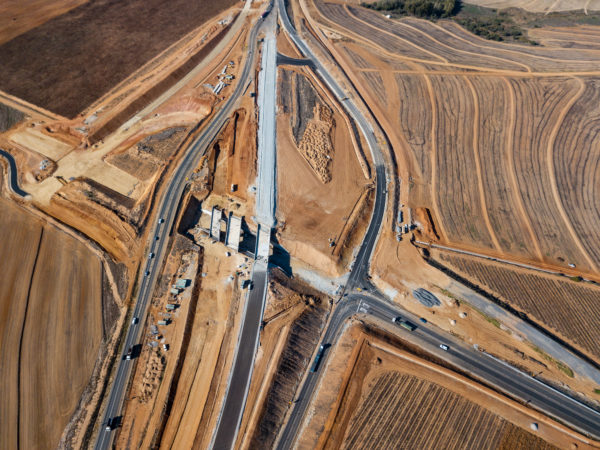
The upgrading of a 33km stretch of the N2 between Mtunzini toll plaza and the Empangeni T-junction on the KwaZulu-Natal North Coast, which has been the scene of several fatal crashes, is nearing completion.  

The almost R1-billion project will result in a 14-metre wide, safer dualcarriage highway, which will enable the key arterial road to cope with increased traffic volumes.  

The upgrade of this section of the N2 commenced in March 2016.  

Technical challenges were encountered with the installation of up to 35metre deep piles required for the construction of two major new bridges over the uMhlatuze and uMhlalazi rivers.  

The Project 

When the project is complete, four agricultural overpasses over the N2 would have been lengthened, new bridges would have been built at the R34 Empangeni/Richards Bay interchange and at the P537 Port Dunford underpass, two road-over-rail bridges would have been constructed, and 16 major box culverts and numerous minor box culverts and other drainage structures would also have been built.  

In addition, the height of two overpasses would have been increased by jacking up the bridges. 

This stretch of the N2 is on a declared toll road and, therefore, the income generated from the toll plazas on the N2 north will be utilised for funding this project.  

Corné Roux, SANRAL Eastern Region Project Manager, said due to the growth in traffic, the current lane configuration became inadequate, resulting in delays experienced by the travelling public.  

He said current traffic volumes on the N2 south of Empangeni exceeded 12?000 vehicles per day, with the highest traffic volumes occurring on the section between the eSikhawini and Empangeni interchanges.