
Blog

N2 upgrade between Grahamstown and Fish River Pass underway

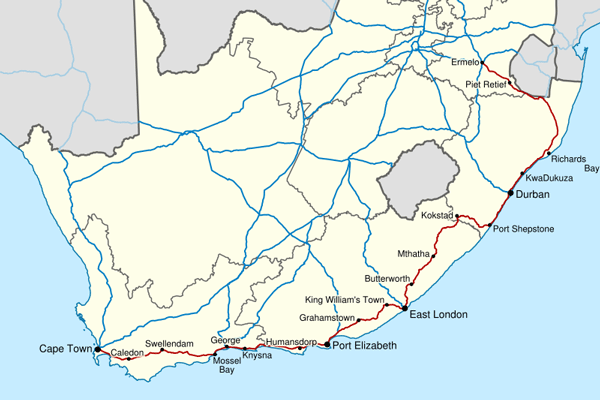
N2-Map-1
The second phase of the N2 project is set to last 24 months and should reach completion in mid-2019.

The South African National Roads Agency (SOC) Limited’s upgrades to the N2 between Grahamstown and the Fish River Pass are progressing well as the second phase of the R980-million road infrastructure upgrade project continues.

SANRAL’s six- to seven-year project, which has been divided into three phases, forms part of a long-term strategy to improve the quality of the roads between Port Elizabeth and King William’s Town.

Mbulelo Peterson, SANRAL Southern Region manager, said: “This upgrade includes various geometric improvements over a mountainous terrain.  It will improve safety and offer safe overtaking opportunities. Once completed, the new road will also ensure travel-time savings for vehicle operators.”

The first phase of the project, which was valued at R980-million, commenced in April 2015 and was completed in May 2017.

“During this phase, an environmental study of the Oldenburgia Grandis – a plant endemic to the Eastern Cape and which grows on quartzite outcrops near and around Grahamstown – was also conducted. In collaboration with Rhodes University, SANRAL funded a botanical research study and transplant programme for the Oldenburgia Grandis affected by the upgrade,” said Peterson.

In addition, during the first phase, important fossil deposits dating back some 350-million-years were uncovered. These fossils will contribute to scientific research for years to come.

The second phase

The second phase of the upgrade project began in June 2017. This phase, valued at R283-million, is located in the Sarah Baartman District Municipality.

Work currently underway on this section of the upgrade includes the establishment of a hard rock quarry, crushing facilities for materials, mass earthworks, the construction of new pavement layers, resurfacing of the road surface and the construction of three agricultural underpasses.

“The impact of stray animals on the safety of road users in this area is a major cause of concern. The construction of three agricultural underpasses, which will allow for the safe movement of animals from one side of the N2 to the other, is therefore an important part of this phase of the project. These agricultural underpasses should help to facilitate road safety and reduce animal-related road accidents along this stretch of the N2,” Peterson said.

The second phase of the project is set to last 24 months and should reach completion in mid-2019.

Creating employment

The entire project will provide employment to 360 individuals and SANRAL has set a 27% SMME participation goal for phase two of the project.

The goal will increase for phase three. This means that approximately 120 small, micro and medium enterprises (SMMEs) will have an opportunity to work on the project over the seven years.

“The legislated requirement is for the main contractor to outsource approximately one-third of the project to emergent small road construction firms,” said Peterson. “There were 22 SMMEs who worked on the first phase of the project and this will increase in phase two. A non-motorised transport facility, the bypass at the fish River Pass and rehabilitation work on the adjacent R67 are examples of specific works which are being carried out by SMMEs.”

SANRAL noted that an increase in traffic volumes, particularly of heavy vehicles, over the past 10 years, prompted the need for this road upgrade. Furthermore, the existing road, which was built in the 1960s, did not meet the road agency’s desired alignment and safety standards.

“The project will improve and prepare the N2 to support increasing volumes of motorists on this national road over the next 25 years. [It] will also improve safety and travel time on the national road network that provides the economic link between Port Elizabeth and East London, which also serves as the west-east link between the Western Cape and KwaZulu-Natal,” Peterson concluded.

National roads “an exception”

n1-inside
The primary road network, controlled by SANRAL is graded B, meaning it is “fit for the future”.

The report by the South African Institution of Civil Engineers (SAICE) on the status of public infrastructure in the country is a cause for concern.

It paints a bleak picture of the general level of infrastructure maintenance and contains a warning: there is a danger of collapse.

There are exceptions and national roads are one of these. These include heavy-haul freight lines, the Gautrain rail lines and airports under the control of the Airports Company of South Africa.

The primary road network, controlled by the South African National Roads Agency (SOC) Limited (SANRAL) is graded B, meaning it is “fit for the future”, or to give the full SAICE-description: “Infrastructure is in good condition and properly maintained. It satisfies current demands and is sufficiently robust to deal with minor incidents.”

Vusi Mona, SANRAL’s communications manager, said: “The SAICE-report correctly identifies the state of our national road network – and points to possible stresses.”

The report underlines SANRAL’s retention of its high level of professional engineering expertise, its maintenance of its road network to a high standard. However, the national roads did not achieve an A- grading because of the incorporation of provincial roads which are in poor condition.

Mona said it does point out the need for adequate dedicated funding.

The vast majority of SANRAL’s funding comes from the National Treasury. Tolling on some 13% of the roads, partly as a result of public-private partnerships, looks after the rest.

Mona said: “The fact is simply that as SANRAL has taken on provincial roads, this has not been accompanied by a sufficient increase in funding. The allocated and expected funding from the national fiscus means SANRAL cannot take on more than another 3 000km of provincial roads, as highlighted in our recent long-term strategy – Horizon 2030. The expected increase of the network by another 15 000km to 35 000km has therefore been mooted.

“We are happy with the SAICE-grading but very aware of the fact that the national road network is the artery of the country’s economy, which needs constant upgrading, expansion and maintenance – which underlines the SAICE point that adequate dedicated funding is a necessity.”

Pioneering change in construction

construction-change-2
SANRAL has introduced a contractual clause that requires big companies to partner with small companies when bidding for construction projects.

The South African National Roads Agency (SOC) Limited (SANRAL) is trying to level the field in the construction industry one clause at a time.

One of the biggest challenges facing emerging companies in the construction industry is competing with established companies for big projects.

In trying to level the playing fields, SANRAL has introduced a contractual clause that requires big companies to partner with small companies when bidding for construction projects.

This is part of the agency’s vision of empowering small businesses and affording them an opportunity to grow and contribute to infrastructure development.

Joint venture condition: A first of its kind

The joint venture condition was first introduced when two contracts to rehabilitate sections of the R573 Moloto Road were awarded.

The job required big contractors to bid with smaller companies in a joint venture.

According to Nontobeko Mathenjwa and Lawrence Chauke, SANRAL project managers on the Moloto Road, this is the first of its kind and took a lot of planning and consultation to get approval from SANRAL.

“This is a SANRAL initiative. We had no reference or prior experience of implementing this model. It was really exciting to practically develop words and phrases to incorporate into our procurement documentation. I’m glad that it’s working and opening up the industry to small businesses,” said Mathenjwa and Chauke.

In the Limpopo section of the project, a contract was awarded to two partners, KPMM and Chauke Business Enterprise (CBE). On the Mpumalanga section a contract was awarded to a joint venture among four companies: Raubex Construction, Themolo Business Enterprise, Khuluphala Tradings and Biz Afrika.

Big business agrees

Although it was business unusual for big companies, they agree that it’s a great initiative.

“We are happy to take on emerging companies, but they have to play ball and make use of such opportunities. That means no compromise on quality and reliability, so it’s important to attract the partners for the [joint venture],” said Kevin Padayachee, operational director for KPMM.

Emerging companies equally agree that through the joint ventures, they are being empowered and they have become more professional.

Adam Chauke, owner and managing member of CBE, said: “It’s not easy to form partnerships with big companies and sometimes they don’t like to empower us – for fear of competition. But thanks to SANRAL, the likes of KPMM are now required to approach us for partnerships. It’s truly remarkable because it opens up the industry and affords us the opportunity to grow.”

From the experienced gained on the project, the SMMEs will be able to grow their grading at the Construction Industry Development Board (CIDB) and compete for bigger contracts in the future.

SANRAL will continue to support this initiative and introduce it for all other projects going forward.

Long-term horizon set for SANRAL

Macozoma-1
SANRAL CEO, Skhumbuzo Macozoma, said Horizon 2030 aims to ensure the national road network creates economic value for the entire nation and supports the growth of an inclusive economy.

The South African National Roads Agency (SOC) Limited (SANRAL) has embarked on the development of a new, long- term strategy.

Horizon 2030 will articulate its vision and the necessary strategic and tactical interventions needed to deliver on its objectives.

Skhumbuzo Macozoma, the CEO of SANRAL, said: “The more than 22 000km of roads managed by SANRAL are a critical public asset with an estimated net asset value of R251.6-billion.

“Our aim is to ensure the national road network creates economic value for the entire nation and support the growth of an inclusive economy.”

Horizon 2030

Horizon 2030 has been approved by the SANRAL Board for consultation and will now be presented to various stakeholders including communities, industry bodies, strategic partners and labour throughout the country.

Macozoma said: “We are confident that we are building a better South Africa through delivering better roads. This has been embedded in our new vision to provide a national road transport system that delivers a better South Africa for all.”

In 2018 SANRAL will start its third decade as the custodian of the national road network. The new strategy takes into account the priorities of the National Development Plan (NDP) and government’s strategic objective to build a more inclusive economy.

Minister of Transport, Joe Maswanganyi, said: “The national road network should be at the core of future strategic planning in South Africa. It links people to opportunities, connects communities across rural and urban divides and holds vast potential for job creation, empowerment and skills development.  It is sustained by the symbiotic relationship between all the respective road authorities from national to provincial and local.

“Through Horizon 2030, SANRAL wants to highlight the role that the national road network can play in contributing to the aims of the NDP to reduce inequality, support employment and eliminate poverty by the end of the next decade.”

Maswanganyi added that they want to demonstrate how state-owned entities such as SANRAL are assets to the South African economy, adding significant value to the lives of all South Africans.

A reputation of engineering excellence

Macozoma said the new strategy outlines a number of key strategic perspectives that seek to build on SANRAL’s reputation for engineering excellence while also taking into account the changing role of national roads.

Horizon 2030 has now elevated stakeholders and road safety into its core pillars, recognising the crucial role these play in SANRAL’s successful delivery and in preserving the lives of our people.

Road safety a national priority

Government continues to affirm road safety as a national priority and SANRAL, as outlined in the strategy, will play its role in the provision of both safe road infrastructure and technology and promote road safety education and awareness.

The strategy calls for a number of key deliverables that include the development of Roads 2030 long-term plan, public transport enablement, an enhanced role in terms of community development, equitable access to economic opportunities and an integrated funding model.

Macozoma said consultation on the content of the strategy should contribute to a more informed public debate on future funding policy for road infrastructure.

Roads have to compete for funds from the fiscus with other socio-economic priorities and it is of critical importance to find a workable funding strategy.

“Horizon 2030 is SANRAL’s proactive response to the changing dynamics across various sectors of the economy and society,” said Maswanganyi. “In addition, it will ensure that communities across the country share the benefits of a well-managed road network that supports the growth of a transformed economy that contributes to job creation and empowerment.”

New N17 pedestrian bridges

N17-Bridges-1
SANRAL project manager Tshidi Lethale, said SANRAL ensuring that roads are safely engineered for all road users is an important part of the agency’s work.

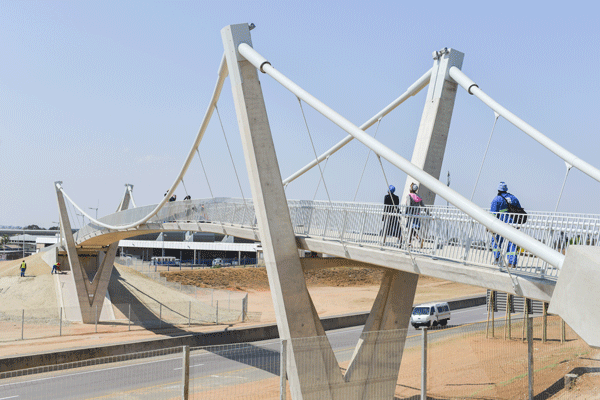
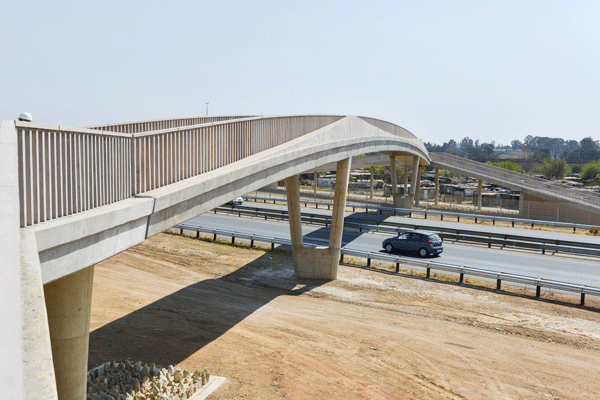
The South African National Roads Agency (SOC) Limited (SANRAL) has constructed three new pedestrian bridges on the N17 between Springs and Johannesburg, which promise to reduce the risk of pedestrians and cyclists being run over by cars when crossing the busy highway.

The bridges were constructed by the roads agency at an investment of R90.8-million.

A welcome relief

Two bridges are in the Springs/Brakpan area, in the East Rand, and the third is in Regents Park, Johannesburg. Completed in August, they are a welcome relief for residents.

N17-Bridges-3

Sibongile Sibiya, ward committee member at Mkhancwa informal settlement in the Springs/Brakpan area, said: “The bridge changed our lives. Before the pedestrian bridge was constructed, we were facing multiple deaths.”

The bridges have rest points for elderly and disabled persons, and concrete bollards to prevent cars from driving on pavements.

SANRAL’s mandate is not only about building and maintaining the national road network.

“Ensuring our roads are safely engineered for all road users is an important part of our work,” said SANRAL project manager Tshidi Lethale.

Lethale explained that pedestrians are the most vulnerable road users. “That is why we make a concerted effort to ensure that pedestrians and cyclists are considered in the planning, design and implementation of road infrastructure.”

SANRAL monitors Cape vulture colony

cape-vulture-1
In 2015 the Cape vulture, which is common to southern Africa, was listed as a regionally endangered species.

No evidence has been found of disturbance to the Msikaba Cape vulture colony during the recent environmental monitoring related to the construction of the Msikaba and Mtentu bridge haul roads.

As part of the environmental requirements for the N2 Wild Coast road project (N2WC), the South African National Roads Agency (SOC) Limited (SANRAL), recently monitored the impact construction had on the Msikaba vulture colony.

In 2015 the Cape vulture, which is common to southern Africa, was listed as a regionally endangered species. The Msikaba vulture colony is one of the primary conservation priorities in the Eastern Cape with approximately 170 to 190 pairs regularly nesting on the cliffs of the Msikaba River Gorge.

Expert monitoring

Ornithologists were appointed to monitor the reaction of the vulture colony to controlled rock cutting explosion taking place on the haul road construction sites some 12 to 13 kilometres away.

This monitoring allowed SANRAL to assess the potential impact of the construction on the vultures during breeding season and ensure that any negative impact was prevented. If discernible negative effects were observed, no further blasting would have been allowed during the breeding season of March to July every year.

“On the day prior to blasting, vulture counts were conducted at half hourly intervals from the vulture viewing platform located directly opposite the colony to determine the number of birds perched on the cliffs and flying above or in front of the colony. This helped to establish a baseline of the vulture activity. Counts were then repeated on the day when blasting took place,” said Vusi Mona, SANRAL’s communications manager.

The initial blast took place at the Mtentu haul road site which is situated 12.8 kilometres north of the vulture colony.

“When compared to the observations of the baseline study, there was no difference between the vultures’ general activities before, during and after the blasting. The vulture colony did not react in any way whatsoever to the blasting,” said Mona.

Similar observations were made during the remaining five blasts at the Mtentu site and the two blasts at the Msikaba site – situated 12 kilometres west of the vulture colony.

No negative effect

As a result, the monitoring programme determined that the blasting activities that took place on the Mtentu and Msikaba haul road sites have not had any noticeable negative effect on the breeding Cape vulture colony to date.

“The vulture colony is exposed to various audible anthropogenic disturbances that range from low flying helicopters and microlight aircraft to gunshots fired in the gorge below. Neither the blasts nor the other audible disturbances seemed to affect the vulture in any way,” said Mona.

“We are pleased to note that although Cape Vultures can be susceptible to disturbances at breeding colonies, there was no evidence of negative reaction to the haul road construction activities.

“While we will continue to monitor from time to time we are reassured that there are also unlikely to be any major disturbances from the construction activities on the bridges or the N2 Wild Coast highway over the next few years,” Mona concluded.

The N11 – an undiscovered tourist gem

loskop-dam-1
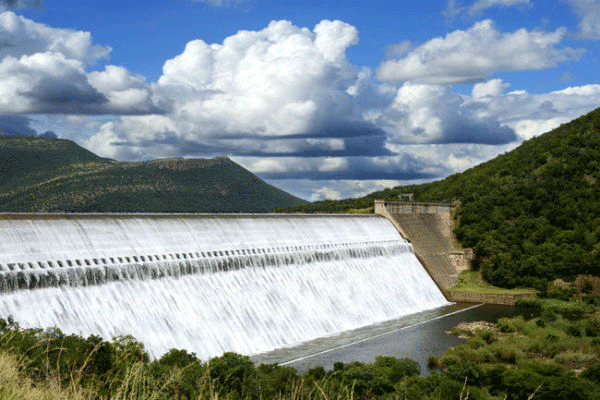
Loskop Dam Nature Reserve is a major tourist attraction in the Mpumalanga region.

The South African National Roads Agency (SOC) Limited (SANRAL) has been renovating section 10 of the N11 – from Middelburg to the Olifants River Bridge, since February 2015, a stone’s throw from Damwal’s commercial hub.

The project, valued at more than R404-million, is aimed at improving safety and curbing road fatalities in the notorious Kranspoort Pass.

The N11 project will provide plenty of opportunities for the province, since it is an important link to Limpopo and the vibrant tourism hub situated along the route, including Forever Loskop Dam, a major attraction in Mpumalanga and the neighbouring reserve.

The reserve is home to more than 70 species of wildlife – including buffalo, leopard and white rhino.

Successful project

The project has employed more than 165 locals and a total of 22 subcontractors were used in the project as part of SANRAL’s community development initiative.

The scope of work included the widening of the pass to accommodate more traffic – adding two lanes in each direction, both up and down.

The improvements included the installation of concrete barriers and two arrestor beds for downhill runaway trucks.

Since the February 2015 start of the project, road construction was expected to be completed by the end of August 2017. Everyone involved has succeeded in achieving this goal.

The road is expected to be formally handed over to SANRAL at the end of October.

Roadshow creates awareness of SANRAL programmes for youth

Sanral-Roadshow-Cofimvaba-1
The roadshow in Cofimvaba in the Eastern Cape.

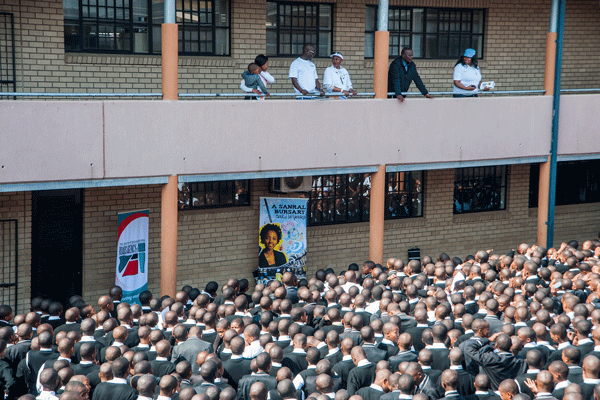
One of the first students to ever be awarded a SANRAL bursary, Lindelani Tsanwani, has led roadshows creating awareness of the roads agency’s programmes available for the youth.

“Financial assistance is available to high school learners and students of tertiary institutions in the Eastern Cape who are looking to pursue careers which involve maths and science.”

This was the message being relayed by the South African National Roads Agency (SOC) Limited (SANRAL) at their annual scholarship and bursary roadshow in the province.

Taking it to the road

The roadshow included three programmes, the university roadshows, the bursary and scholarship programmes for high school learners and the Technical Vocational Education and Training (TVET) roadshows that took place at all colleges in the Eastern Cape.

Tsanwani, who is now a project manager at the roads agency, said: “With regards to bursaries and scholarships, we visited Eastern Cape high schools to create awareness of the opportunities afforded by SANRAL.

“We aimed to visit all schools that received an average of 55% pass rate in grade 12 last year. We have schools in the deep rural areas doing well in maths and science. I understand the struggle and having to stress about not knowing how you will pay for your fees.

“Transformation includes giving opportunities to the disadvantaged. Eastern Cape is one of the poorer provinces in South Africa and we need to have more bursary holders coming from this area.”

Earlier in September, Tsanwani and colleagues had successful roadshows at 15 high schools along the R61 between Queenstown and Mthatha.

The university roadshows also included a visit to Nelson Mandela University (NMU) in Port Elizabeth on Friday, 22 September and the Walter Sisulu University Butterworth campus on Thursday 28 September. The SANRAL team also visited the Walter Sisulu University East London campus.

Practical training

At these roadshows SANRAL explained the practical training opportunities that are available for students currently completing their diploma qualifications. Practical training is a requirement of all civil diploma qualifications. These training opportunities are offered on all SANRAL projects.

Tsanwani said: “Throughout the roadshows we aim to create relationships between SANRAL, universities and the students and to engage them on how we can make the training programme work better for everyone and be accessible for everyone.”

First of four

Tsanwani was among the first four bursary graduates to be employed permanently by SANRAL after university and was among the first ever graduates to manage a SANRAL project. He was also among the first bursary students to complete his Masters studies which was also paid for by SANRAL.

“I was also one of the first graduates to be registered as a professional engineer by SANRAL. I am very proud to be the first in most of the things that SANRAL has done for me and my career,” he said.

Learners can apply for the SANRAL scholarship programme which supports academically deserving applicants in grades 10 to 12. The minimum requirements are an overall aggregate of 75% – with at least 70% in mathematics and science and 65% in English.

The bursaries are awarded to needy South African students who have successfully completed their first year of undergraduate studies or those currently registered for second, third, or fourth year and postgraduate studies.

Eastern Cape roads in good hands with this SMME

Nwabisa-1
Nwabisa Mugubasi, who works with her mother, Nontsokolo, said her company has benefited greatly from the training SANRAL offers to small and emerging enterprises.

A mother-and-daughter team from the Eastern Cape has gained a firm foothold in road construction in the province, developing skills along the way.

Sokhazimla Trading is an active participant in construction activities on the N2 project near Port Elizabeth, where its teams work closely with the main contractor, RoadMac.

Sokhazimla’s work included the installation of subsoil drains on the Stanford Road intersection and it was also responsible for glass grids between the Commercial Road and Burman Road offramps.

A duo

Nwabisa Mugubasi, who works with her mother, Nontsokolo, said her company has benefited greatly from the training SANRAL offers to small and emerging enterprises.

“They go very far to accommodate and empower small contractors. Every opportunity with SANRAL has been positive for us,” she said.

Nontsokolo registered Sokhazimla Trading in 2004 while her daughter was still at school. After completing her studies in project management and road construction, Nwabisa gained some experience with an architectural firm before joining her mother in the business.

The company is registered as a level 1 B-BBEE enterprise and has acquired a 2CE PE rating from the Construction Industry Development Board.

The extra mile

“As an SMME, we see the difference SANRAL makes with the training courses it provides,” said Nwabisa. “We have benefited from the training, especially gaining experience in the procedures required for the completion of tender documents.

“We hope to grow with SANRAL.”

Sokhazimla’s headquarters are in KwaDwezi and the company has another office in North End. It employs six permanent staff and can accommodate up to six additional people, depending on the size of the project.

Mbulelo Peterson, SANRAL’s Southern Region Manager, said the agency supports the growth of emerging enterprises and job creation through the application of participation goals in all its contracts.

“A predetermined percentage of the main contractor’s total contract value must be allocated to the subcontracting of SMMEs,” he said.