
The first phase of the upgrading of the R573 Moloto Road – a 137km stretch from Gauteng through Mpumalanga to Limpopo – is almost complete. This included the construction of four roundabouts as well as a butterfly intersection. The total budget for the project is R3.7bn over five to six years.
Blog
Huguenot Tunnel plans

The extent of closures of the Huguenot Tunnel, scheduled for June 2019 to November 2019, will be clearer once the designs for the maintenance of existing facilities are more advanced. Planning is afoot to take an extra electricity feed from the Drakenstein municipality in addition to the two present Eskom feeds.
More opportunities for smaller contractors
SANRAL is continuing to give small enterprises better access to the road construction machinery they need to execute major SANRAL projects.
The roads agency has recently signed an agreement in this regard with the Wirtgen Group.
The aim of the agreement is to give full access to the Wirtgen Group’s full suite of leading equipment brands to small and medium contractors in the construction industry, in addition to providing financing, training and logistics support.
“This is an important step in the broader national aim to transform the construction and engineering sectors and enable emerging black contractors, including enterprises owned by women and the youth, to participate more fully in major projects,” says Louw Kannemeyer, Engineering Executive at SANRAL.
“Infrastructure development will be a major contributor in the efforts to attract investment to the country and was singled out at the recent Job Summit for its ability to create employment and stimulate economic activity.
“Equipment is one of the major success factors for contractors in the execution of their projects. If contractors are not well equipped, the country also faces the danger of sub-standard road infrastructure.
The agreement will afford upcoming contractors greater access to all Wirtgen Group equipment brands, namely Wirtgen, Vögele, Hamm, Kleemann, Benninghoven and Ciber,” says Waylon Kukard, National Sales Manager at Wirtgen South Africa.
The agreement with Wirtgen is part of a process introduced by SANRAL to open up the engineering and construction industries through its tender and enterprise development initiatives. This is the third such agreement that SANRAL has signed with companies that provide construction equipment.
Through its leading brands, Wirtgen offers a wide range of equipment, ranging from rollers, bitumen spreaders, sweepers, milling machines, recyclers, slipform pavers, modular asphalt pavers, to mobile asphalt plants, crushers and screens.
Emerging contractors will be able to purchase, or lease, the sophisticated machinery required to meet the high standards that are in place within the South African road construction environment.
This move will open new doors for Wirtgen to collaborate with small contractors by offering them access to finance, technical assistance, mentoring and logistical support.
SANRAL and Wirtgen will also collaborate on issues such as training, supply chains and access to information on tendering processes.
New credit ratings agency
Global Credit Ratings Co. has been appointed SANRAL’s new credit ratings agency, effective from 1st October 2018. The roads agency terminated the services of Moody’s Investor Services when their contract expired on 30 June 2018.
Moody’s had earlier pointed out that there were liquidity pressures on SANRAL, this because of the government’s deliberations on the long-term solution for the GFIP funding model. They further explained that this was the reason SANRAL did not issue any new debt, so as to await the final announcement on this matter by the government; thus it had changed the roads agency outlook to “negative”.
However, Moody’s felt that from a “credit risk perspective, SANRAL’s credit profile, its strengths as well as its weaknesses are derived entirely from its relationship with the South African government because of the close operational and financial links between the two”; further noting the tight control that the government exercises over SANRAL’s operations.
In addition, the ratings agency stated that the roads agency “plays a critical role in South Africa’s road infrastructure development”, with “its main mandate being to expand and maintain the national road network on behalf of the national government”. Moody’s believes that “SANRAL will continue to enjoy a very high degree of government support”.
- The GFIP funding model is under pressure mostly because of the poor e-toll collection rate.
- Minister of Transport Blade Nzimande earlier said in a statement that “it is essential to strike a balance between the definite need for more and better roads and the undoubted constraint borne from a lack of funding”. The minister also stressed that people should start engaging in mature debate regarding how they want road infrastructure to be funded.
- Treasury also noted that comments from civil society organisations, like OUTA, encouraging people not to pay e-tolls have hugely impacted on tax morality and act to further undermine the culture of payment.
Survey gives other view on e-tolls
The growth in the number of Gauteng residents who are willing to pay for e-tolls shows that this remains a viable option to fund road infrastructure in South Africa’s economic heartland.
Vusi Mona, SANRAL’s communications manager, says the findings of the Quality of Life Survey 2017/18 released by the Gauteng City-Region Observatory show that more than half of the respondents would be willing to pay for e-tolls. This is 10% higher than the comparative figures in the survey conducted in 2016.
“The survey results clearly contradict the perceptions created by special interest groups that there is overwhelming resistance against e-tolls in Gauteng or that it is an issue which is uppermost in the minds of residents.
“The findings will, no doubt, contribute to a more nuanced and constructive debate about the value that road infrastructure brings to a region’s economy and on the range of funding options that are available,” he says.
The bi-annual survey is conducted through a partnership between the Gauteng provincial government and the Universities of Johannesburg and the Witwatersrand; sourcing opinions from some 25 000 respondents across every municipal ward in the province.
With regards to e-tolls, the respondents were asked whether they agree with the statement “I will never pay my e-tolls.” Some 51% of the participants either “disagreed” or “strongly disagreed” with this statement.
This is a discernible growth from the 40% who agreed when the question was asked in 2016. In addition, strong opposition to e-tolls also declined from 12% to 9% in the corresponding period.
Christina Culwick, the senior researcher at the Gauteng City Region Observatory, says that 43% of respondents in the lowest income brackets indicated that e-tolls are not an issue for them because they do not use the freeways. “This suggest that e-tolls are a relatively progressive payment option for the freeway upgrades.”
The survey also shows that issues related to spatial inequalities – unemployment, crime and access to opportunities – are uppermost in the minds of Gauteng residents. The availability of a well-funded and well-maintained road infrastructure can contribute to solutions for these pressing problems.
“Government is busy with a comprehensive review of its policy on road infrastructure funding and the use of tolling as an option,” says Mona. “The GCRO survey results will, no doubt, add to the quality of information that is available to government.”
- OUTA, which opposes e-tolls and urges people not to pay, has dismissed the report, saying its credibility is in question.
- Culwick explained that the report reflected the answers to questions put to 25 000 respondents and added that the results are contrary to the view of Premier David Makhura that e-tolls have no future in Gauteng.
Blaming SANRAL will not lead to busy shovels
By Skhumbuzo Macozoma
It has become fashionable to blame everything – and anything – that ails the local construction industry on SANRAL.
Thus, construction companies ascribe their weak annual results and failure to report profits primarily on SANRAL’s supposed failure to issue tenders for road construction projects. And, when they, sadly, have to retrench workers or cut down on their wage bills, SANRAL becomes the convenient scapegoat.
We have seen it again recently when a major construction company, Raubex, announced retrenchments following the publication of declining results and a drop in profits. For some reason SANRAL is singled out as the source of all its woes by a company that recently boasted about its achievements in diversifying its business in sectors other than road construction.
SANRAL has been upfront and transparent about the regulatory difficulties we experienced in the issuing of new contracts for road construction, rehabilitation and maintenance. We fully understand the critical role that we play in the construction and engineering sectors and that is why we worked tirelessly with National Treasury to find workable solutions to break the impasse.
Throughout this process we kept our partners in the industry, large and emerging businesses, contractors, suppliers and labour, informed about the issues to the point where we could announce in September that solutions were found and that we would be able to resume the issuing of contracts.
But it is clearly unfair and irresponsible to blame SANRAL as the primary source of the industry’s woes without also putting the spotlight on other contributory issues. These ranges from macro-economic issues like the current down-turn to company-specific issues that might be ascribed to weak management, uninspiring leadership, cost overruns or missed deadlines.
It is, equally, not true to imply that all SANRAL work has come to a halt. If you read through our 2018 Integrated Report, there is an extensive breakdown of construction and maintenance projects commissioned by SANRAL and its concessionaires that are either underway or in the pipeline.
We are issuing multi-billion-rand tenders on the N2 Wild Coast project, including the construction of two of Africa’s largest bridges. We are busy with the major rehabilitation of the Moloto Road. There is construction taking place on the N8 in the Free State, on the N4 near Brits, near the O R Tambo interchange in Mpumalanga, and we have already broken ground on the upgraded N1 section near the Beitbridge Border Post.
The record will also show that the Raubex Group is a primary contractor on many of these projects.
At SANRAL we are encouraged by the important announcements made by President Cyril Ramaphosa in the past six weeks on investments in infrastructure as a catalyst for growth, job creation and local economic development.
We have spent considerable time and effort to refocus SANRAL’s organisation through new appointments in leadership positions and the drafting of a new strategic vision, Horizon 2030.
We have consulted widely with industry and civil society on our new policy on the transformation of the construction and engineering sectors and how to ensure emerging enterprises and black-owned companies can grow from perennial subcontractors to primary contractors on future road building projects.
In the past month we have demonstrated the value of partnerships in our sector with the signing of agreements with major suppliers of equipment and logistical services. They would use their position in the market to give emerging contractors some hand-ups to procure and lease equipment and SANRAL would support them through access to training, supply chains and information about tender processes.
Clearly, this is the road to follow if we want to grow the engineering and construction sectors in South Africa. Partnerships will contribute to the delivery of vital infrastructure to communities and, eventually, to better results for construction companies.
Finger-pointing at SANRAL will not place a single shovel in the ground.
Macozoma is the CEO of SANRAL.
Durban’s Spaghetti Junction “IS SAFE”
A viral hoax about Durban’s Spaghetti Junction threatens road user’s safety but SANRAL assures you there’s nothing to worry about.
The South African National Roads Agency (SOC) Limited (SANRAL) makes a significant contribution to road safety by maintaining and improving South Africa’s road environment and by identifying and addressing road safety concerns.
SANRAL continuously evaluates the national road network against a set of norms and standards and applies this analysis during project design, construction and routine road maintenance.
We also identify and addresses high-incident areas.
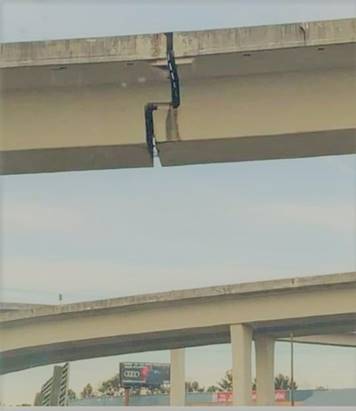
Thus, it is with concern that SANRAL has noted the posting on social media of a photograph of a bridge with a gap and which is purported to be the Spaghetti Junction (EB Cloete Interchange) on the N2 outside Durban.
SANRAL Eastern Region Regional Manager, Dumisani Nkabinde said it was rather unfortunate that a social media post has gone viral, claiming that Spaghetti Junction in Durban “is cracking and will be closed”. The post requested the public to “keep away”.
Nkabinde said: “The photo shows a type of expansion joint located in the span of the bridge commonly known as a half joint. It is not a crack in the deck but is designed to expand and shrink. The picture is not from the EB Cloete Interchange located in Durban, but from an interchange in the United States which also appears to be called “Spaghetti Junction”.
“The link below confirms this. This is further confirmed by the fact that this type of joint is not used at EB Cloete interchange, and the piers and parapet appear different to those at EB Cloete.”
http://www.fox5atlanta.com/news/photo-goes-viral-on-social-media-panicks
Nkabinde concluded that the Spaghetti Junction in Durban is in good condition and there is no structural defe
Improving road safety between Hendrina and Hendrina Power Station
The new road will be much safer than the existing road with provision of 3-meter paved shoulders, construction of a new bridge, provision of passing lanes and upgrading of the roadway through the town section.
Road construction is one of the most challenging and demanding jobs. Every project brings new challenges which require civil engineers to think out of the box.
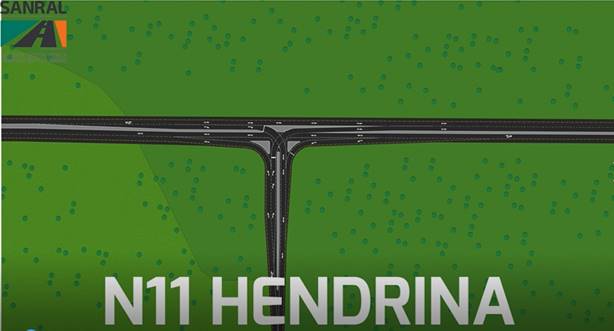
The upgrading of the N11 from Hendrina to the Hendrina power station undertaken by the South African National Roads Agency (SOC) Limited (SANRAL) is one such example.
The road is an important route for coal haulage and transportation of agricultural produce in Mpumalanga.
On average, it carries 2 500 to 3 000 vehicles in one direction per day, mostly heavy trucks from the mines.
The Project
The main aim of the project is to strengthen the existing pavement, which is past its structural design life and is generally in a poor condition and introduce new features to make it safer for motorists.
Because it’s an already existing road, the project presented contractors with some technical challenges.
According to Progress Hlahla, Regional Manager SANRAL northern region, the project had to be split into 18 separate construction sections because of the various difficulties encountered, and complexity of dealing with construction of bridges, building of a temporary bypass for accommodating of passing traffic, high water table in the fills, various services in the way such as water mains, and fibre optic cables.
The new road will be much safer than the existing road with provision of 3-meter paved shoulders, construction of a new bridge, provision of passing lanes and upgrading of the roadway through the town section.
“The first test was to build a bypass along the new road to accommodate passing traffic,” said Hlahla.
Challenges
A major challenge was the relocation of services along the road such as the Telkom and Dark Fibre optic cables and dealing with two water main pipes that run parallel to the road.
It was found that the water mains were in the way for the widening and reconstruction of major culverts and bridges and had to be diverted in order to accommodate the road.
The deviation of these water mains (which service the town from the Optimum mine) was a major headache and impacted negatively on the contractor’s construction programme.
Hlahla said: “We encountered a very high-water table under the road in the town section, which required installation of a new subsoil drainage system to deal with the underground water. The municipality were called in to ensure that the high-water table was not artificially created by leaking of municipal water mains. In general, SANRAL had a good working relationship with the local municipality.
“We are also going to be upgrading the intersection at the Hendrina Secondary School into a traffic circle and will be installing new LED street lighting as well as implementing 5 new bus-stop shelters for convenience of non- motorists.”
Once completed the N11, previously designed for a speed of 80km per hour, will now be much safer and wider to accommodate vehicles travelling at 100km per hour.
Project information:
Project title: Upgrading of the N11 from Hendrina to the Hendrina Power station (20km).
Project value: R 275-million – 20% to be allocated to SMMEs including women owned and youth owned.
Contractors: Power Construction.
Project scope: Construction of layer works, widening of lanes – to 3,7m with 3m surfaced shoulders, – construction of bridges, a traffic circle and reconstruction of kerbs.
Duration: Original contract duration 26 months – delays of 5 months encountered. Contract started November 2016. Expected completion April 2019.
Roundabouts are much safer
Roundabouts have the advantage of reducing conflict points, achieving traffic calming in that they compel traffic to reduce speed but not come to a complete stop.
Deciding on the best interventions to build quality and safer roads can be a challenge, but it’s something that the engineers at the South African National Roads Agency (SOC) Limited (SANRAL) do well.
According to Progress Hlahla, regional manager SANRAL northern region, road safety is top of mind in the planning and design of infrastructure.
“SANRAL always prioritises the safety of road-users, both motorists and pedestrians, in the design of national roads. We strive to introduce balanced and safer engineering solutions based on the type of area as well as traffic and pedestrian activity on to the road,” said Hlahla.
One such example is the introduction of roundabouts – also known as traffic circles – as speed calming measures in the upgrading of the R573 Moloto Road project.
Previously dubbed “the road of death” due to the high number of accidents, Moloto Road is one of the country’s busiest routes, connecting Gauteng, Mpumalanga and Limpopo provinces.
On average it is used by approximately 150 000 commuters daily. Traffic consists of private vehicles, buses, taxis and heavy trucks.
“The objective is to make the road safer for pedestrians. Many lives have been lost due to dangerous crossing of the road. We will also provide safer access roads to private properties and farms in the area,” he said.
A safer option
The roundabouts are a much safer design for this project compared to other intersections, such as T-junctions.
“They have the advantage of reducing conflict points, achieving traffic calming in that they compel traffic to reduce speed but not come to a complete stop,” explained Hlahla.
There are four roundabouts planned for the first phase of the project, three in Mpumalanga – at Vlaaklagte 1 & 2 and Tweefontein – and one in Limpopo – at the intersection of the N11 and R573 in Marble Hall.
In the Mpumalanga section of the R573, two of the three roundabouts will be four-legged, meaning they will have four exit points to accommodate traffic from four directions; and one will be three-legged with three exit points for traffic from three directions.
All the roundabouts will have an 18m radius. The main roads will be 400m in length approaching the roundabouts, and 100m for secondary roads.
In Limpopo, the main intersection at Marble Hall will be configured from a simple T-junction into a four-legged roundabout with two-lane, 4,8m wide with a 55m outside diameter.
This will help alleviate traffic and accommodate the heavy vehicles carrying mining equipment passing through the town.
Other engineering interventions include the construction of a butterfly intersection at Mathys Zyn Loop. The total width of the road will be 13,4m with 3,7m for each lane and 3m shoulders on both sides.
Project information:
Project title: Upgrading of the R573 Moloto Road (137km Gauteng – Mpumalanga – Limpopo).
Project value: SANRAL has invested R3.7-billion for the whole project – over a period of five to six years. The budget is for Mpumalanga and Limpopo sections only. The Gauteng section of the R573 will be funded by the Gauteng provincial government. Thirty percent of the project value will be awarded to SMMEs.
Contractors for phase 1: Limpopo JV partners – KPMM (Main JV partner) and CBE (Targeted JV partner). Mpumalanga JV partners – Raubex (Main JV partner) and Khuluphala Trading, Themolo, BizAfrika (Targeted JV partners).
More contractors will be appointed throughout the different phases of the project. SANRAL will issue notices on all relevant information about upcoming project phases on the website – www.nra.co.za.
Project scope for phase 1: Construction of roundabouts (traffic circles) and a butterfly intersection; including widening of road lane to 3.7m with 3m shoulder on both sides.
Duration: 28 months – started January 2017 to May 2019 (expected completion date).
Xolobeni court ruling has no effect on N2WCR project
N2WCR Project not affected after strong support from the Eastern Cape Province, local and district municipalities, traditional leaders and communities in the region.
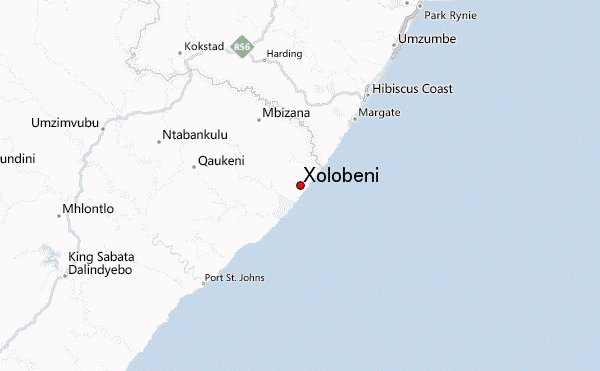
The court ruling in favour of the Xolobeni community against the issuing of mining rights in the area will not have any influence on SANRAL’s N2 Wild Coast Road (N2WCR) project.
The South African National Roads Agency (SOC) Limited (SANRAL) is working closely with local communities and the National Department of Rural Development and Land Reform (DRDLR) to address issues relating to communal land in areas affected by the construction of the road.
“We have always maintained that the road will contribute to the economic development of the region and open opportunities for eco-tourism, conservation and the hospitality sector,” said Vusi Mona, Communications Manager for SANRAL.
The N2 Wild Coast Road will also give communities that have been marginalised in the past access to essential government services such as schools, clinics and pension payout points.
Community support
The project enjoys strong support from the Eastern Cape Province, local and district municipalities, traditional leaders and communities in the region.
SANRAL and the DRDLR obtain community consent to acquire the land required to build any new or realigned road and negotiate with individual land right use holders to acquire communal land assigned to individuals.
The process followed complies fully with the Interim Protection of Informal Land Rights Act that was at the center of yesterday’s court ruling.
Meetings are held with traditional leaders and the affected municipalities to explain the acquisition processes and receive feedback and guidance on how to proceed.
Community meetings where resolutions are taken are advertised and agreements are signed relating to compensation for the land that is required for construction.
The value of the land is determined by a professional valuer and compensation is paid into a trust account managed by the community. In cases involving individuals the contracts make provision for issues relating to buildings that might have been constructed and the possible relocation of graves.
Residents of the Eastern Cape have responded positively to SANRAL’s initiatives and the process of consultation prior to land acquisition.
Lulamile Mapholoba, a resident from the Baleni area, located next to the Mtentu River, said he had moved into a newly built house.
“I was happy with the process that took place when SANRAL acquired the land. They follow a good process. They have built houses for us and we are very happy with the project,” said Mapholoba a Municipal Manager at Greater Kokstad Local Municipality.