
Blog

Beyond Inclusion

The roads agency seeks to expand on the strides already made to integrate female employees in its operations and has challenged itself to go beyond inclusion.  
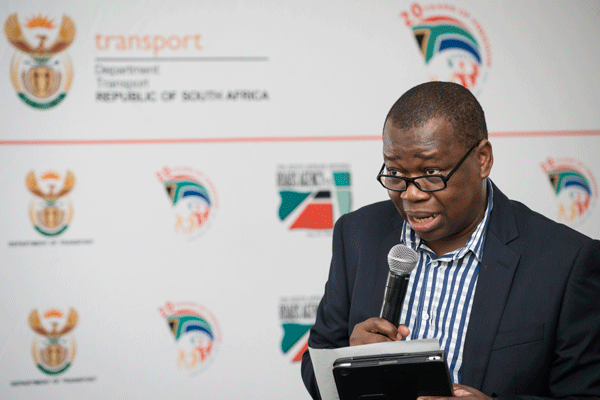
According to Vusi Mona, SANRAL General Manager: Communications, while construction is an industry that is one of the most consistent providers of jobs in South Africa, it has the highest proportion of male employment compared with other industries. 

Leading CCTV News anchor Tian Wei once made the very salient point: “Any society that fails to harness the energy and creativity of its women is at a huge disadvantage in the modern world.”  

The ideal of better inclusion of marginalised groups is by no means a new one. Countries around the world have been grappling with the ideal of integrating them in their economic activities.  

The reason for this is, to some extent, an expansion of the global consciousness; an increased awareness of the brutal and unjust exclusion of certain groups in our economic past.  

The point Tian Wei makes is one that should hit home for any business wanting to operate successfully in a free market: excluding people based on accidental properties such as gender, race, creed or background from partaking in business immediately cuts your eligible workforce by half (if not more).  

It also deprives the business of a diversity of perspectives and a wealth of knowledge that there really is no business case for excluding. Because of South Africa’s history, the main focus of workplace inclusion initiatives and legislation here has been along the lines of marginalised race groups – black, Indian and coloured people.  

Gender inclusion 

But it’s time to widen our focus – it’s time to talk about gender inclusion. The meaningful inclusion of women has been difficult not just because our focus has been on race rather than gender.  

Our society is built on deeply ingrained patriarchy – so deeply ingrained that most of us fail to see or understand it even when it is pointed out to us. In industries such as construction and engineering, the old ideas of what constitutes suitable work for women face even steeper barriers.  

While construction is an industry that is one of the most consistent providers of jobs in South Africa, it has the highest proportion of male employment compared with other industries.  

Why is that? Well, fundamentally, construction and engineering are traditionally perceived to be an uncomfortable workplace for women – not just because of ingrained misogyny, but also because of the nature of the work.  

As a society, we often encourage boys to “get their hands dirty” and to “get out there and build something”, whereas girls are often chastised for “getting dirty”.  

It is so pervasive that even our toys are gendered – engineering toys for boys and homeware toys for girls. But it’s time to tell girls and women that we need them in the built environment and that it is safe for them to explore it.  

Their skills and perspectives add immense value to all our construction and engineering projects. Simply regulating the inclusion of women in this sector does not guarantee success.  

A changed attitude 

Regulation is just the start. What we need is to fundamentally change attitudes, so that regulation is not the only tool we use to implement change. This is a mammoth task we should all be getting involved in.  

It requires that patriarchal attitudes and ideas of gender roles are either grossly overhauled or discarded altogether. This means we need buy-in from the whole workforce, so we all create that change regardless of our gender.  

The very same men who dominate the built environment must be the ones who advocate for women to explore the prospects of the industry – and call out sexism and misogyny in their own peer groups.  

We must also encourage women to “get their hands dirty” and take an active role in physically building our country’s future. We must create safe working environments that will allow female employees to feel like meaningful contributors without being subjected to prejudice.  

This will not be simple. It requires that organisations workshop employees on the importance of diversity, with the goal of leveraging each other’s strengths and achieving business objectives. All prejudice is learnt. We must unlearn these prejudices we have all perpetuated for so many years.  

An ideal South African entity 

As a state-owned entity, the South African National Roads Agency (SOC) Limited (SANRAL) is partly entrusted with being an example of the ideal South African organisation.  

That is: being productive, visionary and, of course, inclusive. The roads agency seeks to expand on the strides already made to integrate female employees in its operations and has challenged itself to go beyond inclusion.  

Beyond inclusion to us means doing more than just regulating, more than talking a good game (although having open conversations about inclusivity certainly helps). But it’s not about policy.  

It is about making sure that room is made for women in corporate leadership, in a way that is not simply nominal. Beyond that, it requires pushing for facilities, tools and gear for women, until it is standard practice and not a unique requirement in some workplaces.  

Going beyond inclusion is about stepping above regulatory conversations and taking action that will create a space for women to contribute meaningfully and become our partners in equity.  

Some things just cannot wait. We must stand up now for the inclusion, valuing and respect of women in the built environment.  

This is an opinion piece by Vusi Mona, SANRAL’s General Manager: Communications.

Road funding: What are our options?

The total estimated funding requirements to sustain the South African road network, including addressing backlogs in surfacing and capacity expansion, is R116.1-billion. 

According to SANRAL General Manager of Communications, Vusi Mona, new road funding models need to be evaluated.

Funding road infrastructure is an issue worldwide. There are more arguments about which funding mechanism should be used than there is money. And there are many mechanisms.  

In Australia there is a fuel tax, a vehicle sales tax, a road user charge, vehicle registration fees and stamp duties. In Brazil there is a tax on the import and sale of oil products.  

In France there is no special tax, while next door, in Germany, there is. But they share a common denominator – public-private partnerships.  

They all have one approach: private money must see a return on investment – and thus tolls are raised. And this is not universally well received. All of this is true in South Africa, too.  

There are many demands on our fiscus, not enough state funding, some reliance on the private sector, resistance to tolling and yet there is a huge demand for more and better roads.  

Questions must be asked about the most suitable funding model for road infrastructure.  

The fuel levy alone is insufficient. The future contribution of the fuel levy to the Central Revenue Fund is uncertain, with the projected electric car take-off in 2022 and established vehicle efficiency technologies.  

In less than five years, electric cars will cost the same as their internal combustion counterparts and that’s the point of lift-off for sales.  

Funding models 

The total estimated funding requirements to sustain the South African road network, including addressing backlogs in surfacing and capacity expansion is R116.1-billion.  

The current allocation for the road network is R52-billion. What can we afford and how do we prioritise? 

So, a conversation has started on funding models. Yet, an example exists that is similar enough, yet different enough, to warrant our attention.  

It has several advantages: it ensures quality, mitigates corruption and takes some of the funding burden off the state’s shoulders. It happens in Colombia, which not only has some of the worst roads in South America, but also not enough.  

To get around the problem, it launched the National Development Finance Corporation (FDN) in 2013.  

What makes it different from other such corporations is that it funds, at most, 25% of any project. The implication is clear: the rest of the project must be packaged in such a way that private investors would find it attractive enough. 

Attractive in many ways: its shareholding, for example, is held by the Colombian state, but also by private, albeit foreign banks, as well as international and regional development institutions.  

And they are all represented on the board, which has to approve all tenders. This makes it very difficult and unlikely that there will be any corruption in a tender.  

This is important, as graft is quite common in infrastructure projects across the world. To know in advance that it is unlikely to occur is a huge advantage.  

The project also has to offer acceptable risks and returns to interest private investors. The result is that pie-in-the-sky-projects, or those beloved by politicians but of no immediate value to the economy or nearby communities, will not see the light of day. 

Almost by definition this means that if the FDN is involved, there is an acceptance that it will be a high-quality project.  

Central to all of this that private investors won’t go near to such a state project if there is not some guarantee that the funds invested will supply a return comparable or better than the open market could have done. 

The only way to do this is for users of the infrastructure, partly funded by the private sector, to continuously pay when they use the supplied facility – in this case a road.  

In plain English, these roads have to be tolled and the toll must be paid. In addition, there must be an undertaking that where tolls are not paid, the state will make up for losses through a subsidy.  

The advantages of the Colombian approach are enormous: less chance of corruption, a guarantee of necessity and quality, users pay for the use of the infrastructure and there is political will to ensure that the payment occurs. 

This is an opinion piece by Vusi Mona, SANRAL’s General Manager: Communications.
Connecting communities to opportunities

SANRAL creates job opportunities and helps develop skills by training locals in the fields of construction and road building, while encouraging active participation of local small businesses.

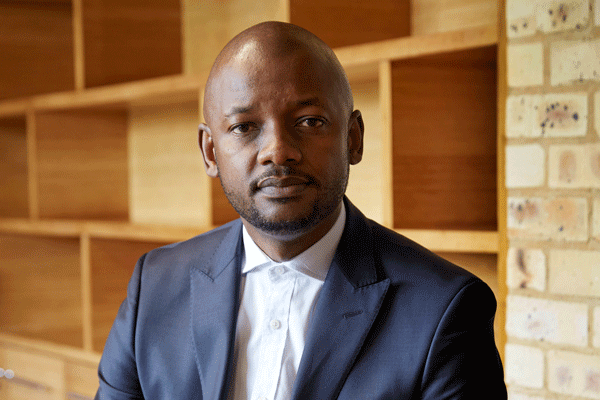
SANRAL CEO, Skhumbuzo Macozoma, said the roads agency wants to ensure communities participate in empowerment initiatives.

Developing and uplifting communities is part of the ethos of the South African National Roads Agency (SOC) Limited (SANRAL).

SANRAL does not just develop in the physical sense – in terms of infrastructure – it ensures the communities along the country’s roads develop economically as well.

Since its establishment 20 years ago, SANRAL has ensured that a significant portion of its work benefits the local labour force, including small-, medium- and micro-enterprises (SMMEs) situated close to its national road network.

Long-term economic benefits

Educating and training young people is also an important aspect of SANRAL’s work. The key motivation is to enable local communities to continue to enjoy the long-term economic benefits of SANRAL projects long after they have been completed.

The agency wants to ensure communities participate in empowerment initiatives. SANRAL’s community development programmes focus on providing pedestrian facilities and safe access points next to the national road network.

SANRAL creates job opportunities and helps develop skills by training locals in the fields of construction and road building. It encourages – and, in fact, requires – the active participation of local small businesses on all our projects.

During the last financial year, SANRAL has undertaken 24 community development projects in various provinces.

The combined value of these amounted to R257-million. The prioritisation of SMMEs, particularly those owned by women and black people, including the hiring and training of local workers, continues community development projects where labour-intensive construction methods are used.

The power of education

Through various partnerships with universities, SANRAL also continues to promote the teaching and learning of young people.

These partnerships include the SANRAL Chair in Mathematics, Science and Technology Education with the University of the Free State; the Science, Technology, Engineering and Mathematics Pipeline Project (STEM PP) at Nelson Mandela University and the Family Maths and Science Programme.

To strengthen its community development efforts, SANRAL is developing a focused strategy to ensure maximum impact.

As stated in the National Development Plan, roads are South Africa’s largest single public asset. They are conduits for economic activity. We connect people so they can do business.

This is an opinion piece by Skhumbuzo Macozoma, SANRAL CEO.

Bridge work halted

Construction of the Mtentu bridge on the N2 Wild Coast road has been halted due to violent protests. Locals have been employed on the project but those that did not find jobs are not pleased. SANRAL strongly condemned the violence. Work will resume when the situation is under control and safe for all concerned.

N3 to be upgraded

Public hearings in connection with the proposed capacity improvement on the N3 between Hammarsdale and Pietermaritzburg are ongoing. The expansion has become necessary because that section of the N3 is near full capacity. The plan is that extra lanes will be added and interchanges reconfigured.

Moloto Road improved

The first phase of the upgrading of the R573 Moloto Road – a 137km stretch from Gauteng through Mpumalanga to Limpopo – is almost complete. This included the construction of four roundabouts as well as a butterfly intersection. The total budget for the project is R3.7bn over five to six years.

Huguenot Tunnel plans

The extent of closures of the Huguenot Tunnel, scheduled for June 2019 to November 2019, will be clearer once the designs for the maintenance of existing facilities are more advanced. Planning is afoot to take an extra electricity feed from the Drakenstein municipality in addition to the two present Eskom feeds.

More opportunities for smaller contractors

SANRAL is continuing to give small enterprises better access to the road construction machinery they need to execute major SANRAL projects.

The roads agency has recently signed an agreement in this regard with the Wirtgen Group.

The aim of the agreement is to give full access to the Wirtgen Group’s full suite of leading equipment brands to small and medium contractors in the construction industry, in addition to providing financing, training and logistics support.

“This is an important step in the broader national aim to transform the construction and engineering sectors and enable emerging black contractors, including enterprises owned by women and the youth, to participate more fully in major projects,” says Louw Kannemeyer, Engineering Executive at SANRAL.

“Infrastructure development will be a major contributor in the efforts to attract investment to the country and was singled out at the recent Job Summit for its ability to create employment and stimulate economic activity.

“Equipment is one of the major success factors for contractors in the execution of their projects. If contractors are not well equipped, the country also faces the danger of sub-standard road infrastructure.

The agreement will afford upcoming contractors greater access to all Wirtgen Group equipment brands, namely Wirtgen, Vögele, Hamm, Kleemann, Benninghoven and Ciber,” says Waylon Kukard, National Sales Manager at Wirtgen South Africa.

The agreement with Wirtgen is part of a process introduced by SANRAL to open up the engineering and construction industries through its tender and enterprise development initiatives. This is the third such agreement that SANRAL has signed with companies that provide construction equipment.

Through its leading brands, Wirtgen offers a wide range of equipment, ranging from rollers, bitumen spreaders, sweepers, milling machines, recyclers, slipform pavers, modular asphalt pavers, to mobile asphalt plants, crushers and screens.

Emerging contractors will be able to purchase, or lease, the sophisticated machinery required to meet the high standards that are in place within the South African road construction environment.

This move will open new doors for Wirtgen to collaborate with small contractors by offering them access to finance, technical assistance, mentoring and logistical support.

SANRAL and Wirtgen will also collaborate on issues such as training, supply chains and access to information on tendering processes.

New credit ratings agency

Global Credit Ratings Co. has been appointed SANRAL’s new credit ratings agency, effective from 1st October 2018. The roads agency terminated the services of Moody’s Investor Services when their contract expired on 30 June 2018.

Moody’s had earlier pointed out that there were liquidity pressures on SANRAL, this because of the government’s deliberations on the long-term solution for the GFIP funding model. They further explained that this was the reason SANRAL did not issue any new debt, so as to await the final announcement on this matter by the government; thus it had changed the roads agency outlook to “negative”.

However, Moody’s felt that from a “credit risk perspective, SANRAL’s credit profile, its strengths as well as its weaknesses are derived entirely from its relationship with the South African government because of the close operational and financial links between the two”; further noting the tight control that the government exercises over SANRAL’s operations.

In addition, the ratings agency stated that the roads agency “plays a critical role in South Africa’s road infrastructure development”, with “its main mandate being to expand and maintain the national road network on behalf of the national government”. Moody’s believes that “SANRAL will continue to enjoy a very high degree of government support”.

  • The GFIP funding model is under pressure mostly because of the poor e-toll collection rate.
  • Minister of Transport Blade Nzimande earlier said in a statement that “it is essential to strike a balance between the definite need for more and better roads and the undoubted constraint borne from a lack of funding”. The minister also stressed that people should start engaging in mature debate regarding how they want road infrastructure to be funded.
  • Treasury also noted that comments from civil society organisations, like OUTA, encouraging people not to pay e-tolls have hugely impacted on tax morality and act to further undermine the culture of payment.

Survey gives other view on e-tolls

The growth in the number of Gauteng residents who are willing to pay for e-tolls shows that this remains a viable option to fund road infrastructure in South Africa’s economic heartland.

Vusi Mona, SANRAL’s communications manager, says the findings of the Quality of Life Survey 2017/18 released by the Gauteng City-Region Observatory show that more than half of the respondents would be willing to pay for e-tolls. This is 10% higher than the comparative figures in the survey conducted in 2016.

“The survey results clearly contradict the perceptions created by special interest groups that there is overwhelming resistance against e-tolls in Gauteng or that it is an issue which is uppermost in the minds of residents.

“The findings will, no doubt, contribute to a more nuanced and constructive debate about the value that road infrastructure brings to a region’s economy and on the range of funding options that are available,” he says.

The bi-annual survey is conducted through a partnership between the Gauteng provincial government and the Universities of Johannesburg and the Witwatersrand; sourcing opinions from some 25 000 respondents across every municipal ward in the province.

With regards to e-tolls, the respondents were asked whether they agree with the statement “I will never pay my e-tolls.” Some 51% of the participants either “disagreed” or “strongly disagreed” with this statement.

This is a discernible growth from the 40% who agreed when the question was asked in 2016. In addition, strong opposition to e-tolls also declined from 12% to 9% in the corresponding period.

Christina Culwick, the senior researcher at the Gauteng City Region Observatory, says that 43% of respondents in the lowest income brackets indicated that e-tolls are not an issue for them because they do not use the freeways. “This suggest that e-tolls are a relatively progressive payment option for the freeway upgrades.”

The survey also shows that issues related to spatial inequalities – unemployment, crime and access to opportunities – are uppermost in the minds of Gauteng residents. The availability of a well-funded and well-maintained road infrastructure can contribute to solutions for these pressing problems.

“Government is busy with a comprehensive review of its policy on road infrastructure funding and the use of tolling as an option,” says Mona. “The GCRO survey results will, no doubt, add to the quality of information that is available to government.”

  • OUTA, which opposes e-tolls and urges people not to pay, has dismissed the report, saying its credibility is in question.
  • Culwick explained that the report reflected the answers to questions put to 25 000 respondents and added that the results are contrary to the view of Premier David Makhura that e-tolls have no future in Gauteng.