
The N1 South-Bound will be closed to motorists on Sunday until Monday and motorists are advised to make use of alternative routes.
The South African National Roads Agency (SOC) Limited (SANRAL) would like to notify travelers that the N1 South-bound is scheduled to be closed from Sunday, 14 April 2019 at 18h00 until 04h00 on Monday, 14 April 2019 for the erection of a new pedestrian bridge at Erasmusrand.
The road will be closed between the Rigel Avenue and R21 interchanges. This bridge is to replace the Bridge that was demolished in 2016. Travelers are advised to make use of alternative routes during these times.
Should motorists still wish to use this route, travelers using the N1 South-bound will be diverted as follows:
Off-ramp at and turn left onto Rigel Avenue towards Delmas (R50).
Turn right onto Solomon Mahlangu Drive (M10).
Turn left onto the R21 towards Kempton Park/ OR Tambo International
Turn right back onto the N1 South towards Johannesburg
Off-ramp left onto the N1 South towards Johannesburg
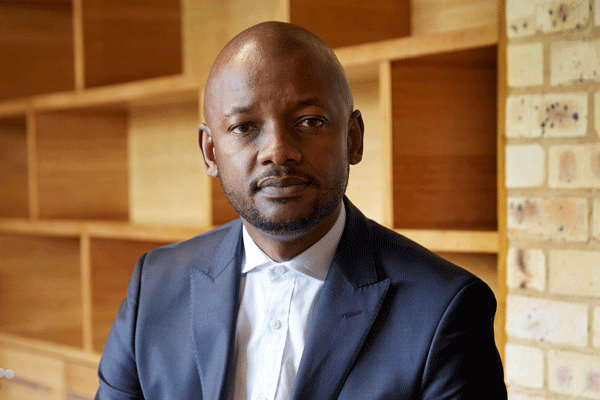
“We encourage road users to plan their trips ahead of time and to practice caution as they make use of the detours during this time,” said Progress Hlahla, SANRAL’s Northern Region Manager.
SANRAL apologises for any inconvenience caused during the erection of this bridge.
With winter approaching, motorists are warned to be aware of roaming animals close to the road reserve.
Although roaming animals are solely the responsibility of their owners, it is in TRAC’s interest to keep the N4 Toll Route animal-free as safety on our road is our primary concern.
With a large portion of the N4 Toll Route between Tshwane and Mozambique running parallel to farmlands and highly-populated rural areas there is always a risk of livestock or pets roaming onto the road.
With winter approaching, the problem is expected to escalate as livestock move closer to the road reserve in search of better grazing land.
This problem concerns TRAC immensely as it has a direct impact on safety on the road.
Although roaming animals are solely the responsibility of their owners, it is in TRAC’s interest to keep the N4 Toll Route animal-free as safety on our road is our primary concern.
Community assistance
However, we need assistance and support from communities along the route to address the issue effectively.
Despite our efforts to resolve the problem through various methods – such as erecting fences and barriers to keep animals off the road – the problem persists.
This is attributed largely to two factors – the lack of support from community members who allow their animals to roam free and the ongoing theft of the erected barriers.
We therefore appeal to owners to do their part in keeping their animals off the road by confining them to enclosed areas.
According to law, the onus to prevent livestock or pets from straying, falls on the animal owner. If damage is caused by an animal straying onto a public road the animal owner can be held liable.
We further urge community members to report the theft of SANRAL infrastructure to TRAC’s Whistle Blower Hotline on 082 900 2447. Callers remain anonymous and could be rewarded with up to R10 000 for information that leads to the recovery of infrastructure and/or legal action.
Safety tips
We also urge road users to be wary when driving on the route, and to observe the following road safety regulations and tips:
Always obey the speed limit and wear safety belts;
Take special care near animal crossing warning signs;
Be vigilant and alert. Get into the habit of scanning the roadside as you drive;
Be especially cautious at night;
If you see one animal, expect that there are others nearby;
If you see an animal near the road and think you have time to avoid hitting it, reduce your speed, tap your brakes and sound your hooter to warn other drivers;
If an animal is in your path, brake firmly but do not swerve to avoid it. Sound your horn in a series of short bursts to frighten it away. Provided you can slow down with control, steer around the animal – watch out for oncoming traffic – but stay on the road if possible;
If a collision seems inevitable, don’t swerve to avoid the animal; your risk of injury may be greater if you do.
Road users are also urged to play their part in combating this problem, by reporting stray animals to the TRAC 24-hour Helpdesk on 0800 87 22 64 or 082 881 4444.
Learners were taught the importance of teamwork and how to brainstorm creative solutions using the theoretical and practical parts of civil engineering.
WATER WINNERS: Professional Technologist for SMEC Tronel Strydom (centre) joined the winners of the iGEMS Water competition, from left, Sanctor High School learner Cursty Adams, Ethembeni High School learner Basetsana Malie, Douglas Mbopa High School learner Xhanti Qandana and Chapman High School learner, Matthew Human.
The South African National Roads Agency (SOC) Limited (SANRAL) supported high school learners in Port Elizabeth as they participated in the water engineering competition hosted by iGEMS.
SANRAL, together with SMEC, Labco and iGEMS, collaborated in hosting the fifth annual iGEMS water engineering competition, which educated high school learners on the skills required to plan and build a water distribution network.
The competition was held at the SANRAL’s Regional Training Laboratory on 25 March.
Brainstorming and practical solutions
The Port Elizabeth learners were taught the importance of teamwork and how to brainstorm creative solutions using the theoretical and practical parts of civil engineering in order to build infrastructure to provide clean water.
“This competition is very practical, and it gives learners the opportunity to work in teams, with their hands and look at practical issues in the civil engineering sector,” said Tronel Strydom, Professional Technologist for SMEC, who judged the water competition. She added that civil engineers understand that all communities deserve good reliable infrastructure.
The 15 participating schools included Alexander Road, Douglas Mbopa, Cillie, Ethembeni, Hillside, Khwezi Lomso, Molly Blackburn, Newton Tech, Chapman, Sanctor, Uitenhage, Daniel Pienaar, Woolhope, Lawson Brown and Ndyebo.
The teams of grade 11 and 12 learners were required to build a water distributor to distribute three-litre bottles equally between three points on a grid, making use of different connections and two different diameters. The learners were then judged according to a penalty point system.
Learner’s speak
Basetsana Malie (Ethembeni High School), Xhanti Qandana (Douglas Mbopa), Cursty Adams (Sanctor) and Matthew Human (Chapman) were the winning team.
Malie, an 18-year-old grade 12 learner, said her team started off not knowing what to do.
“We told ourselves to enjoy the competition. We also considered each other’s opinions which helped us win the competition.”
Second-prize winner, Xhanti Qandana, a 16-year-old, grade 11 learner at Douglas Mbopa, said: “At first I thought civil engineering was about building roads, but now it has taught me that it also has to do with water affecting roads and how civil engineers would have to deal with such situations.”
Samkelo Ngobese, a 17-year-old, grade 12 learner from Daniel Pienaar, said: “Civil engineering is the most important skill to have because it will give me the opportunity to build homes and distribute equal amount of water to communities.”
Human, a 16-year-old grade 11 learner, said it was important to study civil engineering.
“Civil engineering is important to build infrastructures to provide efficient ways for equal water transportation,” said Human.
Mbulelo Peterson, SANRAL Southern Region’s Manager, said in addition to supporting the iGEMS Water competition, SANRAL promotes the importance of civil engineering.
“By supporting this competition, we commit to the development of young aspiring civil engineers. We also further promote the importance of civil engineering through supporting projects like the Nelson Mandela University (NMU) School of Engineering STEM Pipeline Project, bursary and scholarships and training civil engineering graduates in the SANRAL Southern Region’s Technical Excellence Academy,” said Peterson.
While the cost of continuous repairs is soaring, of bigger concern is the loss of life as a result of pedestrians crossing our freeways.
Any acts of vandalism to road infrastructure or incidents along freeways may be reported to the TMC call centre at 0800 65 64 63.
For the South African National Roads Agency (SOC) Limited (SANRAL), road safety is about more than preventing crashes on freeways and to this end we continue to invest in securing them with appropriate fencing.
Furthermore, SANRAL ensures that the Freeway Management System (FMS) cameras permanently monitor 165km of the busiest freeways in the Western Cape, which includes sections of the N1, N2, N7, R300 and M5.
Vandalism
Vandalism of the fencing erected to keep both motorists and pedestrians safe on the freeways remain a huge concern and while SANRAL continues to replace damaged or stolen fences as quickly as possible, an urgent appeal has been made to the public to help safeguard the roads and report vandalism and theft.
Randall Cable, SANRAL Western Region Manager, said: “Between December 2018 and January 2019 we have seen a spike in the vandalism and our Routine Route Maintenance teams are repairing damaged fences at least once a week.
“Furthermore, we have deployed security personnel to patrol the areas most frequently affected, particularly the N2 and R300, in a bid to deter would-be vandals.”
While the cost of continuous asset repairs is soaring, of bigger concern is the loss of life as a result of pedestrians crossing freeways to get to work or school.
Loss of life
“Recent research conducted by the FMS operators found that approximately 17 000 pedestrian activities occur on our freeways daily. Of that, about 10 000 include pedestrians walking along the road, while a staggering 7 000 pedestrians cross the freeway at unsafe places. This has resulted in 185 pedestrian crashes in 2018 of which 57 were confirmed pedestrian fatalities,” continued Cable.
There are currently at least 20 pedestrian bridges constructed over the freeways and, contrary to the perception that pedestrians ignore those bridges, approximately 26 000 pedestrians use the bridges as a safer alternative daily.
Cable said: “We have also seen success where we erected a 5km fence on the concrete median on the R300 freeway between the Stellenbosch Arterial and the N2, and despite some repairs to fences along the freeway due to vandalism, we have definitely seen a reduction in the number of pedestrian crossings and associated fatalities on the R300.”
It is also important for motorists to play a role in removing the motivation for criminal elements, by not displaying valuable items in their cars, particularly in slow-moving traffic during peak times.
“Our FMS operators are now detecting incidents on the freeway in under three minutes on average and are able to notify appropriate law enforcement teams in the shortest possible time. We will continue to work with other authorities to address the issues holistically, and respond proactively to known hotspot areas,” concluded Cable.
Any acts of vandalism to road infrastructure or incidents along freeways may be reported to the TMC call centre at 0800 65 64 63.
Progress on the N2 Wild Coast project is steady – near the Msikaba bridge a 1.63km single carriageway and four-lane undivided road with two interchanges is being constructed, as is a single carriageway between it and the Mtentu bridge and an 11.5km road toward the Umtamvuna river.
Planning of the upgrades on the N3 between Durban and Maritzburg is on-going: the EB Cloete Interchange will be upgraded, additional lanes will be added between Cato Ridge and Dardanelles as well as from there to Lynnfield Park. Construction will begin in mid-2020.
There will be no construction work on the Mpumalanga section of the R573, or Moloto Road, this year. SANRAL is concentrating on stakeholder consultation and information sessions with local communities and SMMEs.
There will not be full-scale closure of the Huguenot Tunnel. Repairs will be mostly done at night. This may mean permitting light motor vehicles through the tunnel and diverting heavy vehicles to alternative routes. Refurbishment of the south bore will begin in the second half of the year and construction of the north bore in early 2020.
A new strategic path for state-owned entities that will improve their ability to create jobs, enable inclusive growth and become financially sustainable, was one of the primary announcements made by President Cyril Ramaphosa in his 2019 State of the Nation Address.
He also envisaged a comprehensive overhaul of the way in which infrastructure projects will be managed in the future, including a more effective utilisation of professional skills within the public sector – and more partnerships with the private sector.
Speaking in Parliament, President Ramaphosa made repeated references to the need to accelerate inclusive economic growth and emphasised the role of strategic state-owned enterprises and well-managed investments in infrastructure to achieve this objective.
A critical factor is government’s initiative to mobilise resources and attract investments in the provision of infrastructure. More than R1.3 trillion has been invested in the past five years and this has become “the flywheel of the engine of our economy”.
However, infrastructure development has slowed down for a number of reasons. A primary concern is that infrastructure provision is too fragmented between the different spheres of government. There is a lack of integration between projects aimed at housing development, physical infrastructure and social amenities.
Government is, therefore introducing “a new infrastructure implementation model” to address these issues. This will be underpinned by the new Infrastructure Fund announced by President Ramaphosa in September 2018.
The key features of the new implementation model are:
An initial R100bn allocation into the Infrastructure Fund will be used to leverage further funding from the private sector and development finance institutions.
The emphasis will be on “deeper partnerships” between public sector entities in the planning, building and maintenance of infrastructure.
The technical capacity in government will be strengthened by building a pool of engineers, project managers and spatial planners. They will form “action teams that can make things happen faster on the ground.”
The capabilities of the state and the private sector will be merged to address infrastructure challenges.
Steps taken include the appointment of new boards to entities that have suffered from an absence of good governance, and the establishment of a Presidential Council on state-owned enterprises (SOEs). This council will provide political oversight and strategic management, reposition and revitalise entities and ensure they can play a role as catalysts of economic growth and development.
Where such entities are not able to raise sufficient financing from the fiscus, banks, capital markets and development finance institutions, government will explore other mechanisms such as strategic equity partnerships or selling off non-strategic assets. However, this will not include the disposal of assets that are “strategic to the well-being of the economy and the people”.
A pronounced shift towards future investment in infrastructure – including the construction and rehabilitation of sections of the national road network – was one of the prominent features of the 2018/19 Budget.
Delivering his first budget speech, Finance Minister Tito Mboweni allocated an additional R3.5bn to SANRAL over the next three years to improve non-toll roads. This represents an increase of an average annual rate of 25.5% – from R6.9bn in 2018/19 to R13.7bn in 2021/2022.
However, this should be viewed against a reduction of R5.8bn in 2018/19 to meet SANRAL’s cash requirements for the Gauteng Freeway Improvement Project (GFIP). Thus, transfers for GFIP are expected to decrease from R6.3bn in 2018/19 to only R633m in 2021/22.
Mr Mboweni did not step back from his earlier support for the user-pay principle expressed in his 2018 medium-term budget speech in which he called on people to pay their e-tolls. This time around he said: “I emphasised the importance of the user-pay principle. It is a principle which we should uphold. In any future negotiations this should be borne in mind.”
Contained within the Department of Transport’s budget of R64.2bn are some indications of major road construction projects that are on the cards. Among these are:
5bn for all non-toll roads over the medium-term period
3bn for the upgrade of the Moloto Road (R573)
2bn for the construction of the two bridges on the N2 Wild Coast Road
Major allocations for the upgrades to the N2 (Cape Town), N3 (Mariannhill) and N2 North and South Roads
The resurfacing of 3 300km and improvements to 1 500km of roads, upgrading of intersections to interchanges and the building of new interchanges and bridges.
The budget notes that SANRAL will continue to focus on its programme to undertake preventative maintenance to preserve and improve the national road network. Total expenditure is expected to increase at an average annual rate of 5.1% – from R33.2bn in 2018/19 to R38.6bn in 20201/22.
The bulk of SANRAL’s total expenditure comprises payments to service providers for routine road maintenance and construction. As a result, goods and services expenditure accounts for 74.3% of total expenditure over the medium term.
SANRAL also expects its personnel to increase by 98 over the medium term – from 392 in 2018/19 to 490. This means an increase in expenditure on compensation at an average annual rate of 17.5%.
The agency generates revenue from transfers from the Department of Transport – for the non-toll network – and fees on the toll network. Revenue is expected to increase from R25.6bn in 2018/19 to R29.3bn in 2021/22. This includes an expected increase in toll revenue at an annual rate of 1.9%.