
Blog

SANRAL APPOINTS ACTING CEO WITH EFFECT FROM 17 NOVEMBER 2021

The contract of the current CEO of SANRAL ends on 30 November 2021. The CEO has requested a leave of absence from 17 November 2021 to 30 November 2021, which the SANRAL Board has duly granted.

To address the gap emanating therefrom, the Board of SANRAL has appointed Ms Lehlohonolo Pitse, the company’s current Chief Audit Executive, as the Acting CEO of SANRAL with effect from 17 November 2021 until the commencement of duty by a new CEO. The Board is at an advanced stage of the recruitment process for the CEO of SANRAL. Once a suitable candidate has been identified, the name shall be recommended to the Minister of Transport, who is the shareholder representative of SANRAL, for his approval.

SANRAL is grateful to Mr Macozoma for his sterling operational stewardship of the organisation over the past five years. The Board, the Management and the staff of SANRAL are committed to maintaining the high operational and governance standards this organisation is respected for

SANRAL ANNOUNCES NORTH WEST ROUTINE ROAD MAINTENANCE

North West, October 18, 2021: The South African National Roads Agency SOC Limited (SANRAL) has informed the community of Zeerust, in the North West province, of a R53 million routine road maintenance (RMM) project, of which more than 30 per cent will go towards local subcontractors.

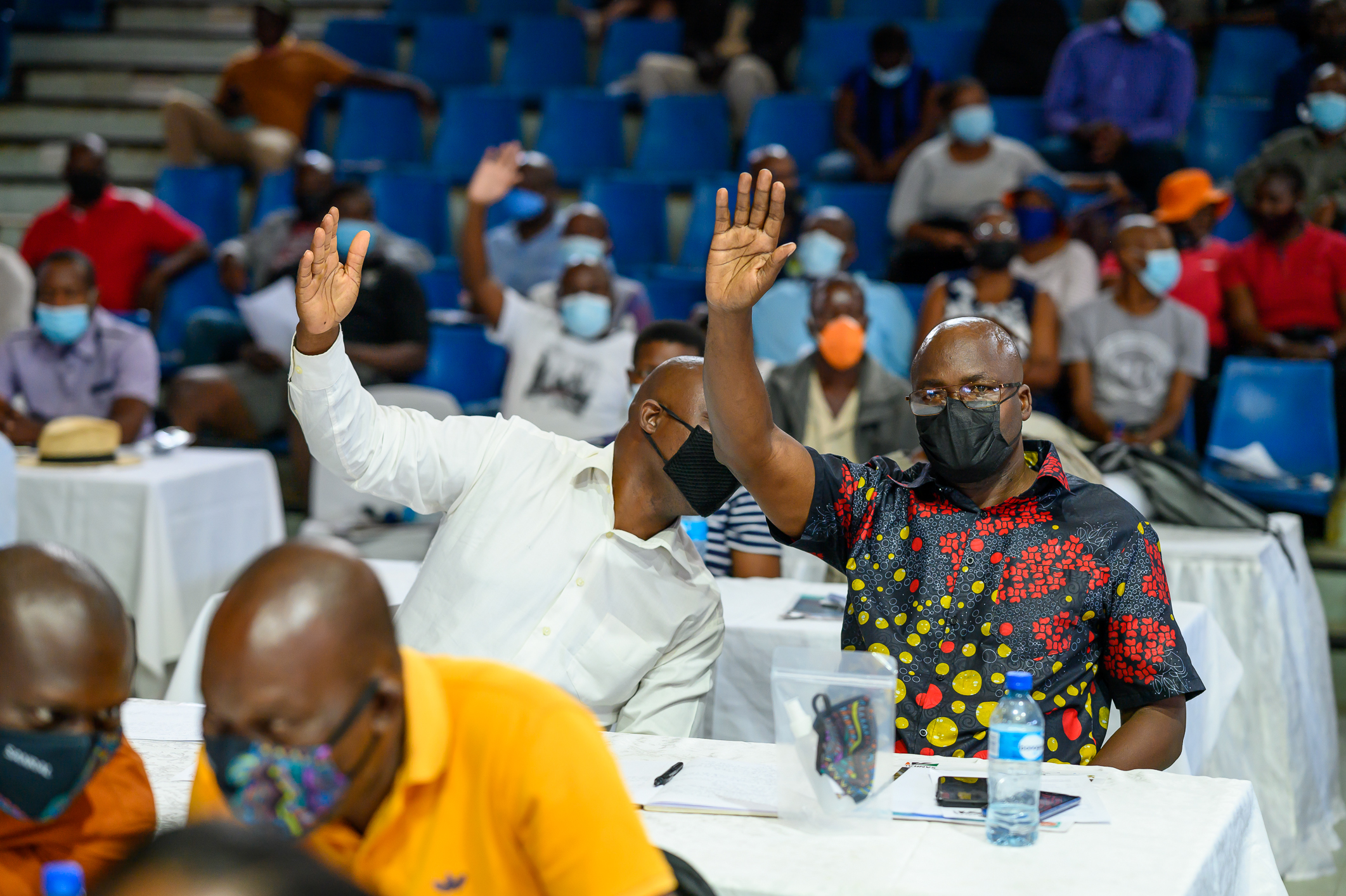
SANRAL made this announcement at a recent Taking SANRAL to the People engagement in Zeerust. The event was held in line with SANRAL’s fourth pillar of stakeholder relations, which requires that the roads agency engages communities on matters that affect them.

The objective of the community engagement was to share details on Vision 2030 and the Transformation Policy aimed at achieving economic development, and inclusivity.

The RRM planned for the R49 sections 1 and 2, with a total of 110.5km in Zeerust, North West, will include a much-needed clean-up of the road reserve, as a part of the general maintenance, vegetation control, pavement repairs and traffic accommodation.

SANRAL’s Northern Region Stakeholder Coordinator, Jullecsia Saul, said emphasised the importance of empowering women, children and persons living with disabilities.

Saul also highlighted the need for more consultation in job creation: “This project has afforded local small, medium, and micro enterprises (SMMEs) the opportunity to understand SANRAL’s tendering process, which contribute to the Zeerust community through job creation. We are also here to address concerns raised about the current ongoing projects; such is the significance of this information sharing session.

Taking SANRAL to the People was created as a solution to the growing need of communities to have access to SANRAL, because of how far the head offices are situated,” Saul added.

Northern Region Project Manager, Miss Karabo Otloa, discussed the upcoming SANRAL project in greater detail.

“The R49 starts at the Mahikeng municipal border and goes straight up to the Kopfontein border post with Botswana. The RRM project route is split into two sections. It started in November 2020 and will continue until October 2023. The project value is R53 million, and it will run for 36 months. The main contractor is Vea Roads Maintenance & Civil. We have expensive roads that need rehabilitation through consistent upgrading and maintenance, and this is where the RRM division comes in.”

“We also subcontract a portion of the maintenance work. The National Treasury has requested that all state-owned entities (SOEs) subcontract 30% of the work, and the percentage is also determined by the BEE level of the main contractor. In this project, we have subcontracted more than 30%.”

The Bakwena Platinum Corridor Concessionaire commercial manager, Solomon Kganyago, discussed Bakwena’s partnership with SANRAL.

“Bakwena has a public 30-year concession contract with SANRAL. We implement the policies SANRAL introduces because we work in the same communities. It becomes a collective responsibility towards the provision of safer roads. In return, Bakwena manages the tollgates, the nearest one being the Swartruggens tollgate. It also benefits us to match the amount of work SANRAL has done thus far,” he said.

Chairperson of the SANRAL Board, Mr Themba Mhambi, delivered the keynote address and answered a few of the community’s burning questions.

“We are grateful that you are all here, we truly appreciate the way you have been engaging with SANRAL. We are not here to be defensive. We are here to share information and listen attentively so we can correct anything that is not right. As a public institution we are duty bound to work with the government at the level of the community.”

“We are going to make sure the NGOs and business forums are bought into such engagements. We are also making sure that in our engagements with the municipality, all the various stakeholder groups are involved. SANRAL is not perfect and the only way to improve this is continued engagement with you, the municipality and the PLC [project liaison committee] members.”

Members of the community emphasised the need for SANRAL to host another engagement session soon to discuss in detail the issues raised. SANRAL was in full agreement with that request.

SANRAL EXCEEDS CONTRACT PARTICIPATION GOALS WITH 40% ALLOCATION TO SMMEs

Richards Bay, 18 October 2021 – Black businesses stand to receive up to 40 per cent of the contract value on two periodic maintenance contracts on the N2 in the King Cetshwayo District Municipality, exceeding the minimum target of 30 per cent.

The good news was announcement by Deputy Minister of Transport, Ms Sindisiwe Chikunga, at a stakeholder engagement session of the South African National Roads Agency SOC Limited (SANRAL) in the uMfolozi Local Municipality today.

“In line with SANRAL’s Transformation Policy and government’s Preferential Procurement Regulation, a minimum of 30 per cent of the contract value of all projects is to be subcontracted to targeted enterprises, in a bid to prioritise economic development opportunities for black-owned entities. These entities include women-owned businesses, youth-owned businesses and companies owned by or which benefit persons with disabilities. However, in this case, SANRAL is exceeding that target and a total of 40% of the contract value is set aside for black businesses,” said Deputy Minister Chikunga.

The first project is periodic maintenance on the N2, from Empangeni T-Junction for 15km, with a contract value of more than R83 million. There are currently 20 persons directly employed on site, 16 of which are from the uMhlathuze Local Municipality area. The number of employees is expected to increase to 60 in the coming weeks.

The second project is periodic maintenance on the N2, from Eteza Weighbridge, for 15km. The value of the project is R89 million, of which more than R30 million is for black-owned SMMEs. More than R3 million will be set aside for women and youth-owned businesses. The bulk of the workers currently on site are from the uMfolozi Local Municipality.

“Both these projects started in April this year and we anticipate completion by April 2022. Of the more than R4 million wage bill for each of these projects, at least R2.8 million will be targeted at women and youth,” said Trevor Zumani, SANRAL Project Manager.

The event was hosted by the King Cetshwayo District Municipality Deputy Mayor, Cllr Jabu Vilakazi who expressed huge appreciation for the economic injection that these road construction projects bring to the various local municipalities and the district at large. Also in attendance was the MEC of Transport in KZN, Ms Peggy Nkonyeni. She echoed the sentiments of the Deputy Minister and lauded the effective cooperative governance across national, provincial and municipal structures, to the benefit of SMMEs and local job seekers, while emphasising the need for more economic development opportunities for women.

SANRAL Board Chair, Mr Themba Mhambi, emphasised the importance of supplier development: “We prioritise training for successful subcontractors, with ongoing mentoring under the main contractor, to ensure growth and development. Subcontractors should be capacitated to eventually become main contractors.”

To this end, SANRAL has MOUs in place with several partners. One such MOU is with the South African Forum of Civil Engineering Contractors (SAFCEC). The MOU with SAFCEC is geared to explore options and solutions that enable mentorship, development, capacity building and training of small contractors, giving them the skills and knowledge needed to execute road construction and maintenance projects.

President Ramaphosa on epic N2 Wild Coast Road project

“It is not far-fetched to say that years from now, this N2 Wild Coast Road will enable an entrepreneur from Lusikisiki to transport their goods onward to Gaborone, to Lusaka, then to Dar es Salaam. It is not inconceivable that a bus from Kinshasa in the DRC will be able to bring tourists directly to the Wild Coast.” So said President Cyril Ramaphosa at his recent visit to the Msikaba Bridge site on the N2 Wild Coast Road (N2WCR) project near Lusikisiki in the Eastern Cape. He described the project as world-class and called on local communities and traditional leaders to support it.

The R1.65 billion Msikaba Bridge is one component of the 410km N2WCR, which will link the Western Cape, Eastern Cape, KwaZulu-Natal and Mpumalanga, and improve connectivity between SA and Mozambique, Swaziland and Lesotho.

The N2WCR is one of SANRAL’s flagship projects, which will lead to the creation of 8 000 full-time jobs and 21 000 – 28 000 indirect jobs.

President Ramaphosa said, “This translates to a wage bill of around R750 million. Both skilled and semi-skilled people have already been employed on this project. Once the road is completed, ongoing maintenance work is anticipated to create another 900 direct full-time jobs and around 19 000 indirect jobs.”

These numbers affirm SANRAL’s commitment to sustainable job creation. Over the past year alone, SANRAL has created 17 760 job opportunities at its various projects around the country.

The Msikaba Bridge is one of two mega bridges which are part of the N2WCR project. The other is at Mtentu, about 64km away, which will be one of the highest bridges in Africa and one of the longest in the world.


FAST FACTS

Msikaba Bridge

  • Cost R1.65bn
  • 580m long, cable-stayed
  • Completion by end of 2025 or beginning 2026
  • Supported by two 127m high pylons
  • Third highest in Africa
  • Deck will be 194m above the valley

The President said that the project has huge socio-economic and enterprise development benefits. “By regulating that a minimum of 30% of expenditure is earmarked for targeted enterprise subcontractors and suppliers, approximately R4 billion will in future flow to SMMEs from the OR Tambo and Alfred Nzo Districts. This will ensure that the investment on this project will be ploughed back to communities. Already some R120 million has gone to local SMMEs as part of upgrading and linking of roads, and there are several more projects in the pipeline.”

He said that at Msikaba the community participation goal for targeted labour set by SANRAL was exceeded at the end of July, reaching 37%. “Sixty-two per cent of the total work force on this site are locals. Of the 329 employed, 156 are employed by the main contractor, and 173 by subcontractors.”

President Ramaphosa added that the project would also have a positive environmental impact. “The N2 Wild Coast Region Biodiversity Offset Programme will result in the Silaka and Mkhambathi Nature Reserves being expanded, and lead to the creation of several new protected areas in the Pondoland Centre of Floral Endemism totalling approximately 20 000 hectares.”

The highway will narrow travelling distances and time, and will also be safer. Added Ramaphosa: “There is the benefit to tourism from both inside and outside the province. There is the benefit to the provincial and national economy. This highway will support the transportation of goods and services to the entire Southern African region.


In this way, he said, the N2WCR supports “not only our domestic priorities, but the economic integration agenda of the African continent”.

“With the coming into operation of the Africa Continental Free Trade Area in January this year, I can certainly see this project playing a key role in the movement of goods and services to a continental market,” he said.

“Through the Programme for Infrastructure Development in Africa (PIDA) we have a common framework for African stakeholders to build the infrastructure necessary for more integrated transport, energy, ICT and trans-boundary water networks to boost trade, spark growth and create jobs. In this regard, the N2 Wild Coast Road project will no doubt play an important role.

“We are committed to ensure that we grow our economy through infrastructure development. Infrastructure is the flywheel of our economic growth,” he said.

“What is most beneficial about massive infrastructure projects such as this one, is that the yields are sustained over a prolonged period.”


Fly with President Ramaphosa over part of the N2WCR project, to gain an idea of its scale, at https://fb.watch/8h9ybIjt1d/


SANRAL keeps its eyes on the road


Prioritising innovation is vital for creating a cost-effective and high-quality road transport system that supports economic growth for the benefit of all South Africans. SANRAL’s innovative Freeway Management System (FMS) allows for real-time monitoring and management of the national road network.

The system harnesses the latest monitoring tools and technologies to relay information on the flow of traffic via 24-hour Traffic Management Centres. This is displayed on variable message signs and sent to various online platforms and radio stations for broadcast to the public. The FMS allows for effective engagement with road users in a bid to respond to an array of incidents that occur on busy freeways across the country.

How does the FMS benefit you?

  • Improved road safety
  • Reduced traffic congestion
  • Better road incident management
  • Quicker detection of crashes, stationary vehicles, veld fires and hijackings
  • Faster response times by emergency services
  • Prevention of crimes such as theft (smash and grab) and vandalism.

Did you know?

The reach of the FMS is growing. It now covers hundreds of kilometres in SA’s biggest urban areas.

In the Western Region, the FMS monitors some of the busiest freeways in the Western Cape, namely the N1, N2, N7, R300 and M5. Network coverage on the N1 was recently extended to the eastern side of the Huguenot Tunnel through Du Toit’s Kloof Pass. This added a further 14.7km and took the monitored route from 165km to 179.7km.


In the Northern Region, which includes Gauteng and Mpumalanga, the length of freeway covered by the FMS is 251km

In the Eastern Region, the FMS currently spans 187km, including around 120km of the busiest sections of the N2 and N3 in KwaZulu-Natal – from the Prospecton Interchange on the N2, northward to the Watson Highway Interchange, and on the N3 from the Candella Road Bridge to Market Road.

The FMS operators detect incidents on the freeway in just a few minutes, and are able to notify appropriate emergency response teams in the shortest possible time.

SANRAL busy with R35bn upgrade to N2/N3 corridor

Upgrades of the N2 and N3 in KwaZulu-Natal form part of National Government’s key Strategic Integrated Projects – SIP2: Durban-Free State-Gauteng Logistics and Industrial Corridor. SIP2 aims to strengthen the logistics and transport corridor between SA’s main industrial hubs, improve access to Durban’s export and import facilities and raise efficiency along the corridor.

The upgrade of the N2 will focus on a 55km stretch from Lovu River on the South Coast to Umdloti on the North Coast. The N3 upgrade will focus on a 79.3km section from Durban to Pietermaritzburg.


Improvements

These upgrades will include the widening of the N2 and N3 carriageways, with four or five lanes in each direction, and the reconfiguration of most major interchanges along these route sections.

Packages

Due to the length and estimated cost of the entire N2 and N3 upgrades, the corridor will be split into a number of detailed design and construction packages. These may be broken down into further reasonably sized construction packages.

Timespan

The upgrades are expected to take 8–10 years to complete, depending on funding availability.

Cost

The total estimated construction costs are approximately R14bn for the N2, and R21bn for the N3. This excludes the cost for the N3 realignment around Townhill in Pietermaritzburg, which is being investigated separately.

Stimulus

President Cyril Ramaphosa recently introduced the “stimulus package” as a new measure “to reignite growth, stimulate economic recovery and secure confidence in sectors affected by regulatory uncertainty and inconsistency”. Projects earmarked for the stimulus package will be funded from the existing budget envelope. SANRAL’s allocation from the total stimulus package is R3.5bn, which will be used to initiate the SIP projects over the next two years, including two N2 project packages and five N3 project packages as part of SIP2.


Jobs

The N2 and N3 upgrade projects are estimated to produce over 15 000 jobs over the duration of the construction.

Community development

SANRAL is committed to transformation of the engineering and construction sectors through community development projects during the N2 and N3 upgrades. Clear guidelines and structures are in place to ensure that local communities benefit directly from the procurement of goods and services, from using local suppliers to giving preference to the creation of local jobs.

SANRAL committed to transforming the construction industry

At a time when transformation is often associated with fronting, SANRAL’s zero tolerance stance on fronting and its commitment to facilitating genuine transformation serves as a sterling example – not only to other State-owned enterprises, but also to the private sector.

SANRAL is laying the foundation for a more diverse and inclusive road transport industry. It is working to ensure that small emerging businesses, especially those owned by black entrepreneurs, women and the youth, become active participants in the construction, engineering and related sectors.

SANRAL’s Transformation Policy has clear targets for the participation of contractors, professionals and suppliers from historically disadvantaged groups. It requires contractors wishing to secure SANRAL tenders to be at least 51% Black-owned.

Thousands of SMMEs have benefitted through contractor development initiatives and mentoring in recent years – tangible evidence of SANRAL’s efforts to drive transformation in the transport sector and beyond.


Fast Facts

In 2020/2021 SANRAL provided work opportunities for 1,265 SMMEs on road construction, rehabilitation and maintenance projects.

Black-owned SMMEs accounted for 85.9% of contracts awarded and 48% of the value of work performed.

Total amount earned: R1,568,526,911


“SANRAL has strategic objectives in its policies in pursuance of societal transformation, which manifest spatially, economically, in terms of skills development, and so on. With our Transformation Policy we were able to develop a framework that we would use to intervene decisively in the markets that we serve to achieve transformation,” said SANRAL CEO Skhumbuzo Macozoma.

He added has 10 sub-sectors that the Agency decided to consciously intervene in. “They include our core business of construction, road maintenance and the toll environment. But finance is not immune, as well as the legal fraternity, the auditing fraternity, the marketing and communications fraternity, the property development fraternity, and the skills development sector. All of these contribute to us being able to implement our mandate of building roads.”

Development of these sub-sector strategies is the current focus of SANRAL’s Transformation Unit, to articulate the policy positions and map a clear path for implementation through defined outcomes and objectives.

These will both accelerate transformation in the sub-sectors through focused efforts and strengthen the country’s overall transformation agenda.

Reaping the benefits

Here is just one example of the impact being made. Inspired by two of his uncles who worked in construction, Lincoln Petersen registered his company Austshamoa Services, that specialises in civil engineering and construction, at the age of 29 in 2012. By 2014 he landed his first maintenance contract, with Drakenstein Municipality.

As with many industries, Petersen was severely affected by the economic impact of COVID-19 and related lockdowns. For the whole of 2020 there was simply no work. The fighting spirit of his uncles propelled him to keep submitting tenders, and this tenacity eventually paid off, with Austshamoa winning their first SANRAL subcontractor tender for Routine Road Maintenance on the N1 sections 1 and 2 between Paarl and Worcester in the Western Cape.

“There are not enough jobs for young people in my community, so they need to find the gaps in the market and create solutions. I started selling fruit and vegetables just a few years ago, and today I create solutions in the built environment space,” said Petersen.

This young man keeps his eye on the ball and already has plans to someday progress to a 7CE grading, as construction and civils are what inspire him most.


Supplier development and support

SANRAL is committed to mentoring small youth-owned contractors, such as Petersen, to increase the number of participants, particularly those which are black-owned. This promotes fair competition, facilitates access to developmental opportunities and builds lasting relationships that see small contractors benefitting from direct development support.

Supplier Development Desks at SANRAL’s regional offices ensure structured assistance to suppliers, including contractors, consultants and material suppliers.

In addition to strategic partnerships, Supplier Development Desks and the Online Supplier Development portal (soon to be officially launched), SANRAL has embarked on a series of Regional Bidder Feedback sessions. These address concerns regarding the number of bidders that get disqualified at the compliance and responsiveness stage, negatively impacting the chance of their bids being successful.

In most instances the mistakes made result from negligence or limited knowledge and skills on how to complete bid documents. Understanding that these challenges can be avoided, Regional Bidder Feedback sessions currently take place in the Northern and Eastern Regions, with the other regions to follow.


N7 upgrade to boost Swartland economy

With an economic injection of R600 million, the next phase of the N7 upgrade, from Rooidraai to Moorreesburg, holds major economic benefits for the Swartland. The scope of work entails widening the cross-section of the N7 section 2 (for approximately 25km) and construction of additional climbing lanes for improved road safety and ease of traffic flow.


Road infrastructure brings economic relief to the Eastern Cape

SANRAL infrastructure development includes long-term mega projects, which will improve socio-economic conditions in the Eastern Cape. Road construction projects will provide new jobs and business opportunities and boost the regional economy. Aside from the N2 Wild Coast Road, significant projects include upgrading the R63 Fort Beaufort to Alice, R56 Matatiele to the KZN border, and N2 Nqadu to Mbokotwana River.


R1.5bn N4 upgrade boosts jobs

SANRAL and Trans African Concessions (TRAC) have a long-standing partnership to maintain and improve the quality of the N4. At least 168 SMMEs have been contracted to work on N4 road rehabilitation and upgrade projects currently under way, including the Belfast-Machadodorp section, amounting to R380 million worth of subcontracts. The N4 saw a 214% increase in total traffic on the South African side from 2001 to 2019.