
Blog

Ismail Essa, SANRAL’s Transformation Manager

Ismail Essa, SANRAL’s Transformation Manager

SANRAL is committed to genuine economic transformation that will see black businesses grow and prosper. Says Ismael Essa, SANRAL’s Transformation Manager: “Now more than ever, we are called upon to drive this agenda aggressively, in a bid to breathe economic recovery into every corner of South Africa touched by the national road network.

“I have said it on many platforms, and I stand by this: we will not tolerate fronting or any other type of wrongdoing. It robs our people of the opportunity to grow as business leaders, and it ultimately robs South Africa of the fair opportunity to liberate her people out of poverty.

“It is vital to invest in small contractors when you need grass cutting done or any other types of minor maintenance work. However, these subcontractors cannot be grass cutters and cleaners indefinitely. You must train and develop them to take on bigger projects. To date, more than 3000 subcontractors have been upskilled as a direct result of this contractor capacity-building that SANRAL has championed as far as routine road maintenance is concerned.”

Through SANRAL’s various engagements, the overwhelming response is indicative of a sector that is growing and that has become increasingly inclusive – particularly of black people, women and youth – and is ready to play its part in developing the road construction industry.

Essa continues: “Our commitment goes beyond extending economic opportunities for black business. If we are to see meaningful transformation in our sector, the next generation must be capacitated now. To this end, the need to feed the engineering sector with skilled, qualified and highly trained engineers was recognised early on.

“In responding to the need for a pipeline of human development, learning platforms were created from school scholarships, bursary schemes, university chairs and, more recently, learnerships for theoretical learning and practical application of the knowledge acquired on the various SANRAL construction projects across the country.

“SANRAL’s commitment to increasing the country’s cohort of engineering talent was fuelled through sponsorship of the SANRAL Chair in Transportation at the University of Cape Town, the University of Stellenbosch Chair in Pavement Engineering, and the Chair in Science, Mathematics and Technology Education at the University of the Free State. Furthermore, we actively encourage the girl child to stake her claim in transforming the road construction sector, and the constant increase in applications received from young girls is heart-warming.”

In the past financial year the SANRAL Bursary Scheme has given educational opportunities to 129 undergraduate and 8 postgraduate students to pursue engineering qualifications at a range of South African universities.

Additionally, 230 deserving learners benefitted from SANRAL Scholarships at various schools, while hundreds of young people – many of whom were not in employment, education or training – have been put through accredited Learnership Programmes that have resulted in full-time employment.

Adds Essa: “We remain committed to our mandate to finance, improve, manage and maintain South Africa’s expanding national road network. All SANRAL projects are facilitated through an inclusive and consultative process using Project Liaison Committees that are being set up locally in the targeted project areas with relevant stakeholders. In short, we want to ensure that we leave behind a legacy of economic development in communities, long after construction sites have been cleared.

“However, the struggle is far from over. As leaders in infrastructure development, SANRAL will continue to find ways of making economic development a lot more inclusive than it is.”

SANRAL’s R30bn shovel-ready projects

SANRAL has advertised 278 maintenance, operations and construction projects worth approximately R30.2 billion.

SANRAL is ready to implement a number of construction projects as part of President Cyril Ramaphosa’s call for infrastructure development projects to unlock South Africa’s economy.

President Ramaphosa made the call recently at the Sustainable Infrastructure Development Symposium of South Africa (SIDSSA). He called on both private and public sector entities to invest in and unlock infrastructure development to stimulate the economy. Following this, Minister of Transport Fikile Mbalula said road infrastructure development would be a key contributor to economic recovery in the wake of the COVID-19 pandemic which has caused widespread economic destruction and loss of life.

SANRAL’s Engineering Executive Louw Kannemeyer, says the road agency has a portfolio of “shovel-ready” projects that would be implemented during the course of the 2020/21 financial year and beyond.

“In the current financial year, SANRAL has advertised 278 maintenance, operations and construction projects worth approximately R30.2 billion. So far, 136 projects to value of R7.3 billion have been awarded.”

Furthermore, SANRAL plans to roll out over 200 additional road infrastructure projects across all nine provinces, impacting directly on economic development, job creation and economic transformation. Twelve projects with an estimated value of R12.1 billion had to be cancelled and retendered, largely due to non-compliant bid submissions. This is one of the major contributing factors to the delay in awarding tenders.

“We recognise the frustrations of the industry and are engaging with regulatory bodies like National Treasury on ways to streamline our procurement processes to make them more efficient and ultimately to speed up the process of adjudicating and awarding tenders. We typically can receive as many as 60 tenders for a single project, especially on CIDB 6 projects (<R20 million) and all these are subject to various regulatory and compliance verifications to confirm that each bid is responsive,” explains Kannemeyer.

He says some of these verifications involve external entities, resulting in numerous delays in finalising the processes.  The challenges are further compounded under COVID-19 lockdown regulations, as some of these entities are not functioning at 100% capacity yet.

During the SIDSSA President Ramaphosa also noted that the success of an infrastructure development response rests on the eradication of corruption and collusion, genuine transformation, complete transparency, unwavering accountability and unparalleled efficiency.

SANRAL’s track record is built on a portfolio of evidence of industry best practice, stringent quality control, transformation that changes lives for the better, and a national road network that serves as a key artery to keep the economy on track.

Hammarsdale Interchange upgrade on N2/N3


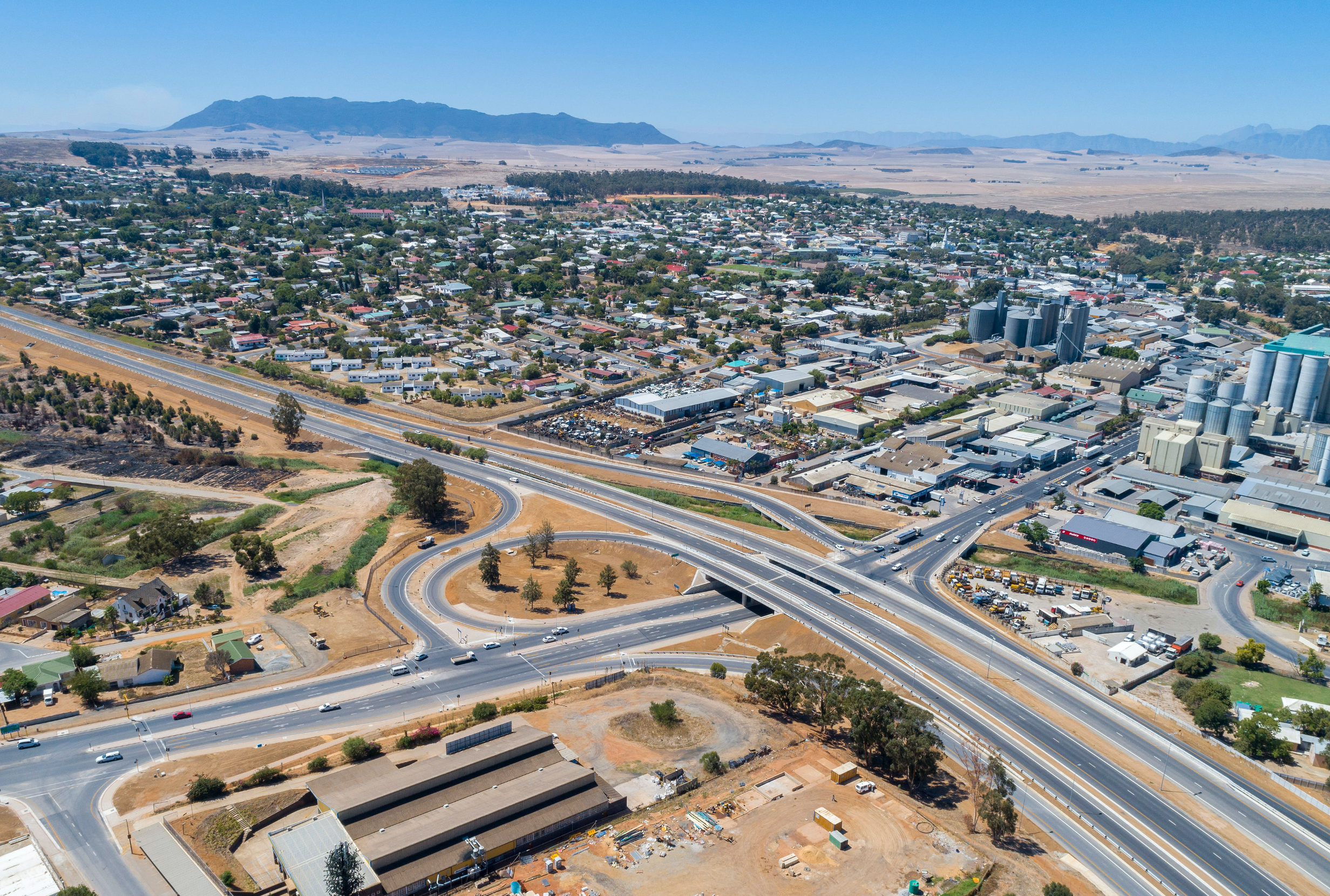
The N2 and N3 carry large volumes of traffic, with a high percentage of heavy vehicles carrying freight to and from the Port of Durban, forming the backbone of South Africa’s freight network.  Upgrading of the Hammarsdale Interchange between Durban and Pietermaritzburg is part of Package 2 of the planned Government Strategic Integrated Projects (SIP 2). The purpose of SIP 2 is to develop the Durban-Free State-Gauteng logistics and industrial corridor and strengthen the national transport link between South Africa’s main industrial hubs.

The national and provincial importance of the Hammarsdale Interchange stems from its location on the N3 between eThekwini and Msunduzi Municipalities, its proximity to the rail line linking Gauteng to Durban Harbour, and the proposed inland container terminal at Cato Ridge. To fast-track its completion, SANRAL partnered with eThekwini Municipality to co-fund the project.

The simple diamond interchange at Hammarsdale has been upgraded to a semi-parclo (partial clover leaf) free-flow interchange. This includes construction of six new on- and off-ramps. The improved geometry of these ramps demanded significant cutting into the existing ridges, requiring regular blasting activities which became familiar to frequent travellers along the route.

The upgraded Interchange will accommodate the increased volume of traffic resulting from development of the Keystone Park Light Industrial, Warehousing and Logistics Precinct at Hammarsdale as a distribution node for freight logistics companies.


N4 Maputo Corridor overload control


Overloaded vehicles remain one of the greatest threats to South Africa’s national road network, as they damage the roads and compromise road safety. For SANRAL and its concessionaire, Trans Africa Concessionaires (TRAC), which manages the N4 between Pretoria and Maputo in Mozambique, protecting the national road infrastructure is a top priority.

“TRAC has invested billions to ensure that the Maputo Development Corridor is on par with international standards. In the early days of our concession contract with TRAC, we conducted surveys which indicated that more than one-third of trucks on the N4 Toll Route were overloaded,” says SANRAL Project Manager for Overload Control Layton Leseane.

“Apart from the impact on road safety, we also realised that this has a detrimental effect on routine road maintenance costs.”

TRAC partnered with other government entities, including traffic law enforcement authorities, to implement strict regulations on overloading. SANRAL entered into an agreement with TRAC in 2002 and as part of this agreement developed overload control facilities; TRAC is responsible for the operations and management of these. SANRAL also entered into a separate agreement with the Mpumalanga Department of Community Safety, Security and Liaison to provide traffic law enforcement.


N2WCR project to unlock tourism in Pondoland

The spectacular 175m Ntentule Falls (left) is the second highest waterfall in South Africa.
Alice Falls (left) is one of the many hidden waterfalls on the Wild Coast

The N2 Wild Coast Road (N2WCR) project will not only unlock catalytic economic development, but it is also opening up a treasure trove of spectacular natural diversity assets for the tourism economy, including secret waterfalls of the Eastern Cape. There are over 20 waterfalls in the area, which are currently only known to locals and a limited number of tourists.

The N2WCR project is a key economic investment by the government to stimulate economic growth in KwaZulu-Natal and the Eastern Cape and unlock mobility and access within the many currently remote and isolated Pondoland communities. It is a key project under the National Strategic Infrastructure Programmes (SIP 3: South Eastern node & corridor development) endorsed by the Presidential Infrastructure Coordinating Commission. Last year professional surveyors and engineers working on SANRAL’s N2WCR Msikaba mega-bridge discovered that South Africa’s second-highest waterfall is the Ntentule Falls on the Mateku River, 20km east of Lusikisiki in the Eastern Cape. At 175m, the Ntentule Falls take second place to the Tugela Falls (947m) in KwaZulu-Natal, the country’s highest waterfall. The Elands River Falls in Mpumalanga becomes the third highest waterfall (150m) after Ntentule.

SANRAL project leader for the N2WCR greenfield section Craig McLachlan, says that the Pondoland Wild Coast area contains a number of spectacular waterfalls, including the better-known Magwa Falls, Waterfall Bluff, Fraser Falls and Alice Falls, among others.

Huguenot tunnel gets an upgrade (WR)


The Huguenot Tunnel is one of SANRAL’s most iconic assets in the Western Cape. For over 32 years, it has served more than 100 million road users safely, quickly and efficiently. SANRAL has implemented an operations plan for much-needed upgrades to the South Bore of the Huguenot Tunnel.

“Over the past year, the bulk of the upgrade and maintenance work to the electrical, electronic and mechanical systems has been completed under live traffic conditions to minimise the inconvenience to road users,” says SANRAL Project Manager Mike Vinello-Lippert..

Once the contracts have been awarded there will be major upgrades to the ventilation and lighting systems, the replacement of the fire detection system and the tunnel FM radio re-broadcast system, the PA system and the upgrade/replacement of the 11kV switchgear.

“This will then determine the timeline for the off-peak partial closure, which we have previously communicated, since certain elements of the work cannot be done under live traffic conditions,” adds Vinello-Lippert.

Meanwhile, the consultant tender for the upgrade of the North Bore, which involves bringing the second tunnel online, is also currently being evaluated. This R2.5 billion contract will take 5–7 years to complete and will ultimately result in the Western Cape’s first bi-directional tunnel, which will be on par with some of the world’s safest and most advanced road tunnels.

N4 experiences the highest traffic count in 2020

With South Africa moving to Level One of the national coronavirus lockdown earlier this month, TRAC is pleased to announce that the N4 Toll Route experienced a significant increase in traffic over the long weekend.

Traffic figures peaked on Sunday 27 September with more than 1 900 vehicles (both directions) passing at Middelburg per hour. A major traffic influx was also experienced at Machadodorp with more than 1 500 vehicles (both directions) passing per hour at the local plaza during the early and late afternoon. This was the highest number of vehicles at these plazas recorded this year.

Despite TRAC’s best efforts to accommodate the excessive traffic, which included having plazas operating at capacity and having our route patrol teams, accident response units and the TRAC Helpdesk on full alert, the elevated traffic volumes affected travel time on the route. The extensive roadworks along the road, especially between Belfast and Machado and near Middelburg, were the main contributors to the congestion. The heaviest delays were experienced at Crossroads (the confluence of the Schoemanskloof and Elands Valley) and the area near the Middelburg Toll Plaza.

TRAC would like to apologise to all road users for the inconvenience and thank them for their patience. Although we understand the frustration caused by traffic backlogs, we are pleased to see how eager South Africans are to travel again. The improvements that are currently under construction along the N4 will ensure an improved travel experience to our road users, once concluded.

Despite the heavy traffic along the route only three accidents were recorded yesterday, with no serious injuries or fatalities recorded.

SANRAL projects will create economic opportunities in the Chris Hani District Municipality

SANRAL’s road construction and routine road maintenance projects planned for the Chris Hani District Municipality will create economic opportunities for the region, according to Councillor Noncedo September Deputy Executive Mayor of Chris Hani District Municipality.

Councillor September said the Chris Hani District Municipality is a “gateway for visitors to the Eastern Cape when they travel from other provinces. ”

She delivered the welcoming address at the South African National Roads Agency’s (SANRAL’s) Taking SANRAL to the People stakeholder engagement session held in Komani (formerly Queenstown) yesterday.

SANRAL engaged stakeholders at the Moth Hall in Komani and used an online platform to address stakeholders at satellite venues in Engcobo and Emalahleni Local Municipalities. Virtual links were also shared with stakeholders who could not attend the venues, and they also had the option to view the engagement on YouTube.

The Taking SANRAL to the People stakeholder engagement session is aimed at promoting dialogue between the road agency, all spheres of government, traditional authorities, business fraternity, public transport associations, industry bodies, communities, and other key stakeholders that are affected by SANRAL projects.

“The SANRAL projects will allow this District Municipality to reclaim our former glory of being a business hub that supports other areas,” said Councillor September.

At the engagement, SANRAL shared its mission to transform the construction industry to be more inclusive.  Stakeholders were given an update on current projects being undertaken in the Chris Hani District Municipality, as well as imminent projects planned. SANRAL also utilised this platform to deliberate on salient issues affecting SANRAL’s service delivery in the area.

“This engagement session is very important at building our capacity through information sharing. This session is a golden opportunity for SMMEs to voice their concerns. Also, I would like to see an increase in the number of youth and women working on these projects,” said Councillor September.

SANRAL Southern Region’s transformation officer, Thandile Makwabe said SANRAL has partnered with few key role players to assist black business in entering the mainstream.

“SANRAL has signed memoranda of understanding (MOUs) with certain role players in industry to ensure rapid transformation is doable. The MOUs were signed with BELL, Barloworld, WIRTGEN, Pilot Crushtec, NAFBI and SAFCEC to assist with training of supervisory personnel,” Makwabe said.

He added that people have received assistance from the companies with whom SANRAL had signed the MOUs and there are currently SMMEs receiving assistance. “SANRAL ensures communication takes place between SMMEs and the larger companies, but there are checks in place to ascertain the viability of the proposed business ventures by SMME,” Makwabe said.

He said SANRAL’s transformation policy states that the agency is “mindful of the impact of the construction industry and its procurement has on the people of South Africa in terms of business and job opportunities; accepts responsibilities to maximise the participation of black contractors, professionals, suppliers and designated groups in all SANRAL projects.”

Dr Mongenzi Noah, SANRAL Southern Region’s community development specialist shared the agency’s 14-Point-Plan, which is to facilitate better project level liaison with local communities and structures. Also, the plan serves to ensure communication and transparency in the execution of works. SANRAL’s 14-Point-Plan ensures inclusivity in the allocation of projects to benefit black business and local communities.

SANRAL in the Eastern Cape manages a road network of 4 952 kilometres. The national road network consists of 22 214 kilometres.  Since 2009, SANRAL has injected R33.3 billion in the Eastern Cape’s road network.

The Southern Region plans to advertise 70 projects in 2020/21 and 2021/2022 FY.  Some are in the planning phase, some in the design phase, and some in the construction phase.

SANRAL’s mandate also entails performing Routine Road Maintenance (RRM) of the road network. In this regard, the Agency maintains several routes within Chris Hani District Municipality.

Part of the engagement was also to inform stakeholders of some upcoming projects.

The agency’s major road infrastructure delivery projects in the Chris Hani District include:

  • The upgrading of the R67 between Swart Kei River to Queenstown,
  • R56 Molteno to Vlakfontein,
  • R56 /N6 Intersection to Dordrecht,
  • R56 Dordrecht to Indwe.

These projects are in the mobilization phase while the R61 between Cradock and Tarkastad is under construction.

The following projects are also at award and evaluation stages and it is expected that an award will be made in October 2020.

  • R56 Middelburg to Molteno, and
  • R56 Vlakfontein to R56/N6 Intersection

New facilities projects in the design phase include:

  • R61 Tsojana – Tsomo River Phase
  • R61 Tsomo River to Qumanco Phase

Tenders are being prepared for the following projects. It is expected to be tendered in October:

  • Upgrade of R61 Section 6/7 between All Saints and Baziya (Phase 2)
  • Upgrade of R61 Section 6 between Qumanco to Ngcobo End (CBD) Phase 2

A tender is closing on Friday, 25 September, for the consulting engineering services for the routine road maintenance of National Route R56 Section 4 KM 20.09 to Section 7 KM 25.71, National Route R58 Section 6 KM 40.06 to Section 7 KM 4.05 and National Route R410 Section 1 KM 0.00 to Section 3 KM 16.85.

N14 Kathu North Traffic Circle will be completed once new contractor is appointed

The South African National Roads Agency SOC Limited (SANRAL), wishes to confirm that work on the N14 Kathu North traffic circle will be completed once a new contractor is appointed.  

“SANRAL notes the concerns about the delay in completing the traffic circles, by protesters who closed the road earlier today and also appreciates the efforts of SAPS and Traffic Law Enforcement officers in re-opening the road”, said Randall Cable, SANRAL Western Region Manager.

The contract for the upgrade of the Kathu traffic circles was terminated in October 2019 due to the contractor failing to perform in accordance with the contract. The works were 70% complete at the time of termination.

Following an evaluation process of the outstanding works and the compilation of new tender documents (also taking into account delays caused by the nationwide COVID-19 lockdown), the tender was advertise for construction, on 11 September 2020. The tender will close on 9 October 2020.

“We have put plans in place for the maintenance of the traffic accommodation on the site, to be managed by the current Routine Road Maintenance contractor responsible for these particular sections of the N14 and this arrangement will continue until a new contractor is appointed to complete the works,” explained Cable.

The awarding of the contract is anticipated to be done by February 2021 with the completion of the construction works earmarked for September 2021.

SANRAL apologises for the inconvenience and remains committed to complete this project as soon as possible, and to ensure a safer and improved road user experience for all.

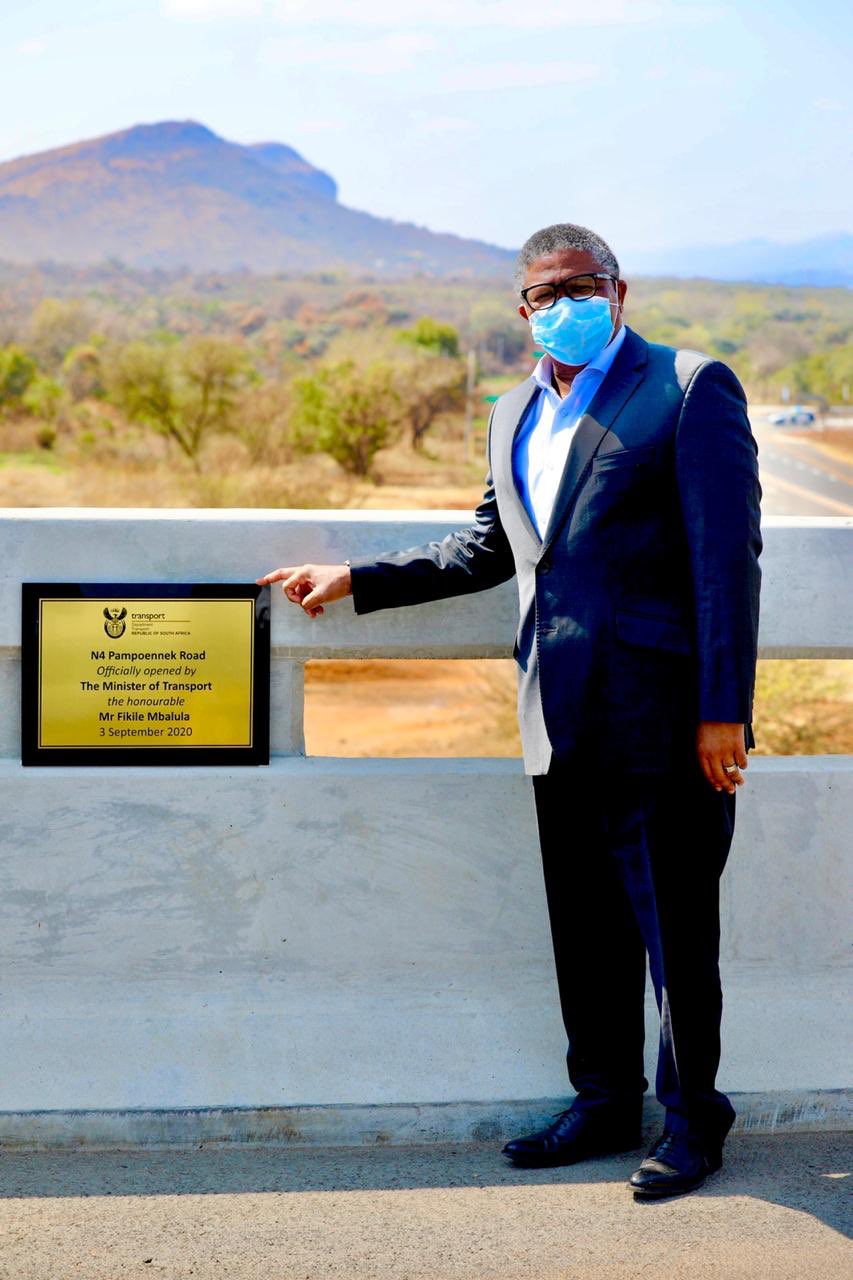
Transport Minister opens Pampoennek Road

Transport Minister Fikile Mbalula says the country’s national road network is an important catalyst for unlocking economic activities on the platinum highway between Gauteng and North West provinces, as well as between South Africa and neighbouring countries.

He was speaking at the official opening of the R512 Pampoennek road in the North West Province. The opening of the road means that motorists will enjoy a free flow of traffic and there will be a better link to the North West from Gauteng, also ensuring that long distance movements do not interfere with local traffic.

“This road gives expression to the notion that transport is the heartbeat of the South African economy, playing an integral part to the country’s economic growth. Roads are an integral part of the South Africa’s transport system and are important infrastructure to enable economic activity and access to social amenities,” says Mbalula.

As part of its ongoing distinct mandate to finance, improve, manage and maintain the national road network – often referred to as the country’s “economic arteries” – the Pampoennek road demonstrates the South African National Road Agency SOC Limited’s (SANRAL) commitment in investing in road infrastructure; a commitment that is aimed at addressing the triple challenges of unemployment, poverty and inequality as well as making roads an impetus to growing the local economy.

Built at a cost of R377 million, the road stretches from the R512 to the west of the Hartbeespoort Dam through Pampoennek, connecting easily to the N4.

SANRAL CEO Skhumbuzo Macozoma echoes the sentiments that the completion of this project demonstrates SANRAL’s ongoing commitment in improving the socio-economic conditions of the people that live around it.

“This project demonstrates that it is possible to transform the construction industry through road infrastructure projects and to also have effective community participation in government projects. All of this finds expression in our long-term Horizon 2030 strategy, which enables and ensures that local community members and SMMEs benefit from our projects. Where the road passes, development follows, and we look forward to seeing more development in this area”, says Macozoma.

Through Horizon 2030, SANRAL has a proactive response to create a national road transport system that delivers a better life for citizens that live alongside its projects.

The construction of the Pampoennek route generated 209 permanent jobs for locals with a R27 460 060.65 expenditure till end of July this year. About 180 locals were offered an opportunity to undergo training with an accredited training service provider and a total of R430 855 was allocated to skills development. Twelve sub-contractors were also employed to the project, with R75m allocated to these sub-contractors.

In the North West SANRAL is already working on the N14, N12 as well as the N18 national roads. As the roads agency continues to develop these corridors, it also continues to work with its partners in both the public and private sectors.