

MEDIA RELEASE
SANRAL Attends 15th Annual Family Math Summit at University of The Free State
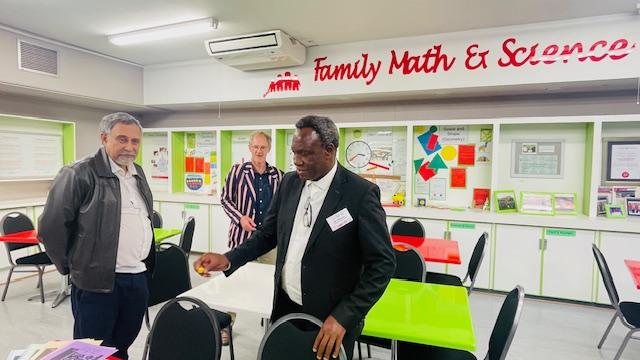
SANRAL Board Chairperson Themba Mhambi and Board Member Mahesh Fakir visited the Science for The Future Labat the University of the Free State on Friday
Mangaung, 5 October 2024 – The South African National Roads Agency SOC Limited’s (SANRAL) ongoing funding of the University of the Free State’s Family Math and Science programme is an obligation that the road agency takes seriously, said SANRAL Board’s Chairperson Themba Mhambi.
“Using public funds, it is in our interest and an obligation that we ensure that this programme not only continues, but that it grows in leaps and bounds. Our dedication to this programme is to ensure its success,” said Mhambi. He was speaking at the 15th Annual Family Math Summit that took place at the University of Free State in Mangaung on Friday.
This innovative partnership between SANRAL and the University of the Free State to train maths and science teachers, as well as to support learners and parents, ultimately resulted into its expansion to nine further universities across the country.
Since 2018, the number of project participants from this partnership has soared from just over 25,000 to more than 105,000 in 2024, reaching a total of 426,000 beneficiaries. This includes over 5,800 teachers, almost 320,000 learners, nearly 98,000 parents, and more than 4,300 students.
One of the major disadvantages of rural schools is the lack of teaching resources. More than 40% of the total project budget is allocated to classroom teaching resources, including learners’ worksheets and activity material, as well as parent workshop resources. SANRAL’s contribution addresses one of the most basic and fundamental needs in teaching and learning at rural schools. Through these interventions, parents, siblings, guardians, and caregivers are empowered to become part of the learning process. This not only benefits learner achievement but also uplifts community members who may have previously been excluded due to limited literacy or numeracy skills.
SANRAL’s Board has approved the continuation of funding of this project. The project is now expanding to include universities in provinces that were previously not represented such as the Western Cape, North West, and Gauteng.
Prof Hester Klopper, the University of the Free State’s Vice-Chancellor and Principal, said that the university’s partnership with SANRAL demonstrates its commitment to advance mathematics education to young people.
“The vision we share with SANRAL represents something remarkable in the university landscape. This initiative has now touched thousands of lives across the country. And this is much more than just numbers; it is about fundamental change on how we approach maths and science education in our schools for the development of our children and this country’s citizens,” said Prof Klopper.
“The partnership we have with SANRAL brings together all role players in making this project a success and making a maximum impact to society. Our universities can no longer afford to be ivory towers; they must be catalysts for transformation. This programme is important because it equips learners to tackle life’s challenges that they face, to equip them with the skills and the ability to navigate through life and apply logical thinking, as well as well learning how to solve complex problems in life. These skills empower children to breakdown challenges in a methodological way and it gives them confidence to solve life’s challenges,” added Prof Klopper.
According to Mr Monde Mondi, SANRAL’s Chief Human Resources Officer, SANRAL took the responsibility to embrace the principles of corporate citizenship since the inception of the programme in 2009.
“At SANRAL, we take corporate citizenship seriously and we have a duty to contribute to the communities that we serve. Corporate Citizenship emphasises that companies should adopt ethical behaviour, commit to community contribution, and protect their environment. Companies should ensure that while they fulfil their mandatory obligations, they should also take care of all stakeholders, and not just shareholders. The partnership that SANRAL has with universities is to fulfil this obligation,” said Mondi.
Mondi’s sentiments couldn’t have been aptly expressed more than the words of Nomqondiso Nako, a parent from Breidbach Primary School in eQonce in the Eastern Cape.
“When the programme was introduced to our school for Grade 3 learners, I was not sure what to expect. But I very quickly saw the difference. The activities we did together made maths simple, practical, and even fun. Instead of being something that felt difficult, maths became something that we could explore together as a family, whether it was through games, problem solving, or using everyday items at home.”
“As a parent, I gained confidence on how I should support my child’s learning. I realised that I do not need to be a maths expert. I only need to engage, encourage, and make learning part of our daily life. My child became more motivated, more confident, and even started teaching me at times. The programme did not only improve marks, but it also strengthened our bond as a family and showed us that learning is something that we can do together.”
“Through this programme, SANRAL and the University of the Free State have planted a seed that will grow far beyond the classroom, but into our homes and in our children’s futures,” said Nako.
-ENDS-